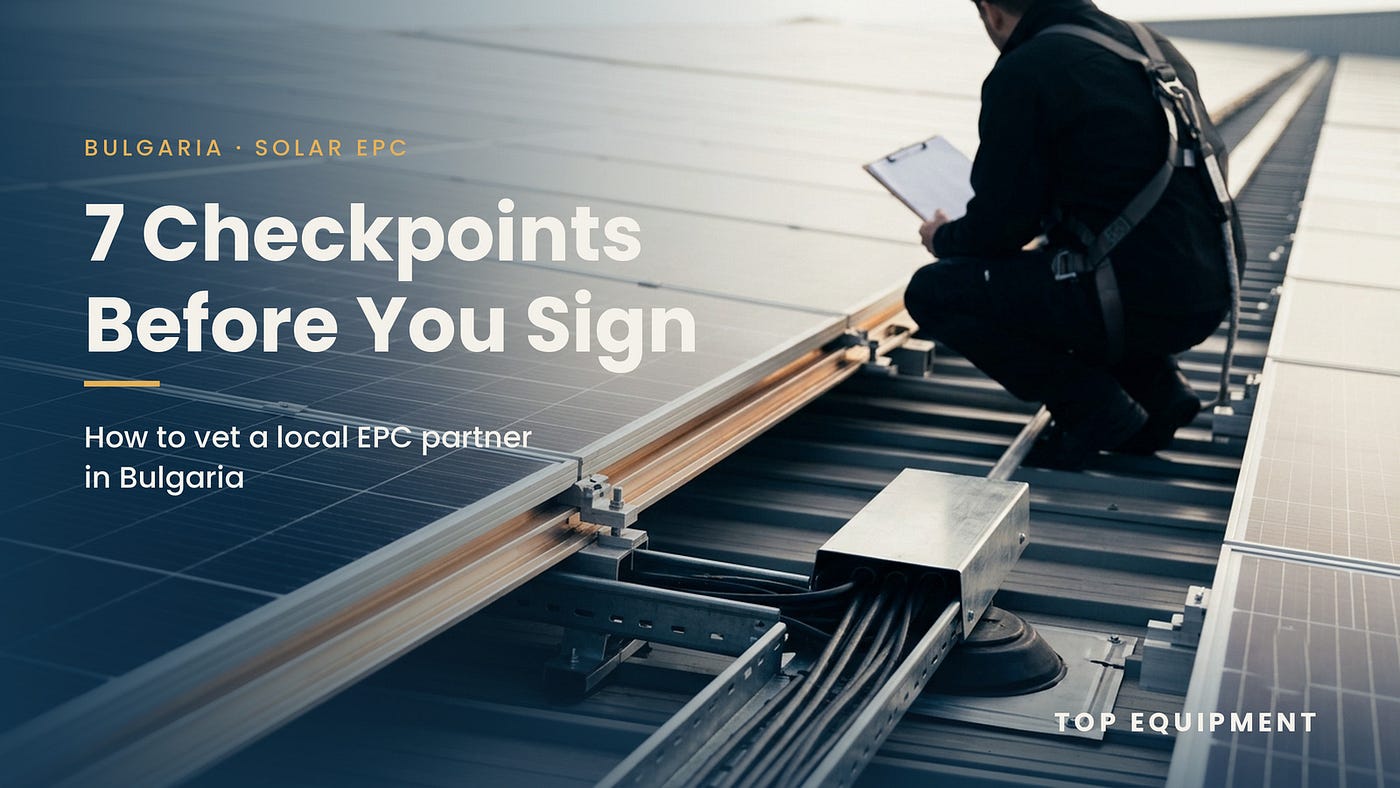
How to Vet a Local EPC Partner in Bulgaria: 7 Technical Checkpoints Beyond Certifications
Certifications prove a contractor can work legally. They say very little about whether this one can deliver your project on schedule.
How to Vet a Local EPC Partner in Bulgaria: 7 Technical Checkpoints Beyond Certifications
Certifications prove a contractor can work legally. They say very little about whether this one can deliver your project on schedule.
Your Bulgarian contractor reports that the grid connection opinion is still pending. Your preliminary agreement has a deadline. You checked everything before signing — Chamber of Builders registration, ISO certificates, a portfolio of completed roofs. None of it told you whether this firm had ever filed a grid connection application in Bulgaria and seen it through.
Certifications prove a contractor can operate legally. They say very little about whether this particular contractor can deliver this particular project on your schedule.
That gap matters more in Bulgaria than most foreign buyers expect. The country installed 1,416 MW of solar in 2025 — its third consecutive gigawatt-plus year — and entered the EU’s top ten solar markets for the first time. But roughly nine out of ten of those megawatts went into ground-mounted utility-scale parks. The commercial and industrial rooftop segment is comparatively thin, which means the pool of contractors with genuine rooftop experience at scale is thinner than the number of firms advertising it.
Seven checkpoints separate legal capability from delivery capability.
1. Grid Connection Experience, Not Just the Certificate
Registration with the Камара на строителите (Chamber of Builders) is mandatory for contractors operating in Bulgaria, and every legitimate EPC firm holds it. It tells you nothing about grid connection.
The substantive questions sit elsewhere. Does the contractor understand where your project falls in the procedure? For projects between 30 kW and 1 MW, including rooftop systems, the grid operator is obliged to issue a binding grid connection opinion within 40 days of the application. Larger projects route differently, and projects above 20 MW additionally require a production licence from the regulator, EWRC.
Does the contractor know about the financial guarantee? Bulgaria now requires a deposit or bank guarantee of roughly EUR 25,565 per MW of requested capacity, provided to the grid operator within three months of receiving the connection opinion. Miss that window and the opinion lapses. On a 500 kWp rooftop this is roughly EUR 12,800 that has to sit somewhere in your cash flow — and it is frequently absent from contractor budgets, because contractors who have never reached that stage do not know it exists.
The measure was introduced to stop speculative capacity reservation, and it changed the shape of the connection queue considerably. A contractor who is not tracking that shift is quoting you on assumptions from a different market.
Ask: name three recent Bulgarian projects where your team filed the connection application. How many days did the operator’s opinion take in each case? If the answer is vague, this stage is being delegated to someone you have not met, and it sits on your critical path.
2. Where the Engineering Actually Happens
Many small and mid-sized contractors buy project designs from external engineering bureaus whose staff never visit the site. The arrangement holds until drawings meet reality — a roof’s structural capacity comes in lower than assumed, or access to the connection point is blocked by existing services.
An external designer cannot revise and re-approve drawings quickly. What follows is a cascade: new structural calculations, revised mounting specifications, sometimes a different inverter configuration. Weeks pass before a single module goes up. A contractor whose designer can stand on your roof and recalculate resolves the same problem in days.
This is not an argument that everything must be in-house. It is an argument that design authority must be reachable.
Ask: which engineer will be personally assigned to this project, and can they attend the site survey? If design sits with an external bureau, agree in writing on a turnaround time for revisions before you sign, and add a buffer for the first discrepancy.
3. Crew Structure and Schedule Control
Most contractors in this market run a hybrid model: their own engineering and commissioning staff, plus installation crews drawn from a network of subcontractors. This is normal and, handled properly, sensible — it avoids idle payroll between projects and lets a contractor scale a crew to your roof rather than forcing your roof to fit their headcount.
The model fails in one specific way. If the contractor has no contractual grip on crew availability, a subcontractor whose previous job overran will simply arrive late, and qualified installers in Bulgaria are booked well ahead during the April-to-September peak. A two-week slip becomes six while the contractor waits for the next available team.
So the question is not “in-house or subcontracted.” It is whether the contractor controls the schedule.
Ask: which stages do you self-perform, and which do you subcontract? For subcontracted stages: are these standing partners you have worked with repeatedly, or will they be tendered after signature? Is the crew’s mobilisation date contractually fixed, and what happens if they miss it? A contractor who names their crews and commits to dates is managing the risk. One who cannot is passing it to you.
4. Equipment Sourcing Channel
Buyers often assume a contractor describing itself as a manufacturer “partner” buys at factory prices. Manufacturers generally do not sell directly to end users, and the chain — regional distributor, national distributor, local reseller, contractor — adds margin at each layer. On a 500 kWp project the difference between sourcing tiers is real money, buried in a line item you cannot see.
What matters here is disclosure, not tier. A contractor sourcing through a national distributor at a transparent margin is a better counterparty than one claiming a direct factory relationship they cannot document.
Ask: which channel do you buy through for this project, and at which tier? Can you show documentation of your supply relationship? Then ask for the equipment cost and the installation cost as separate lines in the quotation. A contractor unwilling to separate them is asking you to trust a number you cannot check.
5. Defect Liability — Who Stays Responsible, and for How Long
“25-year warranty” in a contract usually describes something other than what buyers assume. Coverage operates on three independent levels.
Manufacturer warranties on modules typically run around 25 years on output and 10–12 years on manufacturing defects. Manufacturer warranties on inverters typically run 5–10 years. Both survive the contractor: they originate with the manufacturer and remain valid if the installer becomes insolvent.
The third level is the contractor’s own defect liability for design, installation and commissioning. In European EPC contracts this commonly runs two to five years. It covers the failures no equipment warranty touches — incorrect mounting calculations, cable routing errors, misconfigured inverter parameters, penetration and waterproofing defects at roof level. These are also the failures most likely to surface early, in the first years of operation, which is precisely when this coverage either exists or does not.
Ask: state the defect liability period as a separate clause, covering modules, inverters, mounting structure, cable runs, roof penetrations and the connection point. Two years is a floor. Five is worth negotiating for on projects above 500 kWp.
6. Track Record at Comparable Scale — in Bulgaria
International buyers routinely accept references from Romania, Greece or Serbia as evidence of competence in Bulgaria. Regulatory frameworks diverge more than the map suggests. The financial guarantee described above is a Bulgarian instrument with no direct equivalent next door. Connection queue mechanics, permitting thresholds for rooftop systems, and the documentation grid operators expect all differ by country.
A contractor whose entire portfolio sits across the border will learn Bulgarian procedure on your project, at your cost.
Ask: three Bulgarian projects of comparable scale — within roughly ±30% of your capacity — completed in the last 18 months, with client contacts you may call. Ask each reference one question: did the timeline hold, and if not, what caused the slip and how was it communicated?
7. Documentation for Green Building Certification
For international asset owners, this is often the checkpoint that decides the deal. Green building certification is increasingly a financing condition rather than a marketing enhancement — IFC, for instance, has tied sustainability-linked lending in the Bulgarian and Romanian logistics sector to EDGE certification of the financed assets.
The failure mode here is subtle. A contractor can install a system that performs perfectly and still deliver nothing usable for certification, because certification schemes assess documentation, not sunshine. Under LEED, credit for on-site renewable generation depends on the project retaining the environmental attributes of that generation — meaning the contractor must document what is generated on site, what is consumed on site, and whether renewable energy certificates have been transferred elsewhere. If nobody sets up that documentation during commissioning, reconstructing it afterwards is expensive and sometimes impossible.
Ask: have you delivered a system on a LEED, BREEAM or EDGE certified asset, and can you show the metering and documentation package? If the answer is no, that is not automatically disqualifying — but budget for a separate certification consultant to sit between your contractor and your auditor, and appoint them before commissioning, not after.
None of these seven questions requires technical expertise to ask. They require only that you ask them before signature rather than after the first delay.
A contractor with a valid Chamber of Builders certificate, real ISO paperwork and a portfolio of completed roofs may still have never filed a Bulgarian grid connection application, never documented an installation for EDGE, and never run parallel crews across three sites. Certification confirms they can work. These seven answers tell you whether they can deliver.
TOP EQUIPMENT is a full-cycle solar PV contractor based in Sofia. We publish technical breakdowns of the Bulgarian PV market — regulation, project economics, and the parts of the process that only show up on site. Follow along if you build or own assets here.
메타데이터
- post_id
- bf202d990ff0
- slug
- how-to-vet-a-local-epc-partner-in-bulgaria-7-technical-checkpoints-beyond-certifications-bf202d990ff0
- url
- https://medium.com/@work_18908/how-to-vet-a-local-epc-partner-in-bulgaria-7-technical-checkpoints-beyond-certifications-bf202d990ff0
- canonical_url
- https://medium.com/@work_18908/how-to-vet-a-local-epc-partner-in-bulgaria-7-technical-checkpoints-beyond-certifications-bf202d990ff0
- author_url
- https://medium.com/@work_18908
- status
- ok
- fetched_at
- 2026-08-11 17:30:35