To View the World with Light
Parshat Noach: Learning to be a Teacher from Rav Avi Goldberg, Hy’d
To View the World with Light
Parshat Noach: Learning to be a Teacher from Rav Avi Goldberg, Hy’d
“These are the generations of Noach: Noach was a just man and perfect in his generations…” (Bereshit 6:9)
As we made our way outside the Nitzanim shul in Baka on Simchat Torah night, I commented to our group that, amidst the uplifting days of Sukkot and Shemini Atzeret, I found the night of Simchat Torah to generally be disappointing. The expectations of a ruach filled night, leavened by memories of an amazing Yom Tov while back in yeshiva, rarely pan out. The crowded space, the unfamiliar tunes, and the lack of connection as a guest visiting from thousands of miles away, result in a stark difference between expectations and reality.
On this Simchat Torah night, however, I could not have been more wrong.
We gathered on the street outside the shul, over 1,000 men, women and children, coming together to celebrate the completion of the Torah, giving each other chizzuk under a backdrop of a year of terrible pain and an ominous anniversary arriving the next morning.
It was heavy and sad and happy, all at once. It was inspiring.
The active soldiers in the group were given the first Sifrei Torah to dance with. Watching these young heroes, out of uniform for the Chag but with machine guns on their backs and Torah scrolls held tightly in their arms, was awe inspiring. Most of them were in their late teens or in their 20’s serving in the reserves, some with a spouse next to them or small children in tow, setting an example for what it means to give deeply of oneself to Am Yisrael.
The Shul had distributed booklets for the Hakafot, with each circuit dedicated to a theme or a group related to the events of the last 12 months. The first two Hakafot were dedicated to the soldiers and the hostages still languishing in Gaza one year after October 7th.
The 3rd Hakafa was dedicated shenigmarot hamilim — ‘to the fact that we have no words’ to adequately process what has taken place. It was designated as a silent Hakafa.
Can you imagine? On the Yom Tov designated for singing, dancing, and celebration, the chazan walked around in a circle in silence. No one spoke. One circuit. Then another. Many people cried as they reflected on a nation in pain. Suddenly, the silence and the heaviness were broken with the singing of Anachnu Ma’aminim U’vnei Ma’aminim, “we are believers and the children of believers” led by an inner circle of soldiers with smiles on their faces.
Yes, there have been awful tragedies. Yes, worry and anxiety persists. And yes, we are a nation of believers. We believe in Hashem, and we believe in our future.
The 7th and final Hakafa was dedicated to Hakarat HaTov, to expressing thanks and appreciation for all of the miracles experienced over the last year. Rav Shai Finkelstein got up on someone’s shoulders so that he could be heard. He said, “yes, there has been so much tragedy, but at the same time, the miracles that we have seen this year have been the most since the time of Yetziat Mitzrayim. We must give thanks to Hashem for the miracles, for the victories, for the ability to come together, for the ability to get up when we were hit hard and have an IDF to fight back with. Previous generations could not fight back, nor did they have the capacity to stand up and sing and dance loudly. Maybe in the concentration camps the Jews could dance a soft song for a moment, but here we have our own country and our ability to live as Jews and to fight back and to sing and celebrate Simchat Torah proudly….we must give thanks!”
As the singing started once again, I glanced over at Rabbi Yonah Fuld, whose son Ari, Hy’d, was killed by a terrorist while protecting other Jews six years ago. He was crying. I approached him, and as he hugged me, he said softly Mi K’Amcha Yisrael, “who is like you, oh Israel?”
We cry. We mourn. And we believe.
There is a well-known comment of Rashi at the beginning of Parshat Noach. The Torah famously describes Noach as Tzadik haya bidorotav, that he was “a righteous person in his generations.” Rashi’s quotes the Talmud in Sanhedrin, that Yesh mei’raboteinu dorshim Oto lishvach, “there are those Rabbis who explain this word as a means to praise (Noach).” Not only was Noach righteous in his own generation of notorious spiritual decay, but he would have been considered universally righteous had he lived in any other generation as well. V’Yeish shedorshim oto lignai, “and there are those who explain this word to his discredit.” Noach was only considered righteous when compared to this weak generation, but had he lived in the generation of, say, Avraham, he would not have been considered anything special.
Rav Yisrael of Chortkov (1854–1933) notes an unusual discrepancy in the phrasing of this Rashi. It is not uncommon for the Torah to present a Machloket, and argument between two Rabbinic sages. However, here, the first opinion is quoted as Yesh mei’raboteinu, those from our Rabbis, who teach the pasuk as a praise of Noach. The second opinion simply says V’Yeish shedorshim oto, and there are those who explain the pasuk as a put down. Why is the second opinion not afforded the respect of the first? Why does Rashi not say that there are those Rabbis who learn it one way, and other Rabbis who learn it another way?
Rav Yisrael explains: It is all about one’s perspective. Some look at the verse and choose to see a compliment of Noach. Others look at the same pasuk cynically. This jaundiced view is not mei’raboteinu — from our rabbis, from our teachers, from our leaders who set an example. To be a teacher, to be a Rav, to be a leader, means to look for the opportunity to compliment, to hunt for the good. When one is mei’raboteinu, they do not look for the negative. They seek the positive, which will build connection.
Rav Yisrael of Chortkov teaches that if one can look at this verse describing Noach as a righteous person and conjure up a cynical take on it, such a person is not from among our teachers. That is why those who view this verse as a source of praise of Noach are considered mei’raboteinu, while those who view it negatively are not.
To look and choose to see the best in others. To look ahead with relentless optimism. That was what we and I am sure countless other Jews in places across Israel experienced that Simchat Torah night. Yes, there is sadness. There is a silent Hakafa. But that heaviness will never drag us under. We will jump up and sing Anachnu Ma’aminim U’vnei Ma’aminim. To be a nation meiraboteinu means that we are a nation of teachers, of rabbis. A nation that experiences pain, and responds with belief, optimism, and positivity.
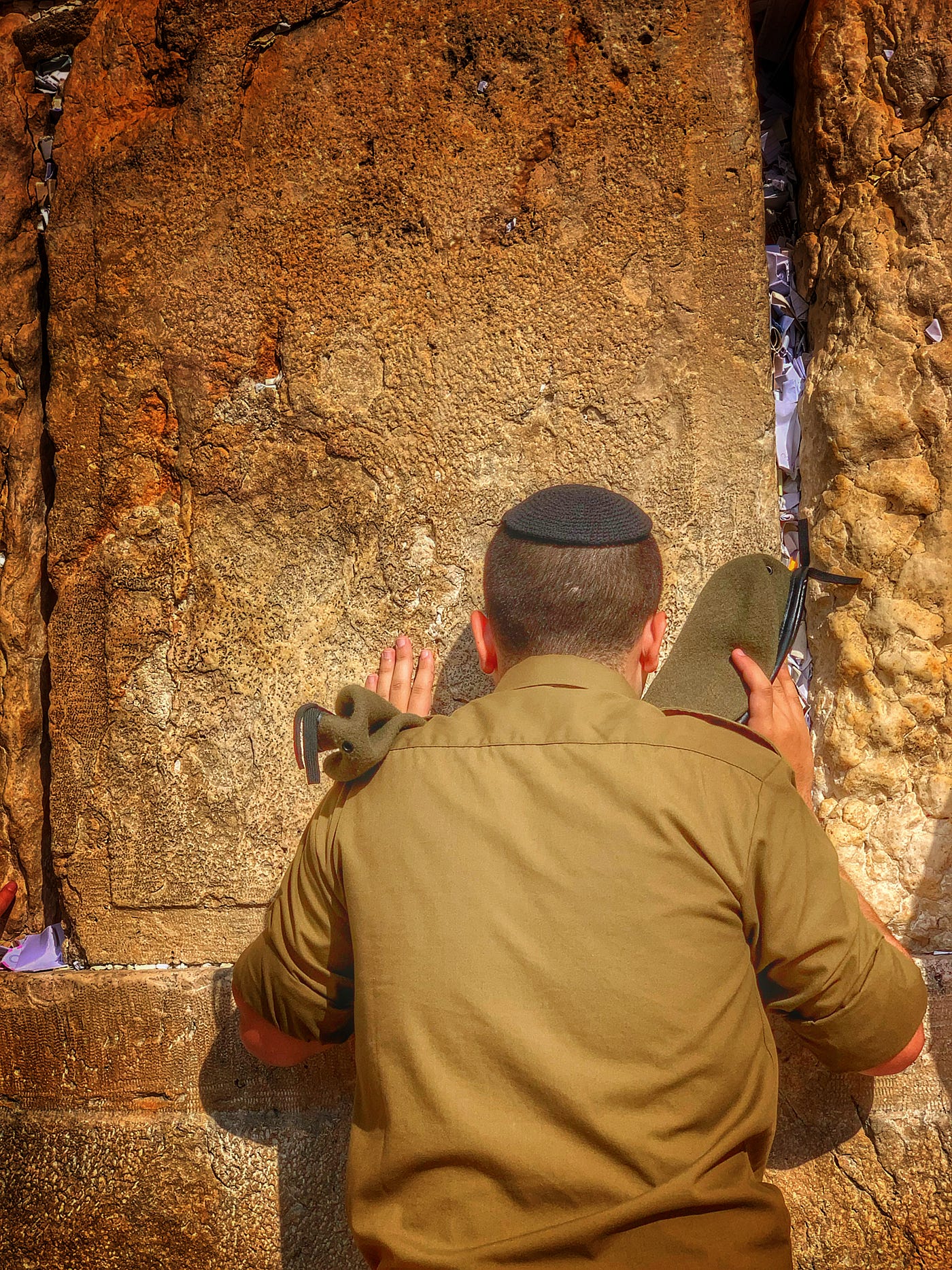
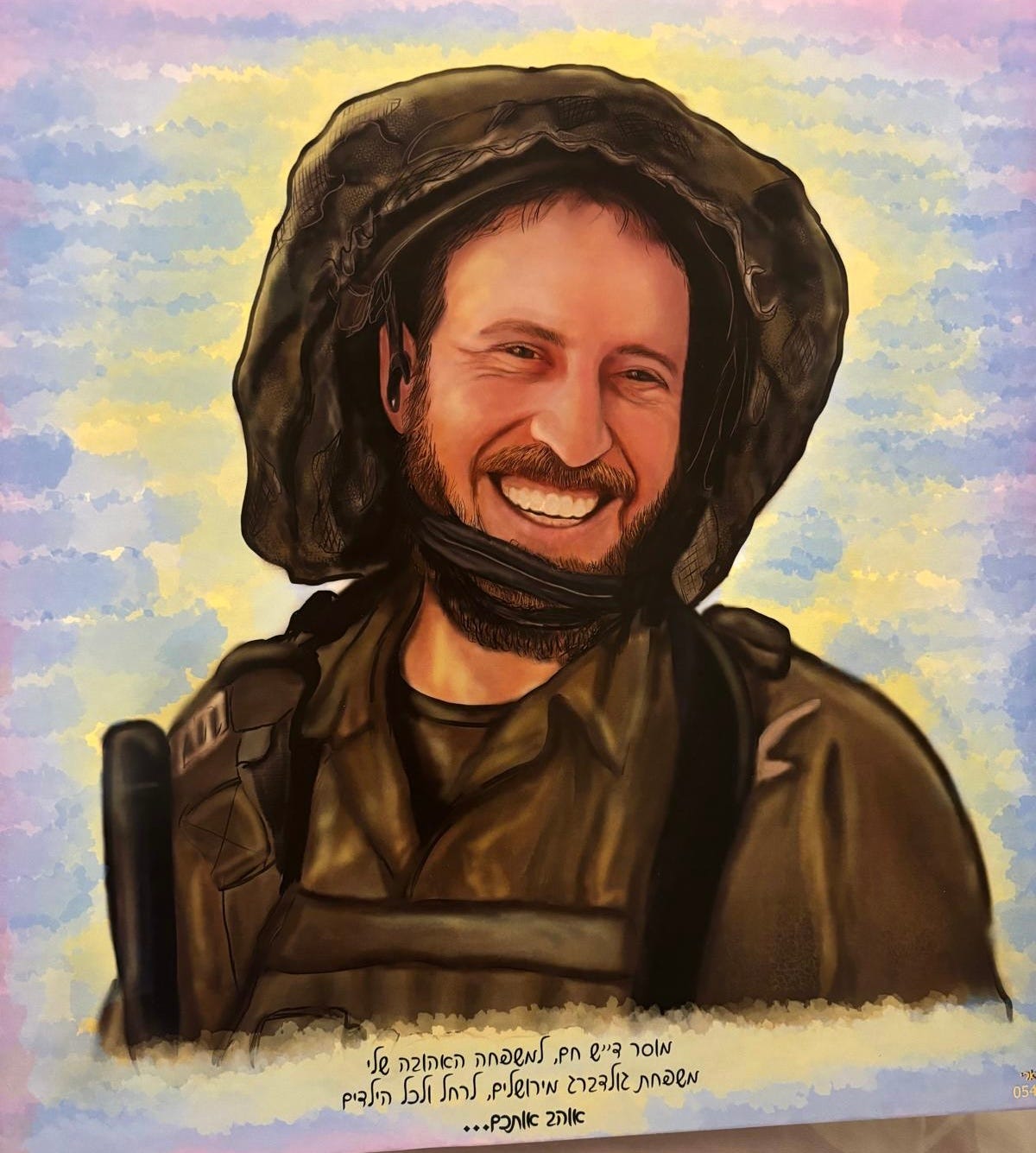
When I saw this Torah, I could not help but think about Captain Rabbi Avi Goldberg, Hy’d, who was tragically taken this past weekend while defending Am Yisrael as an officer in the IDF. Rav Avi embodied the ethos of Yeish MeiRaboteinu. As the Rosh Kollel of our Torah Mitzion Kollel in Memphis, as a community leader, a master high school Rebbe, a doting father of 8, a loving husband, a captain and Rabbi in the army, Rav Avi looked at others and saw only good. It is why in every photo of him that has circulated online since his passing, in every video of him speaking, there remains that ever present smile. Rav Avi, together with his Eshet Chayil Rachel, represent the best of Am Yisrael. He had the quality of relentless optimism and positivity that allowed others to naturally connect with him, to want to be with him and be like him.

artwork by Naomi Gal instagram.com/naomiygal
One of Rav Avi’s friends from their Jerusalem neighborhood wrote a letter reflecting on this loss of his friend and mentor. He writes (translated into English from original Hebrew): “Beyond the engaging content, I’ll always remember the way you delivered your words of Torah — with a constant smile. You could deliver an entire D’var Torah without the smile ever leaving your face. I wonder where you got that ability. Even now, during your shiva, I see all the videos people are sending, and there too, you manage to say your words of Torah, smiling the whole way through. Impressive.”
In Rav Gil Perl’s stirring reflections on Rav Avi’s passing, he shares a conversation they had about reaching today’s adolescents: “At one point the conversation turned to some of the challenges facing teens in our respective schools. I remember vividly how he explained to me that if a student of his was questioning the existence of God or His active role in our world, he’d invite them over to his home and simply walk with them onto the balcony. There they’d look out together at the magnificent vista of the splendid and sprawling city of Jerusalem. A thriving modern city rebuilt from ashes in a matter of decades against incalculable odds. Rav Avi would point to it and say to his student that the best answer he could offer of God’s existence and His involvement in this world was right there before them. Despite the pain and the suffering, the one step back after two steps forward, from his balcony in Jerusalem Rav Avi saw a story unfolding. A story of redemption: personal, societal, ethical, national, and universal. A story that he was part of. A story that we are part of. A story that was worth sacrificing for.”
This is how Rav Avi taught. A gentle walk onto the balcony. Understated and sincere words. He embodied Diracheha Darchei Noam, “(Torah’s) ways are ways of pleasantness,” where the power of a smile, a kind word, playing sweet music in his home together with Rachel, were the tools to bring people along on a spiritual journey with lightness and connection. Through his authentic warmth, a smile that could light up any space, Rav Avi conveyed to everyone he encountered that he cared deeply about them, no matter their background, or who they were. It was real. Devarim Hayotzim Min Halev, Nichnasim….
The tragedy of Rav Avi’s death has reverberated far beyond the usual confines of a family or a neighborhood. This is no doubt due to the significant impact he had on others as a Rav, teacher, and leader. Perhaps it is also because our nation is craving his smile, his way of looking at the world with kind eyes and positivity. Friends, neighbors, soldiers, politicians, and Rabbis have all come to the Goldberg shiva not only to offer their words of comfort, but to connect to the positivity and optimism of Rav Avi which is a microcosm of Am Yisrael.
We miss our Rabboteinu. May his impact continue, and with it, bring smiles, light, connection, and ultimately redemption, to our people.
메타데이터
- post_id
- bf21aa248e2b
- slug
- to-view-the-world-with-light-bf21aa248e2b
- url
- https://medium.com/@dovemerson/to-view-the-world-with-light-bf21aa248e2b
- canonical_url
- https://medium.com/@dovemerson/to-view-the-world-with-light-bf21aa248e2b
- author_url
- https://medium.com/@dovemerson
- status
- ok
- fetched_at
- 2026-07-22 08:27:40