Buffalo Soldiers National Museum in Houston, Texas
Learn about African American (so-called Buffalo) soldiers and their fierce fighting spirit from the 1800s onward.
Buffalo Soldiers National Museum in Houston, Texas
Learn about African American (so-called Buffalo) soldiers and their fierce fighting spirit from the 1800s onward.
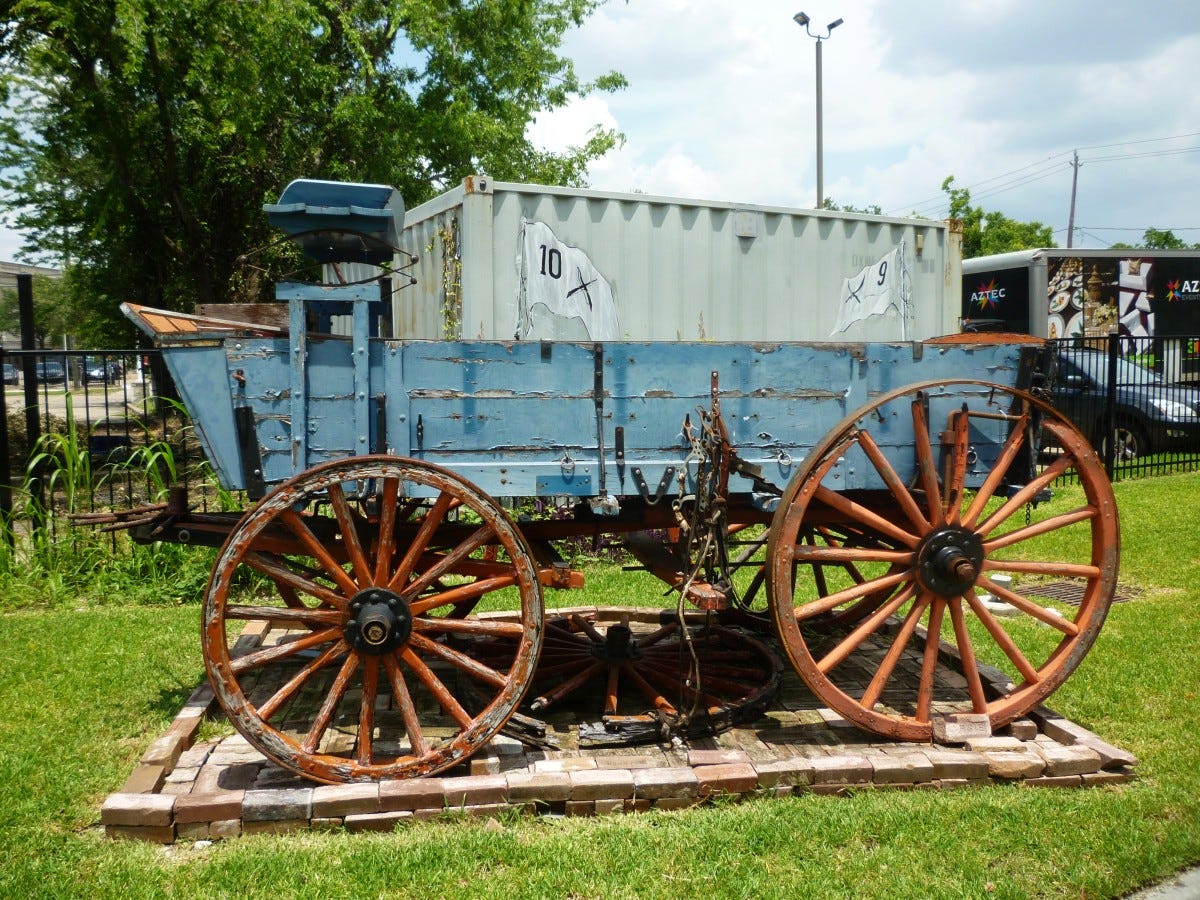
Old wagon on display at the Buffalo Soldiers National Museum in Houston | Source: Peggy Woods (All photos are property of the author; no reuse without permission)
Free link here.
Buffalo Soldiers National Museum
Before ever entering the Buffalo Soldiers National Museum in Houston, Texas, admirers of architecture would undoubtedly like the outward appearance of this impressive building. There are two medallions attached to this edifice. The one by the entrance door nearest the parking lot reads as follows:
“Houston Light Guard Armory
Designed by noted Houston architect Alfred C. Finn, the armory was constructed in 1925 to replace an 1892 building that had become obsolete.
Finn detailed the building to suggest a late Renaissance Period Neo-Gothic English Masonry, represented by the alternating bands of brick and stone and elaborate relief panels above the arched entrance. The building has been owned by the Houston Light Guard, the State of Texas, and the Houston Community College.
Recorded Texas Historic Landmark — 1992"

Buffalo Soldiers National Museum in Houston, front view

Buffalo Soldiers National Museum in Houston parking lot view
Historical Medallion Information
There is even more information on the Texas Historical Commission Official Historical Medallion on the front of the building. The information on that medallion (for those who may never get the chance to read it) is the following:
“Texas Historical Commission
The Houston Light Guard
Organized as a Texas Militia Unit on April 27, 1873, the Houston Light Guard originally participated in parades, ceremonies, and competitive drills and served as guard of honor for visiting dignitaries. The first commander was Capt. Edwin Fairfax Gray (1829–1884). Then the city engineer of Houston. During the 1880s, the Guard, dressed in uniforms of red coats and red-plumed helmets, became known as a leader in drill competitions throughout the United States. Prize money funded their first armory in 1891.
In 1898, the guard was activated for service with United States troops in the Spanish — American War. After participating in the punitive expedition against Mexico, 1916–1917, the unit joined U.S. forces fighting in Europe during World War I.
The Guard built a new armory at this site in 1925 and deeded it to the State of Texas in 1939. The next year, the unit was again activated and during WWII saw action in seven campaigns in Africa and Europe. As part of the 36th Infantry Division, Guard members were among the first American troops in Europe during the war. Now part of the National Guard, the Houston Light Guard represents a proud heritage of distinguished military service.
(1982)”

Buffalo head in the Buffalo Soldiers National Museum
History
Before ever entering this museum, one has a sense of how long our African American soldiers have been engaged in wars fighting on the side of the U.S.
During a significant portion of this time, they did not have equal rights. That did not deter them! The “Buffalo Soldier” nickname applied to them came from their fierce fighting spirit.
The Cheyenne Indians had great respect for buffalo, which roamed the plains freely and in vast herds. If ever backed into a corner, the buffalo never ceased fighting until its dying breath. In combat, the first black American soldiers showed this same courage. Thus, the “Buffalo Soldier” nickname stuck and became applied to all African American soldiers from the 1800s through WWII.
It was in 1866, through an act of Congress, that the very first all-African-American military units were created. In the beginning, they were sent to isolated locations such as Fort Davis in West Texas.
Art in The Buffalo Soldiers National Museum:

Buffalo Soldiers National Museum

Buffalo Soldiers National Museum

Buffalo Soldiers National Museum

Buffalo Soldiers National Museum

Buffalo Soldiers National Museum
Civil War and Beyond
Around 185,000 of these black soldiers served in the Union Army during the Civil War, helping to free some of their people from slavery.
In the beginning, until they had more than proven their courage and bravery in battle, they were assigned menial jobs. They faced discrimination just as existed in the general population.

Carved buffalo sculpture

Old saddles in the Buffalo Soldiers National Museum

Floor tile in the entrance

Front entrance display
Photography in the Museum
Pictures are allowed at the entry-level but not beyond the double doors. So all of the photos shown here were in sanctioned areas for photography.
There is a theater within this Buffalo Soldiers Museum at a lower level. The film is shown continuously, and it is well worth the time to spend watching it. Display cases showing memorabilia are also in that room. The seating is comfortable.
Many of the items beyond those double doors are displayed in three rooms, all connected to a hallway. The walls of the hall display artwork. Taking the time to read about the art and the photographs on display can be very educational.
In the three rooms, there are many more display cases. Some items are out in the open and not behind glass. Old cannonballs for various types of guns are there. Also on display in one of the rooms are vintage items such as crocs, old metal irons, and more household items of the past.
Uniforms and helmets are on view, plus photographs of the modern-day buffalo soldiers — our astronauts. Thirteen photos of them are prominently displayed.

Airman Allison Parker Uniform 1985 at Buffalo Soldier National Museum

Flags and a display case in the Buffalo Soldiers National Museum

Poster in the museum

Poster in the museum

Piece of art in the museum
Education Goal
The goal of the Buffalo Soldiers Museum is to educate the youth of today. Education as to the history of the significant contributions men and women of color have made to protecting the United States of America is also vital.
Proportionately, very few members of our population serve in the military today. We must honor those who have sacrificed themselves to defend our nation and those who still elect to do so today.
Many of the spaces within this non-profit institution can be rented for various occasions such as banquets and galas, meetings and seminars, weddings, and other uses. Areas ranging from 825 to 3,500 square feet are available. Arrangements can be made to view the spaces and plan a special event by calling 713–942–8920.

Beautifully carved wooden bust in Buffalo Soldiers National Museum

Bronze bust named “The Old Soldier”
Sculptural Art
There is some beautiful artwork inside the Buffalo Soldier Museum. Eddie Dixon was the sculptor of the bust called “The Old Soldier,” created in 1993. The following information was taken from the framed information at the base of the statue.
“The bronze bust was donated to the museum by William and Elizabeth Hayden, founders of the Museum of American Art in Paris, Texas. “The Old Soldier” depicts First Sergeant William Moses, a recipient of the Medal of Honor in 1881. The bust stands 27 inches tall, is 18 inches wide, and 15 inches in depth.”
It is a beauty!

Buffalo Soldiers National Museum looking towards the gift shop

Gift shop in the Buffalo Soldiers National Museum
Gift Shop
There is a gift shop within the museum offering all kinds of books, posters, t-shirts, and souvenirs.

Buffalo Soldiers National Museum in Houston — 19th Century Bell
19th Century Bell
Outside of the building is a mounted bell. It also has history! The date for the Mallalieu Chapel M.E. Church is November 26, 1899. The founders’ names are also listed. Written on a black plaque attached to the bell is the following:
“Mallalieu Methodist Church was founded in 1885 in the first ward of Houston, TX. Members and leadership of the church had a relationship with the African — American soldiers and leadership at U.S. Army Camp Logan. Following the Houston Riots in 1919 and the closing of Camp Logan, the church secured permission to claim and repurpose the wood from the demolished buildings at the army base. The wood was hauled by horse-drawn wagons to the site of the church at 1918 Hickory Street. The new church was completed in 1926, using wood from Camp Logan and erecting the original 19th-century bell, honoring both those who served at Camp Logan and the original founders.”
The expansive Memorial Park in Houston is the location of what was Camp Logan.

Wagon in the parking lot at the Buffalo Soldiers National Museum

Decorated storage container in the parking lot
Address and Hours
Hopefully, you now have some idea of what there is to see and learn at the Houston Buffalo Soldiers Museum. It is open from 10 AM to 5 PM Monday to Friday and from 10 AM to 4 on Saturdays. Admission is free from 1 PM to 5 PM on Thursdays. The Buffalo Soldiers National Museum address is 3816 Caroline Street, Houston, Texas 77004.
Update
The museum is temporarily closed for renovations and should reopen sometime in the summer of 2026. Check the 2nd source link below for updates.
[embed]Terrific video about the museum.
Sources
The information in this article was gleaned from a visit to the Buffalo Soldiers National Museum in Houston. Sources inside include an informative movie, signs next to exhibits and artifacts, and people who work there. Depending on the time or your interest, there is much more to learn. To learn even more, check out these sources:
© Peggy Woods (Originally published on HubPages)
메타데이터
- post_id
- bf3000774d7a
- slug
- buffalo-soldiers-national-museum-in-houston-texas-bf3000774d7a
- url
- https://medium.com/tourist-in-my-own-country/buffalo-soldiers-national-museum-in-houston-texas-bf3000774d7a
- canonical_url
- https://medium.com/tourist-in-my-own-country/buffalo-soldiers-national-museum-in-houston-texas-bf3000774d7a
- author_url
- https://medium.com/@wantresiduals
- status
- ok
- fetched_at
- 2026-07-08 18:29:56