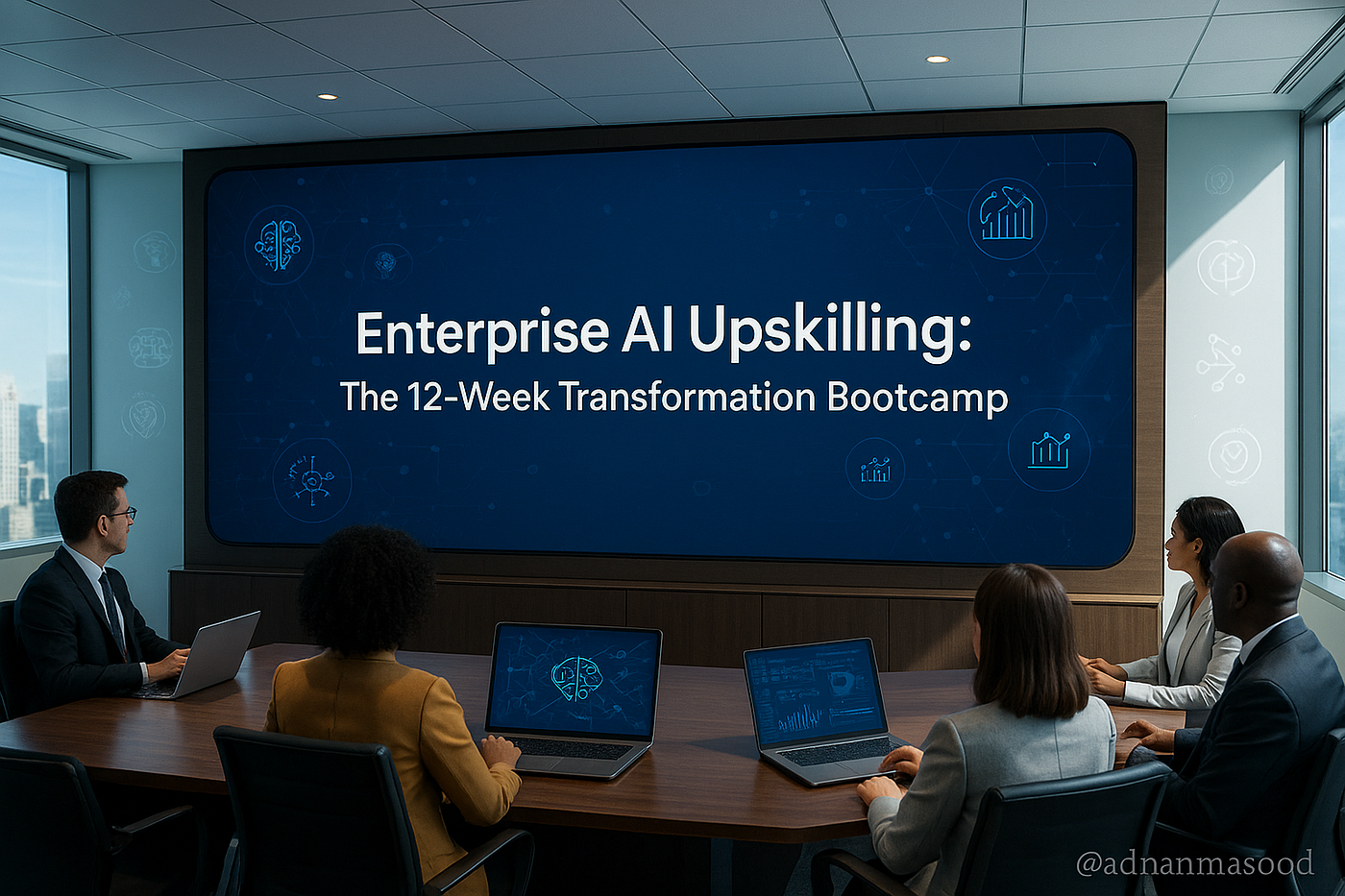
Enterprise AI Upskilling Series: The 12-Week Transformation Bootcamp
A Six-Track Professional Development Framework for Strategic AI Integration Across Executive Leadership, Management Operations, Technical…
Enterprise AI Upskilling Series: The 12-Week Transformation Bootcamp
A Six-Track Professional Development Framework for Strategic AI Integration Across Executive Leadership, Management Operations, Technical Development, Quality Assurance, Data Analytics, and Business Functions
Most enterprise AI initiatives fail because organizations train their technical teams while leaving everyone else behind. The result? Data scientists build impressive models that sit unused, executives make uninformed decisions about AI investments, and middle managers struggle to bridge the gap between strategy and execution.
Over the next six days, I’m releasing one track daily from the Enterprise AI Upskilling: 12-Week Transformation Bootcamp — a comprehensive training framework that addresses this fundamental disconnect.
Each track targets specific organizational roles with practical, immediately applicable skills: executives learn to make informed AI investments and set realistic timelines, middle managers discover how to operationalize AI workflows without getting lost in technical jargon, and business professionals across every department gain hands-on experience with AI tools that directly impact their daily work. This series provides the systematic approach to enterprise-wide AI adoption that actually works — because successful AI transformation requires everyone to speak the same language, not just the people writing the code.
The Enterprise AI Upskilling series represents a comprehensive professional development initiative for organizations ready to harness the transformative power of artificial intelligence across every level of their enterprise. This isn’t just another technology training program — it’s a strategic transformation blueprint designed to move your entire organization from AI-curious to AI-fluent in just 12 weeks.
Drawing from my experience working with and real-world case studies, this bootcamp-style series equips leaders, managers, developers, and business professionals with the practical skills, strategic frameworks, and ethical foundations needed to thrive in the AI era. Each track is meticulously designed to address the unique challenges and opportunities within specific organizational roles, ensuring that every participant gains immediately applicable skills while contributing to a cohesive, enterprise-wide AI adoption strategy.
Whether you’re a C-suite executive setting strategic direction, a middle manager operationalizing AI workflows, or a business professional looking to amplify your productivity, this series provides the roadmap for sustainable, responsible, and profitable AI integration that drives competitive advantage and organizational resilience.
**Part 1: “Enterprise AI Upskilling: Executive Leadership Track” **Strategic Vision Setting, Governance Frameworks, and Board-Level AI Decision Making for Sustainable Competitive Advantage
**Part 2: “Enterprise AI Upskilling: Middle Management Track” **Operational Excellence Through AI Workflow Automation, Team Leadership, and Cross-Functional Implementation Strategies
**Par t3: “Enterprise AI Upskilling: Software Development Track” **AI-Assisted Coding, Model Integration, and Building Next-Generation Applications with Advanced Prompt Engineering
**Part 4: “Enterprise AI Upskilling: Quality Assurance Track” **AI-Driven Testing Methodologies, Automated Validation Systems, and Ensuring Quality in AI-Powered Applications
**Part 5: “Enterprise AI Upskilling: Data & Analytics Track” **Advanced Generative AI for Insights, Synthetic Data Creation, and Building Sophisticated Analytics Engines
**Part 6: “Enterprise AI Upskilling: Business Functions Track” **Practical AI Applications for Marketing, HR, Operations, and Change Management Across All Organizational Departments


Recommended Courses for Each Track
Part 1: Enterprise AI Upskilling — Executive Leadership Track
Strategic Vision Setting, Governance Frameworks, and Board-Level AI Decision Making for Sustainable Competitive Advantage.
Executives and senior leaders need a high-level understanding of AI’s capabilities and limitations, so they can set a vision and strategy for AI adoption. DeepLearning.AI provides accessible courses for non-engineers that help demystify AI and guide strategic decision-making:
- AI for Everyone — “AI is not only for engineers.” This introductory non-technical course, taught by Andrew Ng, helps executives and other non-programmers understand core AI concepts and terminology [1]. It offers a realistic view of what today’s AI can and can’t do, so leaders can spot opportunities to apply AI in their organizations and avoid hype-driven pitfalls [1]. As a learner, I found the course valuable for building a sustainable AI strategy: it covers how to identify suitable AI projects, how AI impacts business and society, and even provides an “AI Transformation Playbook” for implementing AI at an organizational level [1]. Benefits: Gain a common AI vocabulary and strategic framework to communicate with technical teams. Usage: Ideal for C-suite leaders or board members crafting a company’s AI vision. Outcome: After this course, you will understand how to integrate AI into your business strategy and make informed, board-level decisions about AI investments [1].
- Generative AI for Everyone — This short course (3+ hours, no coding required) is Andrew Ng’s latest offering focused on the generative AI revolution [2]. As an executive learner, I appreciated how it empowered me to envision new uses of AI in my work. The course explains how generative AI works and what it can (and can’t) do, in terms accessible to non-engineers [2]. It provides hands-on exercises where you actually try tools like ChatGPT, so you can see how to use generative AI for day-to-day tasks and brainstorm applications. Andrew Ng shares tips on effective prompt engineering and even goes beyond simple prompts to show more advanced AI uses [2]. Benefits: Gives leaders insight into cutting-edge AI (like GPT-4, image generators) and their business applications. Usage: Helps in developing an AI-driven strategic vision — e.g. how generative AI can streamline operations or create new products. Outcome: You’ll be better prepared to guide your company’s adoption of generative AI, understanding its impact on business and society and how to craft policies around it [2]. (Notably, the course explicitly addresses business leaders on how to increase productivity with gen AI and develop effective AI strategies [2].)
- AI for Good Specialization — While not exclusively for executives, this 3-course specialization provides a bigger-picture perspective on using AI for positive real-world impact [3]. As a leader, I found it broadened my strategic thinking: it showcases how AI can tackle complex global challenges (from public health to climate change), combining human and machine intelligence for sustainable solutions [3]. It teaches a step-by-step framework for developing AI projects responsibly and includes case studies on governance issues like bias, ethics, and AI safety. Benefits: Sharpens your ability to align AI initiatives with corporate social responsibility and long-term competitive advantage. Usage: Great for executives interested in AI governance frameworks or those guiding AI projects in regulated industries. Outcome: By completion, you will have a framework for managing AI projects end-to-end (with awareness of ethical and governance considerations) and insight into how AI can drive sustainable competitive advantage in the long run [3]. (As instructor Robert Monarch says, even though the focus is humanitarian, the skills “can help you effectively develop any product that uses AI” [3].)
Part 2: Enterprise AI Upskilling — Middle Management Track
Operational Excellence Through AI Workflow Automation, Team Leadership, and Cross-Functional Implementation Strategies.
Middle managers and project leaders serve as the bridge between high-level strategy and technical execution. They need to understand how to implement AI in workflows, manage AI projects, and lead teams through AI-driven changes. DeepLearning.AI offers courses that focus on AI project management and operationalization:
- Structuring Machine Learning Projects — This course (part of the Deep Learning Specialization) is practically a handbook for AI project leaders. Taught by Andrew Ng, it trains you on how to lead machine learning projects successfully [4]. In first person: I learned how to diagnose errors in a model and prioritize the right improvements — skills that normally come from years of industry experience [4]. The course covers handling common problems like mismatched training vs. test data, when to apply techniques like transfer learning or multi-task learning, and how to decide if your team’s model is performing adequately (e.g. comparing against human-level performance) [4]. Benefits: Helps a manager understand the ML development process and make informed decisions (e.g. whether to gather more data or tune hyperparameters). Usage: Perfect for team leads or product managers overseeing AI initiatives — it gives you a mental framework to structure workflows and communicate with data scientists. Outcome: You become a more effective AI project manager who can set direction for the team, anticipate pitfalls, and drive projects to completion with the right strategy [4]. (As the course description notes, it provides the “industry experience” for aspiring technical leaders to set the direction for an AI team [4].)
- Machine Learning in Production — Implementing AI at scale requires understanding deployment and maintenance, not just modeling. This intermediate course (from the now-retired MLOps specialization by DeepLearning.AI) taught me how to design an ML system end-to-end and keep it running reliably [5]. From a manager’s perspective, it emphasizes cross-functional implementation: project scoping, data pipelines, model deployment, and continuous monitoring [5]. Benefits: You learn best practices of modern software DevOps applied to ML (MLOps) — such as establishing model baselines, detecting concept drift in data over time, and designing for scalability and cost-effectiveness [5]. Usage: Use this knowledge to work with engineers in deploying AI workflows (for example, setting up an AI automation pipeline on cloud infrastructure or integrating ML models into existing business processes). Outcome: You’ll be able to oversee AI implementations that are robust and sustainable: ensuring the model keeps working as data evolves, and that your AI products deliver consistent value in production [5]. This course gave me the tools to drive operational excellence — I can now confidently discuss deployment requirements, necessary team roles, and risk mitigation (like monitoring for model performance degradation) when planning AI projects.
- Team Software Engineering with AI — Mid-level engineering managers or tech leads will appreciate this course (Course 2 of the Generative AI for Software Development certificate). It focuses on using AI to enhance team workflows in software projects [6]. I learned how Large Language Models (LLMs) can streamline testing, generate documentation, and even help debug complex dependencies in code [6]. For a development manager, this translates to automation of routine tasks and improved team productivity. Benefits: Shows how to leverage AI as a “team member” — e.g. using an LLM to automatically create unit tests or detect security vulnerabilities in code [6]. Usage: Applicable to any manager looking to infuse AI into their team’s workflow: from automating QA testing to accelerating onboarding with AI-generated docs. Outcome: By implementing these techniques, your team can achieve operational excellence — fewer bugs, faster development cycles, and better collaboration. Personally, after this course I was able to introduce AI pair-programming tools to my team and saw quicker turnaround in our development sprints, as well as more comprehensive test coverage (since AI can suggest tests we hadn’t thought of) [6].
- AI for Everyone (and Generative AI for Everyone) — These courses, mentioned in the Executive Track, are equally valuable for middle managers. They provide the non-technical big picture which helps managers communicate effectively between executives and technical teams. For example, AI for Everyone taught me how to work with an AI team and spot opportunities in my department [1]. It emphasizes that “every job function needs to learn to use data” [1] — a message that resonates strongly at the middle-management level. Benefits: Equips managers with enough AI fluency to champion AI projects in their domain (marketing, finance, operations, etc.) and align those projects with company strategy. Usage: Use the concepts from these courses to identify processes in your unit that could be automated or improved with AI, and to lead change management when implementing AI solutions. Outcome: You’ll become a more effective liaison — able to set realistic AI project goals, secure executive buy-in with well-informed proposals, and manage cross-functional teams (data scientists, engineers, domain experts) because you understand each stakeholder’s language and concerns [1].
Part 3: Enterprise AI Upskilling — Software Development Track
AI-Assisted Coding, Model Integration, and Building Next-Generation Applications with Advanced Prompt Engineering.
This track is for software developers, engineers, and technical architects who want to build AI-powered applications. DeepLearning.AI’s courses here focus on hands-on skills: using AI APIs, integrating ML models into software, and mastering cutting-edge development tools (like LLMs) for coding.
- Generative AI for Software Development (Professional Certificate) — “Leverage AI in your software development workflow.” This 3-course certificate (taught by Laurence Moroney, ex-Google AI lead) completely transformed how I write and ship code [7]. It starts by ensuring you understand how LLMs work (so you can use them more effectively as a developer) [7]. Then it dives into practical prompt engineering and pair programming techniques with tools like ChatGPT and GitHub Copilot [7]. For example, I learned how to prompt an LLM to generate boilerplate code, write unit tests, or even design a database schema — essentially treating the AI as a junior developer on the team [7]. The program also covers implementing advanced design patterns with AI assistance and using LLMs for debugging and performance tuning [7]. Benefits: Accelerates development — you can prototype features faster and catch bugs earlier by collaborating with an AI partner [7]. It also helps you “team up with AI on engineering tasks”, meaning you break through roadblocks by consulting the AI’s knowledge of algorithms, libraries, and best practices [7]. Usage: Any software engineer can integrate these skills immediately: e.g. using prompt engineering to generate code snippets or documentation, relying on AI suggestions during code reviews, or letting an AI analyze a complex codebase to suggest improvements. Outcome: By the end, you’ll have a new paradigm for development — one where LLMs become invaluable team members acting as co-coders, testers, and even security analysts [7]. (It’s telling that Gartner predicts 70% of engineering teams will be using AI coding tools by 2027, underscoring how crucial these skills are for the future [7].) From my experience, after completing this cert, I saw a boost in my productivity and a reduction in tedious coding tasks, as I now confidently delegate those to AI.
- ChatGPT Prompt Engineering for Developers — This is a free, short course (under 2 hours) co-created by OpenAI and DeepLearning.AI that I found perfect for a quick upskill [8]. It teaches how to go beyond using ChatGPT in a chat box and instead use OpenAI’s API to build your own AI-powered applications [8]. In first person: I learned two core principles of writing effective prompts and got hands-on practice systematically improving them. The course outlines best practices for prompt engineering (like how to give clear instructions or use examples in prompts) and shows how to integrate an LLM into various tasks [8]. Benefits: Gives you the ability to quickly add AI features into your software — such as having your app summarize user reviews, classify text sentiment, translate messages, fix grammar, or auto-generate content [8]. Usage: The skills apply widely — whether you’re building a customer service chatbot, an AI writing assistant, or simply using ChatGPT to help you code faster. I personally used the techniques to create a custom chatbot for internal documentation at work, which involved calling the OpenAI API and feeding it our documents; the course’s section on building a custom chatbot was directly applicable. Outcome: By the end of the course, you’ll be able to harness large language models (LLMs) in your own projects with confidence [8]. You’ll understand how LLMs reason, how to avoid common failure modes, and how to iterate on prompts to get the results you need [8]. This dramatically lowers the barrier to adding AI capabilities to any software. (Plus, the fact that over 100k developers enrolled shows how relevant it is [8].)
- AI-Powered Software and System Design — This advanced course (the third in the Generative AI for Software Dev series) focuses on using AI for high-level design and architecture [7]. I learned how to have an AI help design a system’s components and even create or optimize a database from scratch using LLM assistance [7]. It also teaches applying design patterns and secure coding practices with an AI’s guidance [7]. In practice, this meant I could use an LLM to generate multiple design alternatives for a feature and evaluate their trade-offs more quickly. Benefits: Helps experienced developers and architects incorporate AI insights into complex tasks like system architecture, which historically were purely human-driven. Usage: Use an LLM as a sounding board when designing new systems — e.g., “Given these requirements, suggest an API design or a microservice breakdown.” The course showed me how to prompt for such scenarios. Outcome: You’ll be capable of building next-generation applications where AI isn’t just a feature, but part of the development process itself. This can lead to more robust designs (since the AI might recall design principles or edge cases you missed) and faster system iteration. My big takeaway was that AI can be involved at every stage of software creation — from coding to testing to design — making me a much more efficient and thorough engineer [7].
- Open-Source and Specialized Tools — In addition to the above, DeepLearning.AI offers many short, focused courses on tools and libraries that modern AI developers use. For instance, “Open Source Models with Hugging Face” (for integrating pre-trained models from Hugging Face Hub), “Building LLM Applications with LangChain”, or “Vector Databases: from Embeddings to Applications” (important for semantic search and retrieval-augmented generation). As a developer, I found picking and choosing some of these very useful for niche skills. For example, after taking the LangChain course, I was able to build an app that let our users query a knowledge base using natural language, by chaining LLM calls with a vector database for context — a capability straight out of the latest AI application patterns [7]. Benefits: These courses ensure you’re up-to-date with the latest frameworks and techniques in AI app development (LLMOps, RAG, diffusion models, etc.). Usage: They are often project-based, so you come out with a small demo or project (like a working chatbot, an image generator, or a custom model integration) that you can directly repurpose or build upon in your job. Outcome: Enhanced versatility as a software developer — you’re not just coding traditional apps, but you can now seamlessly weave AI capabilities into any project, giving your organization a tech edge.
Part 4: Enterprise AI Upskilling — Quality Assurance Track
AI-Driven Testing Methodologies, Automated Validation Systems, and Ensuring Quality in AI-Powered Applications.
Quality assurance (QA) and testing are critical when deploying AI systems, because AI can introduce new failure modes (like biased outputs, hallucinations, or security vulnerabilities). This track focuses on courses that teach how to test, evaluate, and trust AI systems. As someone concerned with product reliability, these courses gave me tools to ensure our AI is safe and effective:
- Quality and Safety for LLM Applications — This short, beginner-friendly project course taught me how to monitor and enhance the safety of applications that use Large Language Models [9]. Concretely, I learned methods to identify hallucinations in AI outputs (e.g. using an algorithm like SelfCheckGPT to catch when the model is making facts up) [9]. It also covers detecting prompt injections or jailbreak attempts — i.e. when a malicious user tries to trick your chatbot into breaking the rules — using techniques like sentiment analysis and toxicity detection [9]. Another key skill was identifying data leakage, where an AI might reveal sensitive info, by using entity recognition and vector similarity checks [9]. Benefits: Provides a toolkit for AI governance and QA — you’ll know how to set up monitoring for your AI system’s outputs and catch issues in real time [9]. Usage: I immediately applied this at work by incorporating some safety checks into our AI chatbot: after this course, I could implement a pipeline that flags potentially harmful or nonsensical responses for review. Outcome: By course end, you can build a basic LLM monitoring dashboard and have a playbook for evaluating an AI system’s quality over time [9]. For me, it meant increased confidence before each AI release — we could assure stakeholders that we have measures in place to maintain quality and compliance.
- Red Teaming LLM Applications — This course was an eye-opener on attacking your own AI to make it stronger. Inspired by cybersecurity “red teaming,” it teaches how to find vulnerabilities in AI systems before bad actors do [10]. I learned to simulate adversarial scenarios on our chatbot — for example, systematically using malicious prompts to see if I could get the AI to reveal private data or produce disallowed content [10]. The course walks through both manual testing and using an open-source library (by Giskard) to automate certain attacks [10]. Benefits: You come away able to assess the robustness and reliability of an AI application by thinking like an attacker [10]. This includes understanding common LLM failure modes (and their real-world impacts like legal liabilities or reputational damage) and how to mitigate them proactively [10]. Usage: In practice, I used these techniques to “stress test” our AI model before deployment. We uncovered a few surprising ways users could exploit it, which we then fixed by refining prompts and adding filters — a direct win for product quality. Outcome: After completing Red Teaming, you will be able to perform penetration testing on AI systems, ensuring they meet safety requirements and won’t easily be broken by unexpected inputs [10]. It’s a great feeling to know you’ve hardened your AI against threats; as a QA engineer, it meant I could sign off on releases with greater assurance.
- Evaluating and Debugging Generative AI — Focused on the MLOps side of QA, this course introduced me to tools for evaluating AI models and tracking their performance over time [11]. It specifically uses Weights & Biases (W&B), a popular experiment tracking and model debugging platform. From a first-person view: I learned how to instrument a training pipeline with logging, version control for datasets and models, and monitoring metrics as the model interacts in complex scenarios [11]. For example, I practiced tracing an LLM’s outputs over many conversation turns to find where things go wrong, and logging those instances for analysis. Benefits: Emphasizes systematic evaluation — instead of ad-hoc tests, you set up infrastructure to catch issues (like a drift in model performance or a spike in errors) quickly and reliably [11]. Usage: Use these skills to build an analytics dashboard for your AI systems: you can compare different model versions, debug why one version might be making more mistakes, and ensure that when your team updates an AI model, its quality truly improves and doesn’t regress on key metrics. Outcome: You’ll be equipped to implement a continuous AI quality assurance process. In my case, I set up W&B for our image recognition model — this allowed us to notice a slight drop in accuracy after a data update, and we caught and fixed it before it affected customers. The course made me realize that maintaining AI quality is an ongoing effort that needs the right tools and processes (just like traditional software QA) [11].
- LLMOps — This is a hands-on project course that ties together QA with deployment. It walks through the pipeline of fine-tuning and deploying a large language model, emphasizing good practices at each step [12]. As someone interested in quality, I appreciated the focus on versioning data and models (so you always know which model version is in production and what data it was trained on) [12], as well as outputting safety scores for your model’s responses to monitor harmful content [12]. The course has you use tools like BigQuery (for handling large datasets), Kubeflow Pipelines (for orchestrating training), and a bit of Google Cloud for deployment [12]. Benefits: Integrates quality checks into the model lifecycle — from pre-processing data (ensuring data quality) to evaluating the tuned model’s safety before deploying [12]. Usage: If your organization is building custom AI models, LLMOps skills are essential for QA at scale: you’ll be able to establish an automated pipeline where every new model version is fine-tuned on clean data, automatically evaluated for accuracy and safety, and then rolled out with monitoring in place. Outcome: By the end of this project, you will have experienced creating a bespoke AI model with an end-to-end MLOps pipeline, including QA gates (like rejecting a model that scores poorly on safety) [12]. Personally, this gave me the confidence to participate in our team’s model deployment discussions — I can now advocate for including a safety evaluation step and proper version control whenever we release an updated model, which is crucial for maintaining trust and quality.
Part 5: Enterprise AI Upskilling — Data & Analytics Track
Advanced Generative AI for Insights, Synthetic Data Creation, and Building Sophisticated Analytics Engines.
Data analysts and data scientists in an enterprise need to harness AI to derive deeper insights, create data-driven products, and even generate new data when needed. This track covers courses that blend traditional analytics with cutting-edge AI (like generative models), as well as those that focus on data creation and handling.
- DeepLearning.AI Data Analytics Professional Certificate — A comprehensive 5-course program designed to build a job-ready data analytics skillset with modern tools, including generative AI [13]. As someone who went through it, I’d say it lays a strong foundation in statistics and data visualization, but what sets it apart is the integration of AI tools into the analytics workflow [13]. For example, I learned how to use large language models as a “thought partner” when analyzing data — the courses show how an AI can help brainstorm hypotheses, check your work (like debugging a complex spreadsheet formula), or even automate parts of analysis like summarizing findings [13]. There are hands-on labs where you practice using generative AI to speed up tasks such as building a dashboard or creating a simulation model [13]. Benefits: You gain core analytics skills (descriptive and inferential statistics, data cleaning, visualization) plus experience with AI-augmented workflows, which is increasingly how analytics is done in industry [13]. Usage: Applicable to any analyst or data scientist role — e.g. a marketing analyst can use these skills to better parse customer feedback with AI, or an operations analyst can simulate outcomes using AI assistants. The program explicitly caters to various roles (it mentions that whether you’re a software engineer working with data pipelines or a marketer/business analyst, these skills will help you excel in a data-centric world) [13]. Outcome: By the end, you can manage the entire data lifecycle from problem definition to delivering insights, armed with both classical methods and AI tools [13]. I personally felt “future-proof” as an analyst — for instance, I learned how to use an LLM to accelerate data visualization (by quickly generating draft chart interpretations), which made my analytics presentations far more efficient to produce. The certificate was updated as recently as March 2025, so it’s very current with the latest AI developments in analytics [13].
- Generative Adversarial Networks (GANs) Specialization — This intermediate, 3-course specialization is all about synthetic data generation and advanced generative modeling [14]. In a data science role, I found learning GANs to be incredibly powerful: these are models that can create new images, audio, or data that look real. The courses start from basics (building a simple GAN to generate images) and progress to advanced topics like DCGANs, conditional GANs, and StyleGAN [14]. A highlight was learning how to use GANs for data augmentation and privacy preservation — for example, generating additional training data when you have a small dataset, or creating anonymized data that retains statistical patterns but not personal details [14]. It also covers evaluating GAN outputs with metrics like FID (Fréchet Inception Distance) and discusses bias in generative models and how to detect it [14]. Benefits: Gives you cutting-edge skills to create synthetic data (useful in industries where real data is scarce or sensitive) and to understand one of the most exciting areas of deep learning. Usage: I’ve applied GAN knowledge in a few ways: in a computer vision project, we generated synthetic images to train our model (boosting its performance), and in a data privacy context, we experimented with GAN-generated data to share insights with partners without exposing real user data. Outcome: After mastering GANs, you can build sophisticated analytics engines that incorporate generative AI — for example, an engine that generates realistic simulations of customer behavior for “what-if” analysis, or one that enhances image data for an internal analytics tool [14]. You’ll also be aware of the ethical implications (the specialization doesn’t shy away from discussions on fairness and misuse of generative tech [14]). From a personal standpoint, this specialization made me one of the “go-to” people in my company for questions about synthetic data. It’s an intermediate-level program, but very rewarding for those looking to push AI to its creative limits.
- Generative AI for Data Science and Analytics — (Not an official course title, but reflecting a theme across multiple DeepLearning.AI offerings.) Beyond the formal programs above, there are many short courses that data professionals can pick up to enhance specific skills. For instance, “Large Language Models with Semantic Search” teaches how to combine LLMs with vector databases to query large text corpora for insights, which is great for building internal analytics Q&A systems. “Building Data Analytics Dashboards with Generative AI” (hypothetical combination of skills) would involve using tools from the Data Analytics certificate and generative models to auto-generate reports. While not one specific course, I want to note that DeepLearning.AI’s curriculum stays updated — in 2024–2025 they released courses on Retrieval-Augmented Generation (RAG), knowledge graphs, and domain-specific AI applications (like AI in finance, AI in healthcare via specializations), all of which can feed into an analytics professional’s toolbox. Benefits: By sampling these, you remain on the cutting edge of how AI can supercharge analytics: whether it’s using an LLM to instantly answer a business question from company data, or employing a diffusion model to simulate possible outcomes for planning. Usage: Many of these courses are a few weeks long and project-based, so you can directly bring a mini-project to your job — for example, building a prototype of a chatbot that helps HR analyze employee survey sentiments, or a model that predicts supply chain delays using a mix of traditional stats and NLP. Outcome: Continued professional growth and the ability to build “analytics engines” that are far more advanced than traditional BI dashboards. On a personal note, after taking a course on RAG, I built a prototype where an executive could ask a question in English and the system would search through our data warehouse and generate a coherent answer with references. It impressed our leadership and showed the potential of AI-driven analytics.
Part 6: Enterprise AI Upskilling — Business Functions Track
Practical AI Applications for Marketing, HR, Operations, and Change Management Across All Organizational Departments.
AI is transforming every business function — from marketing and sales to human resources, finance, and operations. This track is about empowering all departments to leverage AI tools effectively. The courses here are often non-technical or application-focused, ensuring that professionals in various roles (even without coding skills) can implement AI solutions in their domain:
- AI for Everyone — This course makes a return in the Business Functions track because it truly is for everyone in an organization. As a marketing manager taking it, I learned how to spot AI opportunities in my own department — for example, identifying repetitive reporting tasks that could be automated with AI, or understanding how an AI could help personalize our customer outreach [1]. The course also addresses how AI impacts jobs and how to navigate that change [1], which is crucial for anyone involved in change management or upskilling teams. Benefits: Gives every functional leader or team member a solid grasp of AI basics and a framework to start an AI project. It demystifies terms like neural networks or deep learning so that, say, an HR specialist can discuss AI with a data scientist without feeling lost [1]. Usage: Use this course as a kickoff for company-wide AI upskilling — many firms actually ask all their managers to take “AI for Everyone” to build a common foundation. In practice, it helped me collaborate with our data team better; I could articulate our marketing needs in terms of data and feasibility after understanding what AI can/can’t do. Outcome: Organization-wide AI literacy. Departments such as HR might start considering AI for resume screening or employee sentiment analysis, operations teams might explore predictive maintenance via AI, all because they now speak the language of AI and see its potential through the examples provided in this course [1].
- Generative AI for Everyone — We’ve noted this for executives, but it’s equally transformative for individual contributors and managers in any function. It provides hands-on exposure to generative AI tools that anyone can use to boost productivity [2]. For instance, in the course I learned how to use a text-to-image generator to create custom graphics — a skill that a marketing team member could use for quick ad creatives. I also practiced using ChatGPT to draft emails and brainstorm ideas, which any team (HR, sales, etc.) can benefit from [2]. Crucially, it teaches effective prompt writing tailored to your needs (e.g., prompting for a marketing copy vs. prompting for a summary of a legal document). Benefits: Empowers non-technical employees to become “citizen developers” with AI — they can automate parts of their job or augment their creativity without writing code [2]. Usage: Imagine a few scenarios — a customer support manager uses an AI tool to analyze thousands of support tickets and extract common pain points (saving weeks of manual work), or an HR coordinator uses a generative AI to draft individualized training plans. This course sparks such ideas and gives the foundational knowledge to pursue them. Outcome: A workforce that actively uses AI tools for daily tasks, leading to efficiency gains across departments. Personally, after this course, I started using generative AI in my daily routine (writing better survey questions, translating content for global teams, summarizing long reports), and I’ve seen colleagues in finance use it for things like generating Python scripts to reconcile data — all thanks to the “AI for Everyone” ethos that this course spreads [2].
- AI in Domain-Specific Contexts — DeepLearning.AI also offers courses targeting AI applications in specific fields, which can be valuable for departmental deep dives. Examples include AI for Medicine (a specialization on how AI is used in clinical diagnosis, prognosis, and treatment recommendations) and courses under the AI for Good specialization like AI and Public Health, AI and Climate Change, AI and Disaster Management [3]. While a marketing or HR professional might not take “AI and Climate Change” for their job, the concept here is that AI solutions often share patterns across domains. First-person note: I took AI and Public Health out of personal interest, and realized the techniques for, say, analyzing text messages after a disaster (a project in that course) are analogous to analyzing customer feedback logs in a business [3]. Benefits: These courses inspire lateral thinking — someone in operations might take inspiration from an AI supply chain example in an unrelated domain, or a product manager might learn about AI project frameworks that apply universally (the AI for Good courses explicitly teach a framework for AI projects that can apply to any product development). Usage: If you have a specific interest or your department aligns with one of these domains (e.g., an environmental sustainability team in a corporation could benefit from AI and Climate Change to see how to forecast and mitigate environmental risks with AI), these courses can provide targeted insight. Outcome: Department-specific AI champions. They not only learn the technical side but also how to drive change management — because implementing AI in any domain often requires getting buy-in and working with stakeholders (something highlighted in AI for Good’s human-centered approach). One quote from the AI for Good specialization that resonated with me: “people who take this specialization can expect to learn how to effectively develop any product that uses AI” [3] — it underlines that these skills go beyond the specific examples and teach you how to bring AI into your own domain.
- Practical AI for Business (use cases) — While not a single course, throughout DeepLearning.AI’s programs I encountered practical use cases for marketing, HR, and other functions. For instance, the ChatGPT Prompt Engineering course demonstrated tasks like summarizing user reviews, sentiment analysis, translation, and email generation [8] — all highly relevant to marketing and customer service departments. Seeing those examples, I immediately thought: our customer success team could use an AI to automatically summarize weekly user feedback, or our sales team could use AI to draft personalized outreach emails at scale. Benefits: Exposure to these examples helps you connect the dots between AI capabilities and your daily work challenges. Usage: Often the hurdle in business functions is not technical but ideational — people don’t realize what’s possible. By learning from these courses, I started identifying dozens of small improvements: e.g., our HR team now uses a simple NLP model (from a course project) to scan open-ended survey responses and classify them (sparing our HR analysts days of reading). Outcome: Broad AI adoption across functions. When marketing, HR, operations etc. each pick low-hanging fruit to automate or enhance with AI, the cumulative impact is significant.
Sources
The information above is drawn from official DeepLearning.AI course descriptions and outcomes, as well as insights from instructors:
- DeepLearning.AI course pages and descriptions for AI for Everyone [1] and Generative AI for Everyone [2] highlighting their focus on non-technical professionals and strategic AI usage.
- Andrew Ng’s notes on Machine Learning in Production [5] and Structuring Machine Learning Projects [4], which emphasize leadership in AI projects and production deployment strategies.
- Coursera project course details for Quality and Safety for LLM Applications [9] and Red Teaming LLM Applications [10], showing how to test and secure AI systems.
- The Generative AI for Software Development professional certificate overview [7] and ChatGPT Prompt Engineering for Developers syllabus [8], demonstrating AI-assisted coding, prompt best practices, and API integration.
- DeepLearning.AI’s Data Analytics Professional Certificate description [13] and GANs Specialization outline [14], for how generative AI is incorporated into analytics and data generation.
- Quotes and highlights from the AI for Good Specialization and domain-specific courses [3], illustrating the broad applicability of AI project frameworks and real-world case studies used for teaching.
References & Further Readings
[1] AI for Everyone — DeepLearning.AI, [Online]. Available: https://www.deeplearning.ai/courses/ai-for-everyone/
[2] Generative AI for Everyone — DeepLearning.AI, [Online]. Available: https://www.deeplearning.ai/courses/generative-ai-for-everyone/
[3] AI for Good Specialization — DeepLearning.AI, [Online]. Available: https://www.deeplearning.ai/courses/ai-for-good/
[4] Structuring Machine Learning Projects | Coursera, [Online]. Available: https://www.coursera.org/learn/machine-learning-projects
[5] Machine Learning in Production — DeepLearning.AI, [Online]. Available: https://www.deeplearning.ai/courses/machine-learning-in-production/
[6] Team Software Engineering with AI | Coursera, [Online]. Available: https://www.coursera.org/learn/team-software-engineering-with-ai
[7] Generative AI for Software Development Skill Certificate | Coursera, [Online]. Available: https://www.coursera.org/professional-certificates/generative-ai-for-software-development
[8] Learn ChatGPT Prompt Engineering for Developers in Under 2 Hours | Coursera, [Online]. Available: https://www.coursera.org/projects/chatgpt-prompt-engineering-for-developers-project
[9] Quality and Safety for LLM Applications | Coursera, [Online]. Available: https://www.coursera.org/projects/quality-and-safety-for-llm-applications
[10] Red Teaming LLM Applications Training Project | Coursera, [Online]. Available: https://www.coursera.org/projects/red-teaming-llm-applications
[11] Evaluating and Debugging Generative AI | Coursera, [Online]. Available: https://www.coursera.org/projects/evaluating-and-debugging-generative-ai-project
[12] LLMOps | Coursera, [Online]. Available: https://www.coursera.org/projects/llmops
[13] DeepLearning.AI Data Analytics Professional Certificate | Coursera, [Online]. Available: https://www.coursera.org/professional-certificates/data-analytics
[14] Generative Adversarial Networks (GANs) | Coursera, [Online]. Available: https://www.coursera.org/specializations/generative-adversarial-networks-gans
메타데이터
- post_id
- bf3da2a812fd
- slug
- enterprise-ai-upskilling-series-the-12-week-transformation-bootcamp-bf3da2a812fd
- url
- https://medium.com/@adnanmasood/enterprise-ai-upskilling-series-the-12-week-transformation-bootcamp-bf3da2a812fd
- canonical_url
- https://medium.com/@adnanmasood/enterprise-ai-upskilling-series-the-12-week-transformation-bootcamp-bf3da2a812fd
- author_url
- https://medium.com/@adnanmasood
- status
- ok
- fetched_at
- 2026-06-09 15:37:30