Beyond Cancel Culture: Building a Future of Healthy Public Debate in Nigeria (Part 3)
Understanding Active Participation: The Foundation of Healthy Discourse
Beyond Cancel Culture: Building a Future of Healthy Public Debate in Nigeria (Part 3 Epilogue)
Understanding Active Participation: The Foundation of Healthy Discourse
Obisdev | 6th feb 2026
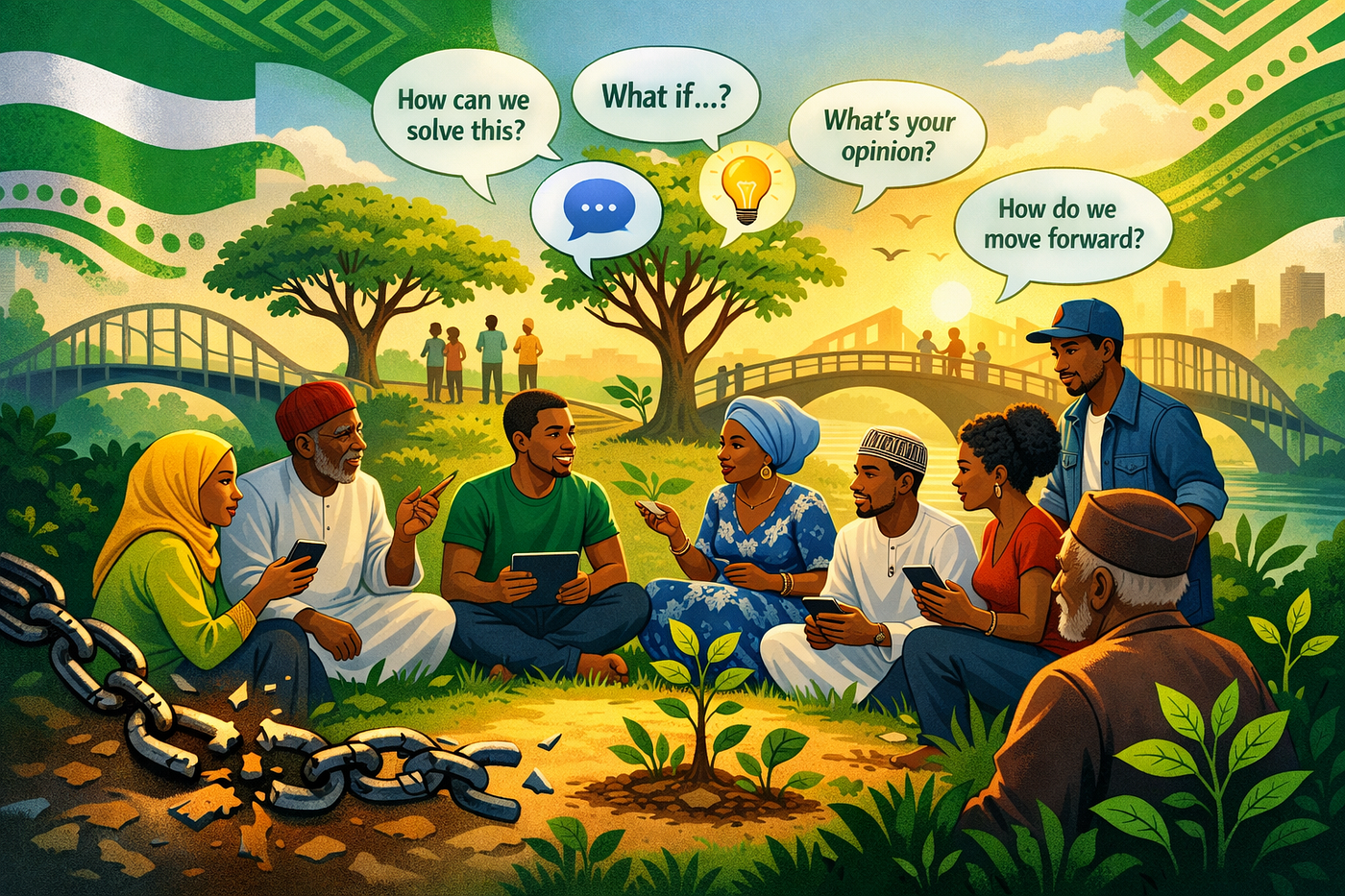
Introduction: From Diagnosis to Prescription
Nigeria does not suffer from a lack of opinions. It suffers from a lack of participation that builds rather than destroys. In Parts 1 and 2 of this series, we examined the anatomy of cancel culture in Nigeria and its devastating impact on public discourse, creativity, and social cohesion. We explored how platforms like X (formerly Twitter) have become battlegrounds where ideas are executed before they can be examined, where character assassination replaces critical engagement, and where the loudest voices drown out the most thoughtful ones.
Now, in this final installment, we shift from diagnosis to prescription. The question is no longer whether Nigeria’s public discourse is broken — we have established that it is. The question is: what do we do about it?
This article presents a comprehensive framework for fostering healthier debate online, particularly on X, where much of Nigeria’s public conversation takes place. It offers practical, actionable solutions for individuals, influencers, organizations, and platforms. These solutions are not theoretical ideals but evidence-based strategies that can be implemented immediately to transform how Nigerians engage with one another online.
Understanding Active Participation: The Foundation of Healthy Discourse
What Active Participation Means
Active participation means choosing engagement over reaction. It means taking responsibility for how conversations evolve rather than outsourcing judgment to mobs. It is not about being soft or diplomatic — it is about being smart and effective.
In practical terms, active participation looks like:
Questioning ideas instead of attacking character. When someone shares an opinion you disagree with, the first response should not be “You are stupid” or “You are a sellout.” It should be “Why do you believe this?” or “What evidence supports this view?”
Offering evidence instead of insults. Arguments are won with facts, logic, and persuasive reasoning — not with mockery, name-calling, or tribal accusations. If you believe someone is wrong, show them why with data, historical context, or credible sources.
Staying present in disagreement long enough to improve thinking on all sides. Healthy debate is not about winning. It is about collective learning. Sometimes, engaging with an opposing view reveals flaws in your own reasoning. Other times, it sharpens your understanding. Either way, society benefits.
Assuming good faith until proven otherwise. Not everyone who disagrees with you is your enemy. Not every poorly worded tweet is a moral crime. Active participation requires extending the benefit of the doubt, asking for clarification, and distinguishing between malice and misunderstanding.
Why Discipline, Not Politeness, Is the Goal
Active participation is not about being polite. It is about being disciplined. A disciplined public culture understands that disagreement is essential to progress and that silencing people is a poor substitute for winning an argument.
Discipline means:
Resisting the dopamine hit of outrage. Social media rewards rage with engagement. Algorithms amplify anger because anger spreads faster than nuance. Disciplined participants recognize this dynamic and refuse to be manipulated by it.
Prioritizing long-term credibility over short-term validation. A witty insult might earn you retweets today, but it damages your credibility tomorrow. People who consistently engage in bad-faith attacks eventually lose influence, even among those who initially agreed with them.
Distinguishing between accountability and cruelty. Holding people accountable for harmful actions is necessary. Public shaming for sport is not. The goal should always be correction and growth, not destruction.
The Nigerian Context: Why We Are Here
Cancel Culture as a Shortcut to Moral Dominance
In Nigeria, cancel culture has become a shortcut to moral dominance. Instead of correcting falsehoods or challenging weak reasoning, people rush to label others as ignorant, wicked, tribal, anti-religious, or politically compromised.
This behavior cuts across politics, religion, sports, entertainment, and activism. It thrives because outrage is rewarded with attention, and attention has become social currency. The more dramatically you denounce someone, the more followers, likes, and retweets you receive. The incentive structure is broken.
The cost is visible:
Thoughtful Nigerians withdraw from public conversations. Many intelligent, well-informed people refuse to share their views publicly because they fear being misunderstood, misrepresented, or mobbed. This creates a vacuum where only the most reckless voices remain.
Younger people learn that visibility comes with danger. The next generation of thinkers, artists, and leaders is watching. They see what happens to people who speak honestly. They learn to self-censor before they even begin.
Creativity is replaced with conformity. Innovation requires the freedom to experiment, to propose unconventional ideas, to challenge orthodoxy. When the penalty for being wrong is public humiliation, people stop taking intellectual risks.
A society that punishes expression cannot sustain innovation. Nigeria’s future depends on our ability to reverse this trend.
Recent Examples That Reveal the Pattern
Consider the following cases, which illustrate how cancellation crowds out discussion:
Victor Osimhen. During moments of controversy involving club decisions, national duty, or public statements, debate rarely focused on facts or context. Instead, outrage dominated. People picked sides instantly — not to examine the issue, but to perform loyalty or superiority. The conversation became about who to drag, not what to understand. Important discussions around athlete welfare, professional autonomy, and national expectations were lost in noise.
Chukwu Emeka. Opinions attributed to him triggered swift backlash, often stripped of nuance. Instead of interrogating the substance of his views, online reactions leaned toward personal attacks and identity-based judgments. What could have been an opportunity for public learning became another warning sign for anyone thinking of speaking openly.
VeryDarkMan (VDM). VDM thrives in the chaos of call-outs and public accusations. While some see his actions as accountability, others observe how spectacle replaces due process and how public shaming becomes entertainment. The attention economy rewards outrage, not resolution. As a result, the public is trained to react emotionally rather than think critically.
These examples show a recurring pattern: Drama travels faster than facts. Punishment is easier than participation.
Why Active Participation Produces Better Outcomes
Active participation does not excuse bad ideas. It exposes them.
When people engage ideas seriously, weak arguments collapse under scrutiny. Strong ideas evolve through critique. Creativity survives disagreement. Cancellation ends conversations. Engagement strengthens them.
Historical Evidence
History shows that progress emerges from debate, not silence. Societies that learn how to argue well are more resilient than those that punish dissent.
Consider:
The abolition of slavery came through decades of fierce public debate between abolitionists and defenders of slavery. The arguments against slavery were not always polite, but they were substantive. Abolitionists did not simply cancel slaveholders; they dismantled their arguments with moral clarity, economic evidence, and philosophical reasoning.
The civil rights movement in the United States succeeded not by silencing opponents but by exposing the logical and moral bankruptcy of segregation through sustained, disciplined advocacy. Leaders like Martin Luther King Jr. engaged opponents in good faith, forcing them to confront the contradictions in their positions.
Nigeria’s own democratic transition in the late 1990s was driven by public discourse — newspapers, radio debates, civil society organizations — that refused to accept authoritarianism as inevitable. Activists and journalists risked their lives to keep conversations alive, knowing that silence meant complicity.
In every case, progress required difficult, uncomfortable, sustained engagement. It required people to argue, to persuade, to challenge, and to listen. Cancellation would have short-circuited all of it.
Evidence from Psychology and Communication Studies
Research in psychology and communication confirms what history teaches us:
Exposure to opposing viewpoints strengthens critical thinking. Studies show that people who regularly engage with perspectives they disagree with develop more nuanced, sophisticated reasoning. Echo chambers, by contrast, produce intellectual stagnation.
Constructive conflict improves group decision-making. Teams that encourage dissent and debate make better decisions than teams that prioritize harmony and consensus. Disagreement, when managed well, surfaces blind spots and prevents groupthink.
Public shaming rarely changes behavior. Research on behavior change shows that humiliation and punishment are among the least effective methods for encouraging growth. People who are shamed typically double down on their original positions or withdraw entirely. Education, dialogue, and incentives are far more effective.
Solutions for Individuals: How You Can Change the Culture
1. Pause Before You Post
The single most powerful intervention you can make is to pause before engaging. Ask yourself:
- Do I understand the full context of this issue? If not, seek more information before forming a strong opinion.
- Am I responding to what was actually said, or to what I assume was meant? Miscommunication is common online. Clarify before attacking.
- Is my response designed to illuminate or to humiliate? If your primary goal is to make someone look bad, reconsider.
- Will this comment contribute to understanding, or just to noise? Social media is already saturated with reactive takes. Add value, not volume.
Practical exercise: Before posting a critical response, wait 10 minutes. Reread your comment. Ask yourself if you would say it to the person’s face in a calm, private setting. If not, revise or delete.
2. Engage Ideas, Not Identities
One of the most toxic patterns in Nigerian online discourse is the tendency to attack people’s identities rather than their arguments. This takes many forms:
- Tribalism: “Of course you think that — you’re Igbo/Yoruba/Hausa.”
- Religious dismissal: “This is what happens when you let atheists/Muslims/Christians speak.”
- Political labeling: “You’re just a Buharist/Obidient/PDP stooge.”
- Ad hominem attacks: “You’re too young/old/uneducated to understand this issue.”
These responses shut down conversation because they make disagreement about who you are, not what you believe. They imply that certain people are inherently incapable of reason or good faith.
Better approach:
Address the argument, not the arguer. Focus on the logic, evidence, and assumptions underlying a position. “I disagree because…” is always better than “You’re wrong because you’re…”
Acknowledge when someone makes a good point, even if you disagree overall. Intellectual honesty builds credibility. “You’re right that X, but I still think Y because…”
Separate intent from impact. Someone can be wrong without being malicious. Reserve moral condemnation for genuinely harmful actions, not mere disagreement.
3. Ask Questions Instead of Making Accusations
Questions are more powerful than accusations. They invite dialogue instead of defense. They create space for learning instead of escalation.
Instead of: “You’re clearly biased and uninformed.” Try: “What evidence are you basing this on? I’ve seen data that suggests the opposite — curious how you reconcile that.”
Instead of: “Only an idiot would believe this.” Try: “Help me understand your reasoning here. What am I missing?”
Instead of: “You’re a hypocrite for saying this.” Try: “How does this position align with what you said last month about [related issue]?”
Questions force you to engage with the substance of an argument. They also make it harder for bad-faith actors to maintain indefensible positions. A good question can expose flaws in reasoning more effectively than any insult.
4. Amplify Good Faith Engagement
Social media algorithms reward outrage, but you can counteract this by deliberately amplifying good-faith discourse.
How to do this:
Retweet thoughtful threads that challenge your assumptions. Show your followers that you value nuance over tribalism.
Quote-tweet with substantive responses, not mockery. Use the quote-tweet feature to add depth to a conversation, not to dunk on someone for likes.
Celebrate people who change their minds. If someone publicly admits they were wrong or updates their position based on new evidence, praise them. Make intellectual humility aspirational, not shameful.
Support creators who model healthy debate. Follow, share, and financially support journalists, podcasters, and commentators who prioritize evidence-based analysis over sensationalism.
5. Know When to Disengage
Not every argument is worth having. Not every person is engaging in good faith. Active participation includes the wisdom to recognize when a conversation has become unproductive.
Signs that disengagement is the right move:
- The other person is repeatedly misrepresenting your position despite corrections. If someone refuses to engage with what you’re actually saying, they’re not interested in dialogue.
- The conversation has devolved into personal attacks. Once someone starts insulting you rather than addressing your arguments, the conversation is over.
- You’re arguing with a troll or engagement farmer. Some accounts exist solely to provoke outrage for clout. Don’t feed them.
- The discussion is making you angrier rather than more informed. If you find yourself becoming increasingly emotional and less rational, step away.
How to disengage gracefully:
“I don’t think we’re going to find common ground here, but I appreciate the exchange.”
“I’ve said what I wanted to say. Happy to revisit this another time if new information emerges.”
Simply stop responding. You don’t owe anyone an endless debate.
Solutions for Influencers and Public Figures
1. Model the Behavior You Want to See
If you have a large platform — whether as a journalist, entertainer, activist, or thought leader — you have a responsibility to set the tone for public discourse. Your followers often mimic your style of engagement.
Best practices:
Criticize ideas, not people. When you disagree with someone publicly, focus on what they said, not who they are. This models how to disagree without dehumanizing.
Correct misinformation without mockery. If someone spreads false information, correct the record clearly and factually. Avoid the temptation to ridicule them, which discourages others from admitting when they’re wrong.
Acknowledge your own mistakes publicly. If you tweet something inaccurate or unfair, own it. Issue corrections. Apologize when appropriate. This normalizes intellectual humility.
Highlight nuance. Resist the urge to reduce complex issues to binaries. Use your platform to introduce subtlety and context, even when it’s less viral than outrage.
2. Use Your Platform to Educate, Not Just React
Influencers often feel pressure to comment on every trending topic. This reactive approach feeds the outrage cycle. Instead, prioritize depth over speed.
Strategies:
Wait for facts before forming strong opinions. If a story is breaking and details are unclear, say so. “Still gathering information — will share thoughts once I know more” is more responsible than rushed hot takes.
Create explainer content. Use threads, videos, or articles to break down complex issues in accessible ways. Help your audience understand the background, stakeholders, and trade-offs involved.
Interview people you disagree with. Showcasing civil disagreement is powerful. When your followers see you engage respectfully with someone from the “other side,” it gives them permission to do the same.
3. Protect Smaller Voices
If you have a large following, be careful about how you call out smaller accounts. A critical tweet from someone with 100,000 followers can unleash a mob on someone with 500 followers.
Guidelines:
Screenshot sparingly. Screenshotting someone’s tweet to criticize it exposes them to harassment. If you must address a bad take, consider paraphrasing without naming the person.
Disable quote-tweets on sensitive posts. If you’re sharing something that might attract pile-ons, disable quote-tweets to prevent your followers from turning it into a dogpile.
Intervene when your followers go too far. If you criticize someone and your followers start sending them abuse, speak up. “Disagree with the idea, but don’t attack the person” is a simple but powerful intervention.
Solutions for Organizations and Civil Society
1. Create Structured Spaces for Debate
One reason online discourse is so toxic is that it lacks structure. Anyone can jump into any conversation at any time, often without context. Organizations can counteract this by creating intentional spaces for debate.
Examples:
Moderated town halls on X Spaces. Host live audio conversations on specific topics with clear rules: speakers must be respectful, arguments must be evidence-based, and participants must stay on topic. Record and share these for wider audiences.
Debate tournaments and public forums. Universities, NGOs, and media organizations can organize formal debates on controversial issues — politics, religion, policy. These events demonstrate that heated disagreement can coexist with mutual respect.
Curated Twitter threads. Invite experts from different perspectives to contribute to a single thread on a contentious topic. Moderate to ensure good faith, then share widely as a model of constructive disagreement.
2. Invest in Media Literacy and Critical Thinking Education
Much of the dysfunction in Nigerian online discourse stems from poor media literacy. Many people don’t know how to:
- Verify sources before sharing information
- Distinguish between fact and opinion
- Identify logical fallacies and bad-faith arguments
- Recognize when they’re being manipulated by algorithms
Solutions:
Partner with schools to integrate media literacy into curricula. Teach students how to evaluate online information, how to spot misinformation, and how to engage in civil discourse.
Create public awareness campaigns. Use infographics, videos, and influencer partnerships to teach basic critical thinking skills. Topics could include: “How to fact-check a viral tweet,” “What is a straw-man argument?” “How algorithms manipulate your emotions.”
Offer workshops for journalists and content creators. Train media professionals to avoid sensationalism, to frame issues with nuance, and to fact-check rigorously.
3. Launch “Good Debate” Certification Programs
Organizations can create incentives for healthy discourse by certifying individuals and platforms that meet certain standards.
How it works:
- Individuals who complete training in debate ethics, fact-checking, and civil discourse receive a digital badge they can display on their profiles.
- Media outlets that adhere to journalistic standards (e.g., corrections policies, balanced reporting) receive certification.
- Platforms that implement anti-harassment features and promote constructive engagement are recognized publicly.
This creates positive social proof. People want to be associated with credibility and professionalism.
4. Build Coalitions Across Ideological Lines
Some of the most effective interventions come from unlikely alliances. When people from opposing political, religious, or ethnic groups come together to advocate for better discourse, it sends a powerful message.
Examples:
- A coalition of Christian and Muslim leaders issuing a joint statement condemning religious hate speech online.
- Politicians from rival parties co-hosting a discussion on civility in political debate.
- Activists from different movements (e.g., feminist groups and men’s rights advocates) dialoguing publicly about areas of disagreement and common ground.
These coalitions demonstrate that shared values (respect, honesty, evidence-based reasoning) can transcend divisions.
Solutions for Social Media Platforms (Especially X)
1. Redesign Engagement Metrics to Reward Quality, Not Outrage
The current engagement model on X rewards virality above all else. Tweets that provoke outrage, anger, or mockery get amplified because they generate comments, retweets, and likes. This creates perverse incentives.
Proposed changes:
Introduce a “quality engagement” score. Instead of just counting likes and retweets, weight engagement by the quality of responses. Threads that generate thoughtful replies should rank higher than those that generate insults.
Penalize harassment in the algorithm. If a tweet consistently attracts abusive replies, deprioritize it. This discourages people from posting deliberately inflammatory content.
Highlight “constructive conversation” threads. Create a special feed or badge for threads where users are engaging in good-faith debate. Promote these as examples of healthy discourse.
2. Improve Moderation and Anti-Harassment Tools
X has made strides in combating harassment, but more can be done.
Recommendations:
Allow users to filter replies by quality. Let people choose to see only replies from verified accounts, accounts they follow, or accounts with a history of constructive engagement.
Expand keyword muting options. Give users more granular control over the kinds of content they see, including the ability to mute specific phrases associated with pile-ons.
Implement temporary “cool-down” periods. If someone is engaging in rapid-fire hostile replies, temporarily limit their ability to post. This interrupts the dopamine feedback loop of rage-tweeting.
Make reporting easier and more effective. Streamline the reporting process for harassment and hate speech. Provide transparency about what happens after a report is filed.
3. Promote Context and Corrections
Misinformation spreads faster than corrections. X can address this by making context more visible.
Solutions:
Expand Community Notes. Community Notes (formerly Birdwatch) allows users to collaboratively add context to misleading tweets. Make this feature more prominent and easier to use.
Prioritize corrections in threads. If someone posts a correction or clarification in a thread, surface it prominently rather than burying it in replies.
Flag old tweets being resurfaced out of context. If a tweet from years ago suddenly goes viral, attach a note indicating its age and any relevant updates.
4. Create Incentives for Civil Discourse
X could experiment with rewards for users who consistently engage in good-faith conversations.
Ideas:
- “Good Faith Debater” badges for users who meet certain criteria (e.g., low rate of blocked/muted accounts, high rate of constructive replies).
- Access to exclusive features for users with strong reputations (e.g., longer character limits, advanced analytics).
- Monetary rewards for creators whose content generates high-quality engagement rather than just virality.
Addressing Sensitive Topics: Politics, Religion, and Identity
Why These Topics Cannot Be Avoided
Nigeria cannot avoid sensitive topics. Politics, religion, and tribal identity shape daily life. Suppressing these conversations does not create peace. It creates misinformation and resentment.
A healthy public environment allows:
Political disagreement without demonization. You can believe someone’s preferred candidate is wrong for the country without believing they are evil or stupid.
Religious difference without insult. Christians, Muslims, and atheists can coexist and debate theology without questioning one another’s humanity.
Identity-based conversations without hostility. Nigerians can discuss ethnic tensions, regional disparities, and historical grievances without resorting to slurs or threats.
Principles for Engaging Sensitive Topics
1. Separate the issue from the person.
“I disagree with your position on X” is not the same as “You are a bad person.” This distinction is critical but often lost online.
2. Start with shared values.
Most Nigerians, regardless of politics or religion, want the same things: security, prosperity, justice, and opportunity. Begin conversations by acknowledging common ground, then explore differences.
3. Use “I” statements.
Instead of “Your religion is wrong,” try “I don’t personally believe X, but I understand why you might.” This makes disagreement less accusatory.
4. Accept that some disagreements won’t be resolved.
Not every conversation ends in consensus. Sometimes, the best outcome is mutual understanding, even without agreement. “I see where you’re coming from, even though I still disagree” is a win.
5. Know when to agree to disagree.
Some debates — especially theological or deeply ideological ones — are unlikely to produce conversions. Recognize when you’ve reached an impasse and move on respectfully.
The Role of the General Public: This Is Not Just a “Them” Problem
This is not only a government problem or a platform problem. It is a behavioral problem.
Every time someone:
- Joins a drag without understanding the issue
- Shares outrage without verification
- Attacks character instead of ideas
- Dogpiles on someone for a poorly worded tweet
- Celebrates cruelty as “dragging skills”
…they participate in the decay of public discourse.
Behavioral change begins when individuals choose differently. Not quieter. Smarter.
Active participation requires effort. It demands patience, curiosity, and restraint. These qualities are harder than outrage, but they produce better outcomes.
Challenges to Sustaining Healthy Debate
There are real obstacles:
1. Funding for civic programs is limited. Media literacy initiatives, debate competitions, and moderated forums require resources that many Nigerian organizations lack.
2. Participation is often low. People are busy. Attending a town hall or workshop feels less urgent than responding to the latest Twitter drama.
3. Online algorithms amplify anger because anger spreads faster than nuance. As long as platforms profit from engagement, they will reward outrage.
4. Tribalism and political polarization further complicate engagement. Many people approach conversations already convinced that opposing views are hostile by default.
5. Fear of reprisal is real. In some contexts, speaking openly can result in professional consequences, social ostracism, or even physical danger.
These challenges are real, but they are not permanent.
Solutions:
- Combining online education with offline dialogue increases impact.
- Teaching debate skills early builds long-term resilience.
- Rewarding clarity instead of chaos slowly reshapes incentives.
- Building coalitions across divides creates safety in numbers.
What a Healthier Nigerian Public Culture Looks Like
Imagine a Nigeria where:
Ideas can be wrong without destroying people. Someone proposes a bad policy, and instead of being canceled, they’re educated. They update their position based on new evidence, and society celebrates this growth.
Creativity thrives because expression is encouraged, not punished. Artists, writers, and thinkers experiment with controversial ideas because they trust that feedback will be constructive, not cruel.
Disagreement is treated as a tool for learning, not a trigger for exclusion. Political opponents debate fiercely but respectfully. Religious groups challenge one another’s doctrines without questioning one another’s right to exist.
Young people grow up seeing healthy disagreement modeled by adults. They learn that you can argue passionately without hating your opponent, that changing your mind is a sign of strength, and that the goal of debate is truth, not victory.
This is not utopian fantasy. It is achievable. But it requires collective commitment.
Final Reflection: The Choice Before Us
If Nigeria wants innovation, creativity, and progress, it must stop confusing dragging with intelligence and cancellation with justice.
Active participation is the discipline of thinking together. Until this discipline becomes cultural, fear will continue to silence voices, and outrage will continue to replace understanding.
A society that learns how to debate learns how to grow.
The future of Nigerian public discourse is not predetermined. It will be shaped by the choices we make today — as individuals, influencers, organizations, and platforms.
Will we continue to reward cruelty and punish nuance? Or will we build a culture where ideas are tested rigorously, people are treated humanely, and progress emerges from dialogue?
The answer depends on us.
About This Series
This is Part 3 of a three-part series on cancel culture and public discourse in Nigeria:
- Part 1: Examined the rise of cancel culture in Nigeria and its impact on creativity, free expression, and social cohesion.
- Part 2: Explored the psychological, social, and economic drivers of cancel culture, and why it has become so pervasive.
- Part 3 (this article): Offers practical, actionable solutions for building healthier public debate, particularly on social media platforms like X.
메타데이터
- post_id
- bf45cb2b1920
- slug
- beyond-cancel-culture-building-a-future-of-healthy-public-debate-in-nigeria-part-3-bf45cb2b1920
- url
- https://medium.com/@ObisDev/beyond-cancel-culture-building-a-future-of-healthy-public-debate-in-nigeria-part-3-bf45cb2b1920
- canonical_url
- https://medium.com/@ObisDev/beyond-cancel-culture-building-a-future-of-healthy-public-debate-in-nigeria-part-3-bf45cb2b1920
- author_url
- https://medium.com/@ObisDev
- status
- ok
- fetched_at
- 2026-06-20 20:29:01