China’s first victory in the Sino-Japanese War
The military and strategic situation in China in late 1937 and early 1938 was characterized by the intensification of the Japanese…
China’s first victory in the Sino-Japanese War
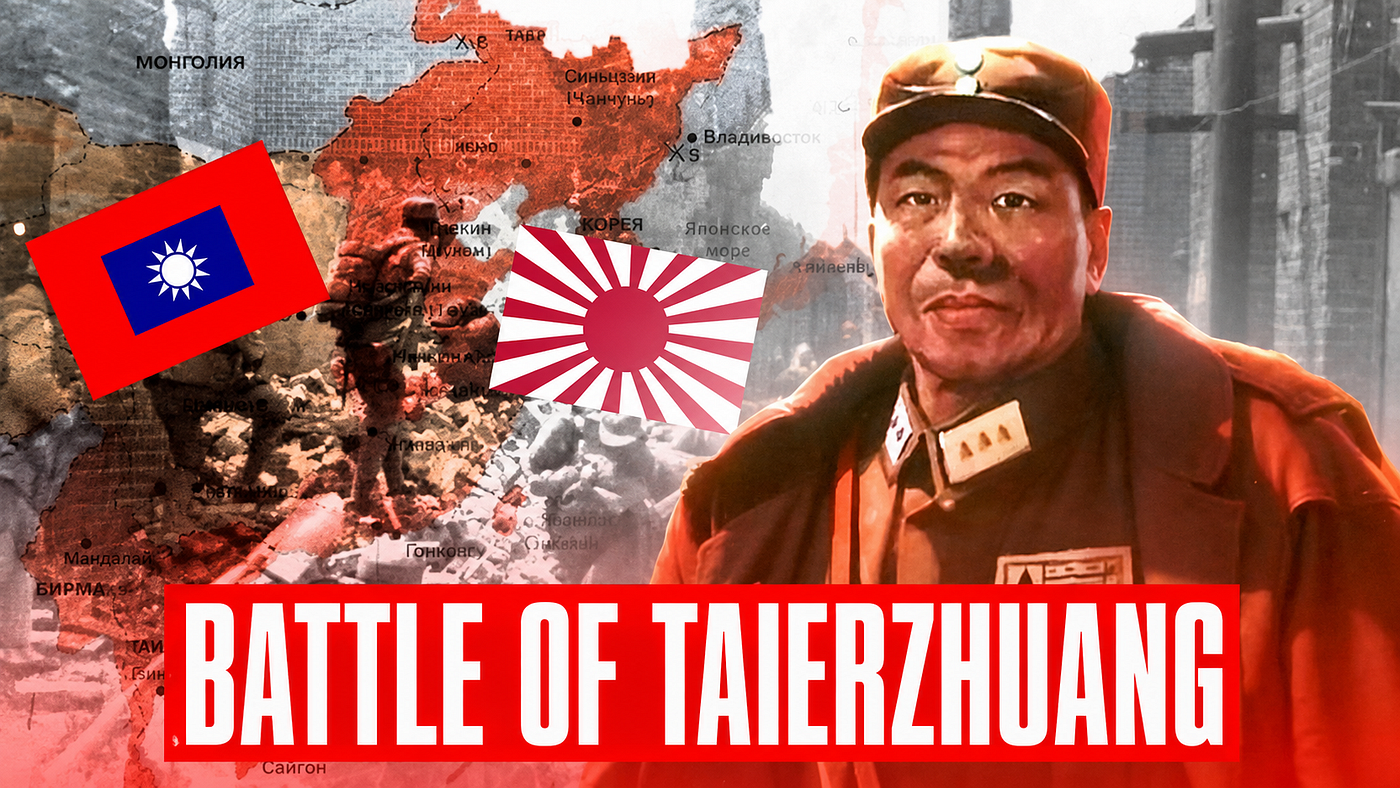
The military and strategic situation in China in late 1937 and early 1938 was characterized by the intensification of the Japanese offensive following the capture of key cities, including Shanghai and Nanjing. Seeking to consolidate control over the central and northern regions of the country, the Japanese command developed a plan to consolidate forces in northern and southern China by capturing strategic hubs such as Xuzhou.
This transportation hub, located at the intersection of railways and waterways, was becoming critical for both sides: its loss could open the Japanese route to Wuhan, while its preservation would allow Chinese troops to stabilize the front. With China’s military resources depleted by previous defeats, the defense of Xuzhou required the mobilization of a diverse force, including regional armies and units previously marginalized by the central command. Despite internal conflicts and a shortage of weapons, resistance to Japanese expansion in this region formed the basis for the first significant success of Chinese forces in the war. On December 13, 1937, after the capture of Nanjing, Japanese forces continued their advance deeper into Chinese territory. By the end of the month, Hangzhou (December 24) and Jinan (December 27) were captured.
During this period, the command of the Japanese North China Army repeatedly submitted proposals to the General Headquarters to conduct an operation in the Xuzhou region to unite the northern and central fronts and subsequently press on Wuhan. Implementing a strategy of connecting the northern and southern theaters of war, the Japanese command decided to use Nanjing and Jinan as bases for a two-pronged offensive on Xuzhou along the Jinpu Railway. Xuzhou, located at the intersection of the Jinpu and Longhai Railways with the Grand Canal, has historically been a key transportation hub linking the provinces of Jiangsu, Shandong, Henan, and Anhui. From a military perspective, control of this region allowed Chinese troops to block Japanese forces on the Jinpu Railway, threatening both Jinan from the north and Nanjing from the south.
This simultaneously protected the Longhai Railway, a vital east-west communication corridor covering the flanks and rear of the Zhengzhou-Pinghan line. For the Japanese army, the capture of Xuzhou opened the possibility of advancing along the Longhai Railway across the plains of central China using mechanized units, directly threatening the Pinghan Railway and Chinese army forces in the Zhengzhou-Wuhan region. Given the strategic importance of this junction, Chiang Kai-shek personally arrived in Gue (modern-day Shangqiu) after the fall of Nanjing to coordinate defensive operations.
On his orders, General Han Fuqiu was arrested and subsequently executed in Wuchang for abandoning his positions in Shandong. For the Battle of Xuzhou, the main forces were concentrated in the Wuhan area, with large troop concentrations deployed along both sections of the Jinpu Railway with the task of slowing the Japanese advance toward Wuhan. Direct command of the defense of Xuzhou was entrusted to Li Zongren, appointed commander of the Fifth War Zone and governor of Anhui Province.
Actions on the Southern Section of the Jinpu Railway
After the capture of Nanjing, part of the Japanese Central China Army crossed the Yangtze and began an offensive north. The 13th Division, supported by flanking units, advanced along the Jinpu Railway, occupying the following areas:
Chuzhou, Lai’an, Liuhe, and Quanjiao.
In mid-January 1938, the offensive continued toward Dingyuan, Zhihe, and Minguang (now Jiashan). The 31st and 51st Armies of the Chinese 11th Group Force, with air support, fought defensive battles on both banks of the Huai River. After capturing Minguang and Zhihe, Japanese forces captured Linhuai Pass, Fengyang, and Bengbu in early February, crossing the Huai River on February 9. In response, the Fifth War Zone dispatched the 59th Army of the 27th Group Force and the 7th Army of the 21st Group Force to the area.
On February 10, the 114th Division of the 51st Army, commanded by Yu Xuezhong, clashed with Japanese forces at Wangzhuang. After several days of fighting, the positions were abandoned, with Chinese casualties exceeding 2,000. On February 13, Zhang Zizhong transferred the 59th Army to the Huai River basin, freeing the 51st Army from combat operations along the Waguanji-Yaoji-Guzhen-Mengcheng line. Simultaneously, the 21st Group took up positions along the Hefei-Shucheng-Badouling-Xiatangji line. On the northern bank of the Huai, Chinese forces (the 51st and 59th Armies) organized stubborn resistance; the 48th Army consolidated its position along the Luqiao-Luohe line; the 31st and 7th Armies launched attacks on the enemy’s flanks and rear.
On February 11, the 31st Army attacked Shangyao. During the assault on the fortified point, more than 3,000 Japanese soldiers retreated to Kaocheng, and about 100 were killed. On February 16, the 7th Army attacked Japanese positions in Chihe and Dingyuan from the Zhangqiao and Laorenzang directions, temporarily breaking through the defenses at Sanjiajian. This forced the enemy to transfer over 6,000 troops from the Huai area to reinforce the front. Taking advantage of this weakened position, Zhang Zizhong’s 59th Army counterattacked Japanese units at Huoshenmiao and Xinqiao, pushing them back to Caolaoji.
Advancing along the Suji-Hukoci-Caolaoji-Wanzhuang line, the army pushed the enemy to the southern bank of the Fei River and reached the northern bank of the Huai. Under pressure from both flanks, the Japanese troops halted their advance and retreated completely beyond the Huai. The 59th Army regained control of the northern bank of the river. A positional situation developed on the southern section of the Jinpu Railway.
Battles for Linyi and Tengxian
In January 1938, the Japanese 5th and 10th Divisions (commanders Itagaki and Isogai) began a linkup operation at Taierzhuang, followed by an offensive on Xuzhou. On January 12, Itagaki’s 5th Division moved south from Weixian toward Linyi to coordinate with units on the Jinpu Highway. By early February, Linyi was under threat. Li Zongren transferred Pan Bingxun’s corps, previously stationed in Haizhou, to the city. This unit, formally a corps, actually consisted of five infantry regiments, previously considered by the Nationalist command as auxiliary forces. After the defeat at Shanghai, the central command was forced to commit all available reserves to the Xuzhou operation.
Li Zongren personally met with Pan Bingxun, convincing him of the importance of defending his positions. By the end of February, intense fighting had broken out in the Linyi area. Pan Bingxun’s units held back the enemy advance, outnumbering them by a full division, with the support of mountain artillery and cavalry. After several days of attacks, the Japanese forces suffered significant losses and were unable to advance. News of the repulse of an attack by elite Japanese units by unknown Chinese units became widely known. Itagaki increased pressure on Linyi, but the garrison requested reinforcements. Li Zongren dispatched Zhang Zizhong’s 59th Army to Linyi. Despite previous conflicts (Pan Bingxun defected to Chiang Kai-shek in 1930 and fought against Zhang Zizhong’s forces), Zhang launched a march and reached Linyi by the evening of March 10. On the morning of March 11, the 59th Army attacked the Japanese positions from the rear, simultaneously with the defenders’ sortie from the city.
After 24 hours of fighting, the enemy retreated 45 kilometers to the city of Jiu. Losses amounted to approximately 3,000 men on each side. On March 20, the 59th Army was redeployed to Feixian. On March 23, the Japanese attacked Linyi again with reinforcements. On March 24, the 59th Army launched an offensive against enemy positions northwest of the city, supporting Pan Bingxun’s forces. By March 29, the Japanese forces were repelled, securing a second victory in the defense of Linyi. These battles disrupted plans to unite the Itagaki and Isogai divisions at Taierzhuang, isolating the Isogai 10th Division. Meanwhile, the Isogai 10th Division advanced south along the Jinpu Highway.
On February 7, Li Zongren ordered the 3rd Army Group to counterattack Jining and Wenshan. The 22nd Division occupied Jining, engaging in street fighting, then attacked Xintai and Mengyin, recapturing the latter. The force suffered over 3,000 casualties, killing over 1,000 Japanese soldiers, which drew enemy forces away from the main line.
On March 12, the Japanese Isogai Division approached Zou County. The Fifth War Zone dispatched the 41st Army of the 22nd Group to cover Tengxian. Wang Mingzhang, commander of the 122nd Division, established his headquarters in Tengxian, taking command of the vanguard. His units, formed in Sichuan and poorly equipped, had repeatedly encountered bias from the central command. Accepting the mission, Wang declared to his soldiers: “We must carry out the order, even if not a single man remains. Otherwise, we will not be able to atone for the guilt of the Sichuan Army for years of internal conflict.” On March 14, Japanese troops (over 30,000 men, supported by aircraft and tanks) launched an offensive across the Jiehe River from four directions.
By March 15, they had broken through the defenses and approached Tengxian, where fewer than 3,000 defenders remained. On March 16, the attack on the city began with air, tank, and artillery support. Wang Mingzhang personally led the defense of the Dongguan area, repelling enemy attacks. By the morning of March 17, the city was surrounded on three sides. Massive artillery bombardment and airstrikes destroyed the eastern wall. By 2:00 PM, the southern and eastern gates had fallen. In the city center, Wang Mingzhang organized street fighting. On the morning of March 18, while repelling an attack on the western districts, he was shot several times and died at the age of 45. Chief of Staff Zhao Weibin also fell in battle. Most of the defenders died in street fighting.
Li Zongren later noted: “Without the defense of Tengxian, there would have been no victory at Taierzhuang; this victory was achieved at the cost of the sacrifices of the defenders of Tengxian.” Taierzhuang, located 30 km from Xuzhou, controlled the northern approaches to the city. On March 23, the advance units of the Isogai Division approached Taierzhuang. The Fifth War Zone ordered three divisions of Sun Lianzhong’s 2nd Army Group to take up defensive positions at Taierzhuang, while Tang Enbo’s 20th Army Corps was to cover the southern bank of the canal and attack Japanese positions at Yixian and Zaozhuang. The total Chinese force exceeded 200,000 (27 divisions, 3 brigades, and special forces), while the Japanese numbered approximately 40,000 (the Isogai and Itagaki divisions). On March 24, Chiang Kai-shek arrived in Xuzhou to direct the operation, establishing a headquarters group led by Bai Chongxi. Before departing for Xuzhou, Bai Chongxi consulted with Zhou Enlai on strategy.
He proposed using the New Fourth Army’s 4th Detachment in the southern Jinpu sector, along with Li Pingxian and Liao Lei’s forces, to conduct mobile and guerrilla operations in the Huaihe basin, preventing the Japanese from transferring reserves north. North of Xuzhou, a combination of positional and maneuverable defenses would be employed, holding key points and destroying enemy reinforcements. Bai Chongxi approved the plan. Later, Zhang Aiping, on behalf of the Eighth Army, presented Li Zongren with an analysis of the possibility of a major battle north of Xuzhou.
On March 24, the Japanese Setani Detachment attacked Taierzhuang with heavy artillery support. Chi Fengcheng’s 31st Division engaged in fierce fighting. The enemy broke through to the northeastern part of the city, where street fighting erupted. The fighting was positional: the Japanese occupied positions during the day, and the Chinese recaptured them with nighttime counterattacks using melee weapons. On March 27, the main forces of Seiya’s Detachment breached the northern gate. The 31st Division engaged in protracted fighting in the city’s neighborhoods. The Fifth Zone ordered the 20th Corps to postpone its attack on Yixian and Zaozhuang, redeploying forces to encircle the Japanese at Taierzhuang.
On March 28, a critical situation developed in the northwestern sector. Chi Fengcheng formed a detachment of 57 volunteers for a counterattack. After the night’s fighting, only the deputy regiment commander, Shang Shibin, and 10 soldiers survived. On March 29, Isogai ordered Setani to expedite the capture of the city. That same day, Chiang Kai-shek sent a categorical order to Li Zongren: the defense of Taierzhuang was mandatory under threat of disciplinary action for failure. Li ordered the 2nd Army Group to defend its positions at all costs and the 20th Corps to urgently move south. By March 31, Chinese forces had surrounded Setani’s detachment.
Sakamoto’s detachment from the 5th Division, which had attacked Linyi, began marching to Setani’s aid on March 29, but was blocked at Xiangcheng and Aiqiu by units of the 52nd and 57th Armies. After several days of fighting, Setani’s rescue plan failed. On April 1, 800 soldiers of the 27th Division attacked the northeastern sector, disorganizing the enemy and capturing some positions. On the night of April 2, an elite detachment of 250 men attacked the northwestern region, recapturing lost positions. On April 3, the Chinese launched a general offensive. Despite the use of tanks and artillery, the Japanese were unable to exploit their success. By April 4, the defenders had recaptured three-quarters of the captured markets in Taierzhuang. On April 6, Chinese units launched a decisive offensive.
The 30th Division occupied Nanlu, while the 27th Division counterattacked the enemy’s eastern positions. The 31st Division attacked Japanese troops in the villages surrounding the area. Setani’s detachment, unable to withstand the onslaught, retreated to Yixian during the night. The Battle of Taierzhuang ended in a tactical victory for the Chinese forces. The battle lasted approximately a month. Despite superior equipment and firepower, the Japanese forces were unable to overcome the stubborn resistance of the Chinese units. Total Chinese losses reached 20,000, while Japanese casualties reached approximately 10,000, with more than 10 tanks and over 10 guns destroyed. This victory marked the first major success of the Chinese armed forces in the war against Japan after a series of defeats at Shanghai and Nanjing, and had a significant morale impact on the subsequent course of military operations.
The Battle of Xuzhou, which included the defense of Linyi, Tengxian, and Taierzhuang, demonstrated the ability of the Chinese armed forces to coordinate the actions of disparate formations in the face of numerical and technical superiority. The tactical mastery of commanders such as Li Zongren, Zhang Zizhong, and Sun Lianzhong, the use of a combination of positional and mobile defenses, and the willingness of regional armies — those in Sichuan and northern China — to make sacrifices fundamentally changed the dynamics of the conflict. The victory at Taierzhuang, achieved at the cost of heavy losses, was not only strategic but also symbolic. It demonstrated the vulnerability of Japanese forces even in conditions where their elite divisions dominated the battlefield. This victory temporarily halted the Japanese advance toward Wuhan, giving the Chinese command time to regroup and strengthen internal communications. Politically, it strengthened the Kuomintang’s position by demonstrating the possibility of resistance without direct foreign aid, and partially overcame the pessimism caused by the fall of Nanjing. However, the success was limited: by the fall of 1938, the Japanese resumed the offensive and captured Wuhan, but the lessons of Xuzhou influenced China’s subsequent strategy, relying on wearing down the enemy in a protracted war.
The battle also revealed systemic problems in the Japanese army: overoptimism, underestimation of resistance, and weakness in managing logistical communications. In historical perspective, these events became part of a broader narrative of World War II in Asia, where local victories shaped global strategic calculations, and the sacrifices of the defenders of Tengxian and Taierzhuang symbolized resistance to occupation that went beyond military tactics.
메타데이터
- post_id
- bf4ef7dba284
- slug
- chinas-first-victory-in-the-sino-japanese-war-bf4ef7dba284
- url
- https://medium.com/@averinvalerij38/chinas-first-victory-in-the-sino-japanese-war-bf4ef7dba284
- canonical_url
- https://medium.com/@averinvalerij38/chinas-first-victory-in-the-sino-japanese-war-bf4ef7dba284
- author_url
- https://medium.com/@averinvalerij38
- status
- ok
- fetched_at
- 2026-07-10 18:03:05