The Reality Check That Changed Everything: What I Learned From 20+ Customer Conversations That…
Two weeks ago, I thought I understood our market. After completing the NSF I-Corps Lean Bootcamp and conducting 20+ customer discovery…
The Reality Check That Changed Everything: What I Learned From 20+ Customer Conversations That Google Never Taught Me
Two weeks ago, I thought I understood our market. After completing the NSF I-Corps Lean Bootcamp and conducting 20+ customer discovery interviews, I realized I knew nothing. Here’s the brutal truth about building a product — and the six hard lessons that completely shattered my assumptions.
The Confidence Before the Storm
Picture this: You’ve spent months developing what you believe is a revolutionary solution. You’ve researched the market extensively, read countless reports, and built a compelling business case. You’re confident you understand your customers’ pain points because, well, you’ve Googled everything there is to know about your industry.
That was me two weeks ago.
I was part of the NSF I-Corps Lean Bootcamp — an intensive two-week program designed to help researchers and technologists explore the commercial potential of their innovations. Our team was developing Axam, an offline AI-powered educational platform that creates distraction-free, secure digital learning environments. We thought we had it all figured out.
We were wrong. Spectacularly wrong.
The Program That Changes Everything
The NSF I-Corps program isn’t your typical business course. It’s based on one simple but brutal principle: get out of the building and talk to real customers. Not the customers you imagine in your head, not the ones described in market reports, but actual human beings who would use your product.
The requirements were clear: conduct 20+ customer discovery interviews in two weeks, attend three intensive virtual sessions, and prepare to have your assumptions demolished. The program’s unofficial motto? “You can’t interview a building.” Translation: stop talking to abstractions and start talking to people.
What I discovered through this process wasn’t just humbling — it was transformative.
The Six Brutal Truths That Shattered My Assumptions
1. The More You Talk to People, the More You Realize You Know Nothing
What I thought: We understood the “connectivity gap” in education. Poor internet access was preventing students from learning effectively.
What I discovered: The connectivity problem was real, but it wasn’t the whole story. Through interviews with educators, IT directors, and administrators, I learned that even schools with good internet faced constant distractions, security nightmares, and maintenance headaches.
One principal told me: “It’s not just about getting online — it’s about staying focused once you’re there.”
This wasn’t something I could have learned from Google. Market reports talked about infrastructure gaps, but they missed the human reality of digital distraction and classroom management challenges.
The lesson: No amount of desk research can replace actual conversations. People’s lived experiences reveal complexities, politics, and unspoken barriers that no report captures.
2. Building a Product is Infinitely Harder Than It Seems
What I thought: We had identified our target customer — schools in remote areas — and our solution would be straightforward to implement.
What I discovered: There’s an entire ecosystem of stakeholders, each with different needs, fears, and motivations that I never imagined existed.
When targeting schools, I learned that:
- Principals control the budget but worry about teacher adoption
- Teachers are the actual users but fear additional workload
- IT departments care about security and maintenance
- Students want engaging content but get easily distracted
- Parents want to see results but don’t understand the technology
- District administrators need compliance and data privacy assurance
Each group had veto power. Each had different definitions of success. Building a product that satisfies all these stakeholders simultaneously? That’s the real challenge.
The lesson: You’re not just building a product — you’re navigating a complex web of human relationships, organizational politics, and competing priorities.
3. Broad Generalizations are Startup Suicide
What I thought: “We help schools in remote areas” was a compelling value proposition.
What I discovered: As our instructors bluntly put it, “You can’t call and talk to or interview a building.” Generic statements mean nothing to real people with real problems.
Instead of “schools in remote areas,” I learned to get specific:
- Which grade levels?
- What subjects?
- Public or private schools?
- What’s the exact budget process?
- Who makes the buying decision?
- What’s their current workflow?
The transformation: “We do offline algebra tutoring for NYC 6th-12th graders exceptionally well” became our north star instead of “We do offline EdTech for every educational institution on Earth.”
The lesson: Specificity isn’t limiting — it’s liberating. When you know exactly who you’re serving, you can build something they actually want.
4. Start Impossibly Small, Then Expand
What I thought: We needed to go big to be successful. Target as many markets as possible.
What I discovered: “We do offline algebra tutoring for NYC 6th-12th graders exceptionally well” is a business. “We do offline EdTech for every educational institution on Earth” is a fantasy.
One of our expert interviews was with Professor Justin Reich from MIT, author of “Failure to Disrupt: Why Technology Alone Can’t Transform Education.” He emphasized that successful EdTech solutions start with a very specific use case and expand from there.
The lesson: Build something that works exceptionally well for a small group before trying to change the world. Master the specific before tackling the general.
5. Google Can’t Teach You What Customers Actually Experience
What I thought: Market research would give us the insights we needed about customer pain points.
What I discovered: The more people I talked to, the more I understood the hidden complexities — the office politics, the unwritten rules, the workarounds people create when systems don’t work.
For example, Google told me that schools need better educational technology. But talking to teachers revealed:
- They already have too many tools and platforms
- They spend 3–5 hours weekly on lesson planning
- They’re frustrated by tools that promise everything but deliver complexity
- They want solutions that make their jobs easier, not harder
One teacher said: “I don’t need another platform to learn. I need something that actually saves me time.”
The lesson: The gap between what people say they want and what they actually need can only be discovered through real conversations.
6. Never Assume the Problem Exists
What I thought: Digital distraction in schools was obviously a massive problem that everyone wanted to solve.
What I discovered: What I thought was a massive pain point didn’t even register for some of our target customers. But when I listened — really listened — they revealed problems I never knew existed.
Some schools weren’t primarily concerned with distraction. They were worried about:
- Teacher burnout and retention
- Compliance with data privacy regulations
- Reducing IT support tickets
- Preparing students for workforce readiness
The transformation: We thought we were solving connectivity issues. We discovered we could solve teacher burnout, security nightmares, reduced IT complaints, and workforce readiness — all with the same solution.
The lesson: Your customers will teach you what problem you’re actually solving. Sometimes it’s bigger than you imagined. Sometimes it’s completely different.
The Business Model Canvas: From Fantasy to Reality
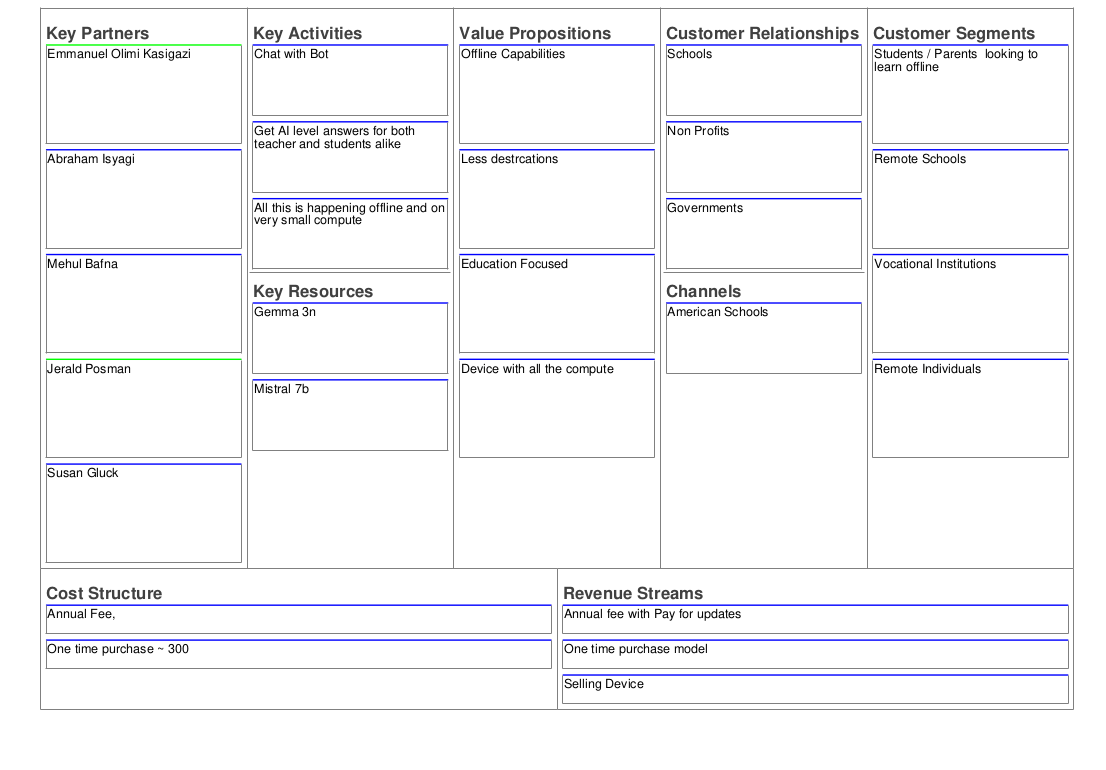
Our Business Model Canvas went through three complete iterations during the program. Here’s how dramatically our understanding changed:
Version 1 (Fantasy):
- Value Proposition: Offline AI tutor for connectivity gaps
- Customer Segments: Underserved communities, rural schools, international NGOs
- Key Focus: Technical capability — making AI work without internet
- Revenue Model: Direct device sales to schools and parents
Version 3 (Reality):
- Value Proposition: For Principals: intuitive platform with comprehensive training; For Teachers: AI-powered toolbox that reduces lesson prep time by 3–5 hours weekly; For IT: fewer help desk tickets and no security headaches
- Customer Segments: NYC public schools (specific Title I schools), homeschooling families, Department of Corrections educational programs
- Key Focus: User experience, security, and teacher adoption
- Revenue Model: Annual per-school site license with ongoing support
The difference? Version 3 was based on real conversations with real people who had real budgets and real authority to make purchasing decisions.
The Unexpected Discoveries
Some of our most valuable insights came from conversations we never planned to have:
The Department of Corrections Connection: During our research, we discovered that correctional facilities face similar challenges to schools — they need secure, offline educational environments. This opened an entirely new market segment we hadn’t considered.
The Homeschooling Revelation: Parents choosing homeschooling often do so to escape digital distractions and maintain control over their children’s learning environment. Our offline platform suddenly became relevant to a completely different customer base.
The Security Insight: Large organizations like Ford build their own on-premise AI systems rather than trusting cloud-based solutions. This validated our approach of keeping AI models on-device, but for security reasons we hadn’t initially considered.
What This Means for Anyone Building Something New
Whether you’re developing a tech product, starting a service business, or launching any venture, these principles apply:
1. Talk to People Early and Often
Don’t wait until you have a perfect product. Start conversations with potential customers from day one. Their insights will save you months of building the wrong thing.
2. Embrace Specificity
“We help everyone” means you help no one. Get specific about who you serve, what problem you solve, and how you solve it better than anyone else.
3. Listen for What They Don’t Say
Pay attention to the frustrations, workarounds, and unspoken challenges in your customers’ stories. Often, the real opportunity lies in what they assume “just can’t be fixed.”
4. Expect Your Assumptions to Be Wrong
Approach customer discovery with genuine curiosity, not confirmation bias. The goal isn’t to validate your idea — it’s to understand reality.
5. Follow the Money and Authority
Find the actual person with the budget, the pain, and the authority to say yes. Everyone else is just an influencer.
The Broader Lesson: Building Products vs. Building Businesses
The NSF I-Corps program taught me that there’s a fundamental difference between building a cool technology and building a sustainable business. Technology is about what’s possible. Business is about what’s necessary, desirable, and economically viable.
Our AI technology was impressive from a technical standpoint. But until we understood the human ecosystem around education — the teachers struggling with lesson plans, the principals worried about implementation, the IT departments concerned about security — we didn’t have a business.
The Path Forward
Today, our startup looks completely different than it did two weeks ago. We have:
- A clear understanding of our primary customer (Title I school principals in NYC)
- Specific value propositions for each stakeholder group
- A revenue model based on real budget processes
- Partnerships with organizations that can accelerate our market entry
- A product roadmap driven by actual customer needs
More importantly, we have a process for continuing to learn and adapt as we grow.
The Meta-Lesson: Entrepreneurship is a Mindset
The most valuable thing I learned wasn’t about our specific product or market. It was about adopting an entrepreneurial mindset that prioritizes learning over being right.
This mindset applies beyond startups:
- For employees: Understanding your internal customers (colleagues, managers, other departments) and their real needs
- For consultants: Discovering what clients actually value versus what they say they want
- For anyone solving problems: Getting out of your assumptions and into real-world validation
Final Thoughts: The Customer is the Hero of Your Story
Perhaps the most profound shift in my thinking came from this realization: The customer is the hero of your story — not you, not your product. You are just there to help them succeed.
This changes everything about how you approach product development, marketing, and customer relationships. Instead of trying to convince people they need your solution, you focus on understanding their journey and finding ways to make them successful.
If you’re building something new — whether it’s a product, service, or even a career transition — I challenge you to spend less time researching online and more time talking to real people. Their stories will teach you things no Google search ever could.
What assumption about your work, industry, or customers turned out to be completely wrong? Share your story in the comments — I’d love to learn from your experience.
Want to learn more about customer discovery and lean startup methodology? The NSF I-Corps program is available to researchers, faculty, and technologists looking to commercialize their innovations. It’s intense, challenging, and will completely change how you think about building products.
P.S. Special thanks to the NSF I-Corps teaching team who pushed us out of our comfort zones and into the real world. Sometimes the best learning happens when your confidence gets completely demolished — and then rebuilt on a foundation of actual evidence.
메타데이터
- post_id
- bf4f77efb07a
- slug
- the-reality-check-that-changed-everything-what-i-learned-from-20-customer-conversations-that-bf4f77efb07a
- url
- https://medium.com/@olimiemma/the-reality-check-that-changed-everything-what-i-learned-from-20-customer-conversations-that-bf4f77efb07a
- canonical_url
- https://medium.com/@olimiemma/the-reality-check-that-changed-everything-what-i-learned-from-20-customer-conversations-that-bf4f77efb07a
- author_url
- https://medium.com/@olimiemma
- status
- ok
- fetched_at
- 2026-07-09 08:45:44