Tokenomics Daily — Nobody Picks ‘The Best Model’ Anymore. Not Even OpenAI.
Two stories today, three days apart, say the same thing from opposite sides of the table. Vercel’s CEO says his customers stopped picking…
Tokenomics Daily — Nobody Picks ‘The Best Model’ Anymore. Not Even OpenAI.
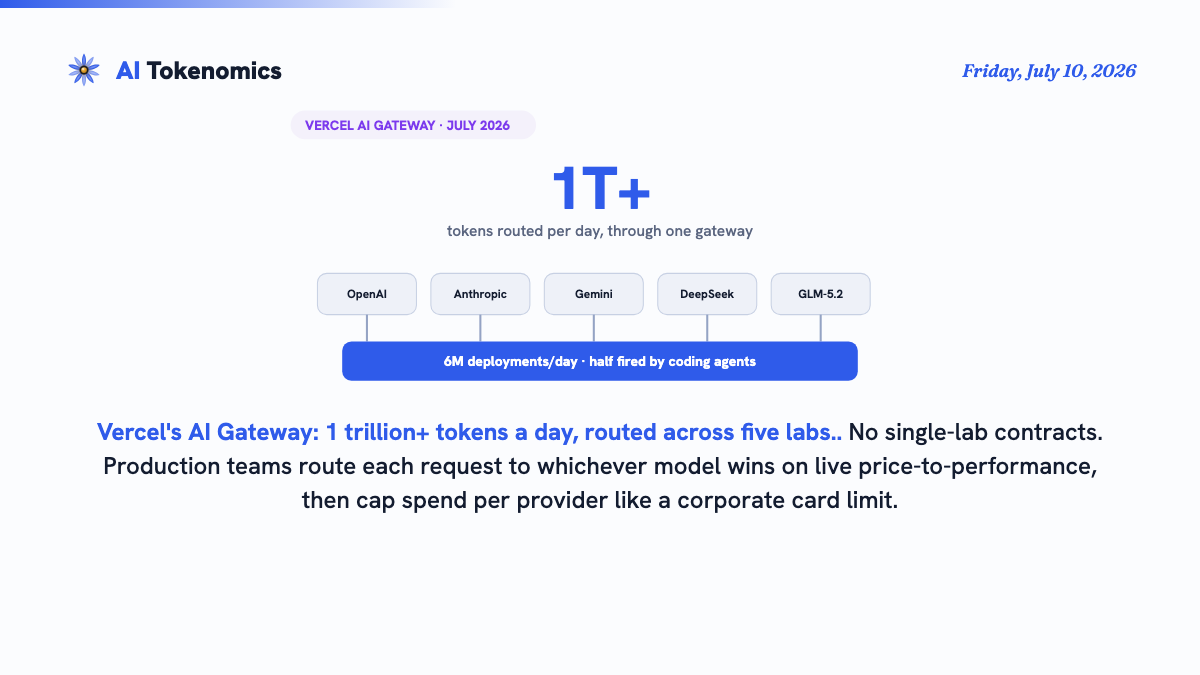
Vercel’s AI Gateway: 1 trillion+ tokens a day, routed across five labs.. No single-lab contracts. Production teams route each request to whichever model wins on live price-to-performance, then cap spend per provider like a corporate card limit.
Two stories today, three days apart, say the same thing from opposite sides of the table. Vercel’s CEO says his customers stopped picking one AI lab and started routing between five. This week OpenAI, the lab everyone used to just pick, split its own flagship into three separate price tiers. The single-model era is over on both sides of the invoice.
Rauch: over 1 trillion tokens a day now move through Vercel’s AI Gateway
Framework lens: Vendor diversification / multi-sourcing procurement
Vercel CEO Guillermo Rauch told TechCrunch on July 6 that more than 1 trillion tokens now flow through the company’s AI Gateway every day, alongside 6 million deployments daily, half of them fired off by coding agents. The number matters for what Rauch says it’s forcing: production teams are dropping single-lab AI contracts for multi-model stacks spanning OpenAI, Anthropic, Gemini, DeepSeek and GLM-5.2, chosen on live price-to-performance data instead of brand loyalty. Vercel’s own CLI already lets teams cap spend per model with a budget flag and set refresh windows, treating each provider connection like a corporate card with a limit. At trillion-token daily scale, a single-digit percentage price gap between providers turns into a real line item, which is why Rauch frames gateway-level cost monitoring, not model-picking, as the actual job now. The vendors are catching up to the buyers: this same week OpenAI split its own flagship into three separate price tiers, admitting ‘pick the best model’ was already dead as a purchasing strategy. [1][2]
OpenAI splits GPT-5.6 into three price tiers: Sol, Terra and Luna
Framework lens: Price discrimination / good-better-best packaging
OpenAI moved GPT-5.6 to general availability on July 9, and for the first time shipped it as three durable, independently priced tiers instead of one model. Sol, the flagship, runs $5 per million input tokens and $30 per million output. Terra, the balanced option, is $2.50 and $15. Luna, the fast and cheap tier, is $1 and $6. Each tier can now advance on its own release schedule instead of being bundled into one generation number. The release also adds explicit prompt-cache breakpoints with a 30-minute minimum cache life, a direct lever on the effective cost of high-volume agent workloads that call the same context repeatedly. Naming the cheap tier and the expensive tier as separate products, not settings, is the tell: OpenAI is no longer selling ‘the best model.’ It’s selling a menu, and asking every buyer to pick the line item that matches the job. [3][4]
A plastics factory’s power bill jumped 6x to $1.2M because of AI data centers next door
Framework lens: Negative externality
Plaskolite, an Ohio and Pennsylvania plastics manufacturer, watched its annual grid capacity charges jump from $200,000 to $1.2 million in a single year, a six-fold increase that has nothing to do with its own operations. The cause is PJM Interconnection’s capacity price, the fee that funds future grid reliability across 13 states, which rocketed from $28.92 to $329.17 per megawatt-day, a 1,038 percent rise, as data centers reserve capacity faster than utilities can build it. Average industrial electricity prices in Pennsylvania and Ohio rose 31 and 26 percent respectively last year, versus 7 percent nationwide. AI compute demand and plastics manufacturing don’t share a supply chain, but they now share a grid, and the factory is paying for the data center’s growth. [5][6]
Microsoft is quietly routing thousands of weekly Excel and Outlook prompts away from Anthropic to save money
Framework lens: Vertical integration / make-vs-buy on inference cost
Microsoft is routing tens of thousands of Microsoft 365 prompts a week through its own MAI models instead of OpenAI’s and Anthropic’s, Bloomberg reported July 7. Mustafa Suleyman, Microsoft’s AI chief, put it bluntly: Anthropic is extremely expensive, and the goal is to reduce and ultimately eliminate that cost. The swap is still small against Copilot’s total prompt volume, but it marks a hyperscaler admitting its own frontier-model bill is heavy enough to justify shipping a lower-capability in-house model at an unchanged subscription price. MAI-Thinking 1 runs 35 billion active parameters and trails Anthropic’s Sonnet 4.6 and Opus 4.8 on coding benchmarks. Microsoft’s OpenAI agreement runs through 2032, but the direction is set: build the cheaper substitute first, negotiate from a position of leverage later. [7][8]
Sanofi is cutting its ServiceNow bill 80% with agents built on Claude Code
Framework lens: Build-vs-buy substitution of per-seat SaaS with agentic-built software
Sanofi, the French pharma giant with 75,000 employees, is cutting ServiceNow usage 80 percent by routing IT requests through agents built on Claude Code and Cursor, targeting at least 10 million dollars in annual savings, The Information reported in early July. The same reporting caught smaller firms making the identical trade at a different scale. Greenleaf Management, a 55-person Atlanta real estate manager, replaced its Salesforce CRM with a custom Claude Code and Replit app that costs about 300 dollars a month to run, saving roughly 100,000 dollars a year. Five small companies profiled cut software costs 40 to 80 percent after dropping Salesforce and HubSpot contracts for AI-built replacements. Enterprise and SMB now share a pattern: agentic coding tools are cheap enough to make bespoke internal software a real substitute for per-seat SaaS licenses. [9][10]
AMD is raising GPU memory prices again as GDDR6 triples on AI data center demand
Framework lens: Derived demand / input-cost pass-through
AMD raised the GPU and GDDR6 memory kit prices it charges board partners, including Sapphire, ASUS, XFX and Vastarmor, by about 10 percent effective July 2026, TrendForce reported. It’s AMD’s second such hike in six months. The driver isn’t gaming demand: GDDR6 spot prices have roughly tripled since autumn 2025, from about 2.50 dollars to 7.50 dollars a gigabyte, as memory makers redirect wafer capacity toward HBM and server DRAM for AI data centers. Consumer GPU buyers are now absorbing collateral cost from the AI buildout before a single accelerator ships to a cloud customer. Retail Radeon cards have already carried street-price increases above 15 percent this year, and analysts see no supply relief before 2027 at the earliest. [11][12]
The lenses, in plain English
AI Gateway (multi-model routing): A single layer your app calls instead of calling OpenAI, Anthropic, Gemini etc. directly. It routes each request to whichever model is cheapest or best for that specific task, and lets you cap spend per provider like a corporate card limit. Vercel says over 1 trillion tokens a day now move through theirs.
Prompt-cache breakpoint: A marker you set in a long prompt so the model provider can reuse the processing it already did for that chunk on your next call, instead of paying full price to reprocess it. OpenAI’s new tiers guarantee that cached chunk stays reusable for at least 30 minutes, which matters a lot for agents that call the same context repeatedly.
Sources
메타데이터
- post_id
- bf69a97d1c73
- slug
- tokenomics-daily-nobody-picks-the-best-model-anymore-not-even-openai-bf69a97d1c73
- url
- https://medium.com/@agrawalparth/tokenomics-daily-nobody-picks-the-best-model-anymore-not-even-openai-bf69a97d1c73
- canonical_url
- https://medium.com/@agrawalparth/tokenomics-daily-nobody-picks-the-best-model-anymore-not-even-openai-bf69a97d1c73
- author_url
- https://medium.com/@agrawalparth
- status
- ok
- fetched_at
- 2026-07-13 20:05:53