Where is SWOT analysis used in strategic planning?
Where is SWOT analysis? It belongs in the situation-analysis stage of strategic planning, after you have gathered useful evidence and…
Where is SWOT analysis used in strategic planning?
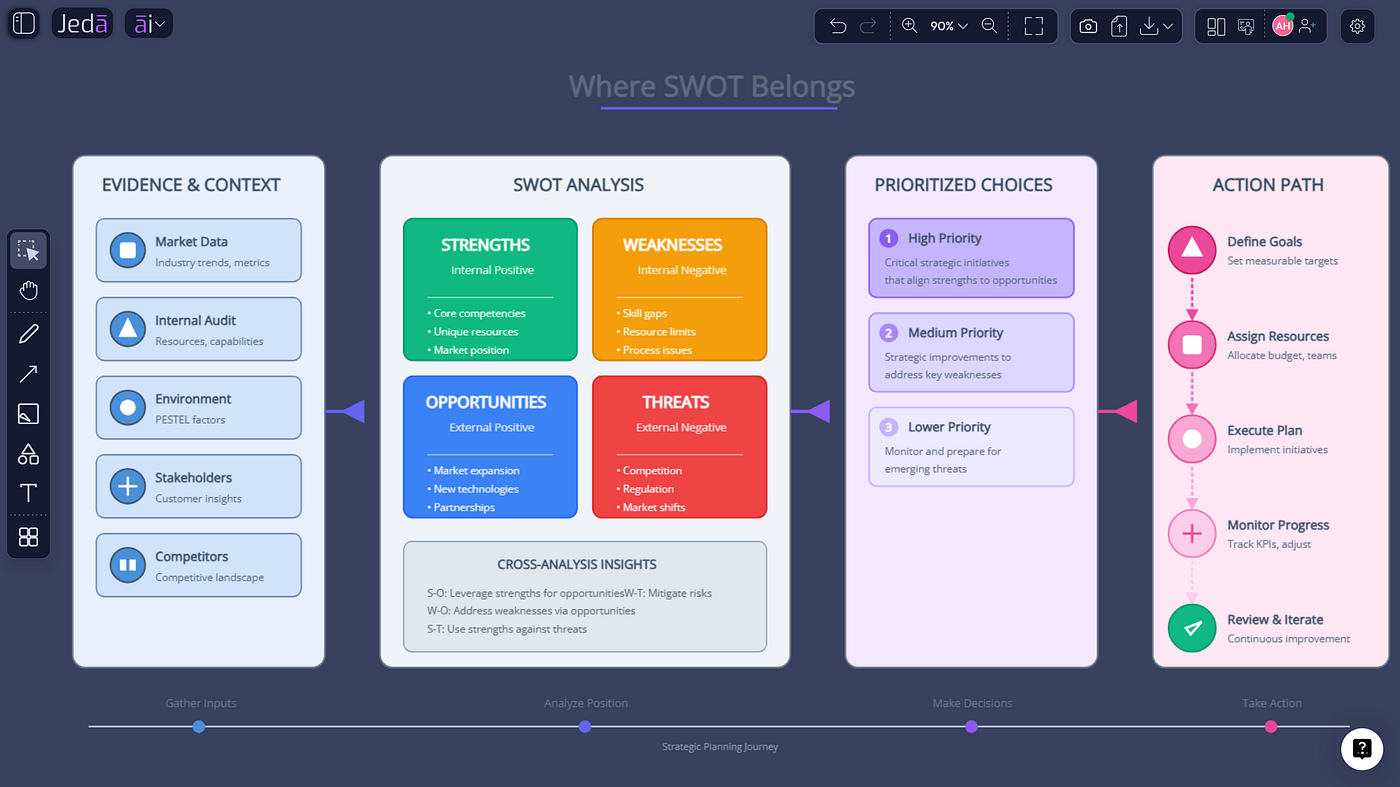
SWOT sits between understanding the situation and choosing a strategy
Where is SWOT analysis? It belongs in the situation-analysis stage of strategic planning, after you have gathered useful evidence and before you choose priorities, goals, and actions. In a business, product, project, or team plan, the SWOT usually sits between the research section and the strategy section. That is the cleanest answer.
The placement matters. Run SWOT too early and you get guesses dressed up as insight. Run it too late and the strategy has already been decided, which turns the matrix into a decoration. A useful SWOT is a hinge: one side holds what you know about the situation, and the other opens into the decisions you need to make.
This guide shows where SWOT analysis fits, what should come before and after it, and how to create an editable version in Jeda.ai using either the guided Analysis Matrix recipe or the Prompt Bar. Jeda.ai supports visual planning inside one AI Workspace and AI Whiteboard, used by more than 150,000 people for structured thinking and collaboration.

Use SWOT after research and before priorities, strategy, and execution
Where is SWOT analysis in the planning process?
SWOT analysis sits in the middle of the planning process. It is not the starting point, and it is not the finished plan. Researchers generally describe it as a situation-analysis or environmental-analysis tool that organizes significant internal and external factors. Strengths and weaknesses describe internal conditions. Opportunities and threats describe external conditions.
The simplest sequence
1. Define the decision. Be clear about what the plan must help you decide.
2. Gather evidence. Review internal performance, capabilities, constraints, customer feedback, project data, and relevant external signals.
3. Build the SWOT. Sort the evidence into strengths, weaknesses, opportunities, and threats.
4. Prioritize the factors. Separate the few items that could change the decision from the long list of mildly interesting observations.
5. Create strategic options. Match internal capabilities with external conditions, then compare possible moves.
6. Turn the choice into action. Set goals, owners, measures, timing, and review points.
Think of SWOT as the compression step. Research often produces too much information. The matrix reduces that material into a shared view of what helps, what hurts, what may open up, and what could get in the way. Only then should the team choose a direction.
What should come before SWOT analysis?
Before the matrix, you need a defined scope and enough evidence to prevent vague brainstorming. You do not need a giant research project, but you do need something more solid than whoever speaks first in the workshop.
1. A specific planning question
“What is our SWOT?” is too broad. Better questions include: Should we launch this feature? How prepared are we to enter a new customer segment? What could block the next phase of this project? A clear question keeps the matrix focused and makes it easier to judge whether an item belongs there.
2. Internal evidence
Strengths and weaknesses should come from the reality inside the organization or initiative. Useful inputs include skills, processes, delivery speed, product quality, team capacity, customer feedback, operational bottlenecks, and available resources. Phrase each point relative to the decision. “Good team” is weak. “The team can release tested updates every two weeks” is useful.
3. External evidence
Opportunities and threats come from outside the immediate control of the team. Look at customer behavior, demand shifts, technology changes, partner availability, supplier conditions, talent availability, and emerging alternatives. Keep these external. An internal staffing gap is a weakness, not a threat. A shortage of available specialists in the wider market may be a threat.
4. Multiple viewpoints
One person can draft a SWOT. A group can challenge it. Invite people who see different parts of the work, then ask them to bring evidence rather than slogans. This is where a shared Visual AI canvas helps: everyone can review the same matrix, edit points, and see the reasoning without passing versions back and forth.
What should come after SWOT analysis?
After SWOT comes prioritization and strategy formulation. This is the part many teams skip. A matrix full of accurate statements still does not tell you what to do. The real work begins when you connect the quadrants and choose which relationships matter.
· Strength plus opportunity: Which existing capability gives you the best chance to pursue a promising opening?
· Weakness plus opportunity: Which limitation must you fix before you can use an opportunity?
· Strength plus threat: Which capability can reduce exposure to an external risk?
· Weakness plus threat: Which combination needs a defensive plan, reduced scope, or a deliberate exit?
Then translate the strongest conclusions into choices. Write a small number of strategic priorities. Give each one an owner, a time horizon, an outcome measure, and a next action. If an item never affects a choice, it probably did not deserve top billing in the matrix.
Where is SWOT analysis used outside annual strategy planning?
SWOT is flexible because the unit of analysis can change. You can examine an organization, a product, a project, a service, a team, an event, or a decision. The trick is to name the subject clearly and keep every factor tied to it.
Product and feature planning
Use SWOT after discovery and evidence review, but before choosing a roadmap direction. It can expose whether a proposed feature fits current strengths, depends on a missing capability, benefits from a shift in user behavior, or faces an external timing risk.
Project planning
Use SWOT during initiation or a major re-planning point. It helps the team distinguish internal delivery constraints from external risks and opportunities, then decide where contingency planning is necessary.
Workshop alignment
Use SWOT after participants have reviewed the same background material. It gives the group a common structure for disagreement. That is useful when people agree on the facts but interpret their importance differently.
Team capability review
Use SWOT before setting development priorities. Keep strengths and weaknesses grounded in observable capability, and keep opportunities and threats linked to the environment in which the team operates.
Launch readiness
Use SWOT after the launch assumptions, audience needs, operational readiness, and external timing have been reviewed. The output can then feed a go, revise, delay, or stop decision.
Academic work also treats SWOT as part of an iterative planning process rather than a one-time linear exercise. That matters. When evidence changes, the matrix and the resulting strategy should be reviewed together.
How to create a SWOT analysis in Jeda.ai
Jeda.ai gives you two practical routes. Use the recipe when you want guidance and a consistent structure. Use the Prompt Bar when you already know the context and want a faster, more flexible starting point. Both methods generate an editable matrix on the AI Whiteboard.
You can start from the Jeda.ai Visual AI Workspace, where matrix generation, collaboration, document context, and other visual formats live on one canvas. The platform also includes 300+ strategic frameworks.
Method 1: Use the Analysis Matrix recipe
1. Open the AI Menu. From the top-left area of the workspace, open the AI Menu to browse guided recipes.
2. Choose Matrix. Open the Matrix recipe category, then go to Strategy & Planning.
3. Select the SWOT recipe. Choose SWOT Analysis (Strengths, Weaknesses, Opportunities, Threats).
4. Describe the subject and decision. Add what you are analyzing, why the analysis is needed, the target audience or user group, the goal, and any relevant context.
5. Add useful evidence. Include the facts or source material the matrix should reflect. Clear inputs reduce generic output.
6. Choose the layout. Use Auto, Column, or Grid based on how you want the matrix arranged.
7. Generate and review. Check whether strengths and weaknesses are truly internal, whether opportunities and threats are external, and whether each point is specific enough to affect a decision.
For a closer look at the canvas and editable visual controls, explore the AI Whiteboard for visual strategy work. It supports matrices, diagrams, mind maps, flowcharts, and other visual outputs on the same workspace.
Method 2: Use the Prompt Bar
1. Open a workspace. Create a new workspace or open the board where you want the analysis to live.
2. Select the Matrix command. Use the command selector in the Prompt Bar at the bottom of the canvas.
3. Write a decision-focused prompt. State what you are analyzing, the decision it should support, the relevant context, and the level of detail you need.
4. Choose the matrix layout. Select Auto, Column, or Grid.
5. Generate the matrix. Jeda.ai places the output on the canvas as editable visual content.
6. Validate the logic. Remove duplicates, challenge unsupported claims, and separate internal factors from external ones.
7. Move from analysis to action. Prioritize the decisive factors. You can also use Vision Transform to convert the finished matrix into another visual format for planning or communication.

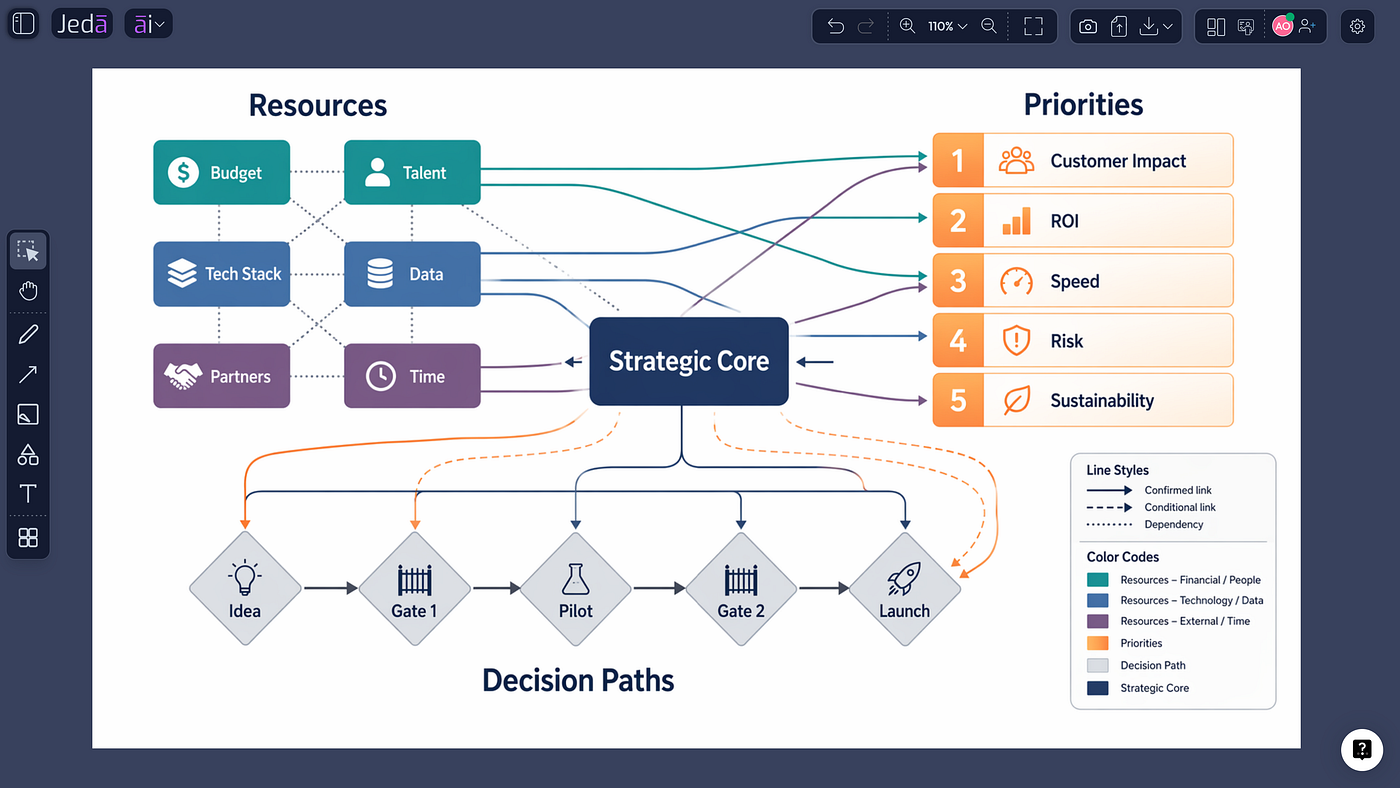
A clear Prompt Bar workflow from question to editable SWOT and action.
Example prompt for a useful SWOT
Good prompts do not ask for “a SWOT about our business” and hope for magic. They define the subject, decision, evidence boundary, and output rules. Here is a reusable example that stays away from fluffy labels.
Example prompt
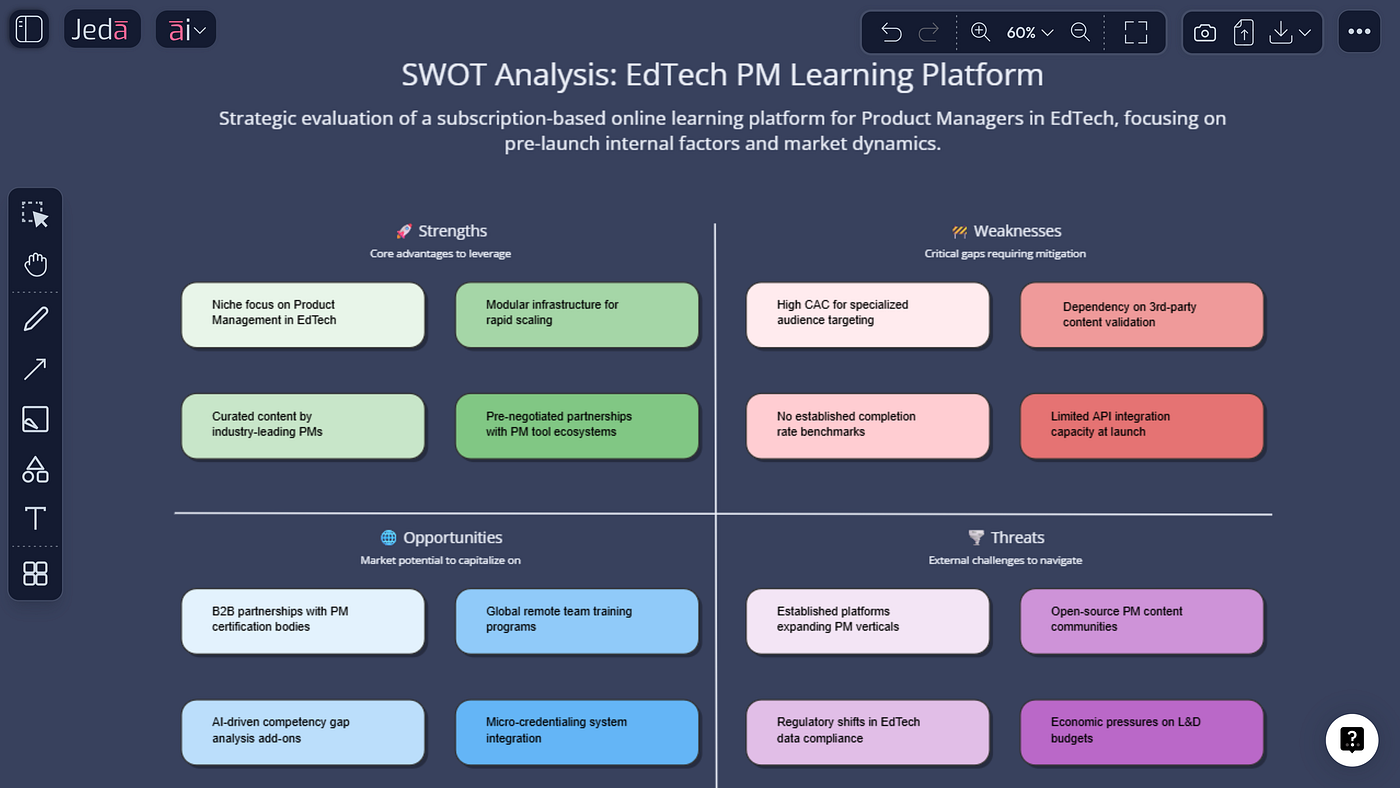
Create a SWOT analysis for a small online learning platform deciding whether to launch real-time group workshops within the next six months. Keep strengths and weaknesses internal. Keep opportunities and threats external. Use the following context: the platform has a loyal learner community, a small content team, reliable recorded-course delivery, limited live-event experience, rising demand for peer learning, and several new low-cost alternatives in the market. Provide four to five specific points per quadrant. End with the three factors that should have the greatest influence on the launch decision.
For more prompt patterns and broader use cases, read Jeda.ai’s practical guide to AI-supported SWOT work. It covers recipe-based and Prompt Bar workflows, editable matrices, and follow-up visual planning.

A decision-focused SWOT output with the three most influential factors highlighted.
How to judge whether the SWOT is in the right place
Ask one question: Does the matrix change the decision that follows? If the answer is yes, the placement is probably right. If the plan was already chosen before the SWOT appeared, it is too late. If the matrix is built before anyone gathers evidence, it is too early.
· The analysis has a clear subject and decision.
· Each item can be traced to evidence, observation, or a stated assumption.
· Internal and external factors are separated correctly.
· The team has ranked the factors instead of treating every item as equally important.
· The next section of the plan uses the SWOT to create options or priorities.
· Owners and actions appear after the strategic choices, not inside the SWOT quadrants.
Common placement mistakes
Starting with the four boxes
The empty matrix looks inviting, but it encourages improvised answers. Start with the decision and evidence. The boxes come later.
Putting SWOT after the strategy
This reverses the logic. The analysis should inform the strategy, not provide retroactive justification for it.
Mixing facts, opinions, and actions
A SWOT factor describes the situation. “Improve onboarding” is an action, not a weakness. The weakness might be “new users need too much support to reach the first successful outcome.”
Treating the matrix as permanent
Conditions change. Review the SWOT when the decision, evidence, or external environment changes. A planning artifact should stay useful, not become a museum piece.
Leaving it in an appendix
If the SWOT shaped the strategy, make that connection visible in the main narrative. A reader should be able to follow the line from evidence to analysis to choice.
Frequently asked questions
Where is SWOT analysis placed in a strategic plan?
Place SWOT analysis after the situation review and evidence gathering, but before strategic priorities, goals, and action plans. It should summarize the internal and external conditions that influence the choices made in the next section of the plan.
Is SWOT analysis part of research or strategy?
SWOT is the bridge between research and strategy. It organizes evidence from internal and external analysis, then helps the team identify the factors that should shape strategic options. The matrix itself is not the final strategy.
Should SWOT come before or after goals?
Usually, SWOT should come before final strategic goals. The analysis helps you decide which goals are realistic, urgent, and aligned with the situation. A broad mission or planning objective may come first, but detailed priorities should follow the SWOT.
Where is SWOT analysis used in a business plan?
In a business plan, place the SWOT after the business context, audience or market review, and internal capability assessment. Put it before the strategy, implementation roadmap, and operating priorities so the reader can see how the analysis influenced the plan.
Can SWOT analysis be used for a project?
Yes. Use SWOT during project initiation, a major change, or a re-planning point. It can organize internal delivery strengths and weaknesses alongside external opportunities and threats, then guide scope, contingency planning, stakeholder decisions, and resource priorities.
How often should a SWOT analysis be updated?
Update it when the underlying decision or evidence changes materially. A quarterly or milestone-based review works for many active initiatives, while a major external change may justify an immediate refresh. Do not update it merely to satisfy a calendar ritual.
What is the biggest weakness of SWOT analysis?
The biggest weakness is that teams often stop at list-making. Vague, unranked points can create the feeling of analysis without producing a choice. The fix is to use evidence, prioritize factors, connect quadrants, and turn the strongest conclusions into action.
Can Jeda.ai generate a SWOT from a prompt?
Yes. Select Matrix in the Prompt Bar, enter a focused prompt, choose a layout, and generate an editable SWOT on the canvas. You can also use the guided SWOT recipe in the Strategy & Planning area of the Matrix recipes.
What does AI+ do on a SWOT matrix?
AI+ extends or deepens the selected SWOT item automatically. It is useful for exploring related detail without rebuilding the matrix. It is not a custom prompt field, so you cannot use it to request a specific output or give detailed instructions.
What should happen immediately after SWOT?
Prioritize the most consequential factors, connect internal conditions with external conditions, compare strategic options, and choose a small number of actions. Then assign owners, measures, timing, and review points so the analysis becomes part of execution.
Final takeaway
A SWOT matrix belongs where understanding turns into choice. Gather the evidence first. Build and challenge the matrix second. Then use the strongest conclusions to create priorities, options, and actions. That sequence sounds obvious, yet it is the difference between a useful planning tool and four tidy boxes that nobody revisits.
Inside Jeda.ai, you can keep that sequence on one Visual AI canvas: generate the matrix, edit it with the team, deepen selected items with AI+, and move the work into another visual format when the next planning step needs it. More than 150,000 users already use the AI Workspace for visual analysis and collaborative planning.
So, where is SWOT analysis? Right between understanding the situation and deciding what to do next.
메타데이터
- post_id
- bf9cefc3af9a
- slug
- where-is-swot-analysis-used-in-strategic-planning-bf9cefc3af9a
- url
- https://medium.com/@ProductiveAiTools/where-is-swot-analysis-used-in-strategic-planning-bf9cefc3af9a
- canonical_url
- https://medium.com/@ProductiveAiTools/where-is-swot-analysis-used-in-strategic-planning-bf9cefc3af9a
- author_url
- https://medium.com/@ProductiveAiTools
- status
- ok
- fetched_at
- 2026-07-10 13:01:02