The Creative Brain: What Happens in an Artist’s Mind?
Have you ever wondered…
The Creative Brain: What Happens in an Artist’s Mind?
Have you ever wondered…
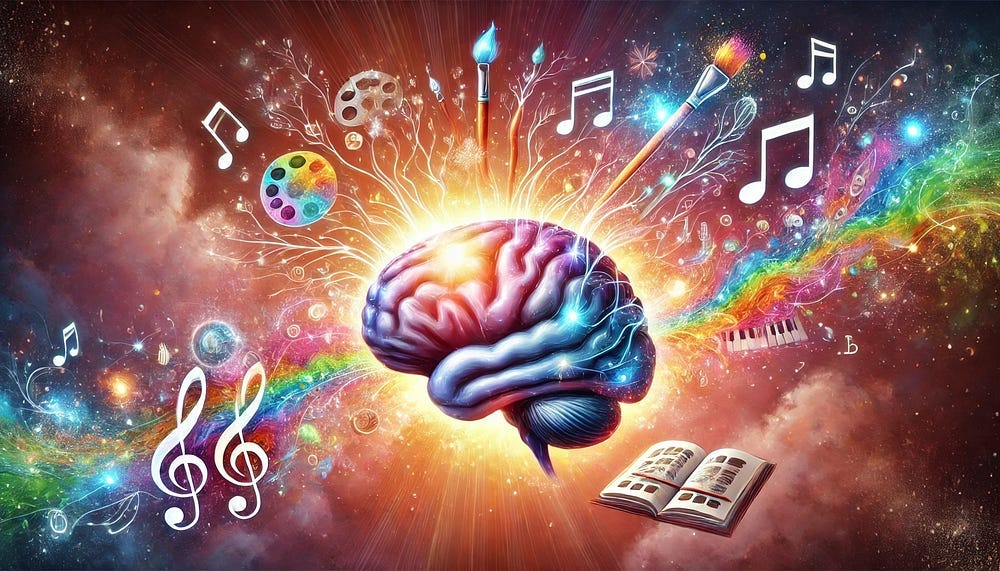
An artistic depiction of the human brain glowing with neural pathways that extend outward and transform into creative elements like paintbrushes, musical notes, and books. The soft, colorful gradient background evokes imagination and inspiration, symbolizing the powerful connection between the brain and artistic expression. Illustration created by Chip WordCraft (AI).
… what’s happening in an artist’s mind when they bring a masterpiece to life? Whether it’s J.R.R. Tolkien crafting the vast world of Middle-earth, George R.R. Martin weaving the intricate politics of Westeros, or a painter turning a blank canvas into a vivid story, creativity is one of the most fascinating aspects of the human brain.
This article dives into the neuroscience of creativity, exploring how the brain differs during creative activities, the role of neuroplasticity, and the incredible cognitive processes behind imagination.
Creativity and the Brain: A Symphony of Networks
Creativity isn’t the work of a single region of the brain, it’s a collaboration between multiple networks:
- The Default Mode Network (DMN): Active during daydreaming, self-reflection, and imagination. It’s what allows artists to envision worlds that don’t yet exist.
- The Executive Control Network: Ensures that wild ideas are refined into coherent creations, balancing creativity with logic.
- The Salience Network: Helps artists focus on what’s essential, drawing connections between unrelated ideas.
Tolkien and Middle-earth

An enchanting scene inspired by J.R.R. Tolkien’s magical world, showcasing rolling green hills with cozy, round-door homes, a glowing tree symbolizing the Tree of Life, and distant mountains under a starlit sky. Subtle silhouettes of mythical creatures hint at the presence of elves and dwarves, evoking adventure and wonder. Illustration created by Chip WordCraft (AI).
J.R.R. Tolkien’s world-building in The Lord of the Rings showcases the DMN at work. Creating an entire language like Elvish or imagining a place like Rivendell required deep reflection and an ability to connect historical, linguistic, and mythical elements. J.R.R. Tolkien’s masterful world-building is a remarkable example of the deep creative processes in fantasy literature. The creation of intricate languages, such as Elvish, demonstrates his profound understanding of linguistics and the nuances of language development. Tolkien did not simply devise a few words; he constructed a fully-fledged language with its own grammar, syntax, and vocabulary, reflecting the rich culture of its speakers.
Furthermore, the imaginative landscapes he conjured (such as the serene and mystical Rivendell) are products of meticulous thought and an uncanny ability to intertwine historical, linguistic, and mythical elements.
Evoking a sense of timelessness, Rivendell is not just a location. It combines nature, art, and ancient lore, illustrating the intersection of mythic narratives and tangible geography.
Neuroplasticity: The Brain’s Ability to Evolve Through Art
Engaging in creative activities enhances neuroplasticity, the brain’s ability to adapt and form new neural connections. Writing a novel or composing music strengthens problem-solving skills by forcing the brain to think in non-linear ways (imagination builds resilience).
George R.R. Martin and Character Depth

An atmospheric scene inspired by George R.R. Martin’s epic worlds, featuring a medieval castle perched on a rugged hill under a dramatic, cloudy sky. Banners flutter in the wind, symbolizing the political intrigue and feuding houses of Westeros, while a lone figure gazes at the castle from a distance. The mood is dark and brooding, reflecting themes of power and ambition. Illustration created by Chip WordCraft (AI).
Martin’s ability to juggle dozens of complex characters and interweaving plotlines in A Song of Ice and Fire highlights an adaptive brain capable of managing multiple narratives. His characters feel real because his imagination taps into deeply human emotions and moral dilemmas. Martin’s remarkable talent for orchestrating a multitude of intricate characters and interwoven plotlines in A Song of Ice and Fire showcases a mind that is not only adaptable but also exceptionally adept at handling complex narratives. Each character is crafted with depth and nuance, making them feel real and relatable.
Martin’s storytelling resonates with readers because he skillfully explores the full spectrum of human emotions, delving into profound moral dilemmas and ethical conflicts that are universally applicable. This ability to capture the essence of humanity in his characters and their struggles draws readers into the richly detailed world he has created, allowing them to connect deeply with the narrative on both emotional and intellectual levels.
Creativity in Motion: What Happens in Real-Time?
When an artist feels creative, the brain enters a state of flow:
- Reduced activity in the prefrontal cortex: The inner critic quiets down, allowing ideas to flow freely.
- Increased alpha brainwaves: These are associated with relaxation and heightened imagination.
- Heightened dopamine levels: Creativity feels rewarding, encouraging deeper focus.
J.K. Rowling and the Birth of Harry Potter

A magical scene set in a mystical forest, illuminated by glowing lights and a shimmering moonlit sky. A grand castle stands in the distance, while a small owl carrying a scroll flies through the foreground, surrounded by floating candles. The atmosphere is filled with wonder and the allure of discovery. Illustration created by Chip WordCraft (AI).
J.K. Rowling’s journey to creating the world of Harry Potter began during a long train ride from Manchester to London. During this seemingly ordinary trip, she experienced a pivotal moment of inspiration, a burst of creativity that we often call an “aha!” moment. This surge of dopamine sparked her imagination, allowing vivid ideas to flow freely, enhanced by the calming alpha brainwaves often associated with relaxed and open-minded thinking. Rowling’s creative process evolved as she meticulously crafted a rich tapestry of characters, magical creatures, and intricate plotlines. Each element of the wizarding world feels deeply immersive and relatable, from the enchanting Hogwarts School of Witchcraft and Wizardry to the complexities of friendship and the struggle between good and evil. Her remarkable ability to build such a detailed and enchanting universe has captivated readers of all ages, making the world she created in Harry Potter resonate profoundly with our own reality.
The Science of Fictional Worlds: Why Writers Create Universes
Building fictional worlds involves a mix of imagination, memory, and empathy:
- Memory networks help writers draw on real-life experiences.
- Empathy regions like the medial prefrontal cortex allow them to create relatable characters.
- Imagination processes in the DMN allow writers to suspend reality.
Mary Shelley and Frankenstein

A dark and atmospheric scene inspired by Mary Shelley’s world, featuring a gothic castle surrounded by stormy skies and lightning. In the foreground, a table lit by flickering candles holds scattered quills, parchment, and a glowing vial of mysterious liquid. The eerie mood reflects themes of science, creation, and humanity’s boundaries. Illustration created by Chip WordCraft (AI).
Mary Shelley’s creation of Frankenstein demonstrates the brain’s ability to combine empathy with imagination. She used her understanding of human emotion and fear, along with her love of science, to craft one of the most enduring tales in literature. Mary Shelley’s creation of Frankenstein is a profound exploration of the human mind, showcasing its remarkable capacity to intertwine empathy with imagination. Drawing from her deep understanding of human emotions, from compassion to terror, she skillfully navigated the complexities of fear accompanying the unknown. Her fascination with scientific advancement and its ethical implications further informed her narrative, allowing her to pose critical questions about creation and responsibility. Through her intricate storytelling, Shelley crafted a timeless tale that captivates readers and delves into the darkest corners of human experience, making Frankenstein one of the most significant contributions to literature.
The Cognitive Benefits of Creativity
Creativity doesn’t just lead to great art. More than that, it has profound effects on cognitive development:
- Boosted problem-solving skills: Creative tasks force the brain to think outside the box.
- Improved emotional regulation: Writing or painting can help process complex emotions.
- Enhanced connectivity: Regular creative practice strengthens the links between brain networks.
Modern Creativity: Film and Digital Art
Directors like Christopher Nolan (Inception) or digital artists who craft virtual realities are modern examples of how creativity continues to push the boundaries of human potential.
Conclusion
The creative brain is a masterpiece in itself, a dynamic interplay of imagination, memory, and logic. From Tolkien’s Middle-earth to Rowling’s Hogwarts, the worlds we cherish prove human creativity’s incredible power. By understanding the science behind artistry, we not only appreciate the work of great creators but also unlock the creative potential within ourselves.
Want to Learn More About the Creative Brain?
If this article sparked your curiosity, here are some great resources to dive deeper into the neuroscience of creativity:
Articles
“The Science Behind Creativity”
“The Cognitive Neuroscience of Creativity”
“Creativity, Brain, and Art: Biological and Neurological Considerations”
Books
The Cambridge Handbook of the Neuroscience of Creativity
The Neuroscience of Creativity
TED Talks
“Neuroscience and Creativity” by Siddharth Warrier
“The Neuroscience of Imagination” by Andrey Vyshedskiy
💡 Your thoughts and ideas matter! 💡 👇 🌟✨ Inspired by this article or curious to share your thoughts? Drop a comment below! If you enjoyed it, share the inspiration and follow me for more stories! ✨🌟
메타데이터
- post_id
- bfa6786c8372
- slug
- the-creative-brain-what-happens-in-an-artists-mind-bfa6786c8372
- url
- https://medium.com/@mihaelaraileanu/the-creative-brain-what-happens-in-an-artists-mind-bfa6786c8372
- canonical_url
- https://medium.com/@mihaelaraileanu/the-creative-brain-what-happens-in-an-artists-mind-bfa6786c8372
- author_url
- https://medium.com/@mihaelaraileanu
- status
- ok
- fetched_at
- 2026-06-09 15:37:30