The Global Pepper Market in 2025: Demand Drivers, Supply Pressures, and the Varieties Reshaping the…
Introduction
The Global Pepper Market in 2025: Demand Drivers, Supply Pressures, and the Varieties Reshaping the Industry
Introduction
Peppers are one of the most commercially important vegetable crops in the world-and in 2025, the market for fresh peppers is undergoing a significant transformation. Consumer preferences are shifting toward flavor complexity, visual appeal, and nutritional density. Retailers are imposing tighter quality, shelf-life, and sustainability standards on their supply chains. Greenhouse growers are expanding production to meet year-round demand while managing rising energy and labor costs. At the center of this transformation is seed breeding innovation: the varieties that growers choose to plant define whether they win or lose in an increasingly competitive fresh produce marketplace. Israeli breeding company BreedX develops conventional pepper varieties with the specific trait profiles that modern commercial growers and supply chains require — combining flavor, disease resistance, shelf life, and yield in configurations that address the real-world pressures of the 2025 market.
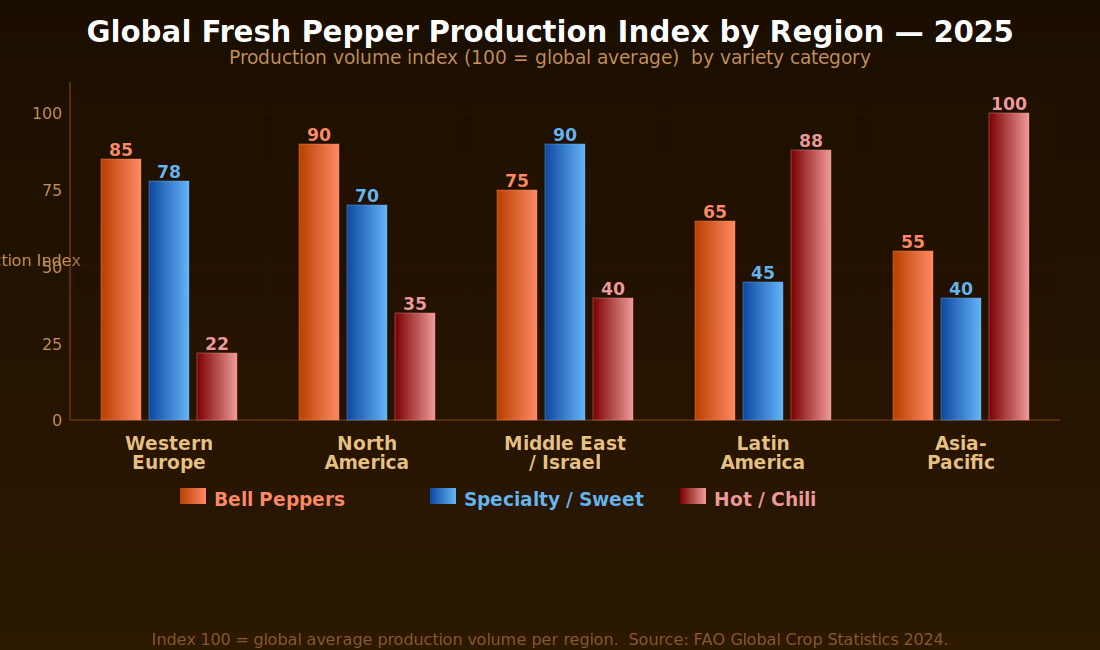
Market Size and Growth: Where the Pepper Industry Stands
The global fresh pepper market — including bell peppers, specialty sweet peppers, and hot peppers — is valued at approximately $18 billion USD in 2025, with a projected CAGR of 5.8% through 2030. Growth is being driven by a convergence of forces:
- Consumer health awareness: Peppers are among the most nutrient-dense vegetables, rich in vitamin C, antioxidants, and capsaicin. Growing consumer focus on functional foods is directly benefiting pepper consumption
- Culinary diversity: The globalization of food culture has expanded mainstream demand for varieties beyond the standard red/yellow/green bell pepper — mini sweet peppers, specialty colors, and snacking varieties are all gaining shelf space
- Greenhouse expansion: Investment in controlled-environment agriculture (CEA) is accelerating, particularly in Northern Europe, North America, and the Middle East. Greenhouse production enables year-round supply and premium quality positioning
- Retail private label quality programs: Supermarket chains across Europe and North America have implemented rigorous specifications for the peppers they carry — creating a floor of quality that independent growers must meet or lose their listing
Regional Market Snapshot: Production and Demand by Geography
Region
Production Focus
Key Varieties in Demand
Growth Driver
Western Europe
Greenhouse dominant
Blocky bell, mini sweet, specialty colors
Retailer specs, year-round supply
North America
Greenhouse + field hybrid
Snacking peppers, colored blocks
Consumer snacking trends
Middle East / Israel
Export-oriented greenhouse
Long red/yellow, sweet pointy
EU export quality programs
Latin America
Field production, export
Jalapeño, cubanelle, bell
Year-round supply to NA/EU
Asia-Pacific
Rapidly expanding
Hot varieties, sweet specialty
Urban consumption growth
Source: FAO Global Crop Production Statistics 2024; USDA Agricultural Trade Data 2024
The Variety Innovation Imperative
In the fresh pepper sector, variety selection is the single most consequential agronomic decision a grower makes. The right variety delivers the yield, disease resistance, shelf life, and visual quality that allow a grower to compete — the wrong one can mean unsaleable product or rejected shipments. This is why seed companies that invest in sustained, purposeful breeding programs are increasingly valued by commercial operations. BreedX pepper varieties are developed through conventional breeding methods — without genetic modification — to deliver trait combinations that address the specific challenges of modern commercial production:
- Disease resistance packages: Tobamovirus resistance (Tm variants), powdery mildew resistance, and Phytophthora tolerance — critical as pathogen pressure intensifies in high-density greenhouse environments
- Extended shelf life: Firmness retention, reduced post-harvest water loss, and color stability — enabling longer supply chains and reduced food waste from farm to retail shelf
- Flavor and Brix optimization: Sugar content, wall thickness, and flesh texture attributes that meet retailer taste panel standards and drive repeat consumer purchase
- Uniform fruit set and sizing: Critical for pack-out efficiency and retailer specification compliance — reducing sorting time and rejection rates at packing stations
Five Trends Shaping Pepper Variety Development in 2025
Seed breeders and growers are responding to the same market signals. Here are the five most consequential trends driving variety development and purchasing decisions:
- Snacking formats: Consumer demand for small, sweet, convenient peppers suitable for eating without preparation has driven explosive growth in mini sweet and snacking pepper categories. Varieties must deliver high sweetness, thin skin, and consistent sizing
- Color diversity: Beyond red, yellow, and orange, retailers and foodservice operators are seeking purple, white, and specialty-colored peppers for visual differentiation and social media appeal
- Tobamovirus resistance expansion: As ToBRFV (Tomato Brown Rugose Fruit Virus) and other tobamoviruses spread through greenhouse crops globally, demand for varieties with robust resistance packages has become a primary purchasing criterion
- Low-input adaptability: Growers facing rising energy costs are seeking varieties that perform well at lower heat inputs and maintain quality under climate stress — a trait profile that requires dedicated breeding attention
- Sustainable supply chain positioning: European retailers in particular are pushing growers to document their environmental footprint. Varieties that achieve equivalent yield with lower water and nutrient inputs are gaining commercial advantage
The Conventional Breeding Advantage in a GMO-Sensitive Market
While biotechnology dominates agricultural research headlines, the fresh produce sector operates under a different set of constraints. European retailers — the world’s most demanding fresh produce buyers — apply strict non-GMO requirements throughout their supply chains. This creates a structural advantage for seed companies that develop innovations through conventional breeding. Non-GMO status is not a compromise; it is a market access requirement for the most valuable fresh produce channels in the world.
Conventional breeding, applied with modern phenotyping tools, genomic selection, and precision data analytics, can deliver variety improvements that rival biotechnology in speed and specificity — without the regulatory and market access complications. This hybrid of traditional methodology and modern technology represents the most commercially practical path for fresh vegetable breeding in the current market environment.
Conclusion
The global pepper market in 2025 is rewarding growers who invest in high-performance, purpose-built varieties and supply chain partners who can consistently meet evolving retailer and consumer standards. The seed varieties at the foundation of commercial pepper production have never been more important — or more sophisticated. As the market continues to segment and specialize, the breeding programs that deliver trait precision, disease resilience, and commercial relevance will define who grows profitably and who falls behind.
메타데이터
- post_id
- bfb7e177fc0a
- slug
- the-global-pepper-market-in-2025-demand-drivers-supply-pressures-and-the-varieties-reshaping-the-bfb7e177fc0a
- url
- https://medium.com/@alltechnews/the-global-pepper-market-in-2025-demand-drivers-supply-pressures-and-the-varieties-reshaping-the-bfb7e177fc0a
- canonical_url
- https://medium.com/@alltechnews/the-global-pepper-market-in-2025-demand-drivers-supply-pressures-and-the-varieties-reshaping-the-bfb7e177fc0a
- author_url
- https://medium.com/@alltechnews
- status
- ok
- fetched_at
- 2026-07-10 13:32:34