AI and Multilingualism Q3: How Mohammad Merajul Islam’s Experience in Bangladesh Shapes the Book’s…
Question 3: How Mohammad Merajul Islam’s Experience in Bangladesh Shapes the Book’s Perspective
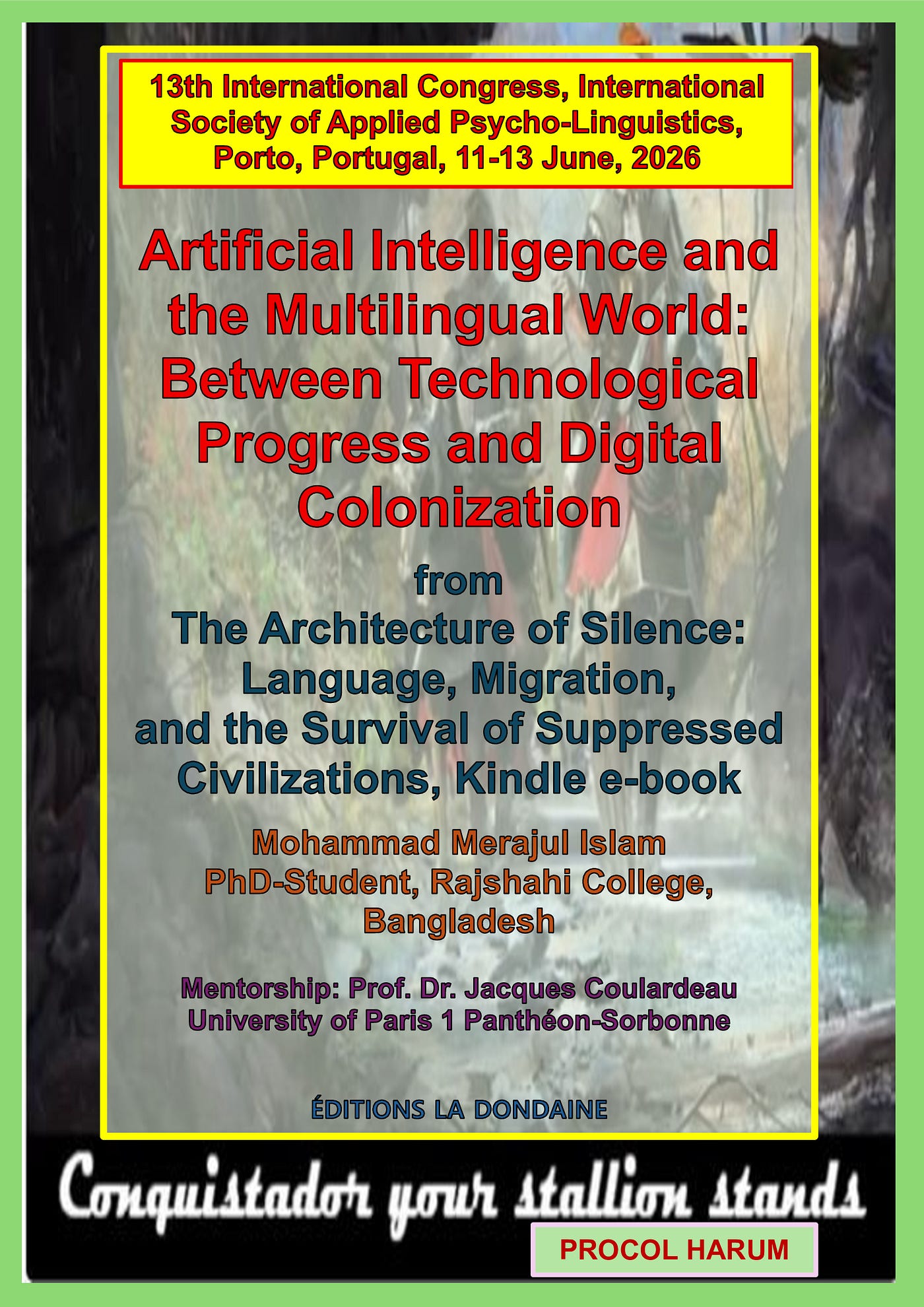
AI and Multilingualism Q3: How Mohammad Merajul Islam’s Experience in Bangladesh Shapes the Book’s Perspective
Question 3: How Mohammad Merajul Islam’s Experience in Bangladesh Shapes the Book’s Perspective
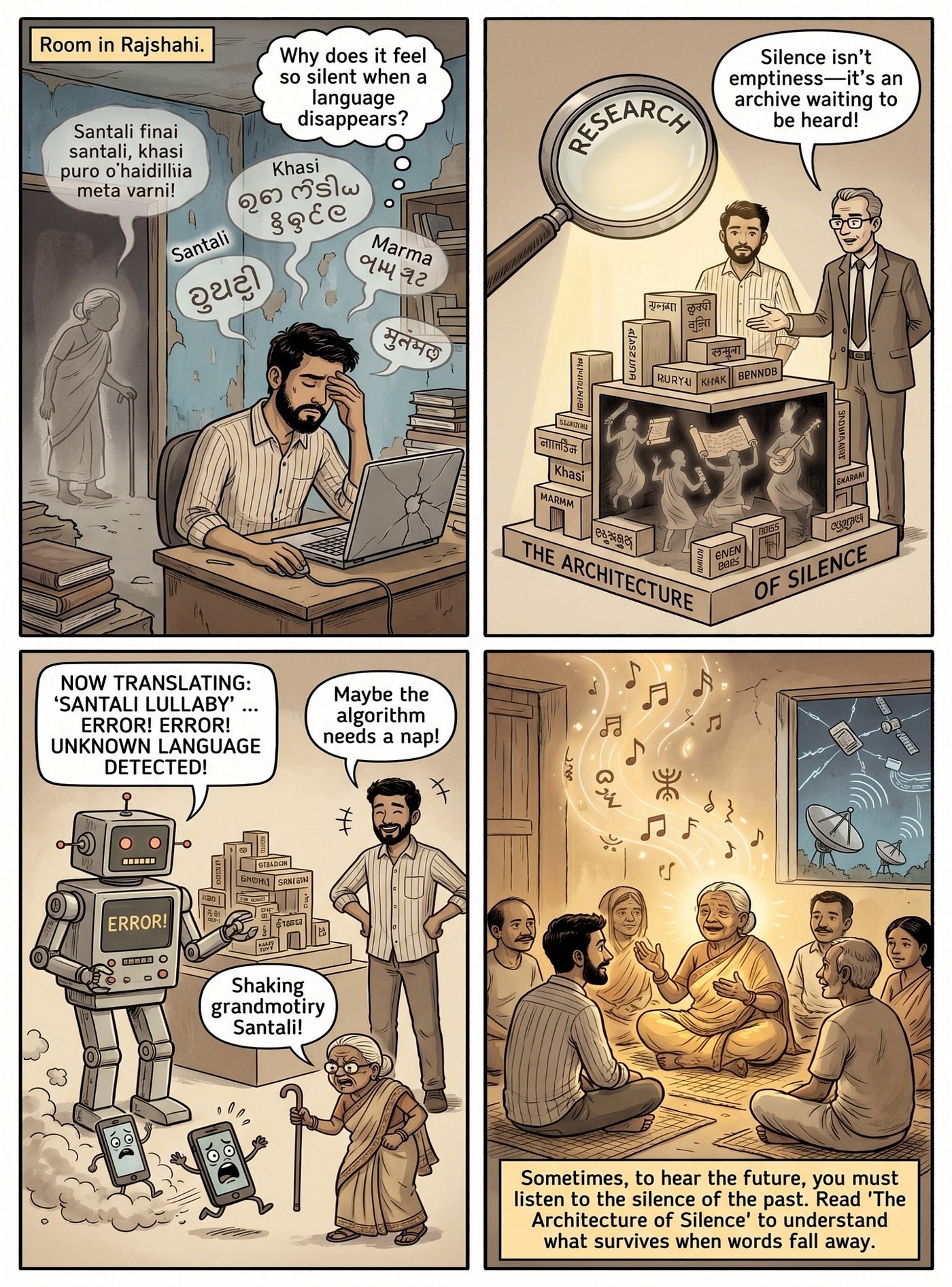
Mohammad Merajul Islam has not crossed borders as a refugee. Yet he lives within a landscape where linguistic erasure is unfolding in real time.
Near Rajshahi, the Santali people continue to preserve one of the oldest living linguistic traditions in South Asia. Their language possesses its own writing system, the Ol Chiki script, developed in 1925 after Santali speakers grew tired of seeing their language filtered through external systems that distorted its sounds and structure.
Today, however, many Santali children are educated primarily in Bangla. Major AI systems are not trained to process Santali meaningfully. When an elderly Santali speaker dies, an entire ecological archive often disappears with them: knowledge of medicinal plants, agricultural rhythms, oral histories, local cosmologies, and names for realities that have no direct Bangla equivalent.
The loss is not merely linguistic. It is epistemological. It is existential for the survivors, be they Santali or not. Any local loss is a loss for the whole of humanity.
Merajul has also observed the pressures facing the Marma people of the Chittagong Hill Tracts. Many younger speakers increasingly abandon their first identificatory tongue, not because they wish to, but because digital infrastructures rarely support it. Their smartphones, keyboards, software systems, and online environments function almost entirely in dominant languages instead.
The machine does not adapt to any human. All humans are forced to adapt to the machine. That’s the essential idea of the book. There is no Artificial Intelligence if a language, and each language has to deal with this separately, does not have a Large Language Model of at least three trillion data points. A maximum of six to twelve languages in the world can have such LLMs. All these languages have been part of vast colonial movements, ancient or recent: English, French, Spanish, Portuguese, Russian, Chinese, maybe Japanese, Arabic, Hindi, maybe Farsi, probably Pali, but no Black African, Amerindian, or primeval languages on any continent. Practically all languages will have to choose between disappearing into silence or integrating into one of the few dominant languages via translation and homogenization. This last danger is a major hazard for languages that are composed of several or even many dialects, like Arabic and Chinese, without speaking of the vast number of languages in the Muslim world that might be exploded with LLMs and AI.
This lived-in proximity to endangered linguistic communities gives the book its urgency. Its perspective does not emerge primarily from institutional archives or academic abstraction. It emerges from witnessing communities struggle to maintain linguistic sovereignty in the twenty-first century itself.
For Mohammad Merajul Islam, this is not distant history. It is a contemporary civilizational crisis unfolding in plain sight.
PhD-Student Mohammad Merajul ISLAM & Dr. Jacques COULARDEAU

메타데이터
- post_id
- bfbcc19b9339
- slug
- ai-and-multilingualism-q3-how-mohammad-merajul-islams-experience-in-bangladesh-shapes-the-book-s-bfbcc19b9339
- url
- https://medium.com/@jacquescoulardeau/ai-and-multilingualism-q3-how-mohammad-merajul-islams-experience-in-bangladesh-shapes-the-book-s-bfbcc19b9339
- canonical_url
- https://medium.com/@jacquescoulardeau/ai-and-multilingualism-q3-how-mohammad-merajul-islams-experience-in-bangladesh-shapes-the-book-s-bfbcc19b9339
- author_url
- https://medium.com/@jacquescoulardeau
- status
- ok
- fetched_at
- 2026-06-15 20:49:13