Scala Developer Salary: Junior, Middle, and Senior Rates in 2026
Scala salaries are not always easy to compare. Many public salary numbers mix gross and net pay, while bonuses, equity, stock grants, and…
Scala Developer Salary: Junior, Middle, and Senior Rates in 2026
Scala salaries are not always easy to compare. Many public salary numbers mix gross and net pay, while bonuses, equity, stock grants, and performance incentives often sit outside the headline figure. Scala makes the picture even more complex because it is a specialized language used in distributed systems, Big Data, enterprise backends, streaming platforms, and high-reliability infrastructure. That specialization usually raises compensation, but the exact rate depends on location, domain, framework expertise, and seniority.
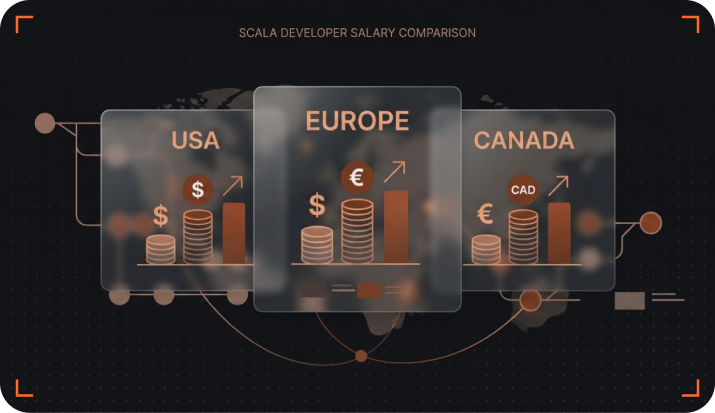
The original guide reviews Scala developer compensation across junior, middle, and senior levels in six markets: the USA, Canada, the UK, Germany, Poland, and Ukraine. It includes monthly net salary ranges and hourly net rates for 2026, with the figures focused on base pay rather than total compensation.
The article is useful for developers comparing their current package, hiring managers planning salary bands, and recruiters building offers for Scala roles. Because the Scala talent pool is smaller than Java or Python, rates can shift faster, so current market data matters.
What Shapes Scala Developer Rates
The biggest factor behind Scala compensation is the type of work the developer does. Standard backend Scala roles, such as building APIs or microservices with Play Framework or Akka HTTP, are well paid but usually sit at the lower end of the Scala market.
Higher rates appear when Scala is used for Big Data, distributed systems, and streaming work. Developers working with Apache Spark, Kafka stream processing, Hadoop ecosystems, and large-scale ETL pipelines often earn more than backend-focused Scala developers. In finance, ad tech, e-commerce, and data infrastructure, employers may pay a clear premium for this experience.
Company type also matters. Well-funded scale-ups and large technology companies may offer lower base salaries but stronger equity or stock packages. Banks, insurers, and enterprise clients often provide higher base salaries with smaller variable components. Remote-first companies may attract global candidates but increasingly adjust offers by location.
Framework knowledge also affects pay. Apache Spark is one of the strongest salary drivers because of its role in data engineering. Akka and Akka Streams matter for concurrency and reactive systems. Play Framework is common for web services. Cats, Cats Effect, and ZIO are valuable in functional programming environments, especially in fintech and distributed systems. Kafka, Slick, and Doobie can also raise a developer’s value when paired with strong production experience.
Developers who combine Spark expertise with Cats or ZIO are especially rare. A senior engineer who can design type-safe, functional Spark pipelines is difficult to replace, and salary expectations usually reflect that.
Scala Pay by Experience Level
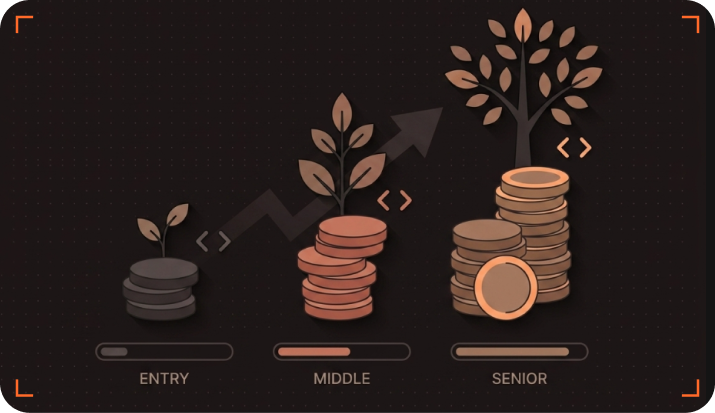
Experience remains one of the strongest predictors of Scala compensation. Because Scala has a steeper learning curve and a smaller talent pool, the gap between junior, middle, and senior rates can be wider than in more common languages.
Junior Scala Developer Compensation
The article makes an important point: a “true junior Scala developer” is rare. Scala’s type system, functional programming model, and complex frameworks make it difficult for complete beginners. Many people listed as junior Scala developers are actually Java, Kotlin, or backend engineers who have started moving into Scala.
This means junior Scala salaries often reflect a hybrid profile. These developers may already have several years of programming experience, but they are still building idiomatic Scala skills.
In the USA, junior Scala developers earn around $7,500 to $12,000 net per month, with an average of about $9,800. Their hourly net rate usually falls between $43 and $70, averaging around $55.
In Canada, junior monthly net pay ranges from about $3,140 to $4,530, with an average of $3,760. The hourly average is around $22. In the UK, junior developers average about $4,740 monthly net and $27 hourly. Germany is slightly higher, with an average monthly net salary of about $4,900 and an hourly average of $28.
Poland and Ukraine show lower absolute rates but remain active markets for remote and B2B work. In Poland, junior Scala developers average around $3,080 monthly net and $20 hourly. In Ukraine, the average is about $1,000 monthly net and $6 hourly.
The guide notes that Eastern European numbers often reflect B2B freelance structures, where developers work through registered companies or as sole traders.
Middle Scala Developer Compensation
The middle level shows the biggest salary jump in the Scala career path. At this stage, developers usually move from supervised coding into module ownership, architecture input, mentoring, and production responsibility.
A middle Scala developer is expected to write idiomatic functional code, understand the type system well, handle concurrency patterns, and have real experience with at least one major framework. This level usually comes after two to four years of dedicated Scala work, although developers with strong Haskell or advanced Java backgrounds may move faster.
In the USA, middle Scala developers earn about $9,600 to $14,300 net per month, with an average near $12,000. Their hourly net rate ranges from $55 to $82, averaging around $68.
Canada’s middle-level average is around $6,420 monthly net and $37 hourly. In the UK, the average reaches about $6,800 per month and $39 hourly. Germany is similar, with an average monthly net salary of around $6,840 and an hourly average of $39.
In Poland, middle Scala developers average about $4,900 monthly net and $31 hourly. In Ukraine, the average is around $2,500 monthly net and $15 hourly.
The article explains that this level has the widest internal range because specialization creates sub-tiers. A middle developer working mainly with Play Framework services may sit closer to the lower end, while someone with production Spark or Kafka ownership can move toward the upper end. Companies often compete strongly for confirmed middle Scala engineers because replacing them can take months.
Senior Scala Developer Compensation
At senior level, base salary growth begins to slow, but total compensation can rise sharply through equity, bonuses, stock options, RSUs, and sign-on packages. The guide’s senior salary numbers reflect base pay only.
Senior Scala engineers own systems or services, lead design reviews, define coding standards, choose technology stacks, evaluate build-versus-buy decisions, and often help assess technical candidates.
In the USA, senior Scala developers earn around $10,750 to $16,400 net per month, with an average of about $13,600. Hourly net rates range from $79 to $125, with an average of $99.
In Canada, the senior average is about $6,910 monthly net and $40 hourly. In the UK, senior Scala developers average around $10,200 monthly net and $58 hourly. Germany averages about $7,550 monthly net and $47 hourly.
Poland shows strong senior rates, with an average monthly net salary of about $7,840 and an hourly average of $49. Ukraine’s senior average is about $6,500 monthly net and $38 hourly.
The guide notes that the absolute dollar gap between the USA and Eastern Europe remains large, but remote hiring is changing the picture. US companies hiring senior Scala developers in Poland or Ukraine often offer packages above local market rates but below domestic US levels.
Highest-Paying Countries and Employers for Scala Developers
The United States remains the highest-paying Scala market, especially because of demand from hedge funds, investment banks, payment companies, streaming platforms, and large e-commerce infrastructure teams. New York, San Francisco, and Seattle remain strong salary centers, while remote roles continue to lift national averages.
Switzerland is also highly competitive, especially around Zurich, where fintech and quantitative trading companies use Scala in performance-critical systems. Germany and the Netherlands follow, with demand from automotive technology, logistics, and cloud infrastructure. The UK remains active, especially in London’s financial services, gaming, and media sectors.
Poland and Ukraine are described as high-value markets for remote Scala talent. Senior developers in Warsaw, Krakow, and Kyiv are increasingly hired at rates closer to Western Europe as demand rises.
Large US technology companies, global investment banks, and specialist data vendors tend to offer the highest total compensation. Companies such as LinkedIn, Databricks, Apple, Goldman Sachs, Morgan Stanley, Barclays, Confluent, Snowflake, and similar employers often exceed base salary ranges because of equity and bonus structures.
Skills Assessment and Interviews for Scala Roles
Scala hiring processes can be long, often involving four to six interview rounds. Developers may spend many hours on calls, tasks, and technical interviews before discovering that the company’s framework, Scala version, or programming style is not a good match.
The article suggests that structured skill evaluations can reduce this mismatch. A verified skills profile can help recruiters match developers with roles based on actual Scala frameworks, domain experience, concurrency models, and technical style rather than simple keyword matching.
This is especially valuable for senior engineers, where wasted interview time can be costly.
Why Submitting a Scala Resume Through a Specialist Platform Helps
The guide also explains the benefits of using a Scala-focused hiring platform. These include stack-specific matching, salary transparency, targeted visibility, interview preparation context, and verified experience signals.
For developers actively looking for new roles, an updated resume combined with a completed skills profile can lead to more relevant interviews and fewer mismatched hiring processes.
Final Thoughts
Scala developer salary depends mainly on experience level, technical specialization, and geography. Junior Scala roles often involve developers transitioning from other languages. Middle-level roles show the largest pay jump because they bring production ownership and framework depth. Senior roles offer strong base pay, but total compensation depends heavily on equity, bonuses, and company type.
A fuller breakdown of Scala developer salary by junior, middle, and senior levels is available in the complete blog post: https://www.jobswithscala.com/blog/scala-developer-salary-junior-middle-and-senior-rates-in-2026/.
메타데이터
- post_id
- bfbd604f6a0c
- slug
- scala-developer-salary-junior-middle-and-senior-rates-in-2026-bfbd604f6a0c
- url
- https://medium.com/@usmedynskahannah/scala-developer-salary-junior-middle-and-senior-rates-in-2026-bfbd604f6a0c
- canonical_url
- https://medium.com/@usmedynskahannah/scala-developer-salary-junior-middle-and-senior-rates-in-2026-bfbd604f6a0c
- author_url
- https://medium.com/@usmedynskahannah
- status
- ok
- fetched_at
- 2026-06-09 15:37:30