Debate-Based Cooperation Pattern in Agentic AI Systems
As artificial intelligence systems are increasingly applied to high-stakes domains such as law, compliance, and public policy, their…
Debate-Based Cooperation Pattern in Agentic AI Systems
As artificial intelligence systems are increasingly applied to high-stakes domains such as law, compliance, and public policy, their decision-making processes must evolve beyond single-pass reasoning. Agentic AI design patterns address this challenge by decomposing reasoning across multiple autonomous agents. Among these patterns, Debate-Based Cooperation offers a structured, rigorous approach to decision-making through controlled adversarial reasoning.
Agentic AI: A System-Oriented View
Agentic AI systems are composed of multiple autonomous agents, each defined by a specific role, goal, and behavioral constraints. Unlike monolithic language-model pipelines, agentic systems emphasize interaction, deliberation, and coordination. This design mirrors organizational decision-making structures found in legal, engineering, and governance institutions.
The Debate-Based Cooperation Pattern
Debate-Based Cooperation introduces controlled opposition into an AI system. Instead of converging immediately on a single answer, the system mandates adversarial agents to present competing arguments and counter-arguments over multiple rounds. A neutral adjudicating agent delays judgment until the argument space has been sufficiently explored, reducing premature conclusions and unexamined assumptions.
⚖️ The Scenario: A Case Fit for AI Court
Let’s put the pattern to work.
The Incident
A young boy suddenly runs onto the road to save a kitten 🐱 A car swerves, crashes, and suffers property damage 🚗💥
Now comes the legal question:
Who is liable?
- The minor?
- The driver?
- Or does necessity and “Good Samaritan” logic apply?
Sounds like a law school exam question… Perfect for an agentic debate.
System Architecture Overview
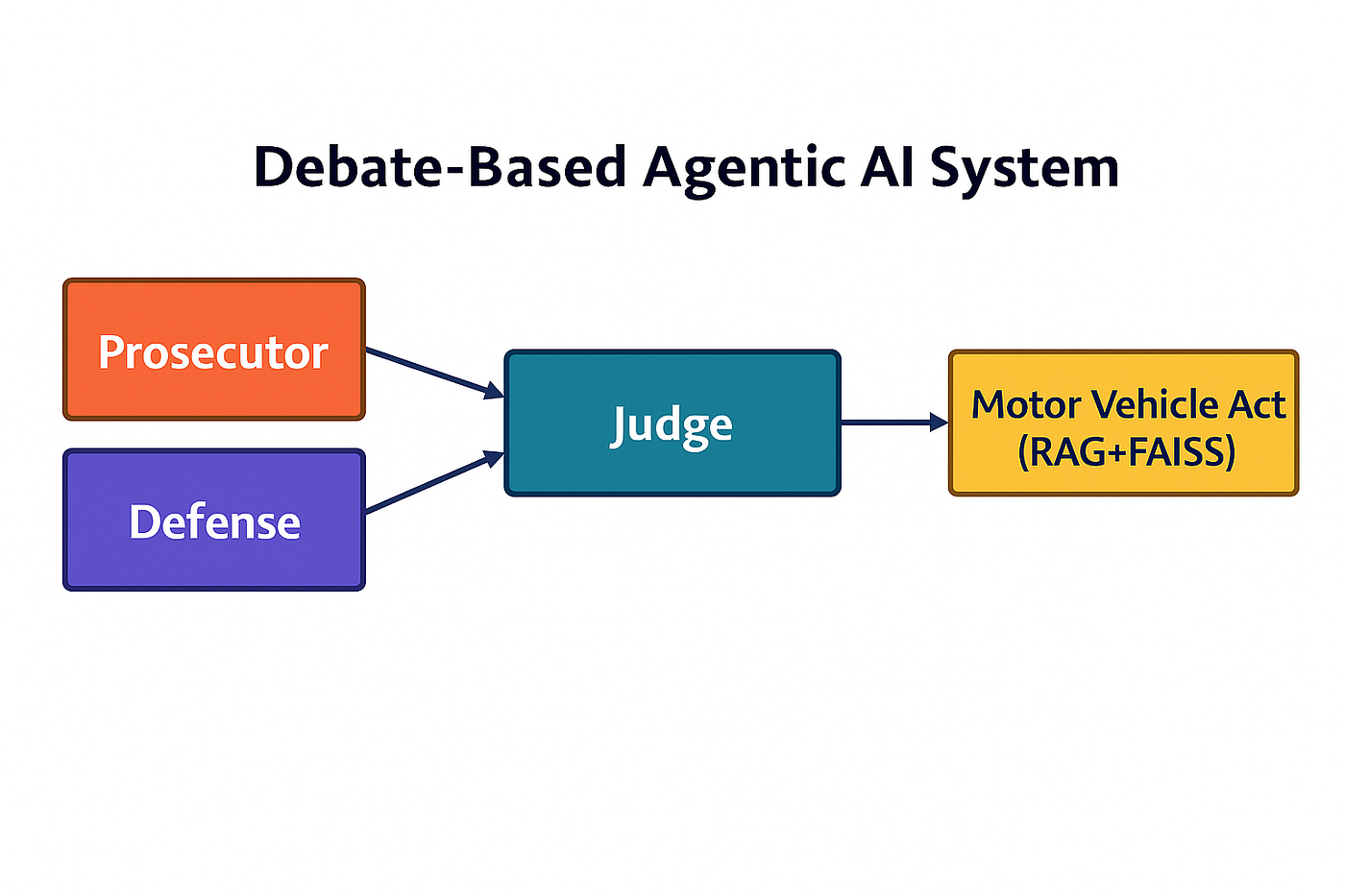
The architecture comprises three primary agent roles: a Prosecutor agent responsible for asserting claims, a Defense agent tasked with rebuttal and mitigation, and a Judge agent that evaluates the debate holistically. Crucially, the Judge agent is augmented with Retrieval-Augmented Generation (RAG) over the Motor Vehicle Act, implemented using FAISS, ensuring that conclusions are grounded in authoritative legal text.
At a high level:
- Arguments are presented
- Rebuttals are exchanged
- Debate continues for multiple rounds
- Judge consults real legal documents
- A final verdict is issued
Execution Flow
The execution proceeds in distinct phases. The Prosecutor agent initiates the debate by asserting liability. The Defense agent responds with counter-arguments emphasizing necessity or mitigating factors. Multiple rounds of rebuttals refine each position. Only after the debate stabilizes does the Judge agent query relevant sections of the Motor Vehicle Act and issue a final, reasoned verdict with explicit legal citations.
📚 Grounding the Debate with Real Law (RAG)
Opinions are cheap. Legal citations are not.
This is where Retrieval‑Augmented Generation (RAG) enters.
The system:
- Loads the Motor Vehicle Act (PDF)
- Splits it into semantic chunks
- Creates embeddings using Gemini
- Stores them in a FAISS vector database
The Judge agent:
- Queries the Act during deliberation
- Cites specific sections
- Grounds the verdict in actual law
So yes — Your AI judge can say “According to Section X…” instead of “In my opinion…”
That’s a big deal.
🗣️ Why Multi‑Round Debate Matters
One of the biggest mistakes in AI systems?
Asking once and trusting the first answer.
This pattern forces thought refinement:
- Claims are challenged
- Weak logic is exposed
- Overconfidence gets punished
- Reasoning improves over rounds
It’s how humans reason well. Why shouldn’t AI?
Why This Pattern Matters
By enforcing structured disagreement, Debate-Based Cooperation significantly improves reasoning depth, reduces hallucination risk, and produces interpretable decision trails. It aligns well with domains that require accountability, auditability, and justification — key requirements for trustworthy AI.
Design Recommendations
Practitioners adopting this pattern should define clearly opposing agent objectives, enforce multi-round deliberation, and ground adjudication in trusted knowledge sources. Persisting debate transcripts is strongly recommended to support audits, evaluations, and continuous system improvement.
Conclusion
Debate-Based Cooperation represents a disciplined approach to Agentic AI design. As AI systems increasingly participate in consequential decision-making, architectures that embrace deliberation, evidence, and delayed judgment will be foundational to building reliable, ethical, and socially acceptable AI systems.
Debate‑Based Cooperation shines when:
- Problems are ambiguous
- Ethics, law, or policy are involved
- Trade‑offs matter
- Accountability is required
Real‑world use cases:
- Legal analysis
- Policy simulations
- Compliance systems
- Ethical AI
- Risk and governance tools
Anywhere humans argue professionally… AI agents can too.
Explore the github link to see this example into an action.
메타데이터
- post_id
- bfbdf229032e
- slug
- debate-based-cooperation-pattern-in-agentic-ai-systems-bfbdf229032e
- url
- https://medium.com/@sunshots/debate-based-cooperation-pattern-in-agentic-ai-systems-bfbdf229032e
- canonical_url
- https://medium.com/@sunshots/debate-based-cooperation-pattern-in-agentic-ai-systems-bfbdf229032e
- author_url
- https://medium.com/@sunshots
- status
- ok
- fetched_at
- 2026-07-11 12:10:32





