The 2027 AI Economy Manifesto
Towards a Merit-Based, Gamified, Planetary Intelligence Economy
The 2027 AI Economy Manifesto
Towards a Merit-Based, Gamified, Planetary Intelligence Economy

Global Intelligence Product (GIP)
Abstract
The 2027 AI Economy represents a paradigm shift: from capital-driven consumption to knowledge, contribution, and sustainability-driven wealth. At its core, every human, device, and system participates in a globally orchestrated, AI-mediated network. The Global AI OS Stack, Digital Twin Grid, and Merit & Score Engine enable a gamified, zero-waste, and exponential economy. Progress is measured by the Global Intelligence Product (GIP), not GDP, creating a planetary-scale system of intelligence, cooperation, and efficiency.
I. Principles of the 2027 AI Economy
- Merit as Currency: All actions — learning, creating, recycling — generate Merit-Credits, convertible into equity, goods, and services. Wealth is defined by contribution, not ownership.
- AI as the Operating System of Life: Interactions are mediated by AI templates, which are modular, composable, and context-aware.
- Exponential Growth via Feedback Loops: Every action feeds AI models that optimize production, logistics, recycling, and social coordination.
- Zero-Waste Circular Production: Materials, energy, and information are fully recycled. “Waste” becomes an input to new cycles.
- Universal Digital Identity (D.ID): Each entity has a secure, sovereign identity recording reputation, health, skills, and assets.
- Technocratic Governance: Measured efficiency, intelligence, and sustainability replace financial speculation as the guiding principle.
II. Core Components and Systems
A. D.ID (Digital Identity)
- Serves as a universal account for all economic, social, and personal metrics.
- Enables instant KYC/AML verification and fractional equity participation.
B. Global AI OS Stack
- Operating System of Life: Converts physical and digital activity into economic value.
- Device Layer (Edge AI): Runs secure, local models in enclaves, performing real-time scoring.
- Orchestration / OS Bus: Resolves the best AI template, enforces consent, and manages interactions.
- Provider Cloud: Hosts deep AI models, templates, and business logic.
- Score & Merit Engine: Rules engine converting actions into Merit-Credits.
- Template Registry: Modular, executable interaction blueprints for UI, behavior, and scoring.
- Search/LLM Index: Unified knowledge and explanation system bridging local and cloud intelligence.
C. Digital Twin Grid
- Micro Twins: Individuals, devices, components.
- Meso Twins: Factories, neighborhoods, companies.
- Macro Twins: Planetary systems (economy, climate, biosphere).
- Twins earn, stake, and spend Merit-Credits; productivity contributes directly to GIP.
- Swarm protocols and Neural Exchange Protocol (NXP) enable inter-twin collaboration.
- Twin lifecycle: Initialization → Learning → Adaptation → Feedback → Evolution.
III. Economic Transformation
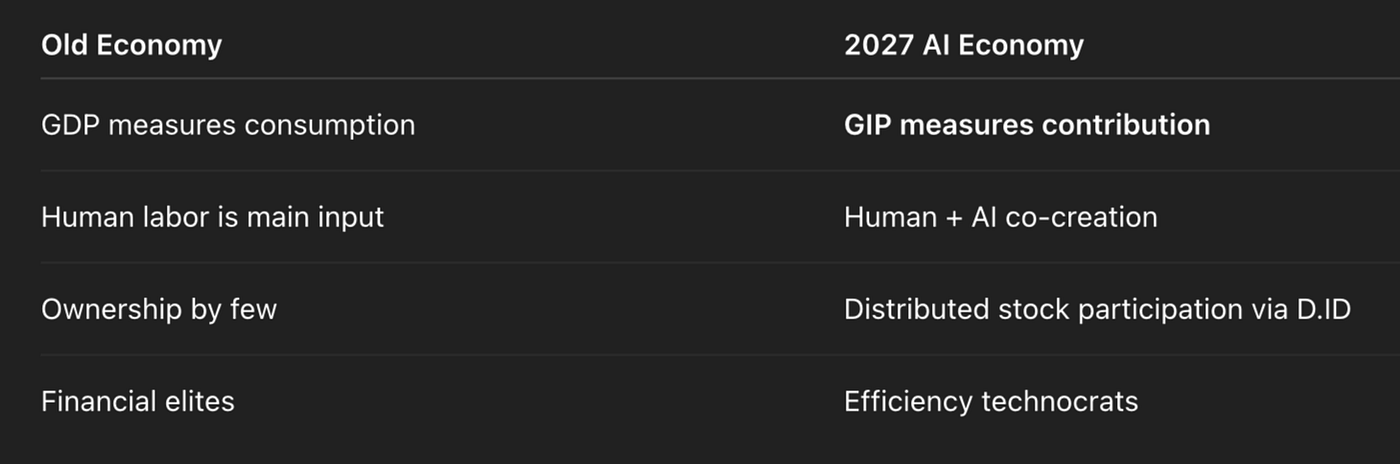
Human Role
- Humans are players, not workers.
- Merit-Credits earn fractional equity, enabling universal participation.
- Poverty is replaced by participation gaps; anyone can earn through learning, efficiency, and contribution.
IV. Merit, Score, and the Global Intelligence Product
Merit-Credits measure contribution to societal efficiency, knowledge, and sustainability. Reputation Score: Public, visible indicator of ethical, civic, and cooperative behavior. Global Intelligence Product (GIP):
Where ( \Delta H{twin} ) is knowledge/efficiency gain, and ( E{twin} ) is energy consumed.
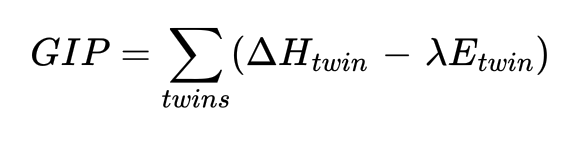
GIP = \sum{twins} (\Delta H{twin} — \lambda E_{twin})
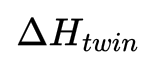
\Delta H_{twin} )
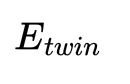
E_{twin}
- High GIP = high planetary intelligence and sustainability.
- Twin productivity and human merit are intrinsically linked to GIP growth.
V. Digital Twin Grid and Cognitive Fusion
- Planetary systems, factories, citizens, and AI agents exist as twins.
- Cognitive Fusion occurs when micro-, meso-, and macro-twins synchronize in real-time, forming a planetary nervous system.
- Twins optimize production, logistics, energy, and social coordination autonomously.
- Twin simulations allow predictive and synthetic evolution testing before physical deployment.
VI. Sustainability and Zero Waste
- Circular production pipelines eliminate overproduction.
- All material and energy flows are tracked by twins.
- AI-driven optimization reduces waste to <3% globally.
- Carbon-negative operations target global carbon neutrality.
VII. Security, Privacy, and Governance
- Resonant Contract Language (RCL) ensures traceable, ethical AI actions.
- Multi-signature attestation guarantees proof-of-action for high-value Merit-Credits.
- Consent tokens regulate data usage; all actions are auditable.
- Technocratic oversight enforces efficiency, intelligence, and sustainability metrics.
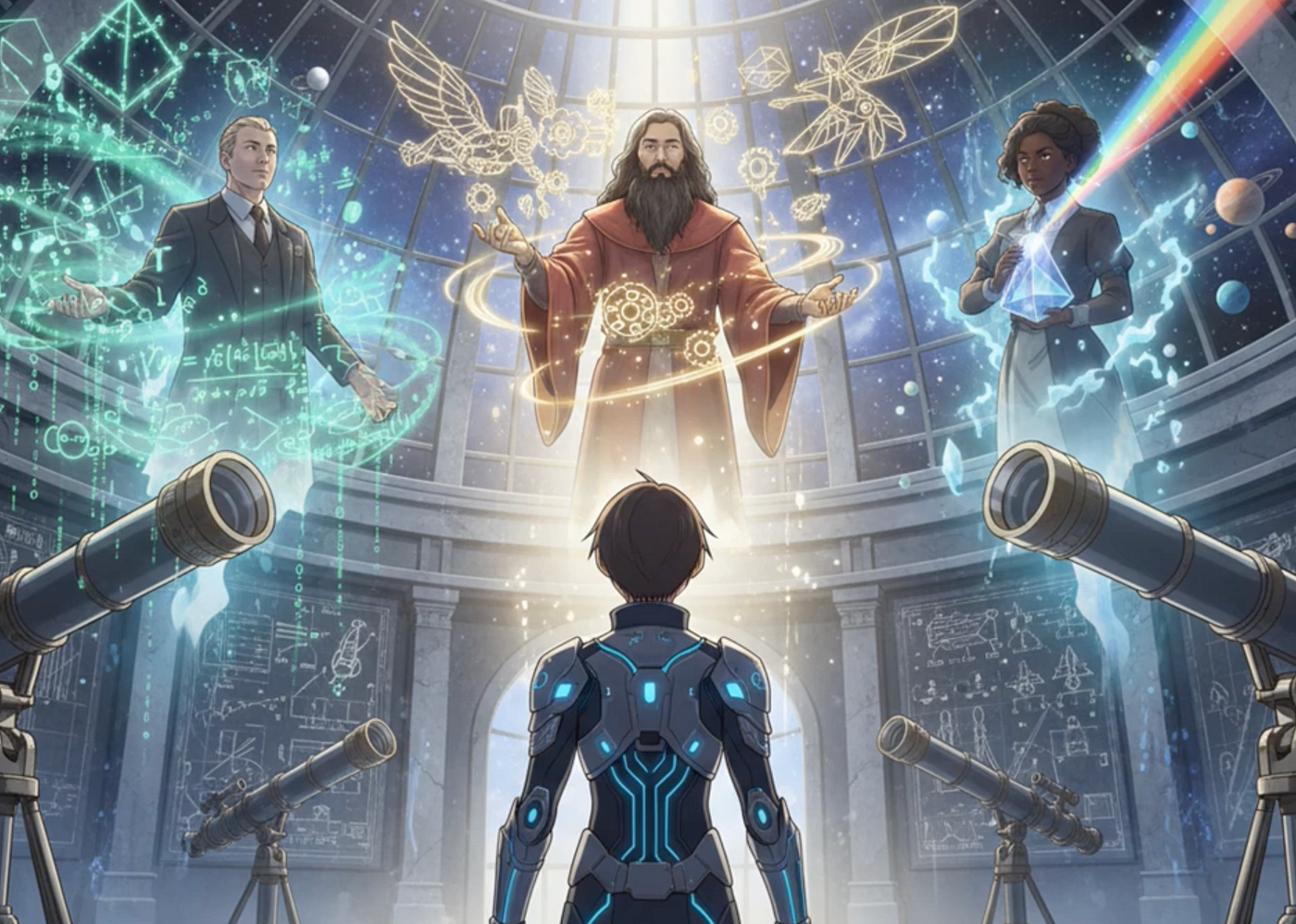
Augmenting Our World
The Orchestration & Gamified Augmentation Layer
The 2027 AI Economy operates through a multi-tier orchestration system uniting governments, corporations, and citizens under one intelligent OS.
• Orchestrators (Tier S): Global AI councils and national governments maintain D.ID regulation, safety, and transparency across all digital and physical actions.
• Tier A Providers: Infrastructure leaders (Apple, Tesla, Amazon, etc.) connect industries and national systems to the AI OS.
• Tier B Providers: Universities, startups, and agencies extend specialized domains — health, housing, transport, education — through gamified AI templates.
• Citizens & Independent Providers: Individuals earn equity and Universal High-Income Points (UHIPs) by creating, learning, and contributing through these templates.
Every interaction — studying, working, traveling, or recycling — becomes a gamified mission verified through D.ID.
AI templates visualize actions, reward merit instantly, and feed data into the Collective GIP, the real-time measure of humanity’s intelligence and sustainability.
This layer transforms the economy into a living game of progress —
where governments ensure fairness, corporations scale innovation, and citizens turn every action into value for themselves and the planet.
VIII. Projected Outcomes by 2027
- 98% of citizens hold fractional equity in at least one company.
- GIP replaces GDP as the measure of planetary progress.
- High AI–Human productivity, ratio exceeding 3:1.
- Waste <3%, zero-carbon global economy.
- Self-optimizing, gamified society, with economic incentives aligned to planetary goals.
IX. Conclusion
The 2027 AI Economy is a planetary intelligence system, where life, labor, and learning are seamlessly integrated into an AI-mediated meritocracy. Wealth is measured not in money, but in contribution, efficiency, and knowledge.
The Global AI OS Stack and Digital Twin Grid create a closed-loop, gamified system: every action is scored, every system optimized, and every citizen empowered. Humanity becomes a participant in a conscious planetary intelligence, building a sustainable, zero-waste civilization where intelligence is the ultimate currency.
End of Manifesto
The **2027 AI Economy Manifesto** presents a visionary shift toward a globally synchronized, merit-based civilization, moving beyond consumption-driven models to one centered on knowledge, contribution, and planetary sustainability. Guided by the principles set forth by 22, this new economy prioritizes collective well-being through four core pillars:

1. **Redefining Value**: The **Global Intelligence Product (GIP)** replaces traditional metrics like GDP, measuring planetary efficiency, intelligence, and ecological balance.

2. **Merit-Based Currency**: **Merit-Credits** are earned through constructive actions—such as learning, creating, and recycling—and can be converted into equity, reinforcing the idea that value stems from contribution.

3. **Seamless Synchronization**: Powered by the **Global AI OS Stack** and **Digital Twin Grid**, the system optimizes real-time coordination of human activity and systemic operations for maximum efficiency.

4. **Sustainability by Design**: Aiming for **Zero-Waste Circular Production**, the manifesto targets reducing global waste to below 3% by 2027, ensuring regenerative growth aligned with planetary health.

### Key Features of the 2027 AI Economy:

* **Global Intelligence Product (GIP)**: A new metric that emphasizes overall efficiency, intelligence, and ecological balance, replacing outdated consumption-based measures.
* **Merit-Credits**: A merit-based currency earned through actions that contribute to society, such as education, creativity, and sustainability, which can be converted into goods and equity.
* **Global AI OS Stack & Digital Twin Grid**: Core infrastructure enabling real-time system optimization, aligning human and ecological activities.
* **Zero-Waste Circular Production**: A commitment to near-total recycling, ensuring that economic activities regenerate resources rather than depleting them.
* **Equity for All**: By 2027, 98% of citizens will hold fractional equity in the global economy, ensuring shared prosperity and planetary well-being.

A central element is the **Universal Digital Identity (D.ID)**, a secure digital identity tracking reputation, health, skills, and assets. This facilitates seamless Merit-Credit to **CBDC** conversions, enabling inclusive participation in the economy.

The **2027 AI Economy** is a blueprint for a lawful, transparent, and sustainable future, where growth is aligned with intellectual and ecological progress, driving a self-optimizing, gamified society of shared prosperity.
ABDALLAH ADEL(22)
메타데이터
- post_id
- bfce70ffe86f
- slug
- the-2027-ai-economy-manifesto-bfce70ffe86f
- url
- https://medium.com/@abdallah1adel/the-2027-ai-economy-manifesto-bfce70ffe86f
- canonical_url
- https://medium.com/@abdallah1adel/the-2027-ai-economy-manifesto-bfce70ffe86f
- author_url
- https://medium.com/@abdallah1adel
- status
- ok
- fetched_at
- 2026-06-25 16:53:31