The Staying Power of Neil Young’s Zuma
Tonight on the Friday Long Play on The Mad Music Asylum, I am featuring an album I have heard at least 500 times. Allow me to explain. In…
The Staying Power of Neil Young’s Zuma
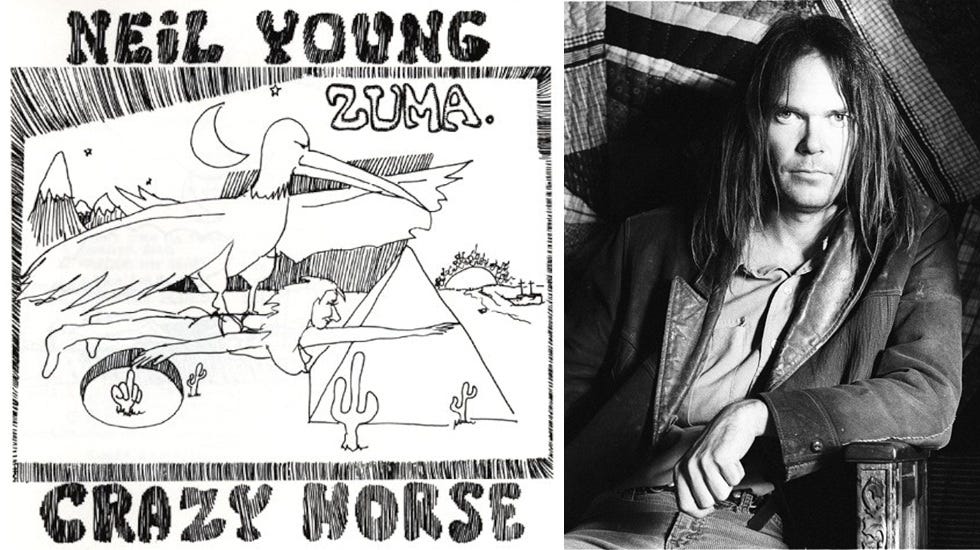
Tonight on the Friday Long Play on The Mad Music Asylum, I am featuring an album I have heard at least 500 times. Allow me to explain. In the summer of 1979, I did an internship at CNN in Atlanta Georgia. I was only there for three months, so I lived in a frat house on the Emory University campus, just down the street. Some of the “brothers” were also there that summer, and since I was working long hours, I did not get to socialize much with them. My only memory of that summer was that one of the guys was obsessed with Neil Young, and he played the Zuma album non-stop, day and night, all summer long. That album, probably more than any other is burned into my memory like no other. You would think that after repeated listenings, I would have tired of it, but you would be mistaken.
Neil Young’s Zuma stands as one of the most compelling and emotionally charged albums in his extensive catalog, representing a pivotal moment in the artist’s evolution during the mid-1970s. Released in November 1975, the album emerged from a period of personal upheaval and creative restlessness, capturing Young at his most vulnerable and electrifying.
The album’s creation was deeply intertwined with Young’s tumultuous personal life following the dissolution of Crosby, Stills, Nash & Young and amid relationship difficulties. Young retreated to his ranch in Northern California, to a studio he built near Zuma Beach in Malibu, with the Pacific coastline serving as both literal and metaphorical backdrop. Musically, Zuma represents Young’s return to a guitar-driven, rock-oriented sound, featuring Crazy Horse, whose loose, powerful playing style perfectly complemented Young’s raw emotional delivery.
The opening track “Don’t Cry No Tears” immediately establishes the album’s emotional terrain with its mixture of resignation and defiance. Young’s vocals carry a world-weary quality that suggests hard-won wisdom, while the guitar work alternates between gentle fingerpicking and soaring electric passages. This song sets the template for much of what follows: deeply personal lyrics wrapped in deceptively simple musical arrangements that reveal their complexity through repeated listening.
“Danger Bird” serves as perhaps the album’s most enigmatic and powerful statement. The song’s narrative structure, following the journey of a wounded bird, operates on multiple metaphorical levels while maintaining the directness that characterizes Young’s best songwriting. The interplay between acoustic and electric guitars creates a sonic landscape that mirrors the song’s themes of vulnerability and resilience, with Crazy Horse providing a foundation that is both sturdy and emotionally responsive.
The album’s centerpiece, “Cortez the Killer,” stands among Young’s most ambitious works. Stretching over seven minutes, the song combines historical narrative with personal reflection, using the Spanish conquest of the Aztec Empire as a framework for exploring themes of destruction and loss. The extended guitar solos represent some of Young’s most expressive playing, with each note carrying emotional weight. Despite its length challenging conventional radio formatting, its power made it impossible to ignore.
“Barstool Blues” finds Young in a more introspective mode, with the sparse arrangement highlighting the intimacy of the lyrics. The song’s exploration of loneliness and disconnection resonates with the album’s broader themes while showcasing Young’s ability to find profound meaning in seemingly mundane situations. The careful pacing and dynamic restraint demonstrate the mature artistry that Young had developed by this point in his career.
The production on Zuma achieves a remarkable balance between clarity and rawness, capturing natural reverb and ambiance that places listeners directly in the room with the musicians. Lyrically, the album finds Young grappling with themes of love, loss, and transformation with unusual directness, avoiding cryptic symbolism for clear-eyed examinations of human relationships.
The critical reception of Zuma was overwhelmingly positive, with many reviewers noting the album’s emotional honesty and musical cohesion. The record demonstrated Young’s ability to channel personal turmoil into compelling art without descending into self-indulgence or melodrama. Critics particularly praised the guitar work and the integration of the band performances, recognizing Crazy Horse as more than mere accompanists but as essential collaborators in the creative process.
Commercially, Zuma performed well, reaching the top 25 on the Billboard 200 and establishing Young’s continued relevance in the rapidly changing musical landscape of the mid-1970s. The album’s success proved that there remained an audience for thoughtful, guitar-based rock music even as disco and punk were beginning to reshape popular music.
The influence of Zuma on subsequent generations of musicians cannot be overstated. The album’s combination of emotional vulnerability and musical power provided a template for countless artists seeking to balance commercial appeal with artistic integrity. The guitar work, in particular, influenced the development of alternative rock and grunge, with musicians like Kurt Cobain citing Young as a primary influence on their approach to songwriting and performance.
Beyond its immediate impact, Zuma has continued to reveal new layers of meaning and musical sophistication over the decades since its release. The album’s themes of environmental concern, personal responsibility, and the search for authentic connection feel remarkably contemporary, suggesting that Young’s artistic vision extended well beyond the immediate circumstances of the album’s creation.
The recording process itself became part of the album’s legend, with stories of late-night sessions, spontaneous creative breakthroughs, and the careful cultivation of the right emotional atmosphere for each song. These accounts reveal an artist at the height of his creative powers, willing to take risks and push boundaries while maintaining the essential humanity that makes his music so enduring.
Today, Zuma stands as a testament to the power of honest artistic expression and the importance of maintaining creative integrity in the face of personal and professional challenges. The album represents Young at his most human, creating music that speaks to universal experiences while remaining deeply rooted in his own unique perspective and musical vision. It remains essential listening for anyone seeking to understand not only Neil Young’s artistic development but also the broader evolution of American rock music during one of its most fertile periods.
Listen to Neil’s masterpiece tonight at 9 pm Eastern time on The Mad Music Asylum.
메타데이터
- post_id
- bfe5152f2cd3
- slug
- the-staying-power-of-neil-youngs-zuma-bfe5152f2cd3
- url
- https://medium.com/@themadmusicasylum/the-staying-power-of-neil-youngs-zuma-bfe5152f2cd3
- canonical_url
- https://medium.com/@themadmusicasylum/the-staying-power-of-neil-youngs-zuma-bfe5152f2cd3
- author_url
- https://medium.com/@themadmusicasylum
- status
- ok
- fetched_at
- 2026-07-18 01:08:56