III. Papa Legba, An Epistle To Lwa
“Jete dlo oui nan lakou a Hey ho
III. Papa Legba, An Epistle To Lwa
“Jete dlo oui nan lakou a Hey ho
Ha Legba nan lakou a hey
Rassemble oui nan lakou a Hey ho” — Boukman Eksperyans, “Legba”
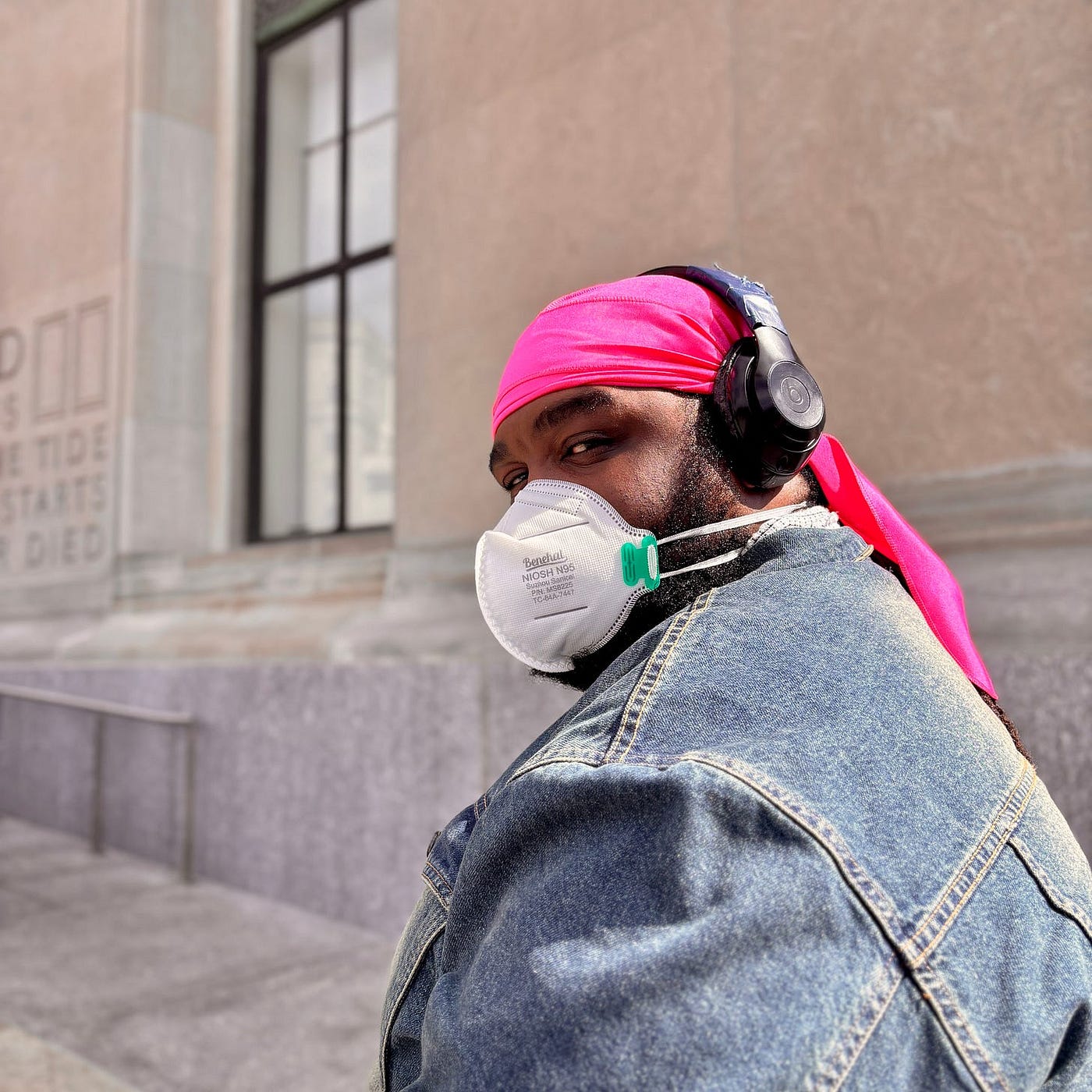
Photo of me.
Legba, I feel as though I’m at a crossroads with what it means to desire. Though I want — I yearn, desire, there’s never a dull moment where to desire instills dread upon me What is it that I want in this life? Sometimes I feel like a Black body whose thoughts I carry are to be thrown into the ether with no one to receive or capture them. There. There is where I have been preoccupied with what I didn’t want: to be wrought with the perturbation of having to be in the know to desire. Who is to say once I had what I wanted, I wouldn’t want more? But that in itself sounds sad. Part of me intellectualizes to avoid asking not because I’m ashamed of what I desire, but because I don’t know what I, as an individual Black person desires. My desire is bigger than myself. My desire is posthumous. A pursuit to discover this was a fruitless endeavor. Part of me felt the pursuit didn’t matter. The what I desire, ultimately, didn’t matter, you know? Sometimes, I’m angry when confronted with this figuring-it-out. We’re conditioned to desire a formulation of things, so the initial reaction is to reevaluate all there is to desire and what it means to accept and mourn what we’ll never have. For as long as I’m here I still have the time to speculate should fate have other plans. I was incessant about wanting my being alive to have purpose and meaning on my own terms. This is what my teenage-young adult self would fixate on. I was brought up Catholic. I was then an atheist exploring the pages of The Dhammapada who became captivated by the school of Existentialism — all within the span of my years graduating high school — being in and out of college — schools of thought I later abandoned — but some aspects of these philosophies I retained. Existentialism as a school of thought is too individualistic and the meaning that I, as a Black person, would try to create independently of this world is sutured by Eurowestern metaphysics; to put it another way, the meaning that we make up of ourselves and everything else, is antiBlack. Meandering in thought for meaning for dissatisfaction that meaning was predetermined, fear that meaning was lost, absent. Meaning is the defining marker of purpose, which is the defining marker of existence. To have desire is to have meaning and vice versa. There was a point in time where I didn’t think I was here for any reason at all. Therein lies an ongoing problem — a problem in teleology with the belief that value is tethered to finality and purpose. I accepted that I was a mistake. I was not a mistake in a pejorative way, but a mistake perhaps made on the audacious whims of my parents. Though I stress that it wasn’t much of a choice my mother had given the fact that Haitian women and girls were inculcated into a Christocatholic, cisheteropatriarchal, transphobic, misogynoirist society, (i.e.: socializing them at a young age to conform to the social contract of having children and getting married.)
Even now as an agnostic, Legba, I feel I was a fortuity that has had no goodness or ill-intention behind my being born. Despite this however, I still seldom think about three years ago when a Haitian woman by the name of Bertrhude Albert said in an Instagram post, “God made you Haitian on purpose. Discover that purpose because Haiti’s future development depends on it.” This made me think wholly differently in my relationship to myself as an Ayisyen being born in America, agnosticism, Ayiti, our collective history as Ayisyen, and being in fruitless pursuit of meaning and purpose. As uninformed and ignorant as I was (and still am) to our history, religious trauma and my growing spiritual, philosophical curiosity have consistently brought me to ask myself what has gotten me here beyond the corporeal — how otherworldly presences have manifested themselves — made themselves known through innumerable, fleeting transmutations of yesterday. The way before, now, and the to-be-actualized that happens that makes me feel as though spirits have been watching me, listening to me, but never actually allowing me to get close entices me to desire. There is nothing that you could probably tell me that would not require me to broach the dimensions of my own bewilderment. I would then find myself not to be as bewildered as I first believed. I often answer my own questions as I am frustratingly reminded that I am tasked to navigate through this dread alone. Perhaps for me god is articulated in the form of stewardship by way of my being a writer, where pursuit becomes less lonely, purpose less incapacious, meaning less informed by formulaic or programmatic structures.
Support Patrick’s writing: cash.me | venmo | paypal
Patrick Jonathan Derilus is a Nyack-born American-Haitian nonbinary writer, music producer, graphic designer, and educator who resides in Brooklyn, New York. His gender pronouns are he, him, his, or they, them, theirs. He writes poetry, short stories, and essays. He is published in The Library of Unconventional Lives, RaceBaitR, Rabble Literature Magazine, and elsewhere. He is the author of Perennial: a collection of letters.
메타데이터
- post_id
- bfe56572ee66
- slug
- iii-papa-legba-an-epistle-to-lwa-bfe56572ee66
- url
- https://medium.com/@pjd1/iii-papa-legba-an-epistle-to-lwa-bfe56572ee66
- canonical_url
- https://medium.com/@pjd1/iii-papa-legba-an-epistle-to-lwa-bfe56572ee66
- author_url
- https://medium.com/@pjd1
- status
- ok
- fetched_at
- 2026-07-11 12:56:19