The BCI Race Isn’t About the Technology
Neuralink grabs headlines. The real competition is over who builds the institutional plumbing first.
The BCI Race Isn’t About the Technology
Neuralink grabs headlines. The real competition is over who builds the institutional plumbing first.
There’s a version of the brain-computer interface story everyone knows: engineer implants a chip, patient moves a cursor with their thoughts, the world changes. Neuralink has been performing this version for two years. It’s compelling. It’s also misleading about what actually determines whether BCIs become a real industry.
The harder problem has never been whether BCIs work in a lab. It’s whether they can survive contact with the real world — the approval system, hospital billing codes, neurosurgeons who don’t want new liability, and the inside of a patient’s skull for ten years straight.
That cluster of problems — regulatory, economic, clinical — is what actually governs the pace of commercialization. Which is why the most consequential BCI developments in 2025 weren’t technical demonstrations. They were policy documents.
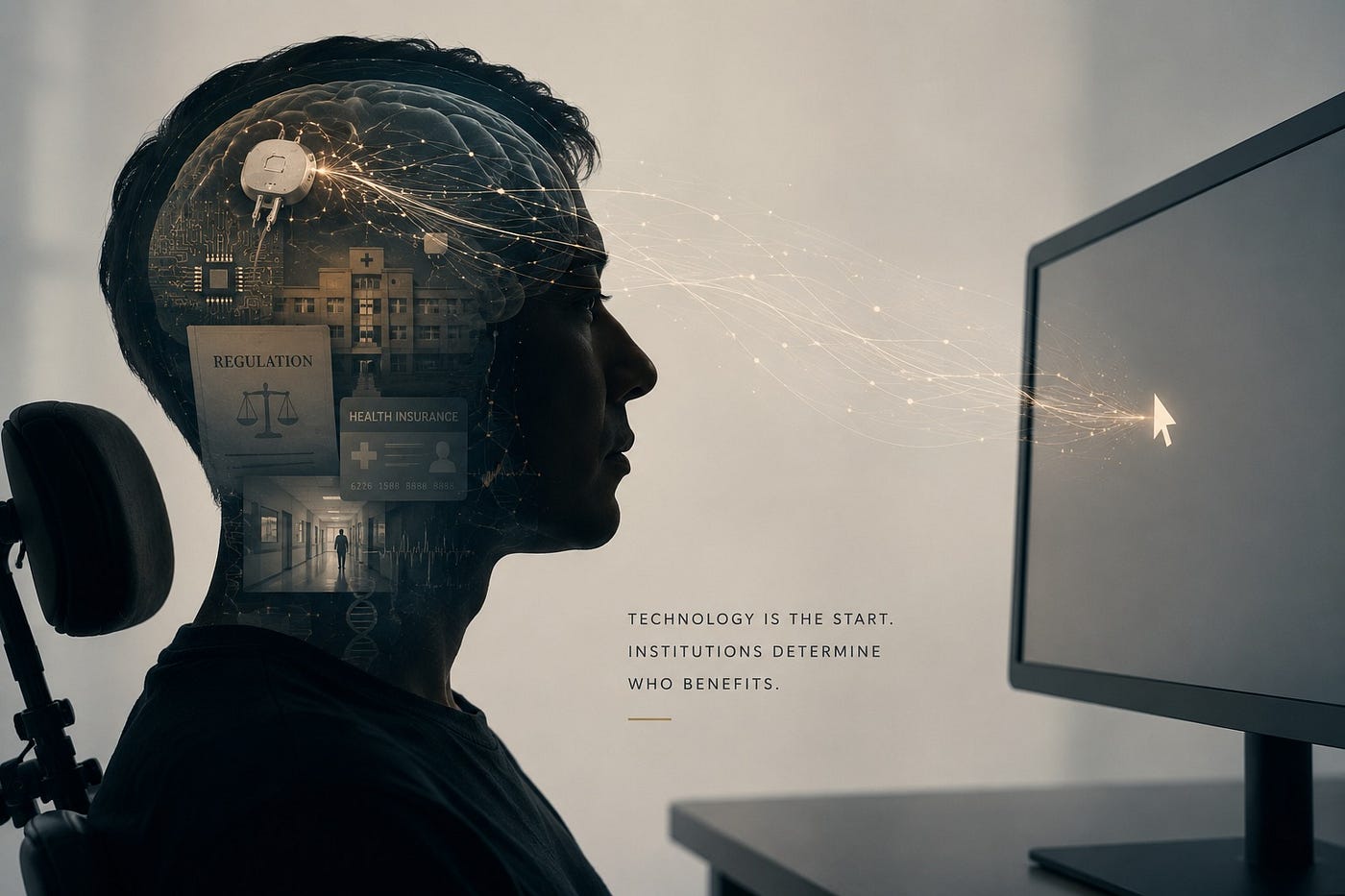
Technology is the start. Institutions determine who benefits.
China Just Moved Three Chess Pieces at Once
In 2025, China advanced industrial policy, regulatory reform, and payment infrastructure for BCIs simultaneously. Seven ministries jointly published an implementation plan targeting two to three globally competitive BCI enterprises by 2030 — covering the full supply chain from neural decoding chips to manufacturing pilots [1]. The state isn’t betting on a product; it’s betting on an ecosystem.
In the same year, China’s device regulator added implantable BCIs to its priority review catalogue [2], and the national health insurance body began incorporating neurological services into a formal pricing framework [3].
None of this means BCIs are ready to scale in China. But it means the institutional infrastructure that scaling requires is being built earlier than almost anywhere else.
The U.S. contrast is instructive. The MIND Act proposed in Congress in 2025 reflects legitimate concern about ethical and safety gaps [8] — but it’s a risk-governance frame, not an industrial strategy. The U.S. is asking how do we regulate this carefully? China is simultaneously asking how do we build the entire system this needs?
The Counterintuitive Bet on Surgery
China’s priority review covers implantable BCIs — devices requiring open-skull surgery. Not the EEG headbands. Not the consumer neurofeedback wearables. This seems backwards.
It isn’t. Invasive BCIs have something non-invasive devices lack: regulatory clarity. An implant treating severe motor paralysis is unambiguously a medical device with a defined clinical population and measurable outcome. Regulators know what to do with it.
Non-invasive BCIs are a definitional mess — medical device, rehabilitation tool, digital health product, or consumer electronics? The blurrier the category, the harder the regulatory path. The invasive route is riskier in engineering terms. It’s faster in institutional terms.
What Headlines Keep Getting Wrong
Public discussion treats human demonstrations as proof of commercial readiness. They’re not the same thing.
For invasive BCIs, the real bar is long-term stability. Chronically implanted electrodes trigger inflammatory responses, glial scarring, and signal degradation over time [7]. Deep brain stimulation — the most mature implantable neurotechnology — is still grappling with these issues after decades [4].
For non-invasive BCIs, the gap is clinical evidence. The stroke rehabilitation market is enormous — 12 million new cases annually [5] — but systematic reviews consistently find small samples, inconsistent protocols, and no long-term follow-up data [6]. “Shows promise” and “ready for standard care” are not the same sentence.
And even past evidence, there’s the adoption problem. Healthcare systems are not early adopters. A technology can be approved, billable, and clinically validated — and still take a decade to become routine.
The Real Competition
BCIs are institutionally embedded technologies. Their adoption depends on regulatory bodies, hospital systems, insurance mechanisms, and physician behavior that moves slowly by design. The race isn’t primarily about who builds the best chip — it’s about who builds the best institutional environment, and who builds it in a way that actually holds up over a decade.
China may move faster on specific high-value clinical applications. That’s a real advantage. It’s not a guarantee.
What determines who wins, ultimately, isn’t the most impressive brain demo. It’s who makes BCIs governable.
Yuyi Bei holds an MPH from Yale School of Public Health, focusing on health policy and emerging medical technologies.
References: [1] MIIT et al. (2025). Implementation Opinion on BCI Industry Development. [2] NMPA (2025). Priority Review Catalogue. [3] NHSA (2025). Neurological Service Pricing Guidelines. [4] Lozano et al. (2019). Nature Reviews Neurology. [5] GBD 2021 Stroke Collaborators (2024). Lancet Neurology. [6] Cervera et al. (2018). Annals of Clinical and Translational Neurology. [7] Polikov et al. (2005). Journal of Neuroscience Methods. [8] U.S. Congress (2025). MIND Act.
메타데이터
- post_id
- bfece9b0b0ee
- slug
- the-bci-race-isnt-about-the-technology-bfece9b0b0ee
- url
- https://medium.com/@beiyuyi10/the-bci-race-isnt-about-the-technology-bfece9b0b0ee
- canonical_url
- https://medium.com/@beiyuyi10/the-bci-race-isnt-about-the-technology-bfece9b0b0ee
- author_url
- https://medium.com/@beiyuyi10
- status
- ok
- fetched_at
- 2026-06-13 16:00:06