ICO Comeback or TGE Reset? How Token Fundraising Is Changing in 2026
Crypto fundraising in 2026 does not look like the ICO rush of 2017. It does not fully match the points-to-airdrop cycle from 2023 and 2024…
ICO Comeback or TGE Reset? How Token Fundraising Is Changing in 2026
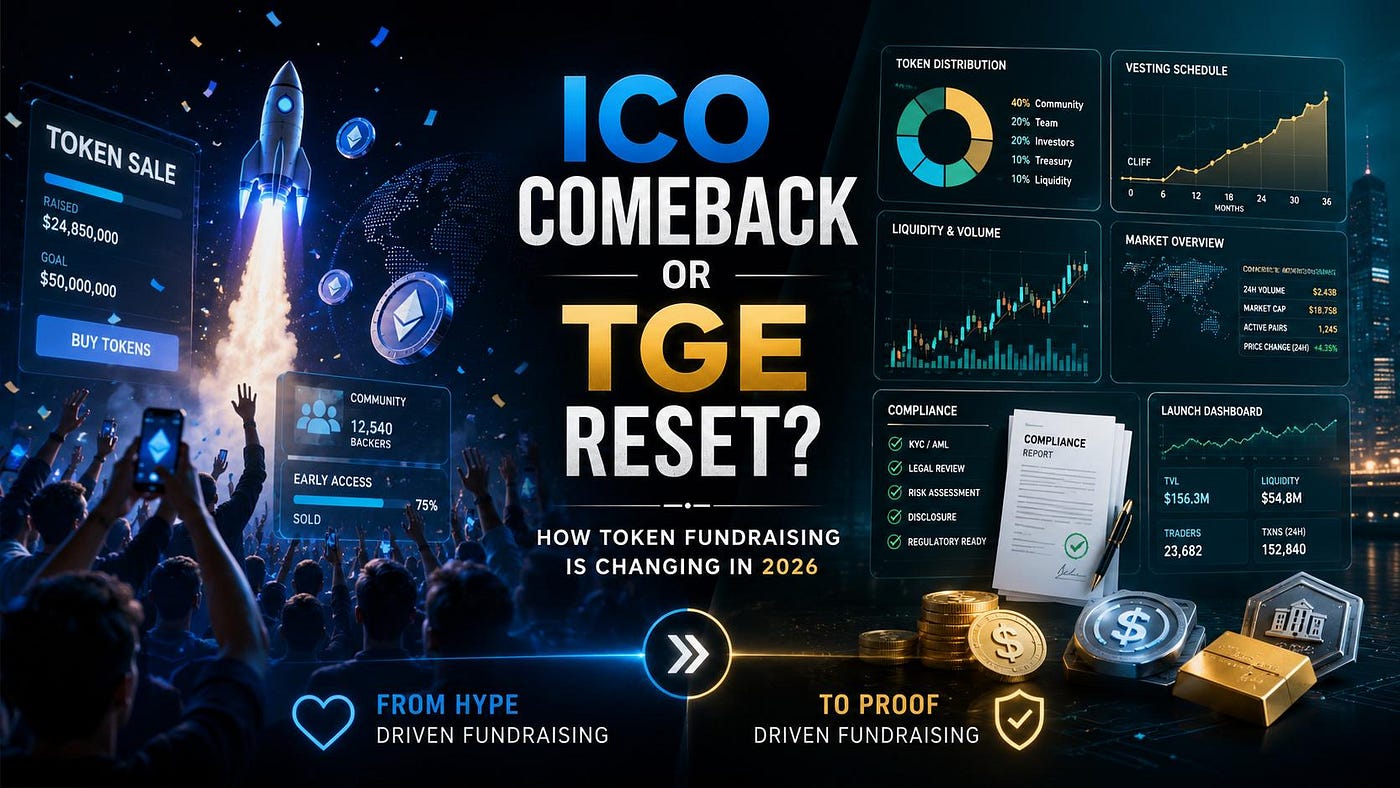
Crypto fundraising in 2026 does not look like the ICO rush of 2017. It does not fully match the points-to-airdrop cycle from 2023 and 2024 either. The market has become stricter. Founders can still raise through tokens, but buyers now expect proof before they commit.
The numbers explain the pressure. The total crypto market ended Q1 2026 near the $2.4 trillion range after a sharp quarterly fall. Centralized exchange spot volume dropped by more than 39% during the same quarter. Stablecoins stayed close to the $300 billion to $318 billion range across major trackers, which shows that capital still exists. It is just more careful now.
Tokenized real-world assets have crossed the $25 billion to $30 billion range across public trackers. Tokenized Treasuries, private credit, commodities, and fund products are pulling serious attention. This matters for every token founder. The market now compares new launches against projects with assets, revenue, users, reserves, audits, or payment activity.
A token sale can no longer survive on a whitepaper and a loud Telegram group.
That is the real change.
2026 is not a simple ICO comeback. It is a reset in how token fundraising works. ICO-style sales are returning in a more controlled form. TGE planning has become more disciplined. Public sales, launchpads, private rounds, airdrops, listings, liquidity plans, and community campaigns now sit inside one larger launch plan.
The question is no longer, “Can we raise with a token?”
The better question is, “Can the market trust this token after launch?”
Why Fundraising Feels Harder in 2026
Crypto still has capital, attention, and active users. The problem is trust. Many buyers have seen token launches open with big claims and then fade within weeks. That has changed how people judge new projects.
Retail users now check unlock schedules, vesting terms, token use, product status, team activity, and exchange plans. Venture investors ask for user data, revenue signals, legal structure, and product depth. Exchanges study liquidity quality, distribution, and holder risk.
This creates a new fundraising climate. Projects with real use can still attract money. Projects built only around launch noise now face more resistance.
ICO Comeback or TGE Reset?
The answer is both, but not in the old way.
ICO-style fundraising is returning because many founders still need early capital from a crypto-native audience. They want buyers, early users, and community members involved before listing. That part has not changed.
The rules around it have changed.
A 2026 ICO needs tighter sale terms, legal review, buyer checks, clear token use, safer vesting, and better treasury planning. It cannot rely on vague claims or loose promises.
A TGE has changed too. It is no longer just the day a token becomes tradable. It is the point where the market tests the project. Buyers watch liquidity, claims, sell pressure, product use, exchange depth, and community response from day one.
An ICO raises attention before the market forms.
A TGE proves whether that market can hold.
Founders need both types of planning now. They need sale discipline before fundraising. They need market discipline before launch.
Why the Old ICO Model Cannot Return
The old ICO model was fast. A team published a whitepaper, opened a sale, built a global community, and raised money without a long venture process.
That speed created problems. Many projects had weak products, unclear token rights, poor legal review, and no real plan after listing. Buyers paid for future promises. Many never saw those promises turn into working products.
2026 does not allow that same loose model.
Buyers now check proof first
Token buyers now study the project before entering a sale. They look at:
- Product status
- Smart contract readiness
- Team record
- Token unlock schedule
- Liquidity plan
- Exchange path
- Community quality
- Treasury use
- Legal position
A weak sale page cannot protect a weak project anymore.
Regulators focus on facts, not labels
A token name does not decide its legal status. The sale structure, buyer rights, marketing claims, expected returns, and token use matter more.
This changes how founders write sale pages, social posts, staking messages, bonus offers, and influencer scripts. Loose wording can create real risk.
Exchanges dislike messy launches
Exchanges want projects with cleaner token distribution, safer liquidity planning, and a lower risk of early holder dumping. A rushed sale can hurt listing discussions later.
Listing teams now study token allocation, legal issues, community health, and market support plans.
Communities ask sharper questions
Crypto users have become more direct. They ask:
- Who gets tokens first?
- What is the unlock plan?
- What is the product status?
- What happens after TGE?
- Why does this token need to exist?
- Will early buyers dump on public users?
A project that cannot answer these questions will struggle.
The TGE Reset: Launch Has Become Market Design
A TGE once looked like a finish line. The project raised funds, announced listing, released claim details, and celebrated launch day.
That model is weaker now.
A **TGE launch services** in 2026 is a market design event. It decides who gets supply, how liquidity opens, how selling pressure appears, how users behave, and how long attention lasts.
Distribution quality beats large numbers
Large airdrops and public sales can look impressive. That does not always mean strong demand. Many wallets claim tokens, sell early, and leave.
Better teams study user quality before distribution. They ask:
- Did this user help the product?
- Did this wallet show real activity?
- Did this buyer understand the project?
- Did this community member stay active over time?
- Does this allocation create long-term value?
A smaller holder base with real interest can beat a large one with no loyalty.
Liquidity planning starts early
Liquidity cannot be added at the last minute. Founders need a plan for trading pairs, launch venue, market depth, LP allocation, market-maker support, treasury reserve, and volatility response.
Thin liquidity creates bad price action.
Loose supply creates early sell pressure.
Restricted access limits buyer interest.
A strong TGE balances these factors before launch day.
Vesting has become a trust signal
Unlock schedules now shape buyer confidence. Fast insider unlocks create fear. Heavy private allocation can make public buyers cautious. Weak community vesting can create claim-and-sell behavior.
Good vesting tells the market that the team understands patience.
It protects users from sudden supply shocks.
The first 90 days matter more than the first day
A token can trend on launch day and still lose attention fast. The market now studies the first 30 to 90 days after TGE.
Projects need planned updates across:
- Product releases
- Exchange follow-ups
- Community events
- Liquidity checks
- Governance activity
- Ecosystem rewards
- Founder communication
- Unlock calendar updates
Silence after launch damages trust.
What Is Changing Token Fundraising in 2026?
Several forces are changing how founders raise money through tokens. These forces affect sale design, token use, investor messaging, and launch timing.
Stablecoins Made On-Chain Fundraising Easier
Stablecoins now sit at the center of crypto capital movement. They help users move value across exchanges, wallets, DeFi apps, launchpads, and payment rails.
For fundraising, this matters. A buyer can join a token sale using a familiar digital dollar unit. A project can price its sale in USDT or USDC. A launchpad can settle funds faster. A treasury can hold capital without immediate conversion pressure.
Stablecoins make token fundraising more practical, even in a cautious market.
They support:
- Faster global participation
- Clear sale pricing
- Simple treasury accounting
- Stronger trading pair options
- Better exchange liquidity planning
Stablecoins do not create demand by themselves. They make participation easier once demand exists.
Venture Capital Has Become More Selective
Crypto venture capital still exists, but it is more focused. Larger rounds are going toward payments, infrastructure, AI, DeFi, prediction markets, and data systems with visible usage.
Early-stage teams face tougher questions. Investors want proof. They want users, revenue signals, product progress, legal clarity, and a credible token plan.
This pushes some teams back toward community fundraising. ICOs, launchpads, private sales, and hybrid rounds now give founders more options.
But public buyers ask hard questions too.
They compare private sale terms against public sale terms. They study vesting. They check insider allocations. They want to know whether early funds get a better deal with less risk.
A fundraising plan must feel fair, not just attractive.
RWA Growth Raised the Proof Standard
Tokenized real-world assets changed buyer expectations. RWA projects deal with assets that can be valued, stored, audited, and reported. That creates a stronger proof culture.
Buyers now ask practical questions:
- Where is the asset?
- Who verifies it?
- Who holds custody?
- How is value reported?
- Who can transfer the token?
- What happens during a dispute?
This mindset has spread to other token categories too. AI projects need usage data. DePIN projects need network activity. DeFi projects need volume and liquidity. Gaming projects need real players.
The market now wants proof before price action.
Points Programs Face More Doubt
Points programs helped many projects attract activity before token launch. Users earned points through trading, referrals, testing, staking, posting, or wallet actions.
The problem is quality.
Many users now farm points with no real loyalty. They join early, complete tasks, wait for allocation, sell the token, and leave.
That has forced a reset.
Projects now need better filters:
- Long-term activity scoring
- Bot detection
- Wallet quality checks
- Product-based rewards
- Smaller rewards for shallow tasks
- Larger rewards for real contribution
- Vesting for large allocations
A points campaign can still work. It must reward useful behavior, not empty motion.
Regulation Changed Fundraising Language
Fundraising copy now needs more care. Projects cannot casually promise gains, guaranteed listings, passive income, or protected returns.
This affects:
- Website copy
- Whitepapers
- Pitch decks
- KOL scripts
- Telegram replies
- AMA answers
- Sale announcements
- Staking pages
Safer communication does not mean weak communication. It means accurate communication.
Projects should explain use, risk, access, timing, allocation, and limits in plain language. That builds trust faster than hype.
Token Utility Is Judged Earlier
A token needs a clear role before fundraising starts. The old habit of launching first and adding utility later has become risky.
The market now asks what the token does inside the product.
Common roles include:
- Access
- Payment
- Rewards
- Governance
- Collateral
- Fee discounts
- Staking
- Settlement
- Network participation
A good token role connects to real user behavior. It gives people a reason to use or hold the token beyond price movement.
Which Fundraising Model Fits 2026?
Founders should not choose a model based on trend value. The right model depends on product maturity, user base, legal position, buyer type, liquidity needs, and exchange plan.
ICO: Direct Fundraising With Stronger Rules
An ICO can work in 2026 for projects with a clear token role, a serious community, and a controlled sale plan.
Best fit:
- Infrastructure projects
- Utility networks
- Gaming economies
- DePIN systems
- AI platforms
- Community-owned apps
- Early ecosystems that need startup capital
A stronger ICO needs:
- Legal review
- Clear token classification
- Buyer eligibility checks
- Defined treasury use
- Sale cap discipline
- Vesting schedules
- Smart contract audits
- Post-sale product timeline
An ICO can still raise well. It needs structure.
IDO: Community-Led Market Entry
An IDO works for projects that want DEX access, launchpad support, and crypto-native buyers.
Best fit:
- DeFi protocols
- Trading tools
- Wallet apps
- Gaming projects
- Smaller community-led launches
- Projects with active on-chain users
An IDO needs:
- Launchpad credibility
- Bot protection
- Fair allocation rules
- Liquidity depth
- Token pair planning
- Claim timing
- Community education
- Slippage control
A strong IDO feels organized from the first block.
IEO: Exchange-Led Sale Access
An IEO gives projects access to an exchange audience. It can support buyer trust since the exchange reviews the project before sale.
Best fit:
- Projects ready for wider retail access
- Tokens with stronger documentation
- Teams prepared for exchange checks
- Projects that need larger user reach
The tradeoff is control. The exchange can influence timing, access rules, sale terms, pricing, and listing details.
Fair Launch: Better for Communities With Real Demand
A fair launch can work when the community already understands the project. It reduces insider advantage and can support trust.
Best fit:
- Products with active users
- Meme or community tokens with strong culture
- DeFi tools with existing activity
- Open networks with simple supply rules
A fair launch still needs planning. Liquidity, contract safety, communication, and claim rules matter from the start.
TGE: Best for Projects Ready for Market Pressure
A TGE can serve many roles. It can open trading, distribute rewards, activate governance, start staking, or begin ecosystem incentives.
Best fit:
- Products with real users
- Protocols with testnet activity
- Projects with planned exchange access
- Communities ready for token use
A strong TGE needs:
- Clear token use
- Liquidity readiness
- Claim rules
- Vesting design
- Exchange or DEX path
- Support plan for the first 90 days
A TGE should open a working market, not just a trading symbol.
What Strong Token Fundraising Looks Like in 2026
The best 2026 fundraising plans share a few traits. They do not rush the sale. They prepare the market first.
Clear Reason for the Token
The project must explain why the token exists in one plain sentence. A forced answer creates doubt.
A strong token reason can involve:
- Network access
- App payments
- User rewards
- Protocol governance
- Collateral use
- Fee reduction
- Supply-side incentives
- Settlement inside the product
The token should solve a real design problem.
Sale Terms That Match the Project Stage
A large raise with little proof can look careless. A smaller raise with clear milestones can feel more credible.
Founders need to plan:
- Hard cap
- Soft cap
- Sale price
- Private sale terms
- Public sale access
- Vesting
- Treasury use
- Liquidity allocation
- Unsold token handling
Every number creates a market signal.
Better Buyer Quality
Not every buyer helps a launch. Some users only want a quick flip. Some wallets farm allocations. Some regions create legal risk.
Better buyer quality can come through:
- Whitelists
- KYC checks
- Contribution limits
- Region controls
- Launchpad screening
- Reputation scoring
- Community participation records
A smaller, cleaner sale can beat a larger weak sale.
Community Before Capital
A project should not open fundraising with an empty room. The community should already understand the product, the token role, and the launch plan.
Useful signals include:
- Real questions in Telegram
- Active Discord discussions
- Founder posts on X
- Beta user feedback
- Waitlist activity
- Testnet participation
- Educational content engagement
Follower count alone means little. The quality of attention matters.
Liquidity Planning Before Listing
Many teams raise first and think about liquidity later. That creates risk.
A good plan answers these questions early:
- DEX, CEX, or hybrid launch?
- Which trading pairs make sense?
- How much liquidity is needed?
- Who manages market-making?
- What supply unlocks on day one?
- What happens during volatility?
- Who communicates during price movement?
Fundraising and liquidity planning now belong together.
Proof-Based Marketing
Marketing still matters, but the content must show proof. The strongest campaigns explain what already works.
Useful proof includes:
- Testnet users
- Revenue data
- Wallet activity
- Audit completion
- App downloads
- Signed partners
- API calls
- Liquidity commitments
- Enterprise pilots
- Asset verification
- Community retention
Good marketing does not replace proof. It makes proof easier to understand.
Which Project Categories Can Raise Better in 2026?
Not every category gets the same response from buyers. The market prefers projects that can show demand, use, assets, or network activity.
RWA Tokens
RWA projects attract attention because they connect tokens to real assets. That can include Treasuries, credit, real estate, commodities, invoices, funds, or whisky casks.
- Custody details
- Asset valuation
- Legal structure
- Transfer rules
- Reporting process
- Buyer eligibility checks
RWA projects win trust through documentation, not noise.
Stablecoin and Payment Projects
Stablecoin and payment systems remain attractive because they solve clear money movement problems.
These projects need:
- Reserve explanation
- Redemption process
- Banking partners
- Custody details
- Compliance controls
- Payment use cases
The market expects reliability in this category. Big claims do not work here.
AI Crypto Tokens
AI crypto projects still get attention, but buyers are more careful now. The token must connect to real use.
Strong proof includes:
- API usage
- Agent activity
- Paid users
- Compute demand
- Data contribution
- Model access
AI branding alone is weak. AI with usage still earns attention.
DePIN Tokens
DePIN projects need measurable network activity. That can include nodes, devices, coverage, bandwidth, storage, sensors, or mapping.
Buyers look for:
- Real device count
- User demand
- Reward logic
- Network coverage
- Supply-side retention
- Revenue path
A DePIN token must reward useful work.
Gaming and Consumer Tokens
Gaming projects need product proof before token launch. Players care about the game first. The token comes second.
Stronger signs include:
- Playable build
- Active users
- Retention data
- In-game economy tests
- Marketplace activity
- Creator activity
- Community events
The token should support the experience. It should not replace the product.
Common Fundraising Mistakes Founders Should Avoid
Token fundraising fails when teams rush decisions that need careful planning.
Raising Too Early
Early fundraising creates pressure. A weak product, unclear token role, and poor legal review can damage the project before launch.
Funds help only when the team has a real plan for using them.
Overpromising Token Utility
Some teams claim one token can handle governance, payments, staking, rewards, burns, access, and growth. That sounds crowded.
A few clear functions work better than many weak ones.
Weak Vesting
Bad vesting can hurt trust fast. Fast insider unlocks create fear. Heavy private allocation can push public buyers away.
Vesting should protect long-term market health.
Treating Marketing Like Noise
Marketing is not just promotion. It explains the project, educates buyers, answers doubts, and prepares the community.
Bad marketing creates hype.
Good marketing creates clarity.
Ignoring Post-Launch Support
A token launch needs support after listing. Teams must plan content, updates, liquidity checks, community activity, and user education.
The market watches what happens after the sale.
A Practical 2026 Fundraising Plan
Founders can reduce risk by planning fundraising in stages.
Token Readiness
Start with the token itself.
Check:
- Token purpose
- Legal review
- Smart contract design
- Supply allocation
- Vesting model
- Utility role
- Governance scope
- Treasury plan
This stage prevents bigger problems later.
Market Readiness
Next, test market interest.
Track:
- Community response
- Waitlist quality
- Beta activity
- Content engagement
- Investor feedback
- Partner interest
- KOL response
- Search demand
A project should not open a sale until the market understands the story.
Fundraising Design
Then choose the sale model.
Decide:
- Private sale or public sale
- Launchpad or direct sale
- Fixed price or tiered price
- KYC or open access
- Vesting or instant claim
- DEX, CEX, or hybrid path
- Sale fallback plan
The model should fit the project, not the trend.
Launch Execution
The public campaign must stay consistent across website, whitepaper, X, Telegram, Discord, PR, KOLs, AMAs, and launchpad pages.
The message can change format by channel. It should not change meaning.
Post-TGE Support
After launch, the team must track:
- Liquidity depth
- Claim behavior
- Holder spread
- Community mood
- Product use
- Exchange activity
- Governance activity
- Unlock dates
- Support issues
- Campaign results
A strong post-TGE plan helps the token move from launch attention to real market presence.
What Founders Should Learn From the 2026 Shift
Token fundraising still works. It just works under tougher rules.
An ICO can still help early teams raise capital and form a community. A TGE can still open the market for a token. A launchpad can still bring buyers. Airdrops can still reward users.
None of these models work well without proof.
Founders need to match the fundraising method to the project’s real stage. A working DeFi product may need a TGE with strong liquidity. An RWA project may need restricted access and clear asset records. A DePIN network may need node data before sale. A gaming project may need player retention before token distribution.
The right question is not, “Which model is trending?”
The right question is, “Which model fits our proof, users, legal position, and liquidity plan?”
That question leads to better fundraising choices.
Final Thoughts
Token fundraising in 2026 is not returning to the old ICO era. It is becoming more mature, more measured, and more proof-led.
The ICO comeback is real only for projects that can meet stronger buyer expectations. The TGE reset is real because distribution alone no longer counts as success.
A strong token launch now starts long before the sale opens. It continues long after listing. Founders need clear token use, active community, safer sale terms, better liquidity planning, disciplined marketing, and steady post-launch support.
The market still rewards strong token stories.
It now asks for evidence first.
메타데이터
- post_id
- bfed0a0b43ea
- slug
- ico-comeback-or-tge-reset-how-token-fundraising-is-changing-in-2026-bfed0a0b43ea
- url
- https://medium.com/activated-thinker/ico-comeback-or-tge-reset-how-token-fundraising-is-changing-in-2026-bfed0a0b43ea
- canonical_url
- https://medium.com/activated-thinker/ico-comeback-or-tge-reset-how-token-fundraising-is-changing-in-2026-bfed0a0b43ea
- author_url
- https://medium.com/@vimal-joseph
- status
- ok
- fetched_at
- 2026-06-13 16:00:06