Equal With the Only God
How Jesus’ Enemies Testify to His Consubstantial Sonship in John 5
Equal With the Only God
How Jesus’ Enemies Testify to His Consubstantial Sonship in John 5
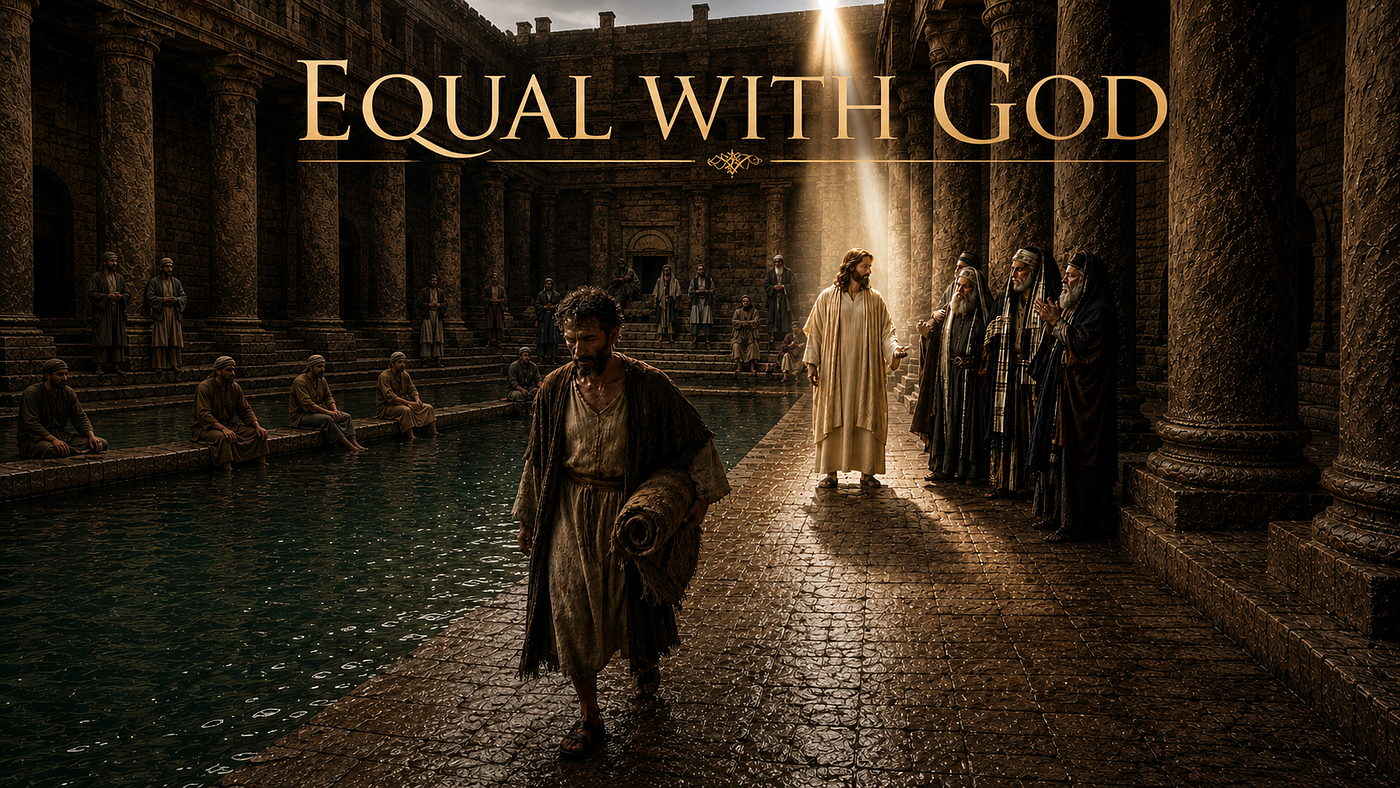
A man had been lying beside the pool for thirty-eight years. Jesus healed him on the Sabbath and told him to pick up his mat, and the authorities came after Him for it.
He gave them one sentence. “My Father is working until now, and I am working.” (John 5:17, ESV)
The charge changed. They had come about a broken Sabbath. They left looking for a way to kill Him. Blasphemy was a capital offense, and blasphemy meant claiming for oneself what belongs to God alone. That is the charge they added, and it is the one that explains the escalation.
When Jesus called God His own Father, the Jews did not hear a title. They heard a claim to God’s own nature, and they tried to kill Him for it.
Israel had sons of God in the loose sense and nobody died over it. The nation was God’s son (Exodus 4:22). The king was God’s son (Psalm 2:7). The righteous were called his sons. None of that was blasphemy. So whatever Jesus said at the pool, it was not that.
What He said was that God was His own Father, ἴδιον, His in a way that belonged to no one else, and that His working and the Father’s working were one working. Aquinas reads the word exactly this way: God is His Father by nature, and the Father of others by adoption. Men who knew that difference heard Him correctly. A son in the proper sense is what his father is.
They were also monotheists. That is the part their reaction makes unavoidable and the part that decides the question. They did not conclude that Jesus was claiming to be a second God, because in their world there was no category for a second source of all reality. They concluded He was claiming to be equal with the only God there is.
But what could equality with God mean to monotheists who believed there was only one God to be equal to?
The Main Argument
P1. The Jews believed there is only one God, the uncreated source of all reality.
P2. They understood Jesus’ claim that God was uniquely His own Father as a claim to equality with God.
“This was why the Jews were seeking all the more to kill him, because not only was he breaking the Sabbath, but he was even calling God his own Father, making himself equal with God.” (John 5:18, ESV)
P3. Equality with God through unique Sonship, in a belief system where there is only one God, is a claim to be what that one God is while remaining personally distinct as Son.
P4. Jesus confirmed rather than corrected them, claiming the Father’s own works, life in Himself, all judgment, and equal honor.
C. Therefore the Sonship the Jews recognized and Jesus affirmed is a Sonship in the nature of the one God: consubstantial with the Father, though personally distinct from Him.
The Jews had no hesitation understanding what Jesus was saying, and evidently what He was saying was worthy of death. So He could not have been claiming to be a son of God in a lesser sense. They were hostile, and they named the reason why: claiming to be equal with God.
What they could not do was hold their monotheism and their reading of Jesus at the same time without arriving somewhere they had no intention of going. If there is one God, and this man is claiming equality with Him, then the claim is not that He is a second God, because that option is ruled out in their own monotheism. The claim is that what God is, this man is. There is only one God, and His statement makes Him equal with that one by nature. He is therefore claiming to be God consubstantially.
That is what the word consubstantial means. A second divine being was never on the table, so a lesser one is ruled out with it. What is left is the same God, in a distinct person, standing in front of them and calling the one God His own Father in a way that belonged to no one else and amounted to equality. That is the blasphemy they charged Him with.
Their charge was accurate. Their verdict was wrong, because what they took for blasphemy was true.
The Confirmation
If they had misread Him, the moment to say so was here. John says so elsewhere. When Jesus told them to destroy the temple and He would raise it in three days, they took Him to mean the building, and John steps in to tell the reader what was meant, that He spoke of the temple of His body. The evangelist corrects misunderstandings when misunderstandings occur.
At the pool He does not correct anything. He reports the charge and lets it stand, and then records what Jesus said next.
The Son does what the Father does, and does it in the same way. The Father raises the dead and gives life, and the Son gives life to whom He will. The Father judges no one, having given all judgment to the Son. The Father has life in Himself, and has granted the Son to have life in Himself, which can only be explained by consubstantiality, not separate being theology. And all of it lands on one command: that all may honor the Son just as they honor the Father.
Jesus isn’t walking a claim back. He’s raising it. Chrysostom saw the shape of it plainly: if equality had not been meant, the defense would have been worse than the charge. Accused of making Himself equal with God, Jesus answers by claiming the works of God, the life of God, the judgment of God, and the honor of God. A denial does not look like that.
And the honor is the piece that cannot be explained away. Works can be done through a prophet. Judgment can be handed to an appointed man. But the God of Israel says He will not give His glory to another, and here is the Son receiving the honor due to the Father alone. Either that is idolatry, or the Son is not another god beside the Father.
The Givenness Objection
The objector notes that the Father “gave” the Son to have life, gave Him authority to judge, and that the Son “can do nothing of Himself.” He concludes the Son’s divinity is received, and therefore inferior. That objection fails, and the following argument demonstrates the point conclusively.
P1. The Father has life in Himself as the uncreated source of all reality.
P2. Jesus says the Son has life in Himself just as the Father does.
P3. Nothing whose nature is composed or conditioned can possess self-existent life.
C. Therefore, the Son is not a conditioned being but shares the nature of the one God.
Composed means made of parts, and whatever is made of parts by nature depends on them. Take away the parts and the thing is gone. It also depends on whatever holds the parts together, which means it depends on something other than itself for being what it is. That is what conditioned means. Not made at a moment, necessarily. Held in place by something.
This is where age gives no help. A thing can have existed forever and still hold its existence from another. Beginningless is not the same as self-existent. An eternal dependent is still a dependent, and life in Himself is not a claim about how long someone has lasted. It is a claim about whether the life is His own or held from something outside Him. No amount of past turns held life into life in Himself.
So the question to ask of any candidate for deity is not when he started. It is whether he is made of anything. A being with a body of flesh and bone by nature is composed. Whatever is by nature composed has its being from its parts and from whatever arranged them, and a being like that does not have life in himself, however long he has had it. He has it the way everything else has it. On loan extrinsically.
The Father "giving" this life to the Son refers to eternal generation, not the Son acquiring divinity. A God who knows Himself perfectly was never without the perfect expression of that self-knowledge, which is the argument I made at length in The Trinity, and Why We Exist.
The objection also mistakes what kind of giving this is. The Father does not hand over a portion of divinity, or a commission, or an office. He gives everything He has except being Father. The knower and the known are one being, told apart only by how each stands to the other. Nothing is held back but the relation itself, which is why the Son can be all that the Father is while never being the Father. A gift that withholds nothing cannot leave the recipient with less.
The Close
They were right about what He said. That is the thing worth sitting with. The people best positioned to hear a Galilean carpenter say something modest about God’s fatherhood, in their own language, in their own city, on their own holy day, heard a man claim to be what God is. They grasped the meaning immediately and sought to kill Him.
The reading has never depended on a council. It was there in the reaction of men who wanted Him dead, and the councils only wrote down what those men had already understood.
What was left to them was the same thing left to us. Not what He meant. That was never in doubt. Only whether He was telling the truth.
메타데이터
- post_id
- bffd97cea2ae
- slug
- equal-with-the-only-god-how-jesus-enemies-testify-to-his-consubstantial-sonship-in-john-5-bffd97cea2ae
- url
- https://medium.com/@tyson.guess/equal-with-the-only-god-how-jesus-enemies-testify-to-his-consubstantial-sonship-in-john-5-bffd97cea2ae
- canonical_url
- https://medium.com/@tyson.guess/equal-with-the-only-god-how-jesus-enemies-testify-to-his-consubstantial-sonship-in-john-5-bffd97cea2ae
- author_url
- https://medium.com/@tyson.guess
- status
- ok
- fetched_at
- 2026-07-30 16:47:26