The Village That Knew Everything
An Uncle Rwamiti Story About Knowledge, Action, and Why the Smartest Village in Africa Nearly Starved
The Village That Knew Everything
An Uncle Rwamiti Story About Knowledge, Action, and Why the Smartest Village in Africa Nearly Starved
AI image generated by the author
The year was 2050.
The village of Kanyegero had become famous across Africa.
Researchers visited.
Government officials visited.
University professors visited.
Even artificial intelligence systems visited, although nobody was quite sure how an AI “visited” anything.
The village had won awards for knowledge.
Thousands of reports had been written about it.
There were reports on agriculture.
Reports on health.
Reports on education.
Reports on climate resilience.
Reports on women’s empowerment.
Reports on youth entrepreneurship.
Reports on sanitation.
Reports on reports.
The village possessed more documented knowledge per goat than any other place in East Africa.
And yet something strange was happening.
People were hungry.
One hot afternoon, Uncle Rwamiti arrived in the village.
Not under a mango tree.
Not at a conference.
Not at a university.
He arrived at a market.
Or rather, what used to be a market.
Half the stalls were empty.
Farm yields had fallen.
Young people were leaving.
The village looked tired.
At the centre of the market stood a magnificent building.
Its sign read:
THE NATIONAL CENTRE FOR KNOWLEDGE EXCELLENCE
Rwamiti smiled.
Whenever people put words like “National,” “Excellence,” or “Strategic” on a building, he had learned to become suspicious.
Inside the building were thousands of books.
Millions of digital files.
Hundreds of screens.
The latest artificial intelligence systems.
A guide proudly welcomed him.
“Welcome, sir.”
“This centre contains fifty years of accumulated knowledge.”
“Wonderful,” said Rwamiti.
“What have you done with it?”
The guide looked confused.
“What do you mean?”
Rwamiti pointed to the shelves.
“Has crop productivity increased?”
“Not really.”
“Has household income increased?”
“Not much.”
“Has youth unemployment fallen?”
“No.”
“Has malnutrition decreased?”
“Not significantly.”
The guide became uncomfortable.
“But we have knowledge.”
Rwamiti nodded.
“I can see that.”
The guide continued.
“We have over twelve thousand reports.”
“Excellent.”
“What problem have they solved?”
Silence.
The guide changed the subject.
“We also have an AI system.”
“Wonderful.”
“What has it changed?”
More silence.
Rwamiti walked outside.
Across the road sat an old woman selling cassava.
Her stall was small.
Her clothes were simple.
Her education was limited.
But customers surrounded her.
Rwamiti bought a piece of cassava.
“Why are so many people buying from you?”
The woman laughed.
“Because I listened.”
“To whom?”
“To the reports.”
Rwamiti raised an eyebrow.
This was becoming interesting.
The woman explained.
“Twenty years ago, some researchers came here.”
“They discovered better drought-resistant crops.”
“They wrote a report.”
“What happened?”
“Nothing.”
“Then another group came.”
“They wrote another report.”
“What happened?”
“Nothing.”
“Then another group came.”
“They wrote another report.”
“What happened?”
The woman grinned.
“Nothing.”
Rwamiti laughed.
“This story is becoming expensive.”
“It gets worse,” she said.
“Eventually I borrowed the reports.”
“I read them.”
“I tested the ideas.”
“I kept what worked.”
“I ignored what didn’t.”
“And?”
“My farm tripled production.”
The old woman pointed toward the knowledge centre.
“They possess knowledge.”
She pointed toward her garden.
“I use knowledge.”
At that moment, a group of university students arrived.
One asked Uncle Rwamiti:
“Jajja, what is the difference between those two things?”
Rwamiti looked at the enormous building.
Then he looked at the old woman’s stall.
“The difference,” he said slowly,
“is the difference between a cookbook and a meal.”
The students laughed.
“You can own a thousand cookbooks and still be hungry.”
More laughter.
“You can download ten million research papers and still solve nothing.”
The students nodded.
“You can attend conferences every week.”
“You can collect certificates.”
“You can earn degrees.”
“You can subscribe to every AI platform on earth.”
He paused.
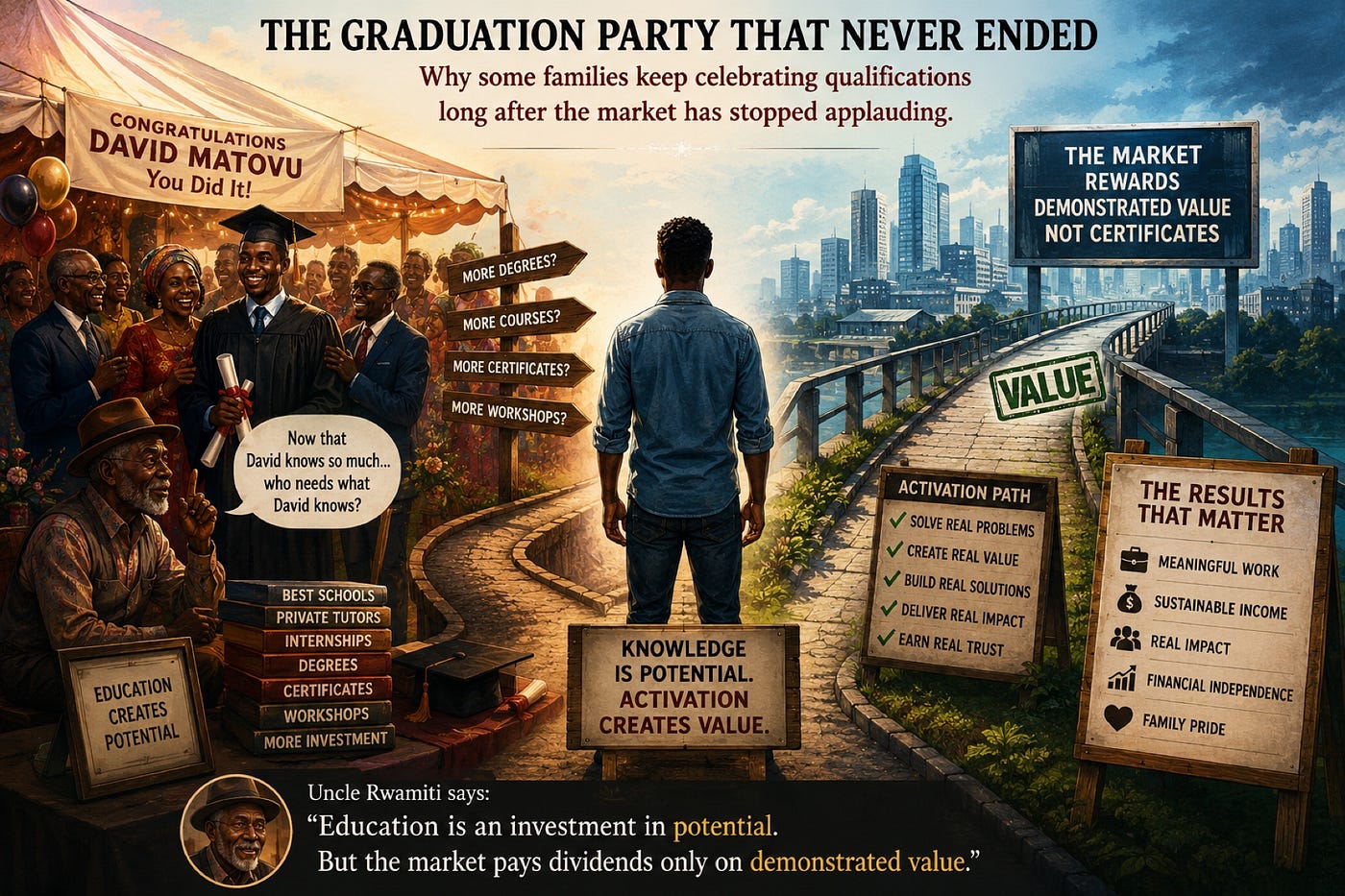
“But knowledge becomes valuable only when somebody uses it.”
One student raised her hand.
“So what became the most valuable profession in 2050?”
Rwamiti smiled.
“Not researchers.”
“Not consultants.”
“Not even artificial intelligence engineers.”
“Then who?”
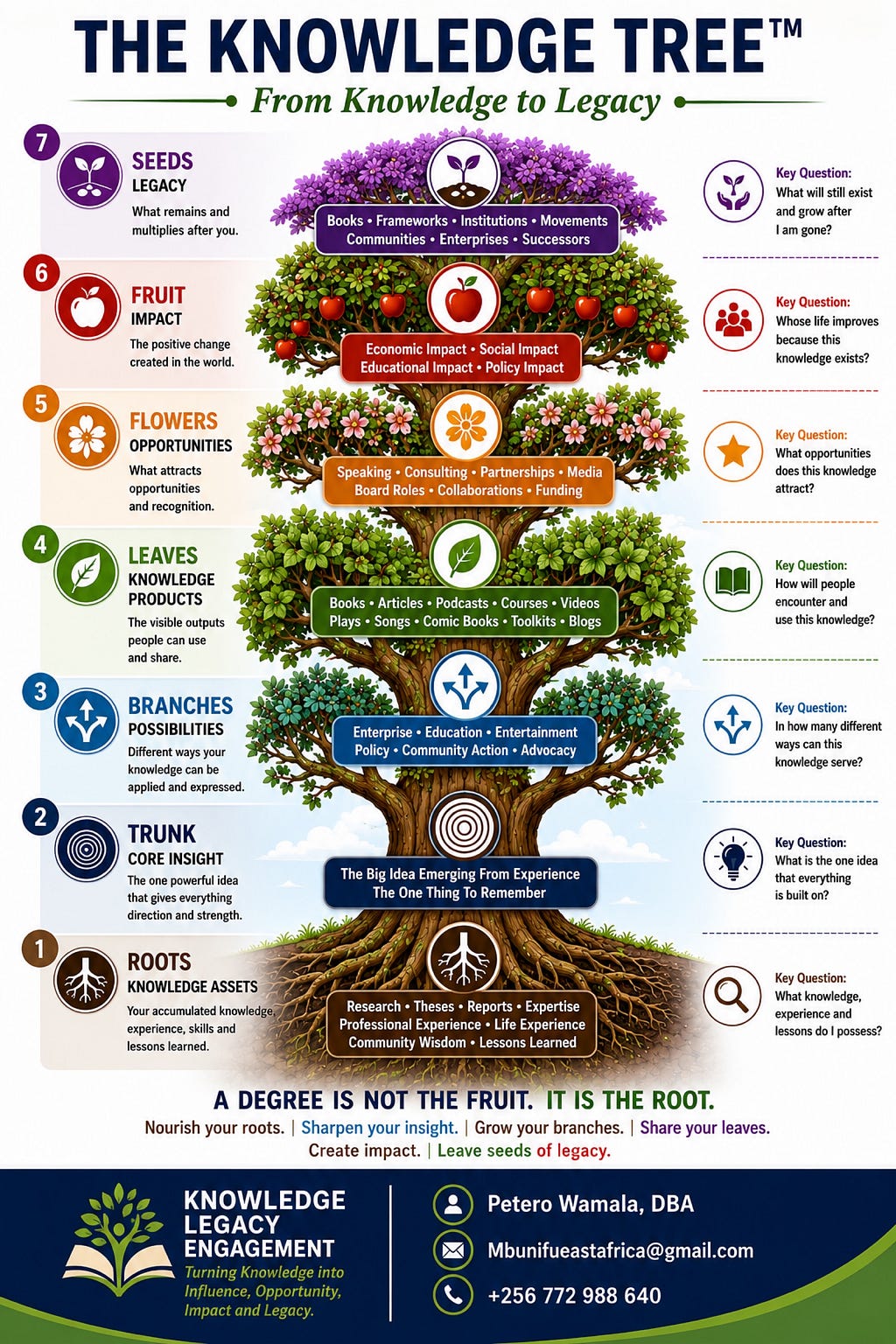
“Knowledge Activators.”
The students looked puzzled.
“People who could take knowledge from reports, archives, databases, books and experts…”
“…and turn it into action.”
He pointed at the old woman.
“She was one.”
The students looked again.
For the first time they realised that the most important person in the village was not inside the knowledge centre.
She was standing beside a sack of cassava.
As the sun began to set, Uncle Rwamiti started walking away.
A student shouted after him.
“Jajja!”
“What is it?”
“If you could send one message back to 2026, what would it be?”
Rwamiti stopped.
For a moment he looked at the giant knowledge centre.
Then at the old woman’s stall.
Then at the road disappearing into the distance.
Finally he said:
“Stop asking how much knowledge you possess.”
“Start asking what your knowledge is doing.”
And with that, he disappeared into the evening.
Uncle Rwamiti’s Reflection
Knowledge is not fully born when it is written. It is born when somebody uses it.
In a world overflowing with information, the winners will not be those who know the most.
They will be those who can transform knowledge into action, action into impact, and impact into opportunity.
Dr Petero wamala writes about the future of knowledge.
메타데이터
- post_id
- c00bcccb4348
- slug
- the-village-that-knew-everything-c00bcccb4348
- url
- https://medium.com/gigonomics/the-village-that-knew-everything-c00bcccb4348
- canonical_url
- https://medium.com/gigonomics/the-village-that-knew-everything-c00bcccb4348
- author_url
- https://medium.com/@peterwamala
- status
- ok
- fetched_at
- 2026-06-26 03:39:16