Why Forestry Businesses Are Struggling With ESG Reporting Without Digital Infrastructure
Environmental, Social, and Governance (ESG) reporting has become one of the most important operational priorities for forestry…
Why Forestry Businesses Are Struggling With ESG Reporting Without Digital Infrastructure
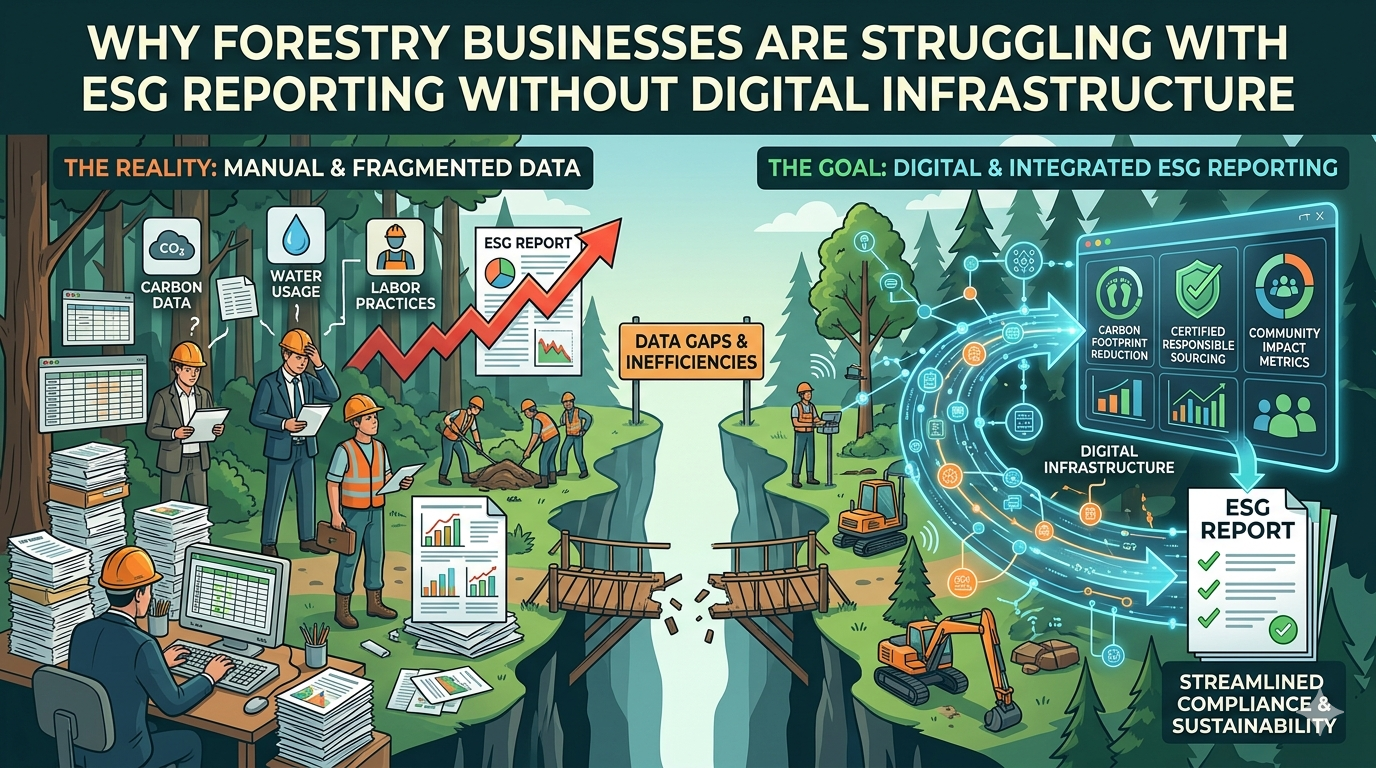
Environmental, Social, and Governance (ESG) reporting has become one of the most important operational priorities for forestry organizations worldwide. Governments, investors, environmental agencies, and corporate stakeholders increasingly expect forestry businesses to maintain transparent sustainability practices supported by measurable environmental data and verifiable reporting systems.
As climate accountability continues becoming a major global focus, forestry organizations are now under pressure to demonstrate measurable contributions toward sustainability goals, carbon reduction initiatives, biodiversity protection, and responsible land management.
However, many forestry businesses continue struggling with ESG reporting because their operational infrastructure was never designed to manage large-scale environmental intelligence and sustainability analytics.
Traditional forestry systems often rely on fragmented workflows, manual documentation, disconnected datasets, delayed operational reporting, and outdated software platforms. These limitations create major obstacles for organizations attempting to maintain accurate ESG reporting systems across complex forestry operations.
Modern forestry businesses increasingly require intelligent digital infrastructure capable of supporting real-time environmental monitoring, automated reporting workflows, GIS analytics, carbon tracking, and predictive sustainability intelligence.
As ESG frameworks continue evolving globally, digital forestry infrastructure is becoming essential for operational transparency and long-term sustainability management.
Why ESG Reporting Has Become Critical for Forestry Businesses
Forestry operations directly impact several environmental and sustainability metrics associated with ESG frameworks.
Organizations managing forest ecosystems must increasingly monitor and report activities related to:
- Carbon sequestration
- Deforestation prevention
- Reforestation efforts
- Biodiversity conservation
- Land-use management
- Water resource protection
- Climate adaptation initiatives
- Ecosystem restoration
Investors and environmental regulators now expect forestry enterprises to provide measurable sustainability data rather than broad environmental claims.
This growing demand for accountability has significantly increased operational pressure across the forestry sector.
Organizations unable to maintain transparent ESG reporting systems often face:
- Reduced investor confidence
- Regulatory compliance challenges
- Carbon verification issues
- Operational inefficiencies
- Sustainability credibility risks
- Difficulty participating in climate-focused programs
As sustainability expectations continue increasing, ESG reporting is evolving from a compliance requirement into a strategic operational necessity.
Traditional Forestry Workflows Create ESG Reporting Problems
Many forestry businesses still manage operations using disconnected systems that were originally designed for timber management and basic operational planning rather than environmental intelligence.
Traditional workflows often depend on:
- Spreadsheet-based reporting
- Manual field surveys
- Paper-based environmental records
- Isolated operational databases
- Delayed sustainability analysis
- Fragmented environmental datasets
These outdated systems create serious limitations when organizations attempt to scale ESG operations.
Some of the most common ESG reporting problems include:
- Inaccurate environmental data
- Delayed reporting cycles
- Poor visibility across forest regions
- Difficulty verifying sustainability metrics
- Limited environmental forecasting
- Inconsistent carbon accounting
Manual reporting workflows also increase the risk of operational errors and compliance gaps.
As forestry operations become more data-intensive, businesses increasingly require centralized digital ecosystems capable of managing environmental intelligence at scale.
Digital Forestry Platforms Are Transforming ESG Operations
Modern forestry organizations are increasingly investing in connected digital ecosystems capable of integrating operational intelligence with sustainability monitoring infrastructure.
Advanced digital forestry solutions combine multiple technologies into centralized environmental management systems, including:
- GIS mapping infrastructure
- AI-powered analytics
- Cloud computing
- Drone monitoring systems
- IoT-enabled environmental sensors
- Automated reporting tools
- Predictive sustainability analytics
These platforms help organizations centralize ESG operations while improving environmental transparency and reporting efficiency.
Digital ecosystems also improve collaboration between:
- Sustainability teams
- Forestry operators
- Environmental consultants
- Carbon verification agencies
- Government regulators
- ESG auditors
Connected operational infrastructure allows forestry businesses to automate many sustainability workflows that were previously dependent on manual reporting systems.
GIS Systems Improve Environmental Visibility
Geographic Information Systems (GIS) have become one of the most important technologies supporting ESG-focused forestry operations.
Advanced GIS forest management systems provide organizations with detailed geospatial intelligence associated with environmental conditions and land-use activities.
GIS technologies support ESG reporting through:
- Forest mapping
- Biodiversity analysis
- Land-use tracking
- Deforestation monitoring
- Habitat protection analysis
- Carbon storage estimation
- Environmental risk assessment
By integrating satellite imagery, drone surveys, and GPS systems, GIS platforms allow organizations to maintain highly accurate environmental visibility across large forestry regions.
This visibility significantly improves sustainability reporting accuracy while helping organizations verify environmental performance more effectively.
GIS infrastructure also supports long-term climate adaptation and conservation planning initiatives.
AI Is Improving ESG Intelligence
Artificial intelligence is rapidly transforming how forestry businesses analyze environmental data and generate sustainability insights.
Traditional ESG reporting systems often depend heavily on historical operational analysis and manual reporting workflows.
AI-powered forestry platforms can process large environmental datasets in real time to generate predictive sustainability intelligence and automated reporting capabilities.
Many organizations now collaborate with an **AI consultancy agency** to develop intelligent environmental systems tailored to ESG-focused forestry operations.
AI technologies support ESG workflows through:
- Carbon sequestration forecasting
- Wildfire risk prediction
- Biodiversity monitoring
- Forest health analysis
- Environmental anomaly detection
- Climate impact modeling
- Sustainability forecasting
- Operational optimization
Machine learning models continuously analyze environmental and operational data collected from:
- Satellite imagery
- Weather systems
- IoT sensors
- Drone analytics
- Inventory databases
This predictive intelligence allows organizations to identify environmental risks earlier while improving sustainability planning accuracy.
Forest Inventory Systems Support ESG Transparency
Accurate forest inventory management is essential for reliable ESG reporting.
Traditional inventory systems often rely on manual field surveys and delayed operational reporting that reduce environmental visibility and data accuracy.
Modern forest inventory management software integrates GIS systems, AI analytics, drone monitoring, and cloud infrastructure to create intelligent environmental monitoring ecosystems.
Advanced inventory systems can track:
- Tree growth rates
- Timber volumes
- Carbon storage levels
- Species distribution
- Land utilization
- Biodiversity indicators
- Regeneration progress
This level of operational intelligence allows organizations to maintain more accurate sustainability reporting systems while reducing administrative reporting complexity.
Automated inventory analytics also improve transparency required for carbon credit verification and ESG compliance programs.
Carbon Markets Are Increasing ESG Reporting Demands
The rapid growth of global carbon markets is increasing the importance of environmental reporting infrastructure within forestry operations.
Organizations participating in carbon ecosystems must maintain transparent reporting systems capable of supporting:
- Carbon sequestration verification
- Environmental monitoring
- Land-use transparency
- Biodiversity reporting
- Reforestation tracking
- Climate mitigation analysis
This growing complexity is increasing demand for carbon credit marketplace development infrastructure integrated with forestry intelligence systems.
Carbon-focused forestry operations require highly accurate environmental data ecosystems capable of supporting large-scale sustainability verification.
Without connected digital infrastructure, organizations often struggle to maintain reliable ESG reporting standards within carbon trading environments.
Cloud Infrastructure Enables Scalable ESG Operations
Cloud-native architecture has become foundational infrastructure for modern sustainability ecosystems.
Traditional on-premise systems often create operational limitations related to:
- Data synchronization
- Accessibility
- Scalability
- Reporting automation
- Analytics processing
Cloud-based forestry systems provide organizations with:
- Centralized environmental data management
- Real-time synchronization
- Automated reporting workflows
- Scalable infrastructure
- Improved collaboration
- Faster analytics processing
- Remote accessibility
Many forestry enterprises now adopt **white label forest management software** built on scalable cloud infrastructure to support growing ESG operations.
Cloud ecosystems improve operational flexibility while enabling organizations to scale sustainability management more efficiently.
Understanding the Cost of ESG-Ready Forestry Platforms
Many organizations underestimate the technical infrastructure required to support scalable ESG ecosystems.
Modern forestry platforms often require integration between:
- GIS systems
- AI analytics
- Environmental monitoring infrastructure
- Carbon intelligence tools
- Cloud architecture
- Automated reporting systems
As businesses scale sustainability initiatives, they increasingly evaluate the actual **cost to develop a forest management software** platform capable of supporting ESG compliance and environmental transparency requirements.
Long-term infrastructure planning is becoming essential for organizations seeking scalable sustainability operations.
Investing early in intelligent forestry infrastructure often reduces future operational inefficiencies and reporting limitations.
AI Development Agencies Are Accelerating ESG Innovation
The increasing complexity of sustainability ecosystems has increased demand for specialized technology development partners.
Many forestry enterprises now collaborate with an **AI development agency** to build intelligent environmental platforms tailored to ESG-focused operations.
AI-powered forestry systems can include:
- Automated sustainability dashboards
- Predictive environmental analytics
- Real-time monitoring systems
- Carbon intelligence platforms
- GIS-integrated operational dashboards
- Environmental forecasting tools
- Biodiversity analytics infrastructure
These systems help organizations improve operational efficiency while strengthening sustainability transparency and ESG reporting capabilities.
The Future of ESG in Forestry Will Be Data-Driven
The future of ESG-focused forestry operations will increasingly depend on intelligent digital ecosystems capable of supporting connected environmental intelligence and predictive sustainability analytics.
Emerging technologies expected to influence ESG forestry management include:
- Real-time carbon intelligence systems
- AI-powered climate forecasting
- IoT-enabled environmental monitoring
- Digital twin forest ecosystems
- Blockchain sustainability verification
- Automated biodiversity analytics
- Drone-based environmental monitoring
Organizations investing early in scalable ESG infrastructure will likely gain significant long-term advantages in sustainability transparency, regulatory compliance, and environmental accountability.
The forestry industry is rapidly evolving toward connected operational ecosystems powered by real-time environmental intelligence.
Conclusion
Forestry businesses are facing increasing pressure to maintain transparent ESG reporting systems capable of supporting sustainability accountability and environmental compliance.
Traditional operational workflows are no longer sufficient for managing the scale and complexity of modern environmental intelligence requirements.
Technologies such as AI, GIS systems, cloud computing, predictive analytics, and real-time monitoring are helping forestry organizations automate sustainability reporting while improving operational visibility and environmental transparency.
As climate initiatives and ESG frameworks continue evolving globally, intelligent digital forestry infrastructure will become essential for organizations seeking scalable sustainability management and long-term operational resilience.
메타데이터
- post_id
- c018e90a098d
- slug
- why-forestry-businesses-are-struggling-with-esg-reporting-without-digital-infrastructure-c018e90a098d
- url
- https://medium.com/@henrywill/why-forestry-businesses-are-struggling-with-esg-reporting-without-digital-infrastructure-c018e90a098d
- canonical_url
- https://medium.com/@henrywill/why-forestry-businesses-are-struggling-with-esg-reporting-without-digital-infrastructure-c018e90a098d
- author_url
- https://medium.com/@henrywill
- status
- ok
- fetched_at
- 2026-06-09 15:37:30