POV: He Just Spoke and Your Brain Went Offline. The Neuroscience of Song Seung Heon’s Voice
A completely serious scientific investigation. I am fine. Everything is fine.
POV: He Just Spoke and Your Brain Went Offline. The Neuroscience of Song Seung Heon’s Voice
A completely serious scientific investigation. I am fine. Everything is fine.

Let me tell you about the first time I truly understood that Song Seung Heon’s voice was a public safety concern.
I was watching a scene. Completely normal Sunday. He leaned slightly forward, looked directly into the camera with those eyes, and said something. I genuinely cannot tell you what he said because my auditory processing centre filed for early retirement approximately 0.3 seconds into the sentence. The only thing I can say about it is that I slumped in my seat, relaxed, and just existed for four whole seconds. Quietly. Like a potted plant that had just been watered.
His voice did that. Without my consent.
And it turns out, and this is the part where I put on my glasses and pretend I am a serious person, there is actual neuroscience behind why this happens. Which means I wasn’t being dramatic. I was having a documented neurological response.
The difference is important.
Your Brain Has a Bouncer, and His Voice Bypassed It
Here’s the thing your high school biology teacher didn’t prepare you for: your nervous system is constantly running security checks on your environment. Every sound, every voice, every tone. Your brain is scanning it. Safe? Threat? Safe? Threat? It’s exhausting. You’re doing it right now without knowing.
This security system is partly managed by something called the parasympathetic nervous system. The branch responsible for the “rest and digest” state, as opposed to the “fight or flight” chaos mode that the rest of 2024 put us in. When your brain hears a voice that registers as calm, low, and controlled, it sends a signal: stand down. We’re okay here.
Cortisol, your stress hormone, lowers. Attention sharpens. The emotional centres of your brain open up.
Song Seung Heon’s voice, specifically, does this in approximately one sentence. Sometimes half a sentence. There was an interview clip I watched where he said about six words, and two people in the comments wrote, “I need a moment.” That is not fandom hyperbole. That is neuroscience in the wild.
The Technical Breakdown (That I Am Absolutely Qualified to Give)
Vocal research? Yes, this is a real field; yes, scientists are doing this with grant money. I respect them enormously. It identifies several qualities that make a voice particularly compelling to the human brain.
Fundamental frequency matters. Lower voices typically register as more authoritative and trustworthy. This is partly evolutionary (don’t ask, it’s complicated and involves a lot of prehistoric situations we no longer need to worry about) and partly just how our auditory processing works. A voice that sits in a lower register doesn’t have to demand your attention. It receives it. Naturally. Without effort.
Resonance is the second thing. A voice that resonates fully, that has depth and warmth rather than sitting thin and high, creates a physical sensation as much as an auditory one. You feel it slightly. In your chest. In your ears. It’s not metaphorical when fans say his voice “hits different". It is, quite literally, hitting different. Different frequencies. Different receptors.
Pacing is the third, and this is where Song Seung Heon specifically deserves a dedicated chapter in whatever textbook covers this. He does not rush. He has never rushed. He will use precisely as much time as a sentence requires, and no less than that, and this results in every word having the weight that it should. Fast talking signals anxiety. Measured talking signals to your nervous system, to your very cells that whoever is speaking has nowhere else to be and is choosing to be here, with you, saying this thing.
Your brain finds this deeply reassuring. Your brain was not asked.
“There’s Just Something About His Voice” Yes. That Something Has a Name.
The meme nailed it, honestly. “There’s just something about his voice” is the layperson's version of "I am experiencing an involuntary parasympathetic response combined with elevated dopamine from unexpected auditory reward processing."
We say “there’s just something” because we don’t have the vocabulary in normal conversation to say “his vocal resonance profile activates my reward pathways while simultaneously signalling safety to my threat-detection system and I’m experiencing a mild but notable reduction in cortisol.”
“There’s just something” is more practical. It fits in a thought bubble. It works in a meme. It is correct.
What’s fascinating about Song Seung Heon specifically and I have done extensive research for this article, by which I mean I have watched a lot of interviews and dramas, which is essentially the same as a literature review is that the voice quality is consistent.
Some actors turn it on for scenes. Some performers have a “camera voice” that’s noticeably different from their casual register. Song Seung Heon appears to simply have this voice. In interviews, in behind the scenes footage, in casual moments, the warmth is there. The unhurried quality is there. The depth is there. Which means every time you encounter it, your nervous system receives the same signal: safe. Calm. Stay.
And stay, you do. For many episodes. Possibly several complete drama rewatches. Your nervous system made this decision, and you are simply living with the consequences.
The Presence Problem
Here’s where voice and body language converge into something genuinely difficult to describe without sounding like you’ve lost the plot.
The presence that some performers have, where they seem to occupy more of a room than their physical dimensions should allow, is partly visual and partly sonic. A voice with weight and resonance creates a kind of acoustic gravity. When someone speaks slowly and fully, in a low register, with confidence, they are sonically occupying the space.
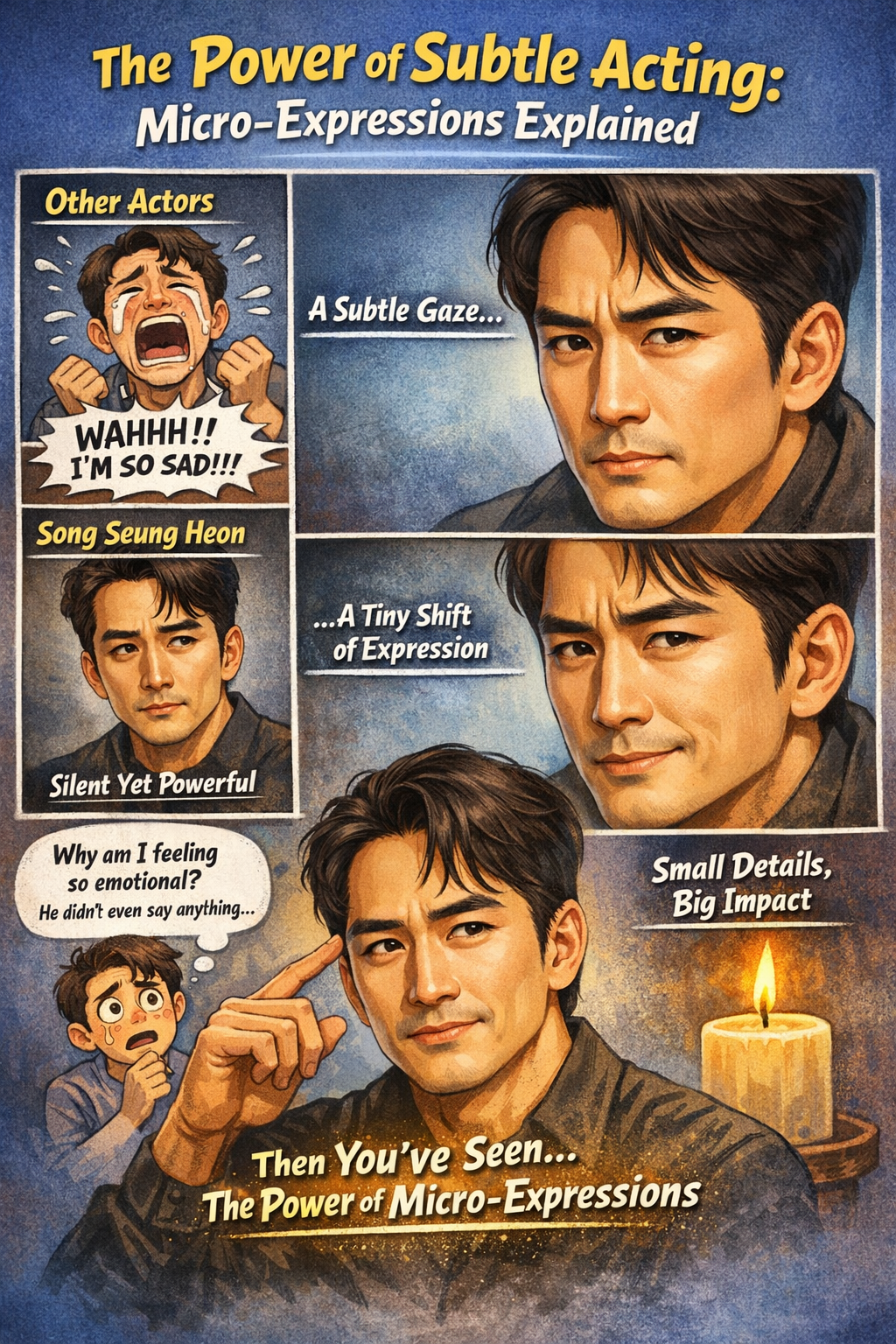
You cannot look away. More than that, you cannot stop listening. Even in scenes where he’s not speaking, you’re waiting. There’s an anticipation that gets created. And when the voice arrives, that measured, warm, unhurried delivery, the payoff is, neurologically speaking, genuinely satisfying.
This is why his silent scenes hit as hard as his dialogue scenes. You’ve been trained by the voice to lean in. The silence borrows the attention his voice has already earned.
I Am Normal About This
Look. I want to be clear.
I started researching this article with the intention of being very intellectually composed about the whole thing and citing some papers about acoustic psychology and wrapping it up. That was the plan.
The plan was derailed when I went back to watch reference clips for this article and experienced, firsthand, the very neurological response I was trying to write about. He said one sentence in one interview, and I had to go make tea and reconsider my life choices.
The science is real. The response is documented. The parasympathetic nervous system activation is a known, studied phenomenon.
And Song Seung Heon, whether he is aware of it or not, whether he is doing it intentionally or whether this is simply who he is, has a voice that does something to people. That lowers the volume of the world. That signals to whatever ancient part of your brain is still running security: you can stop now. Listen. Rest.
Thirty years into a career, and that voice hasn’t got quieter. It’s got more. More settled, more present, more itself.
Which means the neurological damage it causes is, at this point, fully intentional.
We have no complaints.
If your brain also went offline at some point during this article, you’re in the right place. Welcome.
Come find me over at @oppavibesSSH on Instagram; I am posting the memes that send people here, plus edits, breakdowns, and the occasional scientific investigation into why we are all like this. Follow for your daily dose of chaos and cultural analysis.
On Medium, hit Follow for more deep dives where fan devotion meets actual research. And drop a comment below: What's the Song Seung Heon line delivery that personally rearranged your brain chemistry? Timestamps appreciated. We’re building a case file.
메타데이터
- post_id
- c01906b8d294
- slug
- pov-he-just-spoke-and-your-brain-went-offline-the-neuroscience-of-song-seung-heons-voice-c01906b8d294
- url
- https://medium.com/@oppavibessh/pov-he-just-spoke-and-your-brain-went-offline-the-neuroscience-of-song-seung-heons-voice-c01906b8d294
- canonical_url
- https://medium.com/@oppavibessh/pov-he-just-spoke-and-your-brain-went-offline-the-neuroscience-of-song-seung-heons-voice-c01906b8d294
- author_url
- https://medium.com/@oppavibessh
- status
- ok
- fetched_at
- 2026-07-18 17:35:31