Arcfra ABS vs. VMware vSAN: Disk Failure Troubleshooting
A technical comparison of how Arcfra ABS and VMware vSAN detect, isolate, and recover from disk failures while minimizing service impact.
Arcfra ABS vs. VMware vSAN: Disk Failure Troubleshooting
Both Arcfra AECP’s distributed storage (ABS) and VMware vSAN provide capabilities for detecting and handling disk failures, while they differ in how these capabilities are implemented and in the user experience they offer.
The following sections will analyze the key technical differences between Arcfra ABS and VMware vSAN in handling degraded devices, covering failure detection, failure-handling strategies, maintenance performance, false-positive control, and other dimensions, aiming to provide a reference for product selection and operations optimization for enterprise users.
Failure Detection
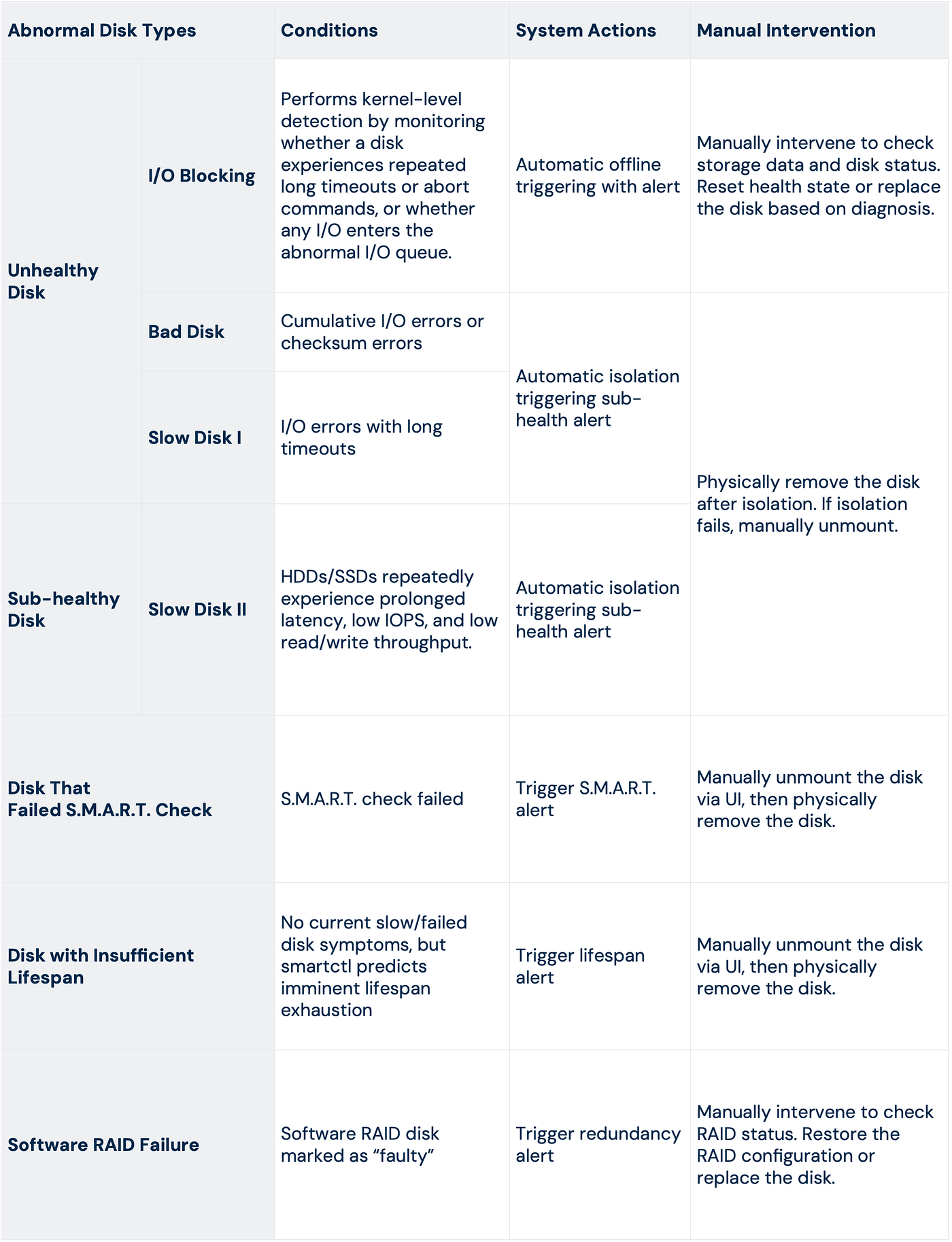
VMware vSAN provides mature, automated strategies for disk health monitoring and fault detection, enabling it to address common disk anomalies. Building on this, Arcfra ABS further strengthens its capabilities in fault classification, status tracking, and handling workflows for enterprise use cases. This enables a more granular identification of different disk anomaly states and development stages.
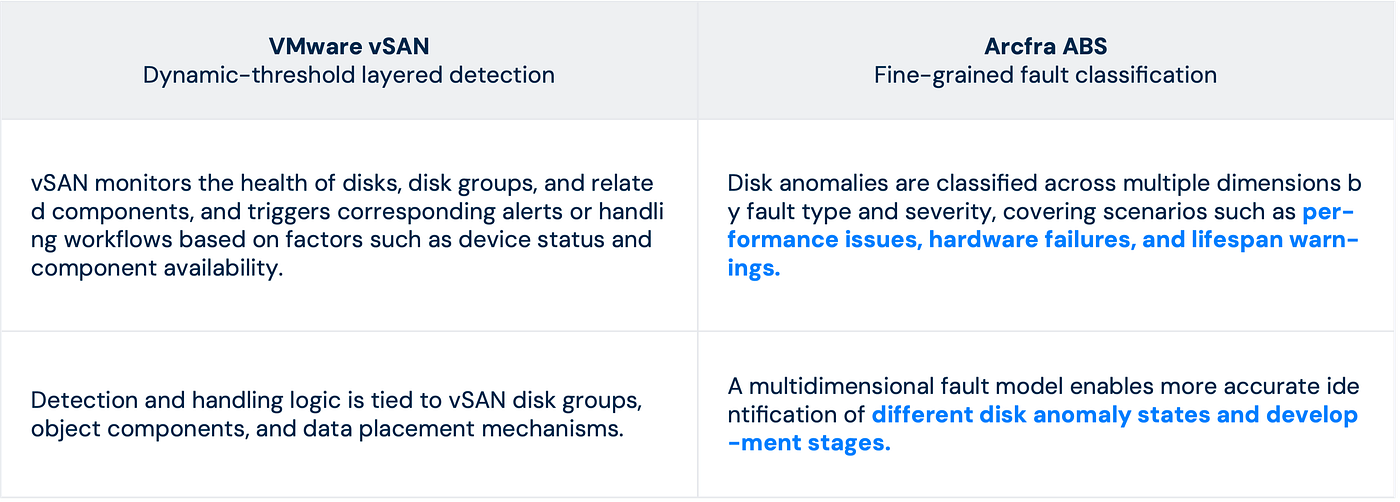
Overview of the Fine-grained Disk Fault Classification in AECP
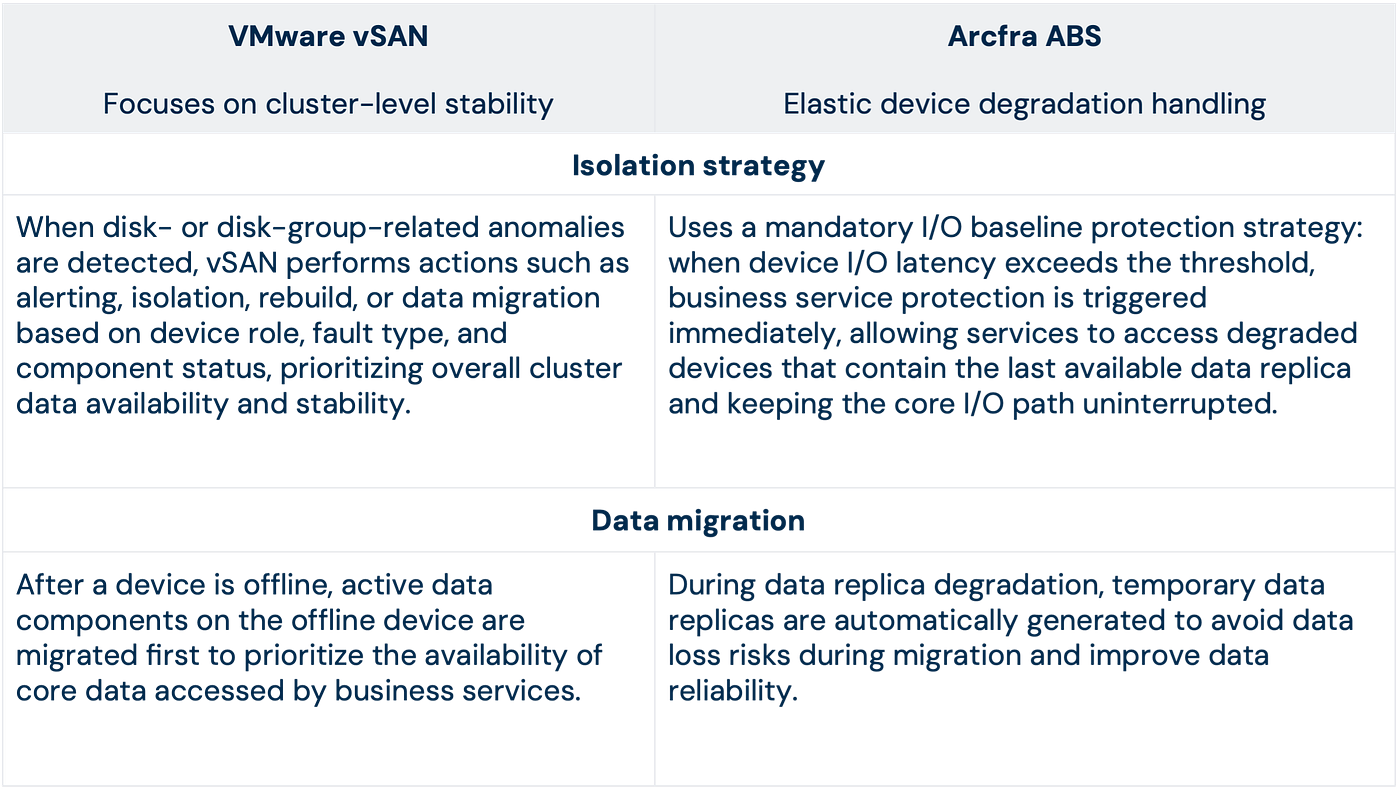
Core Fault Handling Strategies
VMware vSAN emphasizes overall cluster availability and data integrity during fault handling, reducing disk fault impact through alerts, component rebuilds, data migration, and other techniques. Arcfra ABS further enables granular degradation control, minimizing the impact of abnormal devices on service I/O while ensuring data safety.
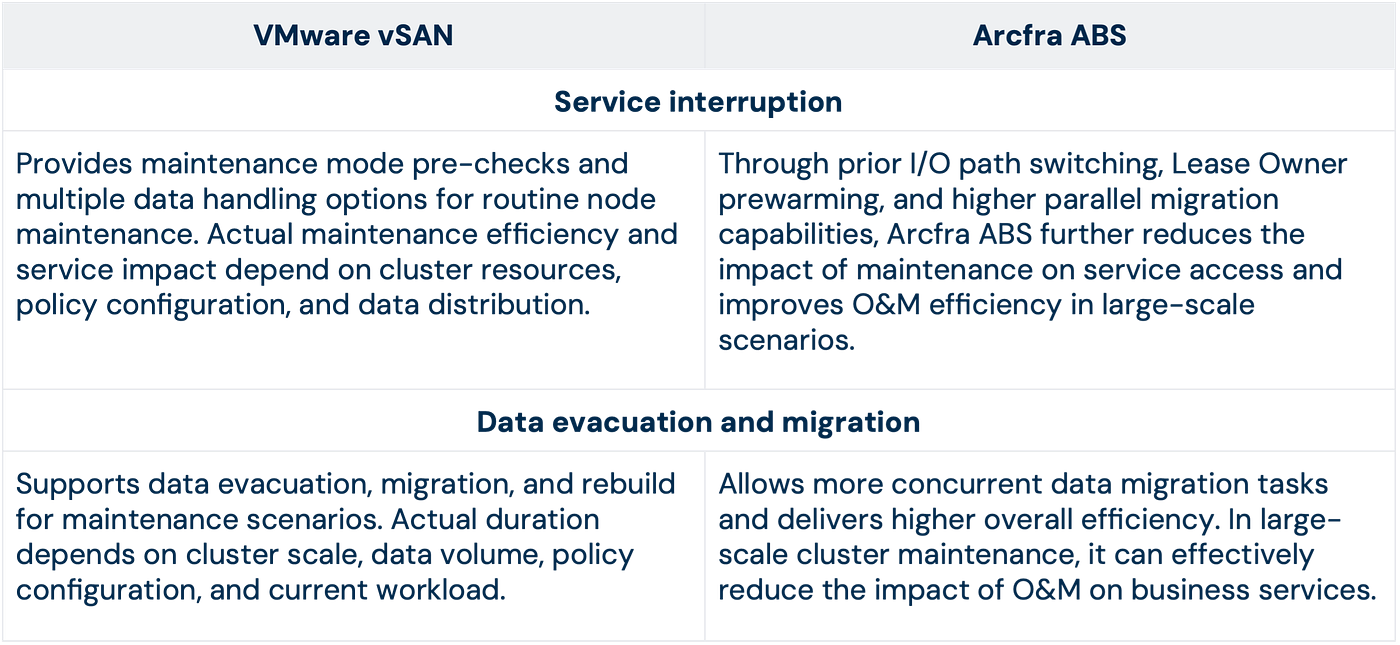
Maintenance Performance
VMware vSAN provides data migration pre-checks and multiple data handling options in maintenance mode, with brief service interruptions. Arcfra ABS further optimizes I/O path switching, data evacuation, and parallel migration during maintenance, helping reduce the impact of O&M operations on critical service performance.
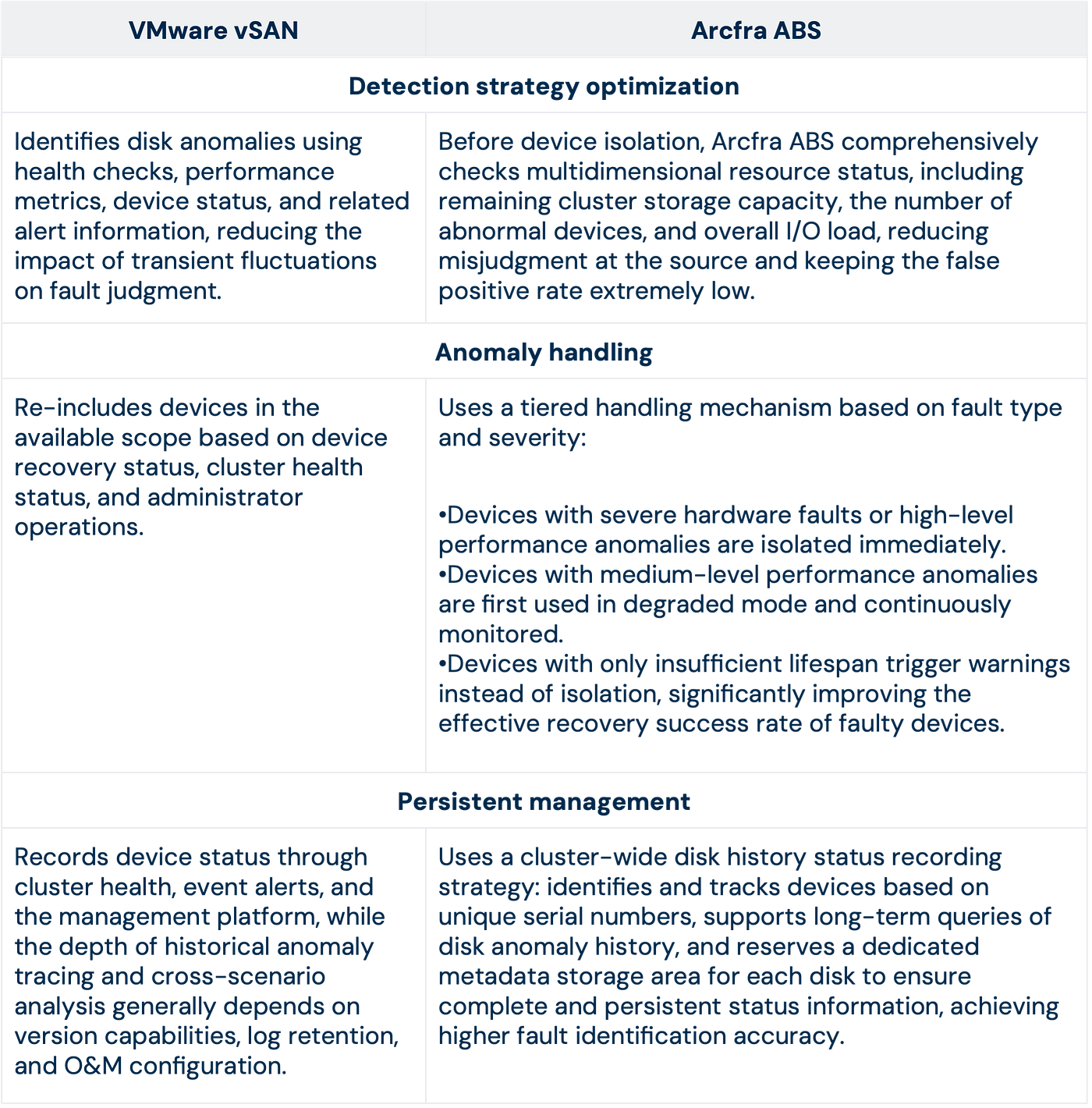
False Positive Control and Identification Accuracy
Both VMware vSAN and Arcfra ABS optimize detection logic through multiple technical measures to reduce misjudgment, while each has its own featured designs in detection strategy, anomaly handling, and status management.
Core Advantages
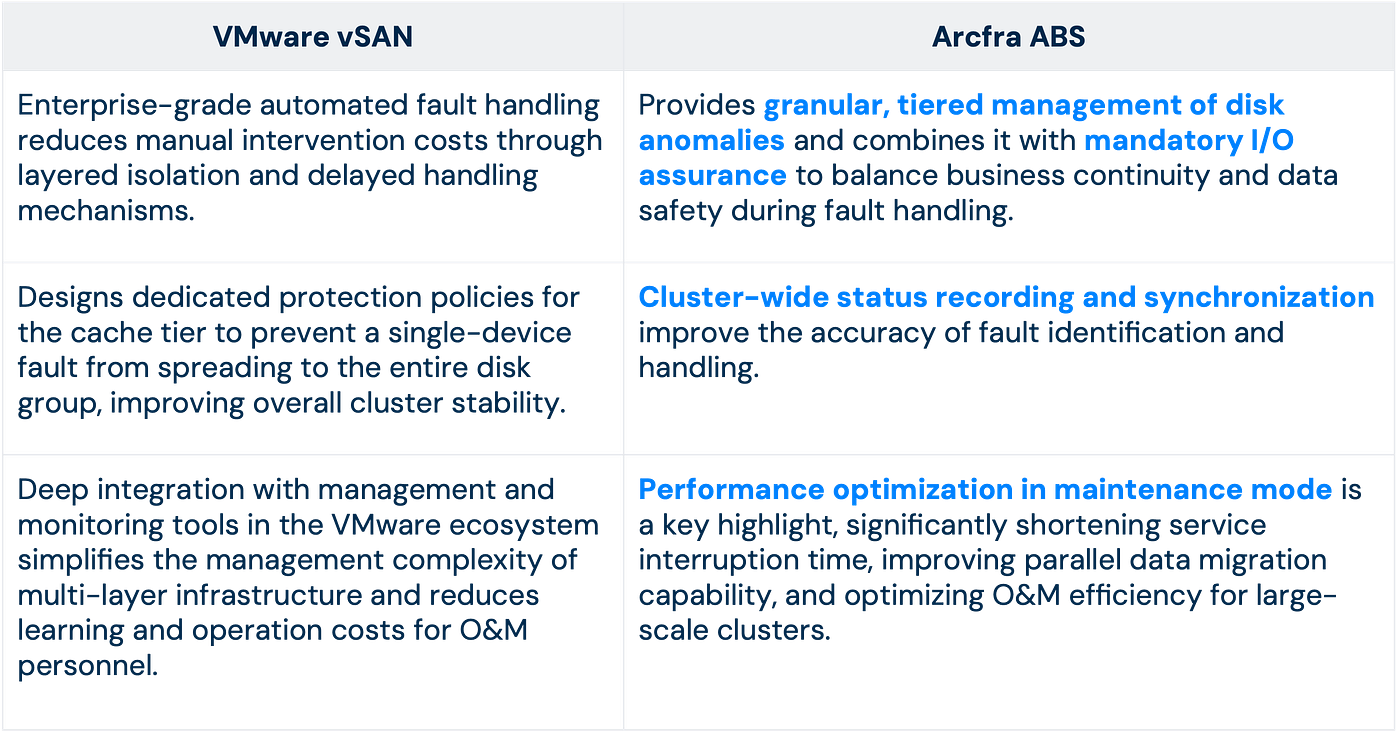
VMware vSAN provides mature, automated O&M and ecosystem integration, reducing management complexity in common disk failure scenarios. Arcfra ABS enhances granular fault identification, business continuity assurance, status tracking, and maintenance efficiency for core business scenarios.
Typical Application Scenarios
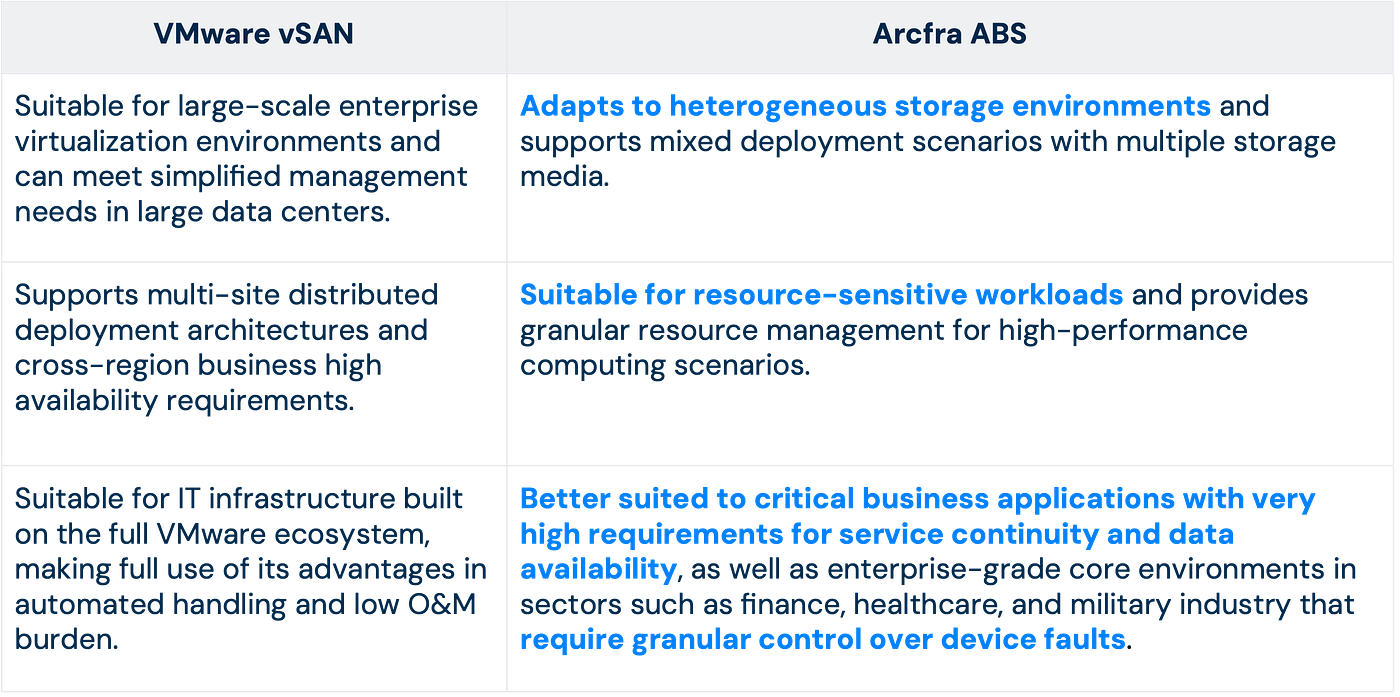
Based on their respective strengths, VMware vSAN can meet simplified management needs in large data centers, while Arcfra ABS is better suited to heterogeneous storage environments and enterprise-grade core environments.
For more information on Arcfra distributed storage features and VMware comparisons:
Arcfra vs. VMware: I/O Path Comparison and Performance Impact
Arcfra vs. VMware: VM Snapshot and I/O Performance Comparison
Arcfra Storage Tiering Model Explained
An In-Depth Look at Arcfra Erasure Coding: Configuration Strategies, Performance, and Best Practices
Navigating the VMware Shake-Up: A Must-Read Guidebook for VMware Replacement
메타데이터
- post_id
- c02112d4a018
- slug
- arcfra-abs-vs-vmware-vsan-disk-failure-troubleshooting-c02112d4a018
- url
- https://medium.com/@arcfraofficial/arcfra-abs-vs-vmware-vsan-disk-failure-troubleshooting-c02112d4a018
- canonical_url
- https://medium.com/@arcfraofficial/arcfra-abs-vs-vmware-vsan-disk-failure-troubleshooting-c02112d4a018
- author_url
- https://medium.com/@arcfraofficial
- status
- ok
- fetched_at
- 2026-07-09 20:10:33