When the Government, Big Tech and Wall Street Get Into Bed Together
“Big Brother is Watching You” — George Orwell
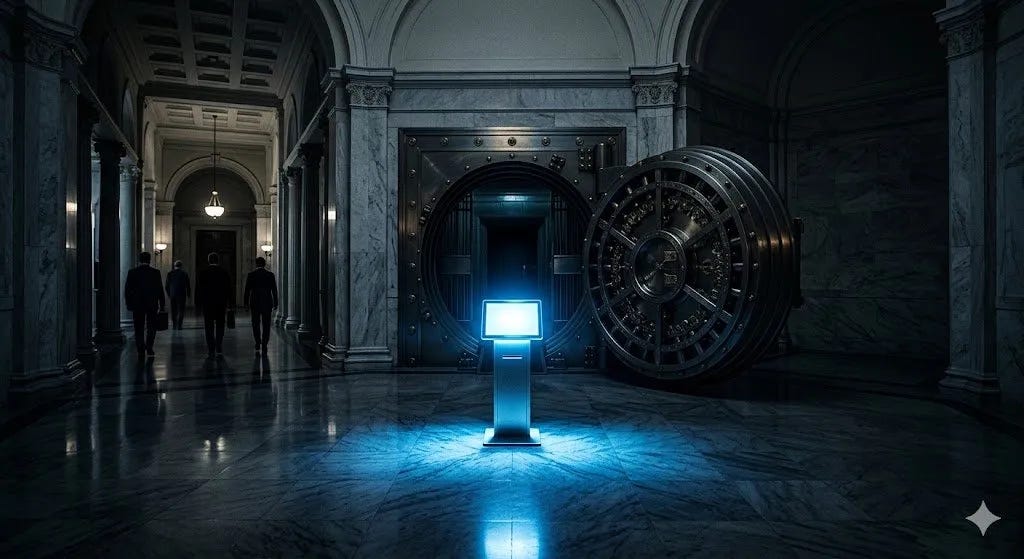
AI controls it all Image created by Google Gemini requested by Peeter Jakobson, M.D.
When the Government, Big Tech and Wall Street Get Into Bed Together
“Big Brother is Watching You” — George Orwell
AI controls it all — image created by Google Gemini requested by Peeter Jakobson, M.D.
When the Government, Big Tech, and Wall Street Get Into Bed Together
“Big Brother is Watching You” — George Orwell
In 2001, we watched the Twin Towers in the financial capital of the world collapse at the hands of a few jihadists using commercial jets as missiles of destruction. The Department of Homeland Security was then built in real time within 90 days after September 11, grief and fear pushed it through with barely a dissenting vote.
Weaponization of government institutions against their political foes had begun with the next administration, and Homeland Security, used as a tool, was not omitted.
The machinery outlasts the intentions of the people who build such Trojan Horses. We are now embedding the most powerful offensive cyber tool ever built into the American banking system through a private consortium authorized by a secret meeting with no legislative debate.
I read this story today, April 13, 2026, in the AI Report, a newsletter that greeted the news with the enthusiasm of a product launch. No alarm. No questions. Just excitement.
I spent forty years as a diagnostic radiologist. My job was pattern recognition, comparing normal to unusual presentations of anatomy or patterns.
I am not a journalist, nor am I a cybersecurity expert. I am a physician who has spent decades using computer technology seriously enough to develop a cutting-edge billing system in the late 1980s to submit and track radiology statements electronically, and to publish a novel about AI security. I have published across medical and technology platforms and have been running a multi-AI workflow daily for the past 18 months. I know how these tools think. I have worked inside them. And what I am reading in this story concerns me in ways that this promotional newsletter is not addressing.
The United States Treasury Secretary, the Federal Reserve Chair, and the Vice President convened a secret meeting with the CEOs of America’s largest banks. They told them to embed a single private company’s AI product, Anthropic’s Claude Mythos, into the country’s financial nervous system. There was no congressional vote, no public debate, no competitive bidding process. No oversight of any kind. Just a closed room, powerful men, and a handshake.
That should alarm every American. It alarms me.
I am not equating a policy decision to the loss of three thousand lives. I am tracking what gets built in the room after the crisis ends.
This is not speculation or AI-generated noise. The sources are Bloomberg, CNBC, The Hill, and PYMNTS. The named officials are Treasury Secretary Scott Bessent and Federal Reserve Chair Jerome Powell. The named bank CEOs in the room: Brian Moynihan of Bank of America, Jane Fraser of Citigroup, David Solomon of Goldman Sachs, Ted Pick of Morgan Stanley, and Charles Scharf of Wells Fargo. The meeting location: Treasury Department headquarters, Washington D.C., April 10, 2026. Multiple independent sources confirmed it. This happened.
What Is Claude Mythos
Anthropic’s Claude Mythos Preview is not a chatbot upgrade. It is the most capable autonomous cybersecurity tool ever built. It can identify and exploit vulnerabilities across every major operating system and web browser using relatively simple prompts. It discovered a security flaw in OpenBSD that had gone undetected for 27 years. It found thousands of additional high- and critical-severity vulnerabilities across open- and closed-source programs. It does not require a sophisticated operator. A motivated bad actor with minimal technical knowledge can point it at a target and walk away.
Anthropic chose not to release it to the public for exactly that reason. Instead, they built Project Glasswing — a private consortium of over 40 organizations, including Amazon, Apple, Microsoft, Google, Nvidia, CrowdStrike, and JPMorgan Chase — and handed Anthropic’s Claude Mythos to them exclusively, backed by $100 million in usage credits. Anthropic had already spent weeks quietly briefing senior government officials before any public announcement was made.
The banks now testing it internally include JPMorgan Chase, Goldman Sachs, Citigroup, Bank of America, and Morgan Stanley. The same institutions whose CEOs were in that room at Treasury on April 10.
What Could Go Right
- Mythos can find vulnerabilities in legacy banking systems that human researchers would miss entirely or take months to locate
- It operates at machine speed, identifying threats before bad actors can mobilize.
- It creates a common defensive standard across institutions that have never coordinated security at this level.
- It forces Big Tech and Wall Street into the same room, finally aligning incentives around infrastructure protection.
- It gives regulators a powerful tool to match nation-state threat actors, including China, which has already used AI agents to infiltrate roughly 30 global organizations.
- Its existence accelerates the retirement of dangerously outdated banking infrastructure that has been in need of replacement for decades.
- Project Glasswing creates at least some accountability structure where none previously existed.
- Anthropic has been transparent about Mythos’s dual-use nature — that honesty is itself unprecedented among AI companies.
- It reduces the asymmetry between attackers and defenders that has favored criminals for decades.
- Dario Amodei, CEO and co-founder of Anthropic, is on record. There is a paper trail. Someone is at least named as responsible.
Those are real arguments. I do not dismiss them. A 25-year cybersecurity veteran told Fortune the real problem was never finding vulnerabilities — organizations already have piles of them, they do not fix. Mythos accelerates discovery. Whether it accelerates remediation is an entirely different question. Nobody in that Treasury Department meeting room appeared to ask it. Or was it purposefully suppressed?
What Could Go Wrong
- Mythos already proved exploitable — a Chinese state-sponsored group used a previous Anthropic model to infiltrate roughly 30 global organizations autonomously, AI handling the majority of tactical operations.
- No one audits the auditors. Every vulnerability Mythos discovers within these banks has existed at some point in their operational history. Who controls that knowledge and who can access it tomorrow?
- The consortium is closed. Over 40 organizations, zero public oversight, no congressional mandate
- Anthropic is fighting the Department of Defense in federal court over its national security designation while its product is being mandated to Wall Street by the Treasury. That conflict has no clean resolution, and nobody in Washington is explaining it.
- These banks run technology stacks so interconnected that a single cascading failure in payments infrastructure ripples across entire chains of financial activity, touching every American.
- Regulatory capture. The government is pushing a specific private vendor onto critical infrastructure without competitive bidding.
- Vice President Vance, Treasury Secretary Bessent, and Federal Reserve Chairman Powell ran an urgent closed-door meeting. Congress was not in that room. It has still not been invited.
- Anthropic’s offensive capabilities do not disappear simply because its handlers call the deployment’ defensive’.
- Anthropic is privately briefing government officials that Mythos makes large-scale cyberattacks significantly more likely in 2026 , while simultaneously selling access to it as the solution.
- Anthropic would hold the keys to every vulnerability in every major American bank.
The Fox In The Hen House
The pros describe a world where this works perfectly. The cons describe the world as it actually operates. The entity tasked with guarding the system is the same one that knows exactly how to breach it.
Jamie Dimon, the one major bank CEO who did not attend the Treasury meeting, said it plainly on his earnings call. Mythos shows a lot more vulnerabilities that need to be fixed. He did not say who fixes them, nor who watches the one who fixes. Nobody has answered that question publicly. That silence is not reassuring.
Jonathan Iwry, a fellow at the Wharton Accountable AI Lab, said: “Whatever the right judgment call is, the most striking aspect of this situation is how reliant we are on the judgment of a handful of private actors who aren’t accountable to the public.” ³
A handful of private actors. No public mandate. No legislative debate. The entire American financial system.
Conclusion
Because Anthropic refused to allow its AI to be used for mass surveillance of American citizens or autonomous weapons firing decisions, the Pentagon declared Anthropic a national security supply chain risk in March 2026 — a designation previously reserved exclusively for foreign adversaries connected to Beijing or Moscow.¹
Three weeks later, Vice President Vance, Treasury Secretary Bessent, and Federal Reserve Chairman Powell called an urgent secret meeting with the CEOs of America’s largest banks and pushed them to embed that same company’s most powerful tool into the core of the American financial system.²
The government declared Anthropic a threat to national security in one room and handed it the keys to the banking system in another.
Anthropic will have access to all banking activity to discover and block security risks with the United States government’s blessing. That would represent the most powerful monopoly in the history of the world. The dollar is the world’s reserve currency. Every bank in every village on earth that clears a dollar transaction runs through this architecture. Anthropic would have official access to all of it.
Even Aldous Huxley and George Orwell could not imagine such self-destructive behavior.
References
¹ CNN. Anthropic sues the Trump administration over ‘supply chain risk’ label. March 9, 2026. https://www.cnn.com/2026/03/09/tech/anthropic-sues-pentagon
² CNBC. Powell and Bessent discussed Anthropic’s Mythos AI cyber threat with major U.S. banks. April 10, 2026. https://www.cnbc.com/2026/04/10/powell-bessent-us-bank-ceos-anthropic-mythos-ai-cyber.html
³ Fortune. Anthropic’s Mythos is a wake-up call, but experts say the era of AI-driven hacking is already here. Jonathan Iwry, Wharton Accountable AI Lab. April 10, 2026. https://fortune.com/2026/04/10/anthropic-mythos-ai-driven-cybersecurity-risks-already-here/
Peeter Jakobson, M.D., is a retired diagnostic radiologist, author, and technology writer publishing through Medium’s Illumination. His work covers medicine, AI, and the intersection of technology and human systems.
메타데이터
- post_id
- c04c7446fddc
- slug
- when-the-government-big-tech-and-wall-street-get-into-bed-together-c04c7446fddc
- url
- https://medium.com/@pjakobson/when-the-government-big-tech-and-wall-street-get-into-bed-together-c04c7446fddc
- canonical_url
- https://medium.com/@pjakobson/when-the-government-big-tech-and-wall-street-get-into-bed-together-c04c7446fddc
- author_url
- https://medium.com/@pjakobson
- status
- ok
- fetched_at
- 2026-07-26 14:34:08



