🟥 PRO│Life Is the Flow of Electrons
An essay series for medical aesthetics professionals.
🟥 PRO│Life Is the Flow of Electrons
An essay series for medical aesthetics professionals.
Why Does Aging Begin?
We recognize aging through visible changes, such as wrinkles, loss of elasticity, and dryness.
Science has explained its causes in terms of various biological phenomena, including DNA damage, mitochondrial dysfunction, chronic inflammation, and stem cell exhaustion.
But we can ask a slightly different question.
“Why do all of these changes appear together as we age?”
We often think of aging as a collection of multiple problems. But if different phenomena progress in the same direction, there may be a common principle beneath them. Could the many changes that make up aging begin from a more fundamental phenomenon?
The Most Important Thing Cells Do.
Cells are constantly making something.
They synthesize proteins, repair damaged structures, respond to external stimuli, and maintain themselves.
But all of these activities require one thing.
Energy.
Without energy, cells cannot do anything.
The energy used by cells is called ATP, or adenosine triphosphate, and nearly all life processes are powered by ATP consumption.
Ultimately, for a cell to be alive means that it is continuously producing and consuming ATP.
Where Does ATP Come From?
ATP is made from food.
But cells do not use food itself. They break down glucose and fatty acids, extract the electrons stored within them, and use those electrons to produce ATP.
At the center of this process is the mitochondrial electron transport chain, or ETC. As its name suggests, it is a system that transfers electrons. As electrons move, energy is generated, and ATP is produced from that energy.
If the movement of electrons stops, ATP production also stops. For life to continue, electrons must continue to move. Therefore, at the cellular level, life can be understood as the process of converting the flow of electrons into energy.
Life ultimately operates on the flow of electrons.
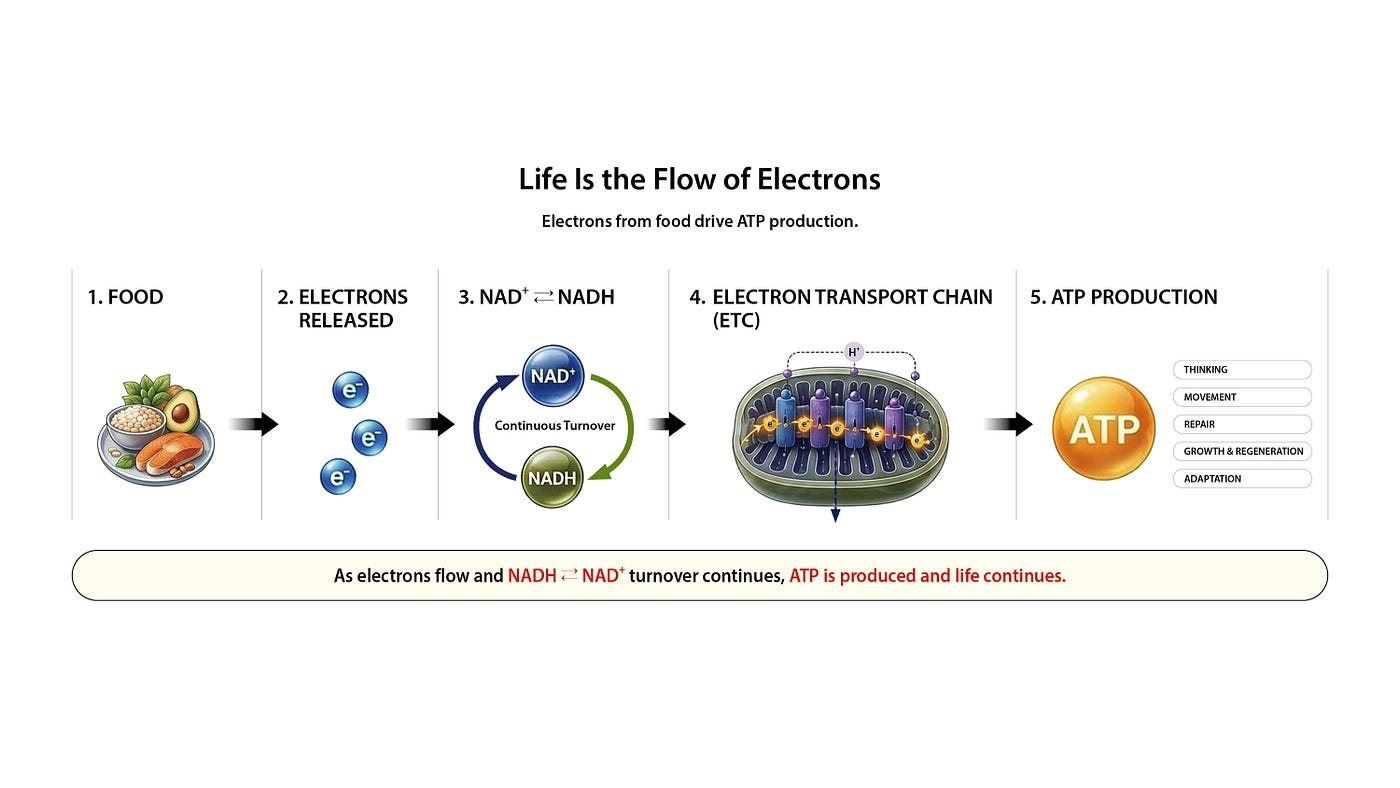
Life Runs on the Flow of Electrons.
What Changes With Aging?
Young cells produce sufficient energy.
They quickly repair damage, respond appropriately to environmental changes, and maintain their functions in a stable way. In contrast, aged cells show decreased ATP production, slower recovery, and increased oxidative stress.
We call these changes aging. At first glance, these phenomena may appear to be separate problems.
But they have something in common.
They are all connected to a decline in the ability to produce energy. And this decline in energy-producing ability is ultimately connected to a decline in the ability to move and utilize electrons.
If we look at the various features of aging from one perspective, they can also be interpreted as a gradual slowdown of electron flow inside the cell.
Why NAD⁺ Matters
This is also why NAD⁺ has recently received attention in aging research.
NAD⁺ and NADH are a key molecular pair that stores and transfers electrons inside the cell. NADH is the electron-carrying form, while NAD⁺ is the form that can accept electrons again. Cells constantly move between these two states to transfer electrons.
We often focus on the amount of NAD⁺. But NAD⁺ is not a warehouse for electrons. It is part of a circulating system through which electrons constantly enter and leave.
A river is healthy not because it has a lot of water, but because it continuously flows.
Likewise, a cell is not healthy simply because it contains a large amount of NAD⁺. What matters is how efficiently and consistently electrons cycle between NADH and NAD⁺.
In young cells, this circulation is active.
Electrons continuously move, energy is continuously produced, and the cell repairs damage and maintains its functions.
In aged cells, on the other hand, this circulation gradually slows down.
Electron flow becomes slower, energy production decreases, and cellular function gradually declines.
“Ultimately, one of the most important differences between young cells and aged cells lies in how efficiently and consistently NADH ⇄ NAD⁺ turnover is maintained.”

NADH ⇄ NAD⁺ Turnover: The Key Difference Between Youth and Aging Cells.
Rethinking Aging.
Aging is not simply the appearance of wrinkles.
Nor can it be fully explained as a phenomenon in which a specific molecule becomes deficient.
Rather, aging may be a process in which the cell’s ability to move electrons, convert them into energy, and circulate them again gradually slows down.
Life operates on the flow of electrons.
Youth is a state in which that flow is maintained quickly and stably,
while aging may be a process in which that flow gradually slows down and becomes stagnant.
Then how do cells move electrons and maintain this circulation? If we follow that question, we eventually encounter a long-known family of molecules.
“Quinones.”
ㅤ
ㅤ
ㅤ
ㅤ
Next
“Coenzyme K: Rethinking Quinones”
ㅤ
ㅤ
ㅤ
ㅤ
ㅤ
ㅤ
ㅤ
References
This essay reinterprets aging from the perspective of “electron flow and the slowdown of NADH ⇄ NAD⁺ turnover,” based on the following papers.
- Cell. 2013;153(6):1194–1217.
- Science. 2015;350(6265):1208–1213.
- Nature Reviews Molecular Cell Biology. 2021;22(2):119–141.
메타데이터
- post_id
- c04f2dc73dd6
- slug
- pro-life-is-the-flow-of-electrons-c04f2dc73dd6
- url
- https://medium.com/@covalttlab/pro-life-is-the-flow-of-electrons-c04f2dc73dd6
- canonical_url
- https://medium.com/@covalttlab/pro-life-is-the-flow-of-electrons-c04f2dc73dd6
- author_url
- https://medium.com/@covalttlab
- status
- ok
- fetched_at
- 2026-06-12 18:14:10