We Drove the Geely Xingyuan in China: The World’s Best-Selling EV of 2025
Under $10,000 on its home turf, Geely’s Xingyuan outsold the Tesla Model Y, the BYD Seagull, and the Wuling Mini EV to become the…
We Drove the Geely Xingyuan in China: The World’s Best-Selling EV of 2025
Under $10,000 on its home turf, Geely’s Xingyuan outsold the Tesla Model Y, the BYD Seagull, and the Wuling Mini EV to become the best-selling vehicle on earth last year. We took its wheel in China to find out how.

Geome: Geely’s Best-Kept Secret
Not the Tesla Model Y. Not the BYD Seagull. Not even the Wuling Hongguang Mini EV. None of them could stop the Xingyuan. But before you can understand the car itself, you need to understand the corporate architecture that spawned it — and like everything about Zhejiang Geely Holding, it’s complicated.
Founded in 1997 in Hangzhou, Geely has quietly assembled one of the most formidable automotive empires on the planet. Its portfolio includes Volvo Cars, Zeekr, Polestar, Lotus, and LEVC — yes, the iconic London black cab. Geely also co-owns the Smart brand with Mercedes-Benz, and holds a stake in the Horse powertrain joint venture with Renault.
In February 2023, Geely launched Galaxy (银河, meaning “Milky Way”), a mass-market EV brand aimed squarely at mainstream Chinese buyers. Then, in October 2024, at the Xingyuan’s launch event, Geely absorbed Geometry — its legacy entry-level EV division — into the Galaxy ecosystem under a new sub-brand called Geome. Within the Galaxy dealer network, branded the “Star Network,” Geome targets the affordable city-car segment without, it claims, cutting corners on technology. The Xingyuan (星愿, “Star Wish”) is the first model to wear the Geome badge. Let’s dig in.
Exterior
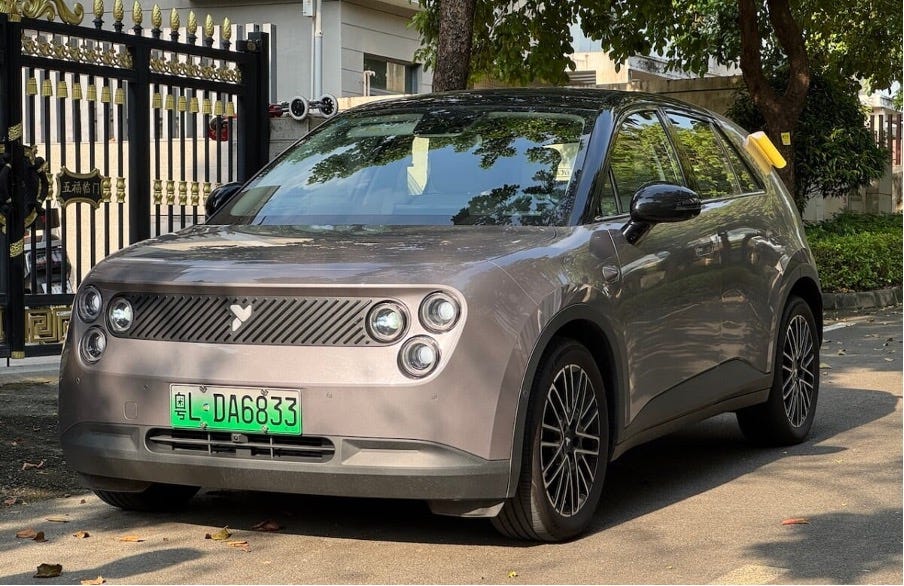
At 162.8 inches long and 71.1 inches wide, the Xingyuan is bigger than a BYD Seagull or a Leapmotor T03, but meaningfully smaller than a BYD Dolphin. Think of its footprint as roughly equivalent to a Renault 5 E-Tech — familiar urban proportions, just without the retro-futurist drama. And that’s intentional: this car is designed to appeal to as many people as possible, not to win a design award.

The moment you touch the door handle, the price point makes itself known with total honesty. Everything here is mechanical: door handles, liftgate, charge port flap on the driver’s side, charge port flap on the passenger side — not a single motorized panel in sight. Shut a door and you’ll hear it: a crisp, hollow thud that telegraphs lightweight, cost-optimized construction. It’s not unpleasant. You just know exactly what you’ve gotten into.

Styling-wise, Geely has gone full bubble — rounded headlights, rounded taillights, no sharp edges trying too hard to make a statement. It’s functional sheetmetal that passes through your field of vision without leaving much of an impression — save for one detail: the Geome badge on the C-pillar, just above the liftgate. Understated, well-proportioned, it’s the only element of the exterior that carries a genuine identity signature. Out back, the center brake light is integrated directly into the rear glass — a neat, cost-saving solution that also happens to look clean.


Interior
Expect a spartan cabin and you’ll be pleasantly wrong. Yes, hard plastics dominate the dashboard — but here’s the thing: they don’t feel cheap. There’s a slight give to them, a textured surface that reads as durable rather than disposable. It’s a genuine surprise for a car at this price.

The central touchscreen is the one visual sticking point: at roughly 8 inches diagonal, it looks underpowered in an era of dashboard-dominating slabs. Geely compensates with a 8.7-inch fully digital driver’s display that more than holds its own — well-positioned, highly legible, delivering exactly the information you need when you’re moving without requiring a second glance. We’ll take that trade-off.

The steering wheel is a highlight. It’s nicely shaped, sits well in the hand, and features tasteful stitching. Behind the rim, you’ll find the expected stalk controls for lighting and wipers, plus two small paddles for regenerative braking adjustment — a feature that earns its place in stop-and-go city driving.

Mirror controls live in the door panel, storage is sensibly laid out across the center console and door pockets, and — here’s something you wouldn’t necessarily expect — all four windows are electrically operated. Heated and ventilated front seats come standard. The front seatbacks carry the Geome logo, which is a touch of brand identity that doesn’t feel forced.

The drive mode selector is basic — three physical buttons on the center console handle climate, the parking brake, and hazard lights. No sub-menus to dig through, no touchscreen hunting required for the basics. We appreciate the directness. The front seats are comfortable for daily urban duty, with well-stitched faux-leather upholstery and a natural seating position. Take a corner with any enthusiasm, though, and the near-total absence of lateral bolstering will remind you, firmly and immediately, that this is not a sport compact.

Infotainment
The Xingyuan runs on FlyMe OS, Geely Group’s in-house operating system — the same software found in the Geely M9 and select Zeekr models. The interface is fluid, logically organized, and mercifully free of the menu-stacking that plagues some competitors. On certain BYD products, heating the seat requires up to four consecutive taps through nested menus. FlyMe OS does not ask this of you. That alone deserves acknowledgment.

Route planning and connected mapping are built in. The screen itself, while compact, is sharp and responsive — you adapt quickly, though more screen real estate would be welcome for everyday use.
Behind the Wheel
This is where the Geome Xingyuan shows its hand — and where it most clearly earns its sales crown. From the first few city blocks, the suspension impresses: small bumps, uneven pavement, and speed humps are absorbed with a suppleness that has no business being present at this price. Crucially, the suspension doesn’t achieve this by going soft and wallowy — it’s properly calibrated, with just enough firmness for confident city and suburban driving.

The steering lives in a different register. It’s overly light for anyone who values front-end feel, and while the ratio is direct enough, the helm consistently withholds information about surface texture and available grip. At higher speeds, the vagueness becomes more apparent — but the car remains predictable and safe. And for the record: we came into this test half-expecting the understeering, wallowing behavior of budget city cars from the early 2000s. That behavior is nowhere to be found in the Xingyuan.

Our test car carried the 85-kW (114-hp), 111 lb-ft rear-mounted motor — rear-wheel drive, notably, in a segment where front-wheel drive is the near-universal default. It’s not going to light up any performance benchmarks: 0–60 mph is an afterthought. But around town, where the Xingyuan lives, it has the punch to slice through traffic, pass cyclists and trucks, and generally stay out of trouble. The rear-drive layout also gives the car a nimbleness that its segment-mates rarely offer.
Noise isolation is the second big surprise. Below 50 mph — the vast majority of the driving conditions this car was engineered for — the cabin is genuinely quiet. Road noise is well suppressed, driveline whine is barely a murmur, and normal conversation requires no raised voices. A slight door-seal whistle appears around 50 mph, and insulation falls off more noticeably above 68 mph. But it’s still quieter than any small-displacement internal combustion engine you’d find in this class.

Real-world energy consumption during our test came in around 10 kWh per 100 km (roughly 16 kWh/100 miles) in urban conditions with the A/C off — a solid figure for a car of this size. With the 40-kWh battery pack, that translates to a realistic range of 186 to 199 miles. Expect that number to be cut roughly in half running the heater hard in winter. The 70-kW DC fast-charging capability takes the battery from low to 50 percent in about 20 minutes. Standard V2L (vehicle-to-load) functionality, allowing you to power external devices directly from the car’s battery, rounds out the package nicely.

Overall, the Xingyuan is thoroughly convincing on the roads it was designed to conquer — urban commutes, school runs, ring roads. Steering precision leaves something to be desired, but the chassis behavior is sound, safe, and sensible.
The Competition
The Xingyuan didn’t win by accident. The Chinese affordable EV segment is arguably the most cutthroat automotive market on the planet, and BYD has owned it for years. Yet in 2025, the Geome Xingyuan finished first overall with 465,775 units sold — ahead of the Wuling Hongguang Mini EV (435,599 units), the Tesla Model Y (425,337 units), and, most strikingly, the BYD Seagull, which mustered just 310,956 sales for the year — a gap of over 150,000 units.
The strategy behind that result is precise. The Xingyuan identified the blind spot between its two main rivals: deliver the dimensions and range of a BYD Dolphin at the price of a BYD Seagull. Where the Seagull is cramped and lightly equipped, the Xingyuan brings 162.8 inches of length, five genuine seats, 13.2 cubic feet of cargo space plus a 2.5-cubic-foot frunk, and standard heated and ventilated front seats — all for less money.


As for the GAC AION UT, it can’t match the Xingyuan’s ride quality, though it does offer a party trick the Geely can’t top: a battery swap in 99 seconds flat.
What About Europe?
The Xingyuan isn’t sold in Europe, and there’s no indication that’ll change anytime soon. The 28.8 percent additional tariffs levied on Geely imports would complicate its pricing, though a sub-€20,000 position still seems achievable. In the meantime, the closest European equivalent sitting in dealerships right now is the BYD Dolphin Surf.
Launched in France in spring 2025 from €19,990, the Dolphin Surf is exactly the rival the Xingyuan beat on its home turf. It measures 157.1 inches long and 67.7 inches wide — 5.7 inches shorter and 3.1 inches narrower than the Xingyuan, differences that translate directly into interior space. Its front-mounted motor produces 156 hp in top-spec form, a significant step up from the Xingyuan’s 114, and it covers 0–62 mph in 9.1 seconds. WLTP range hits 193 miles on the 43-kWh battery.
So: BYD holds the edge in performance and has a slight battery advantage. The Xingyuan punches back with more interior space and what appears to be superior ride quality — though the two are genuinely close.
Pricing
The Xingyuan is offered in three trim levels. The base version — 58 kW, 30-kWh battery, 193 miles of CLTC range — starts at 68,800 RMB, equivalent to just under $9,000 at current exchange rates. Mid-range trims with the 85-kW motor and 40-kWh battery (CLTC range: 255 miles) run between 79,400 and 88,800 RMB, roughly $10,400 to $11,700. The freshly updated 2026 model year adds a top Signature trim with an approximately 52-kWh battery and a claimed 339 miles of CLTC range, topping out at 98,800 RMB — just under $13,000.

Verdict
The Geely Geome Xingyuan is, first and foremost, an industrial achievement — not a passion project. It combines a proven platform derived from genuine premium architecture (the SEA platform, shared with the Volvo EX30 and Zeekr lineup), CATL batteries, and suspension tuning that frankly punches several weight classes above its sticker price. It doesn’t try to dazzle. It just consistently delivers — which is exactly why 465,000 Chinese buyers chose Geome over BYD, over Changan, over AION. In one of the most competitive auto markets on earth, that’s the only verdict that matters.
Yes, the steering could use more feel. Yes, the acceleration is modest. Neither flaw is serious enough to undermine what is, on the whole, a remarkably coherent product — one that, on its own market, has no equal.
Specifications: 2025 Geely Geome Xingyuan (top tested trim) — Motor: 85 kW (114 hp) rear-mounted electric | Torque: 111 lb-ft | Battery: 40 kWh (CATL) | Claimed Range (CLTC): 255 miles | Fast Charging: 70 kW DC | Dimensions: 162.8 in L × 71.1 in W | Cargo: 13.2 cu ft + 2.5 cu ft frunk | As-tested Price (China): approx. $11,700
메타데이터
- post_id
- c061e5a2f37f
- slug
- we-drove-the-geely-xingyuan-in-china-the-worlds-best-selling-ev-of-2025-c061e5a2f37f
- url
- https://medium.com/@nico.d/we-drove-the-geely-xingyuan-in-china-the-worlds-best-selling-ev-of-2025-c061e5a2f37f
- canonical_url
- https://medium.com/@nico.d/we-drove-the-geely-xingyuan-in-china-the-worlds-best-selling-ev-of-2025-c061e5a2f37f
- author_url
- https://medium.com/@nico.d
- status
- ok
- fetched_at
- 2026-06-23 19:38:28