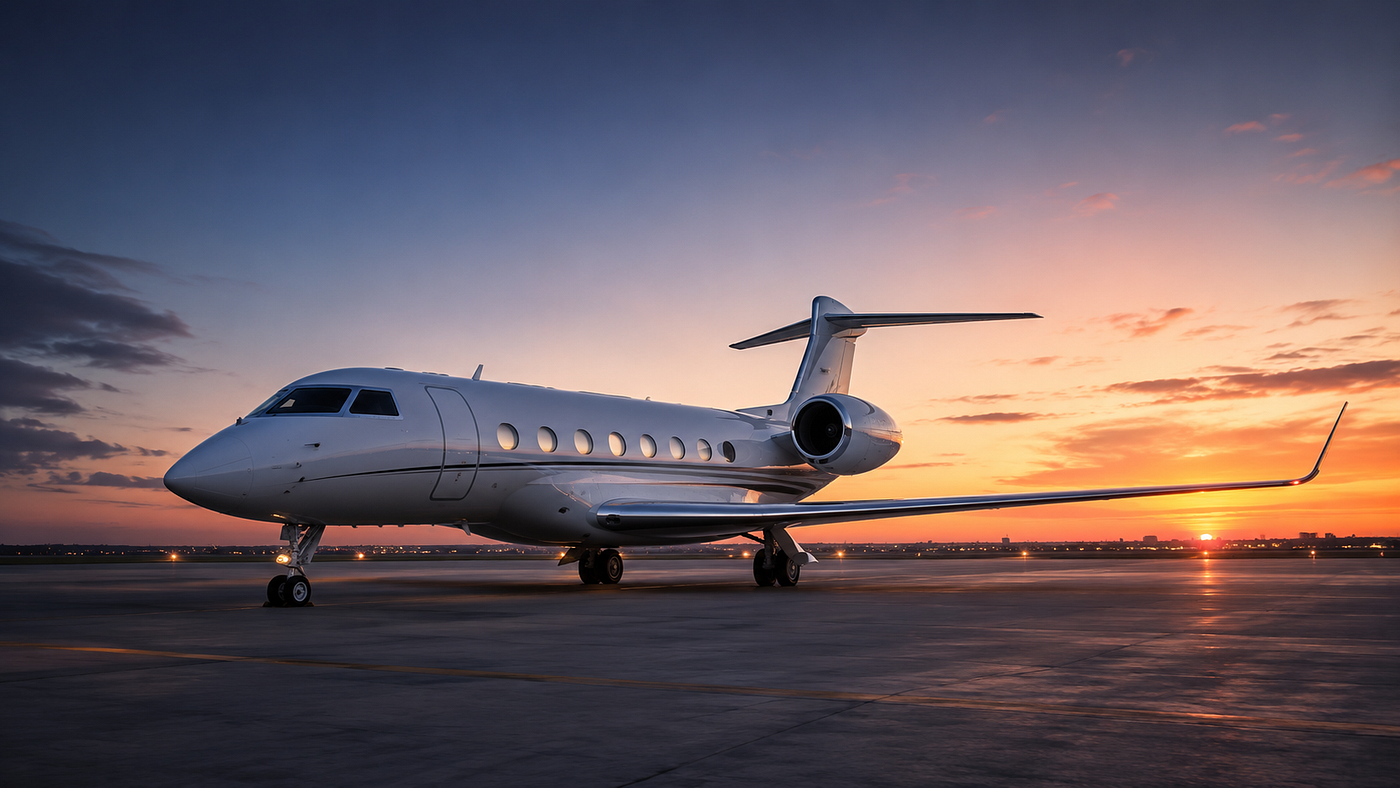
Gulfstream vs Bombardier vs Dassault: Which Jet Family Is Right for Your Mission?
A private aviation consultant’s guide to matching range, cabin, and airport performance to how you actually fly.
Gulfstream vs Bombardier vs Dassault: Which Jet Family Is Right for Your Mission?
A private aviation consultant’s guide to matching range, cabin, and airport performance to how you actually fly.
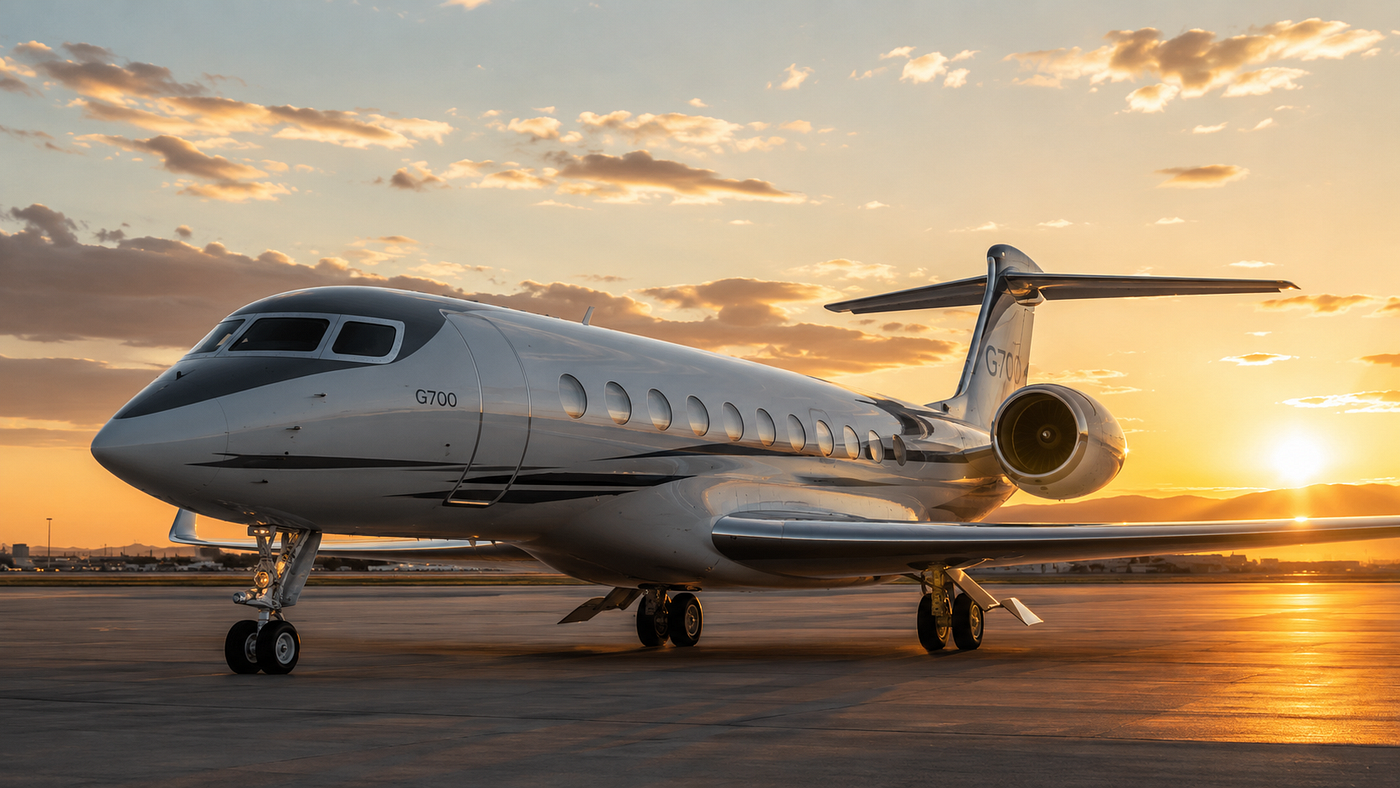
Range, cabin, and airport access — not brand alone — determine the right aircraft for a mission. (AI Generated Image)
Most private jet comparisons start with the wrong question. They ask which manufacturer builds the “best” aircraft, as though private aviation were a single competition with one winner. It isn’t. A family office relocating a household from London to Dubai twice a year has a different problem to solve than a founder who needs to land a small team on a short runway in the Alps three times a month. Gulfstream, Bombardier, and Dassault each built their reputations by solving different versions of that problem, and understanding the difference is more useful than any ranked list.
This guide walks through what actually distinguishes the three manufacturer families — range, cabin architecture, airport performance, and operating philosophy — so you can match an aircraft category to your mission rather than to marketing copy.
Why “Which Brand Is Best” Is the Wrong Frame
Gulfstream, Bombardier, and Dassault are not direct substitutes for one another across their full lineups. Gulfstream and Bombardier both build large-cabin, ultra-long-range flagships aimed at nonstop intercontinental missions. Dassault has historically competed in that space with smaller, more agile aircraft, and is now entering the ultra-long-range flagship category for the first time with a jet still in flight testing.
This isn’t a minor distinction. A prospective charterer who asks a broker for “the best private jet” without specifying mission parameters will typically get a quote for whatever aircraft happens to be positioned nearby and available — which may or may not be the right match for the actual trip. A prospective buyer who orders a flagship because it’s the manufacturer’s flagship, rather than because the mission genuinely requires 7,500-plus nautical miles of range, will likely spend years paying for capability the mission never uses. Both outcomes are avoidable with a slightly more structured starting question.
The more useful comparison is mission-to-mission: Which aircraft, from any of the three families, actually serves the route, runway, and passenger load you fly most often? That’s the lens the rest of this article uses.
A Few Terms Worth Knowing First
Private aviation has its own vocabulary, and a handful of terms recur throughout manufacturer specification sheets and charter quotes. It’s worth defining them once so the rest of this comparison is easy to follow.
• Range (nautical miles, nm): The maximum distance an aircraft can fly nonstop under specific conditions — typically a defined payload, favorable winds, and reserve fuel requirements. Manufacturer-published range figures represent a best-case scenario, not a guarantee for every flight. • Cabin altitude: The equivalent air pressure passengers experience inside the cabin at cruise, even though the aircraft itself may be flying at 40,000-plus feet. A lower cabin altitude, closer to sea level, generally means less fatigue, dehydration, and jet lag on long sectors. • Dispatch reliability: The percentage of scheduled departures that leave on time without a mechanical delay or cancellation — a meaningful, if underdiscussed, indicator of how a fleet performs in daily operation. • FBO (Fixed-Base Operator): The private terminal facility at an airport used for general and business aviation, separate from commercial airline terminals. FBO choice affects ground handling, security, catering, and how quickly you can depart. • Trijet: An aircraft with three engines rather than the more common two. Dassault’s larger Falcons use this configuration, which some operators favor for redundancy on long overwater or remote routes. • Super-midsize, large-cabin, ultra-long-range: Broad industry categories describing aircraft size and range, roughly in ascending order. They are useful shorthand but not precise enough on their own to book a specific mission, as the common-mistake section below explains.
With that vocabulary established, here’s how each manufacturer’s current lineup actually performs.
Gulfstream: Range Leadership and Cabin Altitude
Gulfstream’s modern flagship lineage — the G650, G700, and G800 — has centered its engineering priorities on two things: maximum nonstop range and cabin pressurization that reduces fatigue on long sectors.
The G650, which entered service in 2012 and remained in production until Gulfstream completed the final unit in February 2025, offered up to 7,000 nautical miles of range, with the extended-range G650ER variant pushing that to roughly 7,500 nautical miles at Mach 0.85 and a maximum operating speed near Mach 0.925. It became one of the most decorated aircraft in business aviation, setting more than 100 city-pair speed records over its production run, and its 16-window oval cabin cross-section became a signature design element for the brand.
The G700, certified in 2024, stretched that platform by roughly ten feet, added a fifth living area, and introduced the Symmetry Flight Deck with active control sidesticks — a first in business aviation. Its range sits near 7,750 nautical miles at Mach 0.85, with a top speed of Mach 0.935. Gulfstream also markets it as having the lowest cabin altitude of any purpose-built business jet, a detail that matters more than it sounds: lower cabin altitude at cruise means less fatigue over an eight- or fourteen-hour sector.
The G800, Gulfstream’s current range leader, shares the G650’s shorter fuselage but pairs it with the G700’s wing and Pearl 700 engines, extending range to roughly 8,200 nautical miles — enough to connect most city pairs on Earth nonstop.
On cost, a new G700 has been quoted in the neighborhood of $79–81 million depending on configuration, with a multi-year order backlog as of this writing — a useful reminder that flagship ultra-long-range aircraft are typically bought years before delivery, and that charter or fractional access is often the realistic entry point rather than outright purchase. Across the family, Gulfstream has also standardized a common type rating across the G500, G600, G700, and G800, which matters operationally: it allows flight crews to move between these aircraft with a shared training foundation, which can support scheduling flexibility for operators running mixed fleets.
Where Gulfstream fits: operators whose priority is maximum nonstop range combined with a well-proven, high-dispatch-reliability platform, and who value cabin pressurization science as much as raw speed.
Bombardier: Cabin Volume and the Longest-Range Purpose-Built Jet
Bombardier’s Global family, and specifically the Global 7500, has held the title of the largest purpose-built business jet on the market since its 2018 certification. Its four distinct living zones — including a dedicated crew rest area and a permanent bed in some configurations — set a cabin-volume benchmark the rest of the industry has been designing toward ever since.

Cabin zoning has become as important as range for long-haul comfort. (AI Generated Image)
Performance-wise, the Global 7500 flies up to roughly 7,700 nautical miles at Mach 0.925 maximum speed, powered by twin GE Passport engines. A development aircraft demonstrated the platform’s outer limits with an 8,100-plus nautical mile flight from Singapore to Tucson, Arizona — a useful data point on genuine long-haul capability, though not a representative full-payload mission profile. Bombardier’s successor, the Global 8000, extends range and speed further and is positioned as the fastest and farthest-flying jet in its class.
At the other end of Bombardier’s current lineup, the Challenger 3500 — a super-midsize jet with roughly 3,400 nautical miles of range — has become the best-selling aircraft in its category, with more than 1,000 units delivered across the Challenger 350/3500 lineage. Its widest-in-class cabin and reliability record make it a common choice for domestic and regional missions where an ultra-long-range flagship would be unnecessary and expensive to operate. As of Q2 2025 pricing references, a new Challenger 3500 has listed at roughly $26–27 million — a meaningful contrast to flagship large-cabin pricing, and one reason the model is frequently recommended for operators whose typical mission doesn’t require intercontinental range.
It’s also worth noting that the Global 7500’s cabin technology has become a differentiator in its own right: onboard systems allow passengers to control lighting, temperature, and entertainment from personal devices, and the aircraft’s Pũr Air filtration system is marketed specifically around cabin air quality on long-haul sectors — a detail that matters more to frequent long-range flyers than it might initially seem.
Where Bombardier fits: operators prioritizing cabin volume and livability on long sectors, or — at the other end of the family — mid-size missions where dispatch reliability and cabin width matter more than ultra-long range.
Dassault: Runway Access, Cabin Width, and a New Flagship in Testing
Dassault’s Falcon line has traditionally differentiated itself on short-field and challenging-airport performance rather than outright range, drawing on the company’s fighter-jet aerodynamics heritage from building the Rafale and Mirage.
The Falcon 2000LXS flies roughly 4,000 nautical miles and can land in as little as about 2,300 feet — a fraction of what larger long-range jets require — while retaining the wide-body cabin cross-section shared with Dassault’s larger aircraft. That combination makes it a genuine option for operators who need intercontinental-class cabin comfort but regularly use shorter or more constrained runways.
The Falcon 8X, a trijet derived from the 7X, extends range to roughly 6,450 nautical miles, filling the gap between the mid-size Falcons and Dassault’s newest program.
The Falcon 6X, which entered service in late 2023, offers about 5,500 nautical miles of range at a Mach 0.90 top speed and has the widest cabin cross-section of any purpose-built business jet currently flying, at just over 102 inches. Operators consistently cite cabin width and quietness as the aircraft’s defining characteristics.
Dassault’s next flagship, the Falcon 10X, is a clean-sheet ultra-long-range aircraft designed to compete directly with the G800 and Global 8000, targeting roughly 7,500 nautical miles of range and the largest cabin cross-section in business aviation at 109 inches wide. It is important to be precise about where this program actually stands: the 10X completed its first test flight on June 19, 2026, and Dassault is targeting certification and first deliveries in 2027. As of this writing, it is not yet certified or available for charter or purchase — a distinction worth knowing if a broker or seller describes it as currently available. Dassault’s own timeline points to a roughly two-year certification and flight-test program following the June 2026 first flight, with entry into service anticipated in 2027.

Short-field and challenging-airport performance can matter more than top range. (AI Generated Image)
Dassault’s fighter-jet heritage also shows up operationally: the company builds its Falcons alongside its Rafale military aircraft, on the same production standards, and has historically emphasized fly-by-wire flight control systems with envelope-protection features drawn directly from that military engineering base. For operators who value a manufacturer’s broader engineering depth as a proxy for long-term reliability, that heritage is a legitimate, if qualitative, consideration.
Where Dassault fits: operators who need wide-cabin comfort combined with access to shorter or more demanding runways — resort destinations, secondary airports, or challenging high-altitude fields — rather than the absolute maximum nonstop range figure.
How to Actually Choose: A Mission-First Framework
Rather than starting with a brand preference, work through these questions in order:
- What is your longest realistic nonstop sector, fully loaded with passengers and baggage? Published range figures are typically calculated with limited payload and ideal winds; real-world range with a full cabin is meaningfully shorter. Build in a margin.
- What airports do you actually use, not just the major hubs? If your itinerary includes shorter runways, high-altitude fields, or airports with noise restrictions, short-field and steep-approach performance can matter more than top speed.
- How many people are flying, and do you need to sleep, work, or hold meetings in the air? Cabin zoning — separate work, dining, and rest areas — is a bigger factor in mid-to-long missions than most first-time charterers expect.
- Are you chartering occasionally, chartering frequently, or considering fractional or full ownership? The economics and the “right” aircraft category shift substantially depending on utilization.
- What does your route actually look like on a map, not just point-to-point? Overflight permissions, refueling stops, and time-zone-driven crew duty limits can all affect which aircraft category makes a route practical versus merely theoretical. A route that looks like a single nonstop leg on paper may, in practice, benefit from an aircraft with meaningful range margin above the point-to-point distance, precisely because of the routing and weather adjustments dispatchers build in.
- What is your realistic annual utilization? A handful of trips a year points toward charter; dozens of trips a year on a consistent route pattern may justify evaluating fractional programs or ownership, where the cost-per-hour math changes substantially.

Matching mission to aircraft family starts with your longest realistic sector. (AI Generated Image)
Operational Realities Worth Understanding Before You Book
A few practical considerations rarely make it into manufacturer brochures but consistently affect the charter or ownership experience:
- Range figures are best-case. Headwinds, air traffic routing, and full passenger/baggage loads routinely reduce real-world range below the certified maximum. Always ask an operator or broker for a mission-specific fuel and payload calculation rather than relying on published specifications alone.
- FBO and slot availability affects real scheduling more than aircraft choice. At congested hubs — Teterboro, Le Bourget, or London-area airports during peak seasons — FBO ramp space and landing slots can be a bigger constraint than which aircraft family you fly.
- Privacy and security planning is a separate discipline from aircraft selection. Passenger manifest handling, ramp access control, and route discretion are operational practices, not aircraft features, and are worth discussing explicitly with any operator or broker.
- Larger cabins are not automatically the right choice. An ultra-long-range flagship flown short domestic legs is typically an inefficient and unnecessarily expensive mismatch; matching aircraft size to mission profile is usually the biggest lever for cost control.
- A common and avoidable mistake: booking by “class” (e.g., “get me a heavy jet”) without specifying mission requirements. Two aircraft in the same broad category — say, a super-midsize and a large-cabin jet — can differ substantially in range, cabin pressurization, and runway performance. Specificity in the booking request produces a better-matched aircraft.
- Cost is a function of positioning, not just flight hours. Charter pricing typically reflects not only the hours you fly but where the aircraft has to reposition from beforehand and after your trip. An aircraft based near your departure airport is often meaningfully less expensive than the same aircraft type positioned elsewhere, which is one reason two quotes for the same jet on the same route can differ substantially.
- Seasonal demand affects both price and availability. Peak travel weeks — major holidays, marquee sporting events, and ski or summer resort seasons — compress aircraft availability at popular airports well before the dates arrive. Booking further ahead during these windows is a practical, non-urgent way to protect both price and choice of aircraft.
Where a Charter Broker Fits Into This Decision
For most people reading a comparison like this, the practical next step isn’t choosing a manufacturer in the abstract — it’s finding an operator with the right specific aircraft available for a specific route, on a specific date, at a workable price. This is where a broker model becomes genuinely useful rather than incidental: a broker with access to a wide multi-operator fleet can compare Gulfstream, Bombardier, and Dassault aircraft against your actual mission requirements instead of steering you toward a single fleet’s inventory.
Villiers, a UK-founded private jet charter platform operating since 2013, works this way: it brokers access to a large network of third-party operators and aircraft — spanning light jets through ultra-long-range large-cabin aircraft across all three manufacturer families discussed above — rather than owning and operating a fixed fleet itself. For readers who found the mission-matching framework above useful but don’t have an in-house aviation department to run the comparison for every trip, a broker of this kind can be a legitimate way to translate “I need Falcon 6X-level cabin width but Global 7500-level range” into an actual quote, without having to independently vet operators across three manufacturers yourself. You can view current charter options through Villiers here.
That said, a broker is one tool among several. Owners and heavy repeat charterers may be better served by direct operator relationships, fractional programs, or jet cards, depending on utilization patterns — worth raising directly with any advisor before committing to a single booking model.
Whichever access model you choose, a few basic due-diligence questions apply regardless of broker or operator: ask how aircraft and crews are safety-vetted before being offered on a quote, ask whether pricing is all-in or subject to added fees after booking, and ask what happens operationally if your primary aircraft becomes unavailable close to departure. These questions apply equally whether you’re chartering a Gulfstream, a Bombardier, or a Dassault aircraft, and a credible broker or operator should be able to answer all three without hesitation.
The Bottom Line
There is no universally “best” jet family — only a best-matched aircraft for a specific mission. Gulfstream currently leads on raw nonstop range and cabin-altitude comfort. Bombardier leads on cabin volume in its flagship and on reliability and value in its mid-size Challenger line. Dassault leads on runway flexibility and cabin width, with a genuine flagship contender — the Falcon 10X — still in flight testing rather than in service. Start from your actual route map, passenger count, and runway constraints, and the right family usually becomes obvious well before you need to compare brochures.
Disclosure: This article contains affiliate links. If you choose to book through those links, I may receive a commission at no additional cost to you. Recommendations are based on relevance to the topic and are intended to help readers make informed decisions.
FAQs
Q: What’s the main difference between Gulfstream, Bombardier, and Dassault private jets? A: Gulfstream’s current flagships emphasize maximum nonstop range and low cabin altitude for reduced fatigue. Bombardier’s Global 7500 emphasizes cabin volume with four distinct living zones. Dassault’s Falcon line emphasizes short-field and challenging-airport performance along with wide-cabin comfort, and is developing a new ultra-long-range flagship, the Falcon 10X, currently in flight testing.
Q: Which private jet has the longest range? A: Among certified, in-service aircraft, the Gulfstream G800 currently offers the longest range in this comparison, at roughly 8,200 nautical miles. Dassault’s Falcon 10X targets a similar range class but is not yet certified as of mid-2026.
Q: Which private jet has the widest cabin? A: Among in-service aircraft, the Dassault Falcon 6X currently has the widest cabin cross-section of any purpose-built business jet, at just over 102 inches. Dassault’s forthcoming Falcon 10X is designed for an even wider 109-inch cabin but has not yet entered service.
Q: Is a bigger, longer-range jet always the better choice? A: No. Larger, longer-range aircraft typically cost more to charter or operate and can be an inefficient mismatch for shorter or more regional routes. Matching aircraft size to actual mission profile is usually the most effective way to control cost.
Q: What should I check before booking a private jet charter? A: Confirm real-world range with full passenger and baggage load (not just published specifications), verify FBO and slot availability at your specific airports, and clarify privacy/security practices directly with the operator or broker.
Q: Is Villiers an aircraft operator or a broker? A: Villiers operates as a broker, sourcing aircraft from a network of third-party operators rather than owning and operating its own fixed fleet.
메타데이터
- post_id
- c0764d3a91a3
- slug
- gulfstream-vs-bombardier-vs-dassault-jet-comparison-c0764d3a91a3
- url
- https://medium.com/@profreelancer146/gulfstream-vs-bombardier-vs-dassault-jet-comparison-c0764d3a91a3
- canonical_url
- https://medium.com/@profreelancer146/gulfstream-vs-bombardier-vs-dassault-jet-comparison-c0764d3a91a3
- author_url
- https://medium.com/@profreelancer146
- status
- ok
- fetched_at
- 2026-08-19 23:41:11