WHAT THE HECK IS … a Lost Twin?
How a vanished twin can shape you before birth — and why womb twin survivors are far more common than anyone thinks.
WHAT THE HECK IS … a Lost Twin?
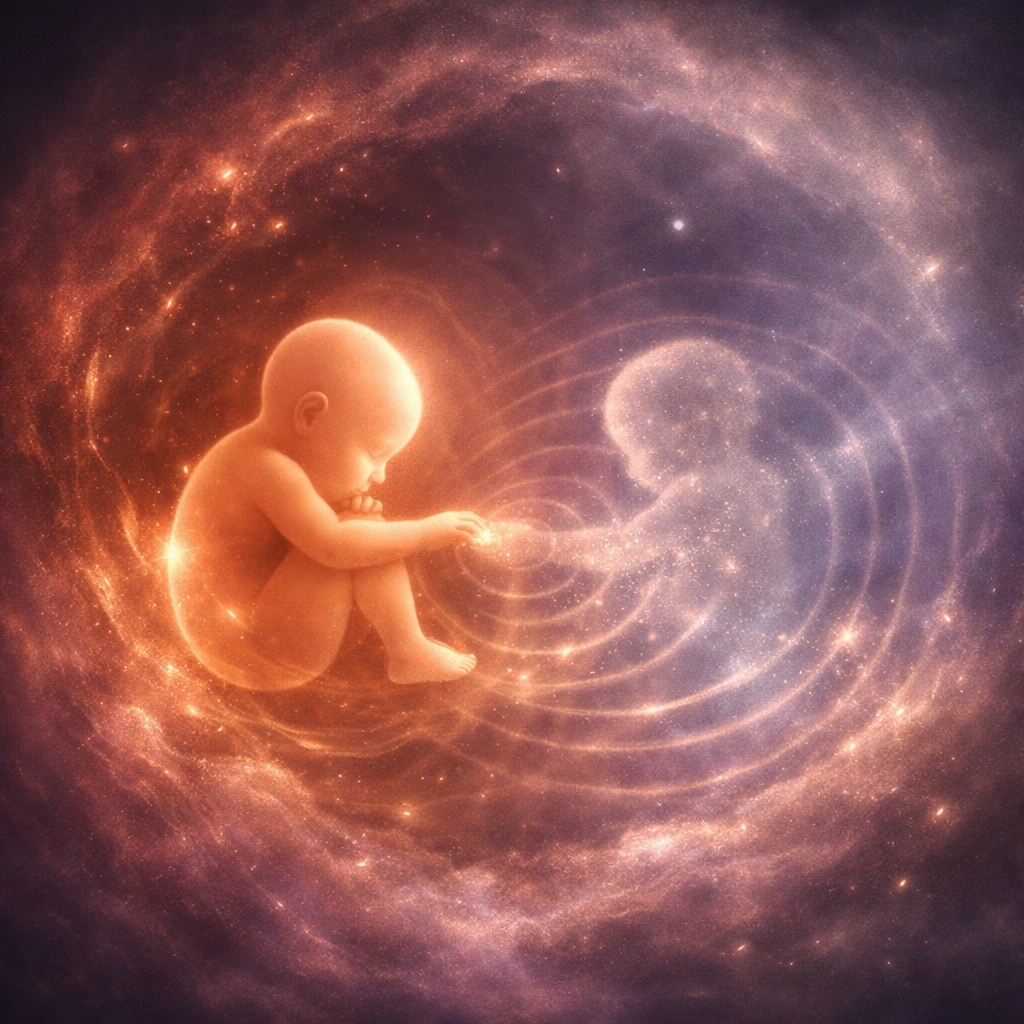
One of the embryos is dying and remains only as a faint memory as it gets absorbed; that's the vanishing twin that leaves the other behind with a big impact on the womb twin survivor. AI-generated image
How a vanished twin can shape you before birth — and why womb twin survivors are far more common than anyone thinks.
You in mother's womb — not alone
Imagine the very beginning.
Not your first memory. Not your birth. Before that. The weeks before you had eyes open or a name or any idea of yourself at all.
You were warm. You were held. And you were not alone.
There was another presence in there with you. Close enough to touch through a thin membrane, like a hand pressed against a gauze curtain. Two heartbeats. Two small bodies learning what warmth felt like. Two beings were already reaching toward each other in the dark — playing, responding, and alive together in a space no bigger than a fist.
And then one of them stopped.
Not gradually. Not with warning. The warmth that was there — right there, close enough to feel — went still. Then cold. Right next to you, in the only world you had ever known. Before you had language. Before you had any way to understand what death was, you felt it.
That is where some stories begin. Before the first breath. Before the first word. In the dark, already grieving something you had no name for yet.
That is where some stories begin. Before the first breath. Before the first word. In the dark, already grieving something you had no name for yet.
Then the other heartbeat stops — and your body feels it first
I didn’t know any of this for a long time. Nobody told me. There was nothing to tell, as far as anyone knew.
I was born. I grew up. I felt things I couldn’t explain — a particular kind of loneliness that had nothing to do with whether people were in the room or not. A sense of something missing that no achievement, no relationship, no amount of fullness could ever quite reach. Like a hunger in a place food doesn’t touch.
I grew up thinking I was an unwanted child. My mother disagreed — she said I was wanted and conceived on the wedding night. But the feeling was always there underneath: that something was wrong. That she couldn’t give me what I needed.
Now I understand it differently. It wasn’t that she failed me. No parent could have given me what I was actually missing. Because what I was missing wasn’t in the family at all. It was from before the family. Before birth. It was the ones who were there first — and then died.
The loneliness that never made sense — until now
What actually happens in a vanishing‑twin pregnancy
Lost Twin Syndrome — also called Womb Twin Survivor Syndrome
— describes what happens when a pregnancy begins with more than one embryo, and one or more of them die in the womb. The surviving baby is born alone. Raised alone. Often never told.
The lost twin doesn’t disappear cleanly. It gets reabsorbed into the placenta, sometimes into traces within the surviving sibling’s body. The mother may notice some light bleeding in the first trimester. Or nothing at all. A quiet vanishing, with no ceremony and no name.
The surviving child grows up carrying something they cannot explain. A shape in the nervous system where someone used to be.
What makes this even harder to grasp is how early it happens. The loss often occurs in the first six to ten weeks — before the first scan, before anyone knew there were two. Before memory. Before self. The body was there. The body shared that space. And the body remembers, even when the mind has nothing to remember with.
How common is a Lost Twin — really?
At least One in ten — the silent survivors of a vanished twin
Studies estimate that vanishing twin syndrome occurs in somewhere between 15% and 36% of all twin pregnancies detected early — and for pregnancies that begin with three or more embryos, the number climbs to around half. The earlier the ultrasound, the more losses are caught. The later the first scan, the more has already happened, unseen.
Before routine early scanning became standard, the vast majority of these losses were never detected at all. A mother bled a little, or not at all, and carried one baby to term. Nobody knew there had been one or more others.
Althea Hayton – the leading researcher in this field
She is someone whose work I deeply respect – estimating that at least one in ten people alive today are what she calls 'womb twin survivors'. And she considers that conservative. Some researchers looking at very early conception data suggest the number is considerably higher.
Sit with that for a moment. One in ten, at minimum. Possibly many more people walking around with an unexplained ache, a particular kind of loneliness, or a hunger they’ve been trying to name their whole lives.
What it feels like to be a womb twin survivor
The signs are not dramatic. They are quiet, persistent, and easy to mistake for personality.
A loneliness that doesn’t lift even in good company. A sense of always searching for something — without knowing what. Relationships that feel either too close or not close enough; nothing comfortably in between. A feeling of being slightly out of place, even in your own life. Of being, somehow, incomplete.
Some survivors describe it as feeling like half of a whole. Others talk about an inner presence — a voice, a companion, or a shadow-self that has always been there but never had a name.
Many spend years in therapy working through these feelings without ever finding the root. Because nobody thinks to look this far back. Before childhood. Before the family. Before birth.
When the pieces finally come together
I found my way to this understanding slowly, through research, through bodywork, and through a kind of careful listening to things I had long dismissed as strange.
I learned that I had not one lost twin, but three. Two brothers — Milan and Robert — and a sister, Victoria Nicole. Each was discovered at a different stage of my life, each arrival landing like cold shivers, like recognition, like, 'Of course.'
Milan always reminded me of a seagull. Of freedom, of flight. Later in life, I learned to fly – paragliding. Maybe because of him.
Robert came through constellation work – clearly, unmistakably, as if he had been waiting.
Victoria Nicole had already come to me in my twenties during what doctors called a phantom pregnancy — and when I asked the presence its name, I received two answers: Victoria and Nicole. Both mean the same thing: conqueror. It was only years later, when I found a teratoma — an encapsulation of hair and teeth — that the picture became complete.
Three lost twins — and the echoes they left behind
One identical sister. Two fraternal brothers. All gone before I was born.
And I, born alone — carrying four lives in one body, without knowing that was what the weight was.
Why this matters more than you think
Understanding this changes something. Not everything, not overnight. But something fundamental shifts when the inexplicable finally has a shape.
The loneliness was real. The hunger was real. The feeling of missing someone you couldn’t name — that was real too. It just belonged to a story that began earlier than anyone thought to look.
You were not too sensitive. Not too intense. Not too much.
You were just missing someone.
You were never too much — you were missing someone
I am not only a writer exploring this territory; I am also a therapist who has walked this path myself and accompanied many people through their own process of discovery. If something in this article touched a quiet place in you, know that support exists and you don’t have to find your way through it alone.
This is part of The Lost Twin Tales — a series about womb-twin survivors, vanishing twins, and the lives shaped by a loss before memory. If it resonated, follow along. There is more where this came from.
메타데이터
- post_id
- c0776bad7583
- slug
- what-the-heck-is-a-lost-twin-c0776bad7583
- url
- https://medium.com/illumination/what-the-heck-is-a-lost-twin-c0776bad7583
- canonical_url
- https://medium.com/illumination/what-the-heck-is-a-lost-twin-c0776bad7583
- author_url
- https://medium.com/@up_89997
- status
- ok
- fetched_at
- 2026-07-10 11:40:45