Human Drivers Are About to Be Reclassified as a Public Hazard
Once autonomous vehicles prove statistical safety superiority, allowing humans to control heavy machinery on public roads will become an…
Human Drivers Are About to Be Reclassified as a Public Hazard
Once autonomous vehicles prove statistical safety superiority, allowing humans to control heavy machinery on public roads will become an unacceptable public safety threat.
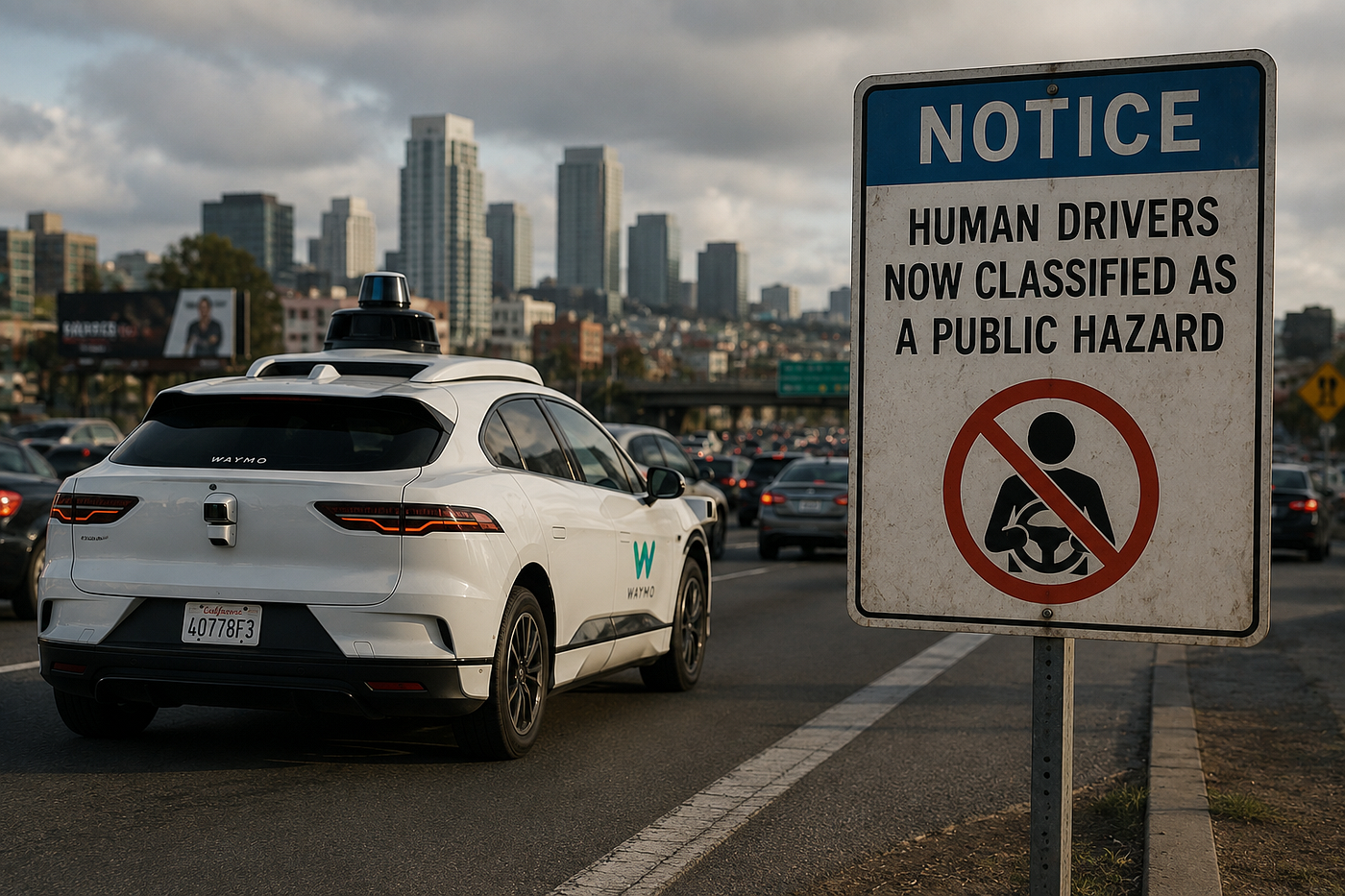
A driverless car passes a stark warning sign, symbolizing a future where human driving may be seen as an avoidable safety risk. (Illustration created by the author using ChatGPT)
For more than a century, we have treated human driving as a normal part of everyday life.
We teach teenagers how to do it. We issue licenses proving they can do it. We insure them, build roads around them, and accept millions of mistakes every year as the unavoidable price of mobility.
But what happens when that assumption stops making sense?
Imagine sitting in a restaurant watching two cars approach an intersection.
One is controlled by a human who has been awake since 5 a.m., is checking directions, has a phone buzzing in the cupholder, and is thinking about an argument from work.
The other is controlled by an autonomous driving system that has no fatigue, no distraction, no road rage, no hangover, and no desire to beat the light before it turns red.
If the machine consistently makes fewer dangerous mistakes, we eventually face an uncomfortable question:
Why are we still allowing the riskier driver to operate the machine?
That is the future autonomous cars could create.
And it is much more disruptive than simply replacing the person behind the steering wheel.
The Real Revolution Isn’t Self-Driving. It’s Changing What We Consider "Safe."
The autonomous vehicle debate usually sounds like a technology story.
Will the cameras work?
Can artificial intelligence understand pedestrians?
Can an autonomous car handle snow?
Will people trust a vehicle they cannot control?
Those are important questions.
But the deeper issue is philosophical.
What happens when human driving becomes demonstrably more dangerous than autonomous driving?
We already have an early glimpse of the answer.
In July 2026, the Insurance Institute for Highway Safety reported that Waymo's driverless vehicles had been involved in 68% fewer police-reportable crashes per mile than human drivers in the cities studied. The research covered roughly 50 million miles of driverless operation and compared them with human driving in the same locations.
The result came with important limitations. Crash-reporting systems for autonomous vehicles and human drivers aren't perfectly comparable, and the researchers specifically warned that better data collection will be necessary as autonomous driving expands.
Still, the direction is difficult to ignore.
The machine isn't merely becoming convenient.
It is becoming a legitimate safety competitor to the human being.
And if that gap keeps widening, society may eventually stop treating human control as an unquestionable right.

A driverless car navigates the city as human drivers face an uncomfortable question: what happens when machines become safer than us? (Illustration created by the author using ChatGPT)
Your Driver’s License was Never a Guarantee of Safety
Here's something we rarely think about.
A driver's license doesn't prove that you are a safe driver.
It proves that, at some point, you demonstrated enough competence to legally operate a vehicle.
After that, the system largely trusts you indefinitely.
You can become exhausted.
You can become distracted.
You can drive aggressively.
You can drive while emotionally upset.
Your reaction time can deteriorate with age.
You can glance at a text message for three seconds.
The road doesn't care.
The car keeps moving.
Autonomous vehicles approach the problem differently.
They don't need to be perfect.
They only need to be better than humans by a meaningful margin.
That's an important distinction.
Nobody needs to prove that an autonomous vehicle will never crash. Humans certainly haven't achieved that standard.
The real question is whether an autonomous system can produce fewer serious crashes, injuries and deaths than human drivers over comparable miles.
Recent Waymo data suggests the answer may increasingly be yes. The company reported that, through March 2026, its autonomous vehicles had accumulated more than 220 million fully autonomous miles and experienced substantially lower rates of serious-injury, injury and airbag-deployment crashes than its human-driver benchmarks.
That's when the conversation changes.
Because once technology becomes safer than the average person, human error stops looking inevitable and starts looking optional.
The Uncomfortable Comparison: Pilots Versus Drivers
Consider commercial aviation.
We don't celebrate a pilot for manually performing every task possible simply because they can.
Modern aircraft use enormous amounts of automation because computers can continuously monitor systems, calculate trajectories and react within fractions of a second.
The pilot remains crucial.
But nobody argues that a pilot should deliberately disable safety systems just to prove that humans are better than machines.
Road transportation could eventually move in the same direction.
The difference is scale.
There are millions of human drivers making independent decisions every second.
One person accelerates too aggressively.
Another runs a red light.
Someone else changes lanes without checking the blind spot.
Another driver falls asleep.
Another has been drinking.
Another is simply having a terrible Tuesday.
Autonomous vehicles don't eliminate every possible failure.
But they can potentially eliminate entire categories of human failure.
And that could fundamentally change how we regulate roads.

A distracted human driver approaches an intersection as a fully autonomous vehicle highlights the growing safety debate between human judgment and machine intelligence.
At First, Humans Won’t Be Banned. They’ll Be Restricted.
This is where the future becomes more interesting.
The transition probably won't look like waking up one morning to a government announcement saying:
"Congratulations. Nobody is allowed to drive anymore."
It will probably happen gradually.
Certain downtown areas could become autonomous-only zones.
Certain highways could reserve lanes for automated vehicles.
Insurance companies could offer dramatically cheaper premiums for autonomous transportation.
Fleet operators could be required to use autonomous systems in high-risk environments.
Commercial trucking routes could gradually shift toward automated operation.
Eventually, some roads might prohibit manual driving during particular hours.
And then something psychologically important happens.
The question changes from:
"Why can't I drive?"
to:
"Why should I be allowed to?"
That's a much harder argument to answer if autonomous vehicles have a demonstrably better safety record.
The Strange Future of the Driver’s License
Imagine a world where your car is technically capable of driving itself almost everywhere.
You sit inside.
You tell it where you're going.
You watch traffic pass outside the window.
You don't touch the steering wheel.
Now imagine wanting to drive manually.
You might need a special permit.
You might pay more for insurance.
You might be restricted to certain roads.
You might have to pass more frequent testing.
That sounds extreme today.
But think about what happened with other technologies.
We don't allow anyone to operate commercial aircraft because they feel confident.
We don't let people operate certain industrial machinery without training.
We don't allow untrained people to control systems simply because they personally enjoy doing it.
Driving has historically been different because everybody drives.
Autonomous technology could eventually destroy that distinction.

A passenger works on a laptop while a fully autonomous vehicle safely navigates city traffic, illustrating how self-driving technology could redefine everyday travel. (Illustration created by the author using ChatGPT)
But There’s a Major Problem: Today’s "Self-Driving" Cars aren’t All Self-Driving
This is where consumers need to be careful.
A vehicle with adaptive cruise control and lane-centering isn't equivalent to a driverless robotaxi.
Neither is a system that can handle highway driving while requiring the driver to remain attentive.
The automation levels matter enormously.
Today's widely available driver-assistance systems are generally Level 2 technologies. The human remains responsible for supervising the vehicle.
Level 4 automation is different.
Under defined operating conditions, a Level 4 system can perform the entire driving task without requiring a human to supervise it. Waymo's driverless service is an example of this category.
The distinction matters because partially automated vehicles introduce their own problems.
If a car handles 95% of driving, the human can become dangerously complacent during the remaining 5%.
The brain is not particularly good at sitting quietly for an hour and suddenly becoming an emergency-response specialist.
It's why "just take over if something happens" sounds easier than it actually is.
Human Drivers Have One Advantage Machines Can’t Easily Copy
There is, however, a serious argument on the other side.
Humans are remarkably adaptable.
We can drive through bizarre situations we've never encountered before.
A police officer waving traffic around a broken traffic light.
A child suddenly running into the street.
A fallen tree blocking a road.
A truck carrying an absurdly large object.
A construction worker improvising a detour.
A confused tourist standing in the middle of an intersection.
Humans can use context, intuition and common sense in ways that remain difficult for machines.
Autonomous systems must learn to handle an enormous number of unusual situations.
That's why declaring victory too early would be foolish.
The IIHS itself emphasized that current autonomous-driving safety data needs better standardized monitoring as deployment expands.
A system that performs brilliantly in Phoenix doesn't automatically prove it will perform equally well in every city, climate, road design and traffic culture on Earth.
Safety has to survive scale.

A Waymo autonomous vehicle safely yields to a pedestrian at a crosswalk, illustrating how self-driving technology prioritizes pedestrian safety in urban environments. (Illustration created by the author using ChatGPT)
The Biggest Enemy of Autonomous Cars May Be Humans
Here's the irony.
Autonomous vehicles may become safer than human drivers while still having accidents caused by human behavior.
An autonomous car can obey its lane.
A human can cut directly in front of it.
An autonomous car can stop for a pedestrian.
A human can illegally pass it.
An autonomous vehicle can maintain a safe following distance.
A human can tailgate it because apparently arriving at the grocery store twelve seconds earlier is a matter of national importance.
This creates a strange transitional period.
Machines will have to learn not only how to drive safely, but how to anticipate unpredictable human behavior.
And humans will have to learn how to coexist with machines that don't drive the way humans do.
That may take years.
The Economic Argument Could Accelerate Everything
Safety won't be the only force pushing autonomous driving forward.
Money will matter enormously.
Consider trucking, delivery fleets, taxis and ride-hailing.
A human driver represents labor costs, scheduling constraints, fatigue, turnover and availability.
An autonomous fleet doesn't eliminate every operating expense, but it could fundamentally change the economics of moving people and goods.
That creates an enormous incentive to automate.
A company doesn't need to hate human drivers.
It simply needs to discover that autonomous transportation is safer, more predictable and cheaper.
Once that happens, economics starts doing the convincing.
What Happens to People Who Actually Love Driving?
This is where things get emotional.
Driving isn't merely transportation for millions of people.
It's freedom.
It's identity.
It's road trips.
It's the feeling of controlling a machine.
It's taking the long way home because the weather is perfect.
It's teaching your teenager to drive.
It's driving an old manual-transmission car on an empty road.
Autonomous vehicles can't erase those feelings overnight.
And they shouldn't.
There may always be places where people can legally drive for recreation.
Track days could become more popular.
Special driving routes could emerge.
Rural roads might retain manual-driving privileges.
Driving could become less of a necessity and more of a hobby.
And ironically, that might make driving more enjoyable.
When you don't have to drive to work every morning, sitting behind the wheel on a Sunday morning might feel special again.

A roadside "Autonomous Vehicle Only" sign imagines a future where self-driving cars receive priority access to public roads. (Illustration created by the author using ChatGPT)
The Future May Not Eliminate Drivers. It May Demote Them.
That's the subtle distinction most autonomous-driving predictions miss.
Humans may not disappear from cars.
They may simply stop being the default decision-makers.
Think about the smartphone camera.
Photography didn't disappear when cameras became automated.
The computer simply took over many technical decisions.
Think about modern elevators.
You don't operate cables and machinery yourself every time you travel between floors.
You press a button.
The system handles the complicated part.
Autonomous transportation could follow the same pattern.
You choose the destination.
The machine handles the road.
The human becomes a passenger, supervisor, owner or occasional manual operator.
That's a much more realistic future than every steering wheel suddenly disappearing.
And Then Comes the Uncomfortable Legal Question
If an autonomous vehicle is statistically safer than a human, what happens when a person chooses to drive manually and causes a crash?
Today, we generally say:
The driver made a mistake.
In the future, society may ask something different:
Why was the human driving in the first place?
That question could transform insurance, liability, licensing and transportation law.
A driver who chooses manual control despite having access to a demonstrably safer automated system could eventually face higher insurance costs.
Not because driving becomes illegal.
But because choosing the riskier option becomes financially visible.
That would be a quiet revolution.
No ban.
No dramatic government announcement.
Just incentives gradually pushing people toward automation.
The Car May Become the Safest When Nobody is Driving It
We are still early in this transition.
NHTSA currently describes fully automated driving systems as a developing technology rather than something consumers can simply buy and use today. Today's consumer market is still dominated by driver-assistance systems that require human responsibility.
But the trajectory is becoming clearer.
Autonomous vehicles don't have to become flawless.
They have to become reliably better than us.
Once they do, the social definition of acceptable risk begins to move.
For generations, we've accepted human driving because there was no practical alternative.
Autonomous technology creates one.
And that could produce the strangest transportation revolution in history.
The biggest threat to the human driver may not be that machines take away the steering wheel.
It may be that machines make us question why we were ever trusted with it so casually.
The driver's seat has always represented freedom.
In the autonomous age, it might eventually represent something else:
unnecessary risk.

A driver’s license held in hand symbolizes the possibility that manual driving could become a more restricted privilege in the age of autonomous vehicles. (Illustration created by the author using ChatGPT)
The Question We Should Be Asking Now
The autonomous-car debate often asks whether you would personally trust a machine to drive you.
That's the wrong question.
The more important question is:
If autonomous vehicles eventually become demonstrably safer than humans, should society still give every licensed driver the right to manually control a two-ton machine at highway speeds?
I don't think there's an easy answer.
But I suspect the answer will become increasingly uncomfortable as the statistics improve.
Because when technology can prevent thousands of mistakes that humans routinely make, "human error" stops sounding like an unavoidable part of transportation.
It starts sounding like a policy choice.
And that may be the moment the driver's license itself begins to change.
What do you think? If autonomous cars eventually prove significantly safer than human drivers, should people still have the unrestricted right to drive manually, or should manual driving become a regulated privilege? Share your view in the comments, especially if you have a personal experience that changed how you think about self-driving cars.
메타데이터
- post_id
- c0887db3871a
- slug
- human-drivers-are-about-to-be-reclassified-as-a-public-hazard-c0887db3871a
- url
- https://medium.com/no-time/human-drivers-are-about-to-be-reclassified-as-a-public-hazard-c0887db3871a
- canonical_url
- https://medium.com/no-time/human-drivers-are-about-to-be-reclassified-as-a-public-hazard-c0887db3871a
- author_url
- https://medium.com/@evplanet
- status
- ok
- fetched_at
- 2026-08-08 10:35:53