What is VAD? A Practical Guide to Voice Activity Detection for Real-Time Voice AI Apps
Voice AI is no longer only about converting speech to text.
What is VAD? A Practical Guide to Voice Activity Detection for Real-Time Voice AI Apps
Voice AI is no longer only about converting speech to text.
The real challenge is making AI conversations feel live, natural, and human-like.
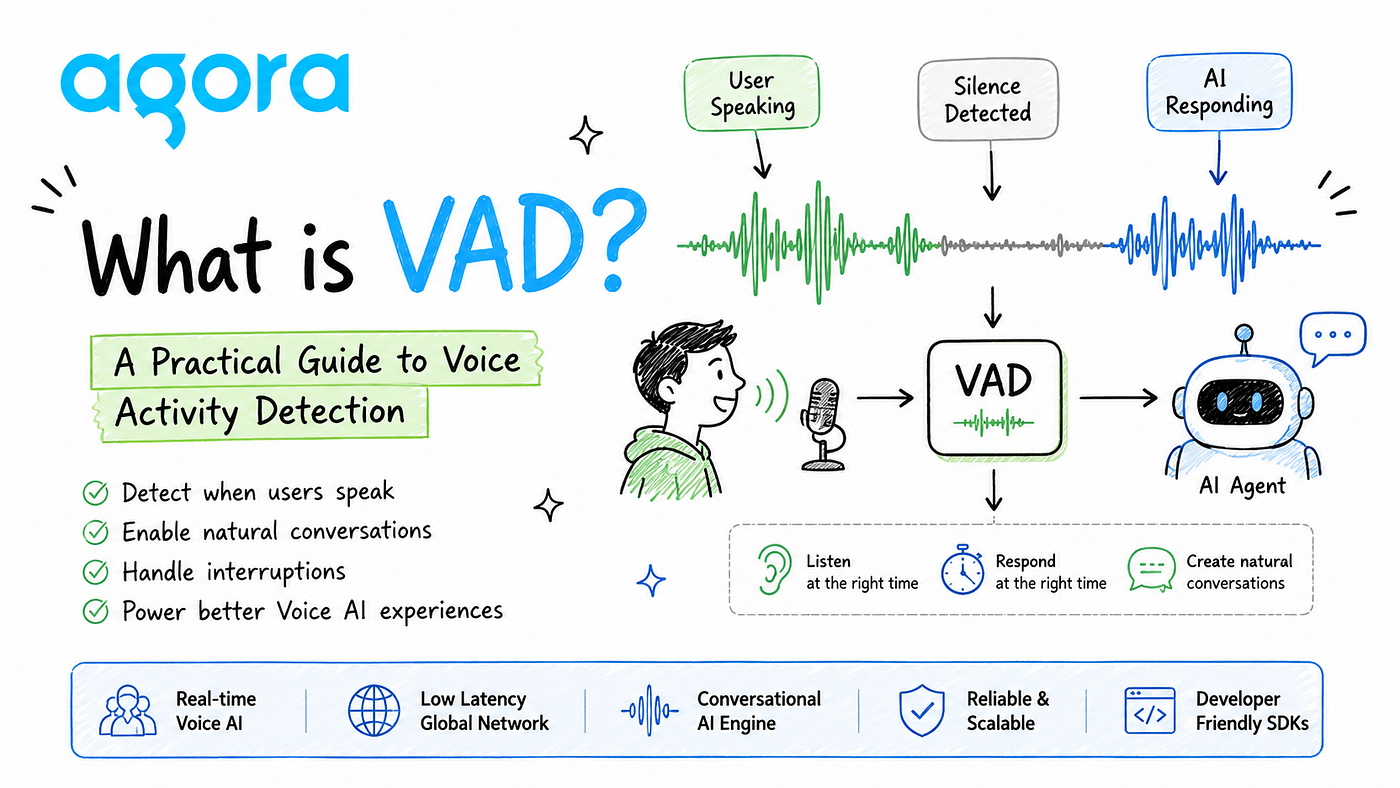
When a user talks to an AI agent, the experience should feel like a real conversation. The AI should listen at the right time, respond quickly, handle pauses naturally, and allow interruptions.
This is where VAD — Voice Activity Detection becomes important.
And if you are building real-time voice AI apps with platforms like Agora, VAD becomes one of the most important concepts to understand.
What is VAD?
VAD stands for Voice Activity Detection.
It is a technique used to detect whether human speech is present in an audio stream.
In simple words:
VAD helps your app understand when the user is speaking and when the user is not speaking.
In a text chatbot, the user types a message and presses Send.
In a voice AI app, there is no send button.
The system has to automatically understand:
- When the user starts speaking
- When the user pause
- When the user finishes speaking
- When the AI should respond
- When the AI should continue listening
That is why VAD is often the invisible “send button” of voice AI.
Why VAD matters
Imagine a user says:
“Can you help me prepare for my Android interview?”
A good AI voice agent should wait until the user finishes the sentence before responding.
But humans naturally pause:
“Can you help me… prepare for my Android interview?”
If the system treats every small pause as the end of speech, the AI may interrupt too early.
If the system waits too long, the AI response feels slow.
So VAD is not just a technical feature. It directly affects the quality of the conversation.
The problem with Voice AI today
Many voice agents still feel unnatural.
They respond too early.
They wait too long.
They miss interruptions.
They fail in noisy environments.
They sometimes keep listening when nobody is speaking.
They sometimes send silence or background noise to speech-to-text systems.
This creates a poor user experience and can also increase processing cost.
Agora’s own writing around TEN VAD and Turn Detection highlights this exact problem: natural conversations include pauses, interruptions, and overlapping speech, and voice agents need to understand these signals to feel more human.
VAD vs Turn Detection
This is very important.
VAD and Turn Detection are related, but they are not the same.
VAD answers:
Is there human speech in this audio frame?
Turn Detection answers:
Has the user finished their turn, or are they only pausing?
VAD is about speech detection.
Turn Detection is about conversation timing.
For example:
User says:
“I think we should…”
Then pauses.
VAD may detect silence.
But Turn Detection needs to understand whether the user is finished or still thinking.
This distinction is very important for real-time AI agents.
Agora’s TEN Turn Detection is designed for full-duplex voice communication and helps detect natural turn-taking cues and interruptions in human-AI conversations.
Where Agora fits in
Agora is built for real-time engagement.
For voice AI builders, Agora provides the real-time communication foundation needed to create live, interactive audio experiences.
With Agora, developers can build experiences where:
- A user joins a real-time audio session
- An AI agent participates in the conversation
- Audio flows with low latency
- The user can speak naturally
- The AI can respond in real time
- The experience feels like a live conversation instead of a traditional request-response chatbot
This is why Agora is a strong fit for voice AI products.
Voice AI does not only need an AI model.
It needs real-time infrastructure.
It needs a reliable audio layer.
It needs low latency.
It needs conversation state.
It needs interruption handling.
It needs real-time user-agent interaction.
VAD helps control the listening and speaking flow inside that experience.
Basic VAD flow

In a real-time voice AI system, this helps avoid sending unnecessary silence or noise into downstream processing systems.
Agora’s [TEN VAD blog explains](https://www.agora.io/en/blog/making-voice-ai-agents-more-human-with-ten-vad-and-turn-detection/ https://www.youtube.com/watch?v=LGjoA0js8Xk) that VAD can run before speech-to-text, detect frames containing human speech, and filter out non-human sounds such as background noise and silence.
VAD in a Voice AI pipeline
A typical voice AI pipeline looks like this:

VAD sits early in the pipeline.
That makes it very important.
If VAD is poor, the rest of the system receives bad input.
If VAD is good, the system becomes more efficient, accurate, and natural.
Agora + VAD mental model
Think of an Agora-powered voice AI experience in three layers:

1. Real-time audio layer
This is where Agora is strong.
Agora helps developers build live voice and video experiences where users can communicate in real time.
2. Conversation control layer
This is where VAD, turn detection, barge-in, silence handling, and interruption logic become important.
3. AI intelligence layer
This is where speech-to-text, LLMs, tools, memory, and text-to-speech systems generate the actual response.
Most developers focus only on the AI model.
But the user experiences all three layers together.
A smart model with poor voice timing still feels bad.
Why VAD improves speech-to-text
Speech-to-text systems work better when they receive useful speech instead of silence, background noise, or random audio.
VAD helps by filtering unnecessary audio before it reaches STT.
This can improve:
- Accuracy
- Latency
- Cost efficiency
- Pipeline quality
- User experience
Agora’s [TEN VAD article](https://www.agora.io/en/blog/making-voice-ai-agents-more-human-with-ten-vad-and-turn-detection/ https://www.youtube.com/watch?v=LGjoA0js8Xk) says this filtering can make downstream STT results more accurate and reduce unnecessary processing costs. It also mentions a real-world case where VAD reduced audio traffic by 62%.
VAD and latency
Latency is everything in voice AI.
In text chat, users can tolerate a small delay.
In voice conversations, delay feels awkward very quickly.
If the AI responds too late, the conversation feels broken.
If the AI responds too early, it feels rude.
VAD directly affects this experience.
A good VAD system helps the AI respond quickly after the user finishes speaking.
A poor VAD system either interrupts the user or waits too long.
This is why VAD is critical for real-time voice AI products.
VAD and barge-in
Barge-in means the user can interrupt the AI while it is speaking.
Example:
AI: “Here are five ways to improve your Android app performance…”
User: “Actually, explain only Jetpack Compose performance.”
A good voice AI system should detect the user’s interruption and adjust.
This makes the conversation feel natural.
Without barge-in, the user has to wait until the AI finishes speaking.
That feels robotic.
VAD helps identify that the user has started speaking again.
Turn Detection helps understand whether the interruption should change the conversation flow.
Agora’s TEN Turn Detection is specifically positioned around natural turn-taking and context-aware interruption handling for real-time human-AI conversations.
Why this matters for developers
If you are building voice AI apps, you cannot only think about prompts and models.
You need to think about the full conversation experience.
Users will not say:
“The VAD threshold is wrong.”
They will say:
“The AI keeps interrupting me.”
Or:
“The AI is too slow.”
Or:
“It does not feel natural.”
That is why developers should care about VAD.
It affects the product experience directly.
Where Agora can help builders
Agora is useful for developers who want to build real-time voice AI products such as:
- AI customer support agents
- AI tutors
- AI interview coaches
- AI sales assistants
- AI language learning apps
- AI healthcare assistants
- AI companions
- Voice bots
- AI agents inside live audio rooms
- Real-time coaching apps
For these products, developers need more than an LLM.
They need a live audio experience.
They need low-latency communication.
They need reliable media infrastructure.
They need the ability to connect users, agents, and audio sessions in real time.
Agora gives developers a strong foundation for that real-time communication layer.
VAD and Turn Detection help make the AI interaction feel natural on top of that layer.
Use case: AI customer support agent
In customer support, users explain problems in their own way.
They pause.
They hesitate.
They change their mind.
They interrupt.
A voice AI support agent should handle this naturally.
VAD helps detect when the customer is speaking.
Turn Detection helps understand when the customer is done.
Agora helps power the real-time voice session.
Together, this creates a smoother customer support experience.
Use case: AI tutor
In education, students often pause because they are thinking.
If VAD is too aggressive, the AI tutor may interrupt the student.
If it is too slow, the tutor feels unresponsive.
For AI tutors, VAD should be tuned to allow natural learning pauses.
This is important for:
- Language learning
- Exam preparation
- Coding tutors
- Interview coaching
- Classroom assistants
Agora-powered real-time voice sessions can make these AI tutors feel live and interactive.
Use case: AI interview coach
An AI interview coach needs fast back-and-forth interaction.
The user may answer, pause, correct themselves, and continue.
The AI should not interrupt too early.
It should also not wait too long.
VAD and turn detection help balance this.
This is a strong use case for real-time voice AI because the interaction feels much closer to a real interview.
Use case: AI healthcare assistant
Healthcare conversations can include long pauses, slower speech, emotional tone, and sensitive context.
A healthcare voice assistant should be patient and accurate.
Bad VAD can create frustration.
Good VAD can help the assistant listen better and respond at the right moment.
For healthcare, real-time reliability and natural conversation flow are both important.
Use case: AI sales assistant
Sales conversations are dynamic.
Users interrupt.
They ask follow-up questions.
They change objections.
They need quick responses.
A sales voice agent should be able to respond naturally and handle interruption.
This is where VAD, Turn Detection, and real-time audio infrastructure become very valuable.
What is TEN VAD?
[Agora’s blog](https://www.agora.io/en/blog/making-voice-ai-agents-more-human-with-ten-vad-and-turn-detection/ https://www.youtube.com/watch?v=LGjoA0js8Xk) introduces TEN VAD as a lightweight, pre-trained Voice Activity Detection model based on deep learning.
It is designed to detect whether human voice is present in an audio frame.
According to Agora, TEN VAD is built for low latency and high accuracy, and it can be used before STT to filter out non-human audio such as background noise and silence.
This matters because modern voice AI systems need to process speech quickly and efficiently.
What is TEN Turn Detection?
TEN Turn Detection is different from VAD.
It focuses on understanding whether the user has finished speaking or is only pausing.
Agora describes TEN Turn Detection as a model designed for full-duplex voice communication between humans and AI agents.
It helps detect natural turn-taking cues and supports context-aware interruptions.
This is important because real conversations are not always clean.
People interrupt.
People pause.
People speak over each other.
People think mid-sentence.
Turn Detection helps AI agents behave more naturally in those situations.
TEN VAD + TEN Turn Detection together
VAD and Turn Detection are more powerful together.
VAD detects speech.
Turn Detection understands conversation flow.
Together, they help voice agents:
- Listen better
- Avoid interrupting too early
- Respond at the right time
- Handle pauses
- Support interruption
- Reduce unnecessary processing
- Feel more human-like
Agora’s blog says developers can use TEN VAD and TEN Turn Detection separately or combine them to build more human-like voice agent experiences.
Common VAD problems
1. AI interrupts too early
This happens when a short pause is treated as the end of speech.
Example:
User: “I want to learn…”
AI: “Sure, what do you want to learn?”
User: “…Android development.”
This breaks the flow.
2. AI responds too late
This happens when the system waits too long after the user finishes speaking.
The user feels like the AI is slow.
3. Noise triggers false speech
Background noise, keyboard typing, fan noise, traffic, or music can confuse weak VAD systems.
4. AI cannot handle interruption
If the user speaks while the AI is talking, the system should detect it and adjust.
Without this, the AI feels rigid.
5. Too much silence is processed
If silence is continuously sent to downstream systems, cost and latency can increase.
Best practices for VAD in Voice AI apps
1. Tune VAD for your use case
A meditation coach and a sales agent should not behave the same way.
A meditation coach may allow long silence.
A sales agent may need faster turn-taking.
2. Do not treat every pause as completion
Humans pause naturally.
Good voice AI should respect that.
3. Combine VAD with Turn Detection
VAD alone detects speech.
Turn Detection helps understand whether the user is actually done.
4. Test in noisy environments
Do not test only in a quiet room.
Test with background noise, laptop microphones, mobile devices, and real users.
5. Support barge-in
Users should be able to interrupt the AI naturally.
This is one of the biggest differences between a robotic voice bot and a natural voice agent.
6. Measure latency
Track how long it takes from the end of user speech to the start of AI response.
This affects perceived quality.
7. Optimize cost
Use VAD to avoid processing unnecessary silence or background noise.
Why Agora is relevant for this space
Agora is not just about basic audio calls.
Agora is a real-time engagement platform that helps developers build live, interactive communication experiences.
For voice AI, this matters because the product experience depends on:
- Real-time audio quality
- Low latency
- Global reliability
- Live session management
- AI agent participation
- Interruption handling
- Natural turn-taking
- Scalable infrastructure
Agora’s work around Conversational AI, real-time media, and the TEN ecosystem makes it highly relevant for developers building the next generation of AI voice agents.
The AI model may generate the answer.
But real-time infrastructure determines how natural the experience feels.
Developer takeaway
When building a voice AI app, do not start only with:
Which LLM should I use?
Also ask:
How will the user speak?
How will the AI know when to listen?
How will the AI know when to respond?
How will the AI handle pauses?
How will the AI handle interruptions?
How will the audio move in real time?
That is the difference between a demo and a production-ready voice AI experience.
Final architecture view

Conclusion
VAD is one of the most important building blocks of real-time voice AI.
It helps the system detect when a user is speaking and when they are not.
But for truly natural AI conversations, VAD should work together with Turn Detection, barge-in handling, low-latency audio, and real-time communication infrastructure.
This is where Agora becomes important.
Agora gives developers the real-time audio and engagement foundation to build live voice AI experiences.
TEN VAD helps detect human speech.
TEN Turn Detection helps understand natural conversation flow.
Together, these building blocks help developers create AI voice agents that feel faster, smarter, and more human.
The future of AI apps will not only be about smarter models.
It will be about better real-time conversations.
And if you are building real-time voice AI, VAD is one of the first concepts you should understand.
메타데이터
- post_id
- c08b889ea603
- slug
- what-is-vad-a-practical-guide-to-voice-activity-detection-for-real-time-voice-ai-apps-c08b889ea603
- url
- https://medium.com/agora-io/what-is-vad-a-practical-guide-to-voice-activity-detection-for-real-time-voice-ai-apps-c08b889ea603
- canonical_url
- https://medium.com/agora-io/what-is-vad-a-practical-guide-to-voice-activity-detection-for-real-time-voice-ai-apps-c08b889ea603
- author_url
- https://medium.com/@anandwana
- status
- ok
- fetched_at
- 2026-07-18 12:05:23