2026 MLB Draft Top 350
It’s that time for my personal top 350 for the 2026 MLB Draft! Over 550 players were reviewed to arrive at this ranking.
2026 MLB Draft Top 350
It’s that time for my personal top 350 for the 2026 MLB Draft! Over 550 players were reviewed to arrive at this ranking.
If you would like to see all of them, you can do so on my player website at https://willtdodge.shinyapps.io/2026MLBDraft/, where you can view my grades and modeled values. Examples will be provided for the top 10 players, but you can customize them fully, too!
My rankings were viewed over the course of the season, molded by season-end data, in-person live looks throughout the Bay Area & the Draft Combine, and mid-season coverage of players. If you would like to see part of that process, you can do so here: https://www.prospectslive.com/author/will-dodge/.
This process has been a massive undertaking. If you feel inclined to support me, you can do so with a Prospects Live subscription, which features over 50 contributors who pour their hearts into what they love across Draft, Pro, Dynasty, and Hobby content.
Shockingly, these reports were not written in one sitting. I have spent the past 3 weeks editing them, but specific stats may still be off. Bear with them; my larger points still stand.
Probably the most important part of the header is that there is a lot of reading material, and you might be looking for one specific player! To help you out, CMD+F is your friend, but also this link, which will show you the raw t500 rankings: https://docs.google.com/spreadsheets/d/1CuvyP1nK-zwJAhL0xgtypPS-6uoCwolOzcx-YjP_ZzE/edit?usp=sharing.
This cycle has truly been a joy to review and has opened the door to meeting several people, for which I am truly grateful.
Now, let’s get to the rankings!
60 FV Tier
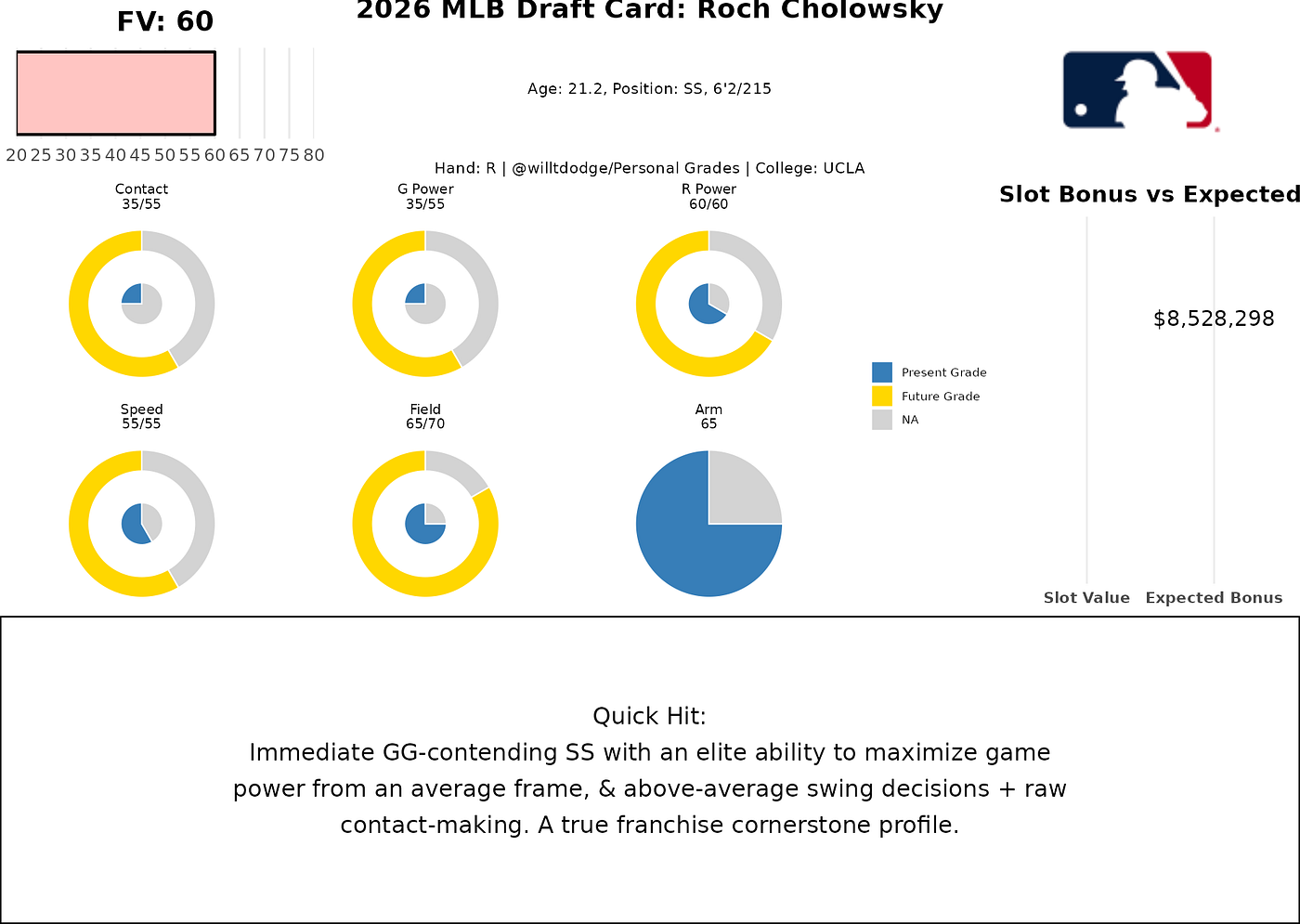
1 SS Roch Cholowsky UCLA
Roch Cholowsky is one of the top College performers in recent history, with a powerful 2-year showing at the plate and an elite 3-year showing in the field.
Has a thin upper half with a slightly built-up lower half, leading with large thighs and glutes. There’s more power in the profile, but not much is left. The swing mechanics entail a slightly open stance with a large step stride. Has good hand and bat speed for a short swing path. Swing is malleable to pitches all over the zone & adjusts his bat finish according to the swing, with barrel accuracy to all parts of the zone.
Built a terrific Fr year into an explosive So year with a game-power jump and a doubling of his BB/K. Then his JR year made a power jump from the 55 range to a plus. The game utilization is there, with mostly pull-side spray but a healthy distribution of LDs & FBs. It’s in the 55 range, as he will likely hold at 25 HR power. His hit tool is also in the 55 range, as he is a more aggressive hitter, but he has good-to-ball skills both in (89%) and out of the zone (66%). There is a notable increase in swing-and-miss against spin and, to a lesser extent, off-speed pitches, but neither is alarming.
Has a high base-running IQ and is an aggressive runner, but is not naturally gifted there. The body should mature at an average level for his agility, but he plays best in the field. In total, probably at best a 15–20 SB guy. Cholowsky’s top traits are at SS, where he was a 70-grade defender coming to UCLA and has lived up to the billing. Metrically, he has been D1’s top defender in DRS over the past two years. His arm is an easy plus, and the glove is an easy double-plus. He has the fluidity and the actions to make plays in all directions at SS, with an internal clock to complete every play, & holds GG-winning upside.
In all, there are 50+ tools in every department of the profile, & should need less than a full year in the MiLB before the Drafting team calls him up. This, in most years, is an easy 1–1 shortlister and holds no real comp, as I believe the bat will perform much better than pre-FA Dansby Swanson. However, if you do want to cherry-pick individual seasons, that 2023 Swanson year is a nice peek at a hopeful Cholowsky peak campaign.
2 C Vahn Lackey Georgia Tech
Vahn Lackey is a 1–1 catching prospect who upped his power at the plate this season, creating a 5-tool profile. Average athletic build; leans on the thinner side but has room to bulk up further if he’s willing to sacrifice a bit of foot speed. Lackey has a very compact stance with a closed upper half. He steps with a larger hip coil, then explodes his backside into the ball with a high bat finish.
He took a big breakout year at the plate in 2025 to a whole other level in ’26, finally showing an improved ability to lift and get to the pull-side, and thus flashing Golden-Spikes-worthy numbers. Fairly unaggressive at the plate with a low Z-swing, but has drastically improved his swing decisions over the course of his career, finally reaching a plus-17 Chase% rate in ’26. He does make bat-to-ball contact, too, at a good rate, with good Overall Whiff (18%) & Z-Whiff (11%) numbers across most pitch types, and has done so throughout his career. These rates hold strong against upper competition as well. The hit tool is above average in projection but very advanced at present.
Lackey made terrific strength gains not only heading into his great 2026 season but also during it. He hit the ball much harder on average, but also raised his power ceiling to the 113-mph range on true maxes. Not only did he make that improvement, but by doing so with lift- and pull-side aggression, he completely flipped his HR-projection profile, now positioning himself in the above-average upper-20s HR range.
Behind the plate is an average framer with good framing ability along the sides of the zone but poor framing at the corners. Lackey is at least a plus blocker & has a plus arm. Overall, this is a 60-grade defensive package, given its potential for flexibility. Lackey is an incredible athlete for the catching position, running at a plus rate, which raises the question of whether an organization could find more consistent value and playing time for him outside the squat. The answer to that will be determined toward the end of his development timeline and will be org-depth- and chart-specific. Still, all that said, he should be able to move to other positions if needed and maintain the athletic control to be a plus defender there… maybe in CF, for example.
The cherry on top for the profile is that plus speed is utilized well on the basepaths. Now that he is showing his power, there truly is no competition. Interestingly, Lackey declined to attend the Draft Combine, reportedly for negotiation purposes, and is a significant possibility for the #1 pick.

55 FV Tier
3 SS Grady Emerson Texas commit
Grady Emerson has a “good/great at everything, elite at none” profile that could tap into more power if he builds more strength. Emerson has a thin midsection, which aligns with his current body grade; he lacks supreme traits, but if he can add strength to his lower half, that, combined with his twitchiness, could create an exciting athletic profile.
He swings with a long, slightly tilted, and steep stroke, but with adjustability. Emerson has flashed a great combination of bat speed and hand speed. Emerson makes contact at a good rate and can adjust to pitches all over the zone. He expands the zone at a low rate and is a better trait than his true bat-to-ball. While neither aspect of that tool is elite, this is an above-average hit tool where the one great part of the swing, the bat speed, could allow him to hold his performance across all levels.
Emerson has flashed higher-tier EV numbers, but his better power quality is his ability to get to good contact consistently, maximize it in the air & to the pull-side. He will need to develop above-average raw power, but if he does, he should post good SLG numbers.
Emerson runs at a comfortable plus level, which could slightly regress if his strength gains come. On the defensive end, Emerson lets his athletic traits do the work, with elite quickness in his mechanics and the control to handle routine plays. His arm is above average, but he should remain at SS, where his overall fielding ability is at a plus level.
He’s an easy top-of-the-Draft profile, but still lacks the supreme impact at the plate to be graded at a consistently All-Star level, though he’s a piece every franchise would love to build around.

4 SP Jackson Flora UC Santa Barbara
Jackson Flora follows Matt Ager & Tyler Bremner as hard-throwing UCSB preseason SP1 candidates from recent years, with a pronounced leg kick.
An overlay of all 3 of them would match up pretty similarly, although Flora is thinner than Ager and more athletic than both. That is notable, as he has a rail-thin frame, but he leverages his looseness to generate force in his pitches. His delivery generates a ton of arm speed, which, early in the ’25 and ’26 seasons, allowed him to consistently touch the 100s from a standard 3/4 release. He extends off the mound at a great rate. Overall, it is a pretty standard-to-high vert release. Still, this is someone who is a great athlete & maintains his velo throughout outings.
He threw his FB & SL at a 96% rate in 2025 & didn’t need to throw a third pitch to succeed in the Big West. However, in 2026, Flora has flashed a new Kick-CH & improved Sweeper, hinting at the potential for an MLB repertoire. The FB is where his bread gets buttered as he touched triple digits to start the season. He’ll settle in around 97 with the pitch, & it was the high riding/low VAA pitch that generates an easy + stuff grade. His command of the pitch overall leaped forward in ’25, but he is in-zone with it at around a 55% clip & non-competitive with it at around a 30% clip. It gets whiffs & chases at an above-average rate & manages contact at a solid rate. It’s a pitch that can generate Ks and perform in line with expectations for its velo. For now, it’s a strong 60, but I think there’s a chance he can maintain throwing it a tick harder and bring it to a 70.
The SL is the other main pitch, thrown at an MLB-average velocity. He actually has command of this pitch at a better rate than the FB, but doesn’t have it at a rate high enough to use consistently enough to bail him out of a loss of FB command. It drops about 12" off the FB and sweeps with 16" of difference. It has been a true put-away pitch for him and hangs in the 55–60 range, but it can be a consistent plus if he throws it a little harder.
New to the Flora set in 2026 is a Kick-CH that kills spin down to the triple-digit range and kills velocity by around 11 mph. His feel for the K-CH is below average, and the raw shape is fairly average in its separation from the FB. Still, the sheer difference in velocity has been enough to fool hitters, and even though it’s mostly used against LHBs, it can still have projected RV performance. Also, in 2026, Flora has swapped a low-90s CT for a high-70s Sweeper. It has the same depth plane as his SL, but sweeps an extra 10” to the glove side.
His command on this pitch is also raw, but the lack of use of it has worked to his advantage at times, completely fooling hitters not expecting something soft to come out of his hand. Flora entered the season as an intriguing test case for how high an essential 2-pitch pitcher could go, and answered that question by improving FB velocity, solidifying a 3rd pitch type, and flashing the potential for a 4th. With that, he is the easy SP1 in this class.

5 SS Tyler Bell Kentucky
Tyler Bell turned down a $1.2M slot as a prep in ’24, where he flashed 1st-Rd talent, and he’s likely proven extremely right. He’s a switch-hitter with an incredible combination of balance and bat speed at the plate (loses a bit of balance on the Right side), and it is a terrific example of how exceptional an athlete he is.
Bell makes 6'1/200 look incredibly lean, but does have a high amount of muscle definition in his lower half. He could add strength to his upper half, but with the tremendous twitch that he possesses, it’s a pro-level frame at present. Bell has a wide, open stance from the left side, takes a step stride toward the pitcher, and violently rotates his shoulders at fire.
He’ll make contact at a fringe rate (76% Contact in ’26 — down 4% from ‘25), with platoon woes, but could be a victim of a highly selective approach. When Bell does make contact, you could imagine it goes far with his present above-average raw power and the potential for further bodily growth to reach a plus. Because of Bell’s violent hacks, he gets to this often, but with his well-balanced swing plane, he can lift pitches with this force from various zones. He has struggled to consistently get to the pull side, but Bell has all-fields power.
Defensively, Bell is an above-average defender, with limited reps in the field due to his Shoulder injury & So eligibility. Still, he has great balance in his defensive stance, and occasional stiffness in his receiving actions holds him back from double-plus upside. There’s above-average speed and arm strength in the bag as well, carrying him to an overall above-average regular projection, but with wide career outcome tails.

50 FV Tier
6 C Ryder Helfrick Arkansas
Ryder Helfrick is another athletic catcher in this Draft, with an incredible ability to destroy baseballs on contact consistently. Inversely to Bell, Helfrick makes 6'1/205 look like a TE, although with a thin lower half that can certainly add 10–15 lbs of strength. He has a closed stance with quick hands that provide great power.
The raw contact making is fringe with an overall 75 Contact%, but makes strong swing decisions built off the lower Chase% at 19. When he’s offered a pitch to drive, he takes advantage of it, delivering at least plus-raw power and EVs up to 114 mph. Helfrick has held his damage in the SEC and sends his hard-hit balls into the air with great efficiency. It’s one of the few “this is what it is” offensive profiles in this class, with not a ton of development time needed for the backstop. Any strength gains can be built and sustained in the offseason, and an org tinkering with their swing or approach to engineer more consistent contact is messing with a forceful, efficient power hitter.
Helfrick is one of the best framers in the country and would be a candidate to go a little higher had this draft taken place a decade ago. He moves well for a catcher on the basepaths, but when behind the plate, struggles to adjust his frame with blocking & coming out of the crouch. Paired with an arm that is merely above average, I would be somewhat curious to see how this plays in LF, but that is a very org-depth-chart-specific curiosity.

7 CF Drew Burress Georgia Tech
Drew Burress is one of the most recognizable players from this class, with 70-grade college career production and 30-grade size at 5'9/185. Where will his career outcome land?
Burress should be a fast-moving prospect with his size, currently possessing elite twitch and great hand speed. Burress has an open stance and smoothly glides towards the pitcher with incredible balance to more than make up for the lack of size. While the swing has slowly unveiled an element of grooved mechanics year over year, Burress has more raw pop than most players in this College crop, with a consistent ability to generate above-average, borderline-plus pop. With his swing, Burress is also one of the best at yanking batted balls to the pull side in the air, aiding his path to the GT HR record, set in one fewer year than the previous record holder, Jason Varitek.
He’s an aggressive hitter with good swing decisions, not often expanding out of the zone (sub-20% in all 3 seasons). While in-zone contact skills are a plus as well, Burress’s stroke leaves him susceptible to in-zone/inside pitches, and the warning signs of this started to show this season, with a higher rate of OOZ-Whiff & limited SLG on pitches to the outer half. Will this require a swing & approach change? I say no at an overall level, as it is a difficult spot to consistently zero in on, even at the pro level, and it could lead to stretches of struggle.
Heading into this season, the majority of Burress’s power was on the pull-side, but this year he showed the ability to go the other way. Burress is an above-average runner, defender, and thrower in CF. His reactions and route-running could stand to improve, but Burress has tremendous IQ out in the field and on the basepaths.

8 CF Eric Booth Jr. Vanderbilt commit
Eric Booth Jr is arguably the top prep player in explosiveness, leading with elite bat speed. Has the body frame of an NFL LB (and the bloodlines of an RB) that will not require him to spend a ton of time building up strength, after adding around 30 lbs in the past year+.
The elephant in the room is that the swing is fairly unique, although it could be compared to Brett Lawrie with an intense pre-load wrap and a flat-to-downward path. He can consistently unload in his swings, but it will leave him unbalanced at times, and he looks to be fighting his own body at others. While he has the strength to match the power impact of the rest of the top guys, he has failed to do so consistently… until recently. Akin to Ethan Holliday from last cycle (this was more due to s/m, but the larger point stands), Booth has undergone a significant swing tweak on the platform from Winter to Spring and, as a result, has lifted a lot more, tapping into the HR power.
Booth’s inability to lift his hard-hit batted balls had previously been the big hole in his offensive game, creating significant uncertainty in projecting future power performance. Now, really, similarly to Holliday (OK), MS HS competition quality is below average, and buying into the pro-viability of this change is risky. Booth in the present has above-average raw power showings with wood EVs up to 105mph from last Fall, and he should be able to grow into at least plus. While he struggled to generate SLG production in top competition, Booth showed excellent on-base abilities with above-average contact rates and average but aggressive swing decisions.
He’s a double-plus runner who will certainly stay in CF with great reads in the present and closing speed into the gaps. The one big flaw in Booth’s toolset, and one with little room for growth, is his arm strength, which is, at best, below average. Booth has the potential to be a 4-tool prospect, with the one lacking tool being the one you would gladly take as the flat tire, but it will take a leap of faith to reach that result. Booth Jr was a Combine attendee decliner, and could be a candidate to rise on Draft Day.

9 TWP Jared Grindlinger Tennessee commit
Jared Grindlinger is a late reclassifier who has credible TWP potential. As an athlete, he’s a lanky 6'3/180 with long levers and certainly untapped strength gains. He’ll be done growing in size soon (only 17.2 after all), but with a strong midsection, he should be able to carry this projected strength gain with ease.
As a pitcher, he has a rocking delivery that leverages his athleticism, with good extension and a high release point. He currently has good arm speed, but with these projected strength gains and aging, he will be able to throw harder. The FB will sit in the lower 90s, touching 96. It gets above-average ASR, with some slight carryover expected, but it’s still not a spectacular Stuff pitch. The projection in this offering is its ability to be thrown harder down the line.
His feel for FB shape is also average, but his feel for the breakers is plus, as is his projectable ability to throw the SL hard. His ability to alter shapes is unique, especially given his age. The CH kills spin and velo well and is also commanded. He won’t throw it with a dynamic shape, but the separation off the FB is still evident. All of this on the mound comes with at least plus command for his age.
As a hitter, he has strong contact ability but has struggled to lift consistently; he has consistent bat impact. Grindlinger has a long but quick swing that often remains balanced. The key bright spot is his ability to make contact (sub-5% I-ZWhiff), with good swing decisions. This came at the launch distribution heavily pointing to GBs, but he’ll have time to adjust to this, as he’s still growing into his frame.
Grindlinger has flashed average raw power to this point, with mostly pull-side usage, but if he were to commit to a hitter-only path, he should be able to tap into more juice. He’s an average runner who has seen limited time in the OF (see above: pitching), but will have a strong arm.
In sum, Grindlinger’s drafting organization will have a major decision to make regarding his development timeline: which side to focus the majority of training on. I truly think he can make it as both, with time, although the feasibility & history of that (especially with domestic development) is essentially 0%. A gun to my head says he can create more value in the field if you can get him to lift more, but he is a dynamic athlete on the mound as well. We could potentially learn the answer to this just by how Rob Manfred announces his position on Draft day.

10 SP Cameron Flukey Coastal Carolina / Portal
Cameron Flukey has Tyler Glasnow-esque levers and, overall, is a total twig for his height. There is certainly room to build up his lower half to add more strength, although this would hinder the overall flexibility and the flying limbs used in the delivery.
The delivery begins with a Ben Casparius-like triple blind toe tap & perpendicular to the rest of his body. Then he gets into a Glasnow-like leg-and-arm pump, driving down the hill and gaining both a high amount of extension & a lower release point than expected for his height. He has a fairly long arm path and high arm angle & finishes low to the ground.
This creates a favorable FB shape for someone, given his size, where he is cutting the mound distance more than usual & generating a natural FB ride while releasing the ball from a lower vertical point than usual. The pitch gets a standard amount of run & sits in the mid-90s. He commands it fairly well, although he is in-zone with it almost too much & will just middle-middle it a lot. It managed contact well in general and was still good against P4 schools, though not as well. Because he was so In-Zone, there was a lot of chasing when the pitch was in the shadow, but a lower overall whiff rate. It’s a plus pitch for me now, but I think it can grow into a 70.
CB is the leading secondary with more than 30" of iVB difference & 15" of sweep diff. It isn’t thrown hard, & when In-Zone, it doesn’t have much sharp break, but when thrown off the FB, it presents a massive change of pace. Still, this pitch is effective on its own, as he used it at a 20% clip. Despite the hitters knowing it was coming, they still had to be caught off guard. It drew very low swing rates & a near-50% whiff clip.
Additionally, it managed contact very well while generating Ks at a 43% clip. I am skeptical about how it will play in the big leagues, as it really started to get hit hard against P4’s. I give it a 60; it could get higher if it were thrown harder.
The SL is the third pitch, which gets double-plane depth off the FB but isn’t thrown all that hard, averaging 83. He is also In-Zone on that pitch a ton, though he often leaves it middle-middle. Overall, it performed worse than the CB, but against P4, it managed contact better & generated more swing-and-miss. That could be because in those games he threw it 2mph harder. Still, I think this pitch has the truer upside, although for now there is less demand for it. There is a surprise CH that misses bats & manages contact well, but is used only 4% of the time and usually shocks hitters. There is a 7mph drop & some tumble off the FB, but not much ride & spin kill. The command for it is not terrific.
Command overall in the arsenal is very good. This is 1st Rd arm, although one of these breakers needs to take a Stuff leap to carry him out of a #4–5 rotation projection. He should run an above-average BB% in the majors, but his K% will be average-to-below, and his FB can only limit contact so well.
Body and overall comp is Tyler Glasnow if he can get that breaker harder, but a performance comp to 2023 Freddy Peralta. Flukey missed 8 weeks of the ’26 season due to a rib injury, which significantly affected his health.

11 LF Martin Shelar Mississippi State
Martin Shelar is an advanced offensive profiling prep OFer with unique traits. He pairs his advanced frame with his older age, allowing him to out-strength similar bodies.
Has an Evan Longoria-like stance at the plate that stutters with multiple toe taps, but glides into a long, fast stroke accelerated by elite hand speed. Shelar’s barrel adjustability is top-notch, and he has made quality contact across the zone. When combined with a good chase tool, Shelar has a top-of-the-prep-class hit tool. Shelar wowed at the Combine with a 116 mph exit velo and numerous distances over 440'. It’s plus power accompanying the hit tool, and when you combine those grades, it gets to rarified air quickly.
He’s an average runner, with a below-average collective defensive ability. He’ll field smoothly with good route-running, but lacks the athletic projection to make the superior plays. He’ll likely be moved to LF later down the line in pro ball, which fits well with his fringe/average arm.
My friends at Baseball Prospectus have beaten me to it, but this is a flag-plant prospect for me and should go in the front half of the first round.
12 LF Derek Curiel LSU
Derek Curiel is a thin and loose athlete who could add more strength to the frame, but will likely never be average in that department. Certainly has the size to add to the body, but it will come at the expense of agility, and we have been asking this question for about 4 years, due in part to his long-time presence at the top of Draft lists. Swings with more pop than the slappy hitter’s size and setup suggest, but is looking to drive LDs. Even his farthest HR did not come with an A-swing, but with an adjusted barrel and a more launchy path. With that raw strength, it can only project for a future 40-grade raw pop.
He hits FBs at a really low rate as well, so not sure if the power will ever grow into a consistent in-game threat. Does his damage at the plate with his terrific approach, where he does not swing often and rarely expands the zone or swings & misses. He’s held these rates against the top competition in the country and hits the ball hard at a consistent rate; it is just often on the ground or lined out. Just an average runner who did not steal many despite numerous opportunities.
LSU played him in LF as a FR, where he graded as average, although he would play CF at 98% of other schools. Still, it is hard to see how his defensive skills would translate to him being a long-term CF, let alone that he will be an above-average LF over the long run. Holds a fringe arm as well.
There is one elite tool in the profile, but it is the most important one, at least. Holds upside as a consistent .300+ AVG guy with .380+ OBP. The problem is that it is hard to see him SLG anything over .440, with the vast majority of XBHs being 2Bs. Combine that with little to no defensive value, & you get a player with a high probability of being a consistent MLB regular, but low probability of being an All-Star.
13 SP Logan Schmidt LSU commit
Logan Schmidt is one of the top Prep arms in the class with his complete arsenal.
Even as a reclassifier who will be sub-18 on Draft Day, Schmidt has a near-pro-ready frame with a bulky upper half & wide shoulders. He can add even more mass with a thinner lower half, but there’s already a lot of strength in the profile, as shown by his velo jump this summer. His delivery comp is similar to Gage Jump, with a drop-and-drive stride (though at times it’s a step-and-throw) down the mound & a 3/4 arm angle. He is a huge extender down the mound, and the slight oddity to his delivery massively plays to his advantage.
The FB has taken strides this summer, now sitting in the mid-90s and touching 97. The pitch has been a weapon for him in the circuit, as he can use it to play up in velocity through his hard-to-track arm path. The pitch itself has some slight run but lacks an outlier shape. He commands this pitch at an above-average rate and possesses good body control to maintain it over time. On an individual level, this pitch is 55-grade quality, which I could very likely see outperform this due to hitters not picking it up from the delivery.
His best pitch is a sweeper where he’ll flash a CB, a SL, and a blend of the two. No matter, this pitch has been used against batters on both sides and has been effective. He’ll hang at 80mph with it and has good command of the offering, but its best feature is its sharp sweeping action that also offers some vertical depth difference off the FB. It has plus-upside.
The CH is also a pitch that has recently come along for him & offers above-average upside for its vertical-separating action off the FB. The pitch’s velocity difference and command are both average, but it has been a weapon for Schmidt against RHBs. Schmidt’s combination of 3 55+-graded pitches, the present showing, and body projectability for above-average command makes him a 1st-round-quality arm, and he should be a projected factor in an MLB-competing team’s rotation.
14 SP Joey Volchko Georgia
Joey Volchko is a Stanford transfer to Athens with high standards. Lost his SP spot Fr. year due to loss of command, held it So. year, but lost his strikeout ability. Well-developed athletically, with broad shoulders and large arms; still a little thin in his lower half, but has somewhat developed glutes & thighs. High-effort delivery, especially with a large leg kick, in which he inverts his ankle back to CF, then twists it back to the plate as he moves down the mound.
To the naked eye, this looks like it limits his extension down the mound, but I’m not sure what the number is. Has dropped his slot to a lower 3/4 arm angle, resulting in a below-average release.
His primary FB is a CT in the mid-90s, with a true FF seldom used in the upper 90s. This pitch is often sprayed to the glove side. But it has missed bats and generated GBs at a high combined clip, due in large part to its extremely wide start and end points. There is obvious 65/70 upside to this pitch if the command can be figured out and built on its uniqueness.
Top secondary is an upper-80s Sweeper. This pitch he does have command of, and it is an easy +/++ especially given the velo. Due to his command of this pitch (and not the FB), he’ll use it often, so there is a high swing%, but an average whiff rate. This pitch does get a high GB%, but it has performed really poorly in BABIP-luck.
His SW is thrown the hardest in the country, & there’s command for it. The specs could show a little more action, but in the long run, this is a 70-pitch. Three other pitches in the arsenal are really extensions of the two main ones.
The CH has splinker action, but it really just works as a slower but deeper SI. This pitch has performed a lot like the FF. There is at least a command for it; he doesn’t get many whiffs with it, but it’s a super high GB% pitch. The pitch isn’t thrown hard enough to register the who cares what the shape is give a high grade level like a Paul Skenes splinker, but it is still good enough to get a 55 if it were used more often. The CB is a deeper version of the SL. It is really the one pitch that deviates far enough from the rest of the repertoire’s specs, but there is a 30-grade command for it. It also gets a 50 just for how hard it is thrown.
15 CF Blake Bowen Oregon State commit
Blake Bowen is an elite power/run/arm tooled OFer with decent contact skills, creating one of the top HS profiles in the country. He fits into the “LB in CF” bucket with a large upper-half build and still holds some strength projection in the lower half. While carrying that mass on his body, Bowen still flashes at least plus-graded run times (6.4 60yd), and should settle in as a 60-grade runner.
Bowen swings with top-of-the-class bat & hand speed, and has an upward stroke that looks to launch pull-side bombs. Bowen flashed a tease of this elite power with numerous 111+ EVs at the Combine, including 4 425'+ blasts. Even with that approach, he has done a decent job of showing adjustability throughout the zone. His obvious hit tool flaw at the moment is pitch recognition, which has led him to expand the zone at a high rate. He makes contact at an average rate overall, but it’s a fringe tool at the moment, holding him back from 5-tool status.
Bowen has the in-game tools to maximize it with a high number of hard-hit pulled fly balls, but has a high number of GBs, creating an in-game performance track record that has been a little feast-or-famine. Still, Bowen shows off his HR power at a consistent rate, making him a plus HR threat.
Bowen mixes in one of the top prep OF arm grade toolsets in the class. There’s a chance he could outgrow his current standing in CF and be pushed to RF, but Bowen is still very experienced in CF and should start in an org there. All the ingredients are there for a really special profile.
Throughout this process, Bowen has been very high on my board (like 4th overall), but continued spin recognition issues in the Spring made me pump the brakes a bit. But those breaks are very slight. Shelar and Bowen will be my “My Guys” in this class.
16 3B Chris Hacopian Texas A&M
Chris Hacopian is a bat-first impact prospect who ripped apart the B1G while at Maryland the last 2 seasons and will now test out how it plays in the SEC. He has a pro-ready body that lacks agility and twitch but packs strength beyond his size. Hacopian’s swing comes with top-tier bat speed but is long and structured.
This got picked apart a bit in the Cape, where he lost his SLG impact, but he was still able to maintain a low K-rate. Hacopian is a Swiss Army knife at the plate, with great swing decisions, bat-to-ball approach, and present + projectable power. He swings at a low rate overall but increases his aggression on pitches in the zone and rarely chases. The zone-contact is at a plus rate as well, and is part of why his K% at MD was sub-10 & BB% at 10+ in both years. His hit tool ability sustains against upper velocity & in the Cape, so it gets 65-grade upside.
The impact is at a plus level as well, with a 60-graded raw pop that he gets to often. He’ll hit for LDs more consistently than he would for FBs, and has an even spray, but his contact quality is consistently superb. Especially, he hits breakers and all secondaries for a better SLG than he does for his FBs, and this ability has held up against upper competition. There are at least plus offensive tools across the board, which puts him at the top of that class.
The rest of the profile is fairly lackluster, but that’s alright. He lacks agility, and it doesn’t impact his base running. It’s below-average speed for now, which I expect will regress. He played SS while at MD, but will certainly not stay there at A&M, as he was a 30-grade defender at SS, and a 35-grade defender at 3B on the Cape. There’s a good chance he gets moved to some sort of defensive neutral position, whether that is LF or 1B, or even DH.
At peak, he projects for a .290/.375/.490 slash with a high BB/K-rate. This is a profile similar to 2021 Raffy Devers, trading some of the HR power for fewer Ks. The underlying massive red flag in Hacopian’s game now is the health. He missed a portion of Fall Ball with a wrist fracture, and was in and out of the Aggie lineup throughout the season with Back issues. Hacopian was a Combine attendee decliner, which I suspect is more due to health reasons than to pure selection-number reasons.
17 SP Cade Townsend Mississippi
Cade Townsend was the Ole Miss Rebs Weekday SP as a True Fr in ’25 and will be So. Eligible in the ’26 Draft, who exploded after a chance to compete for a weekend spot for the season. He pitched with an FB-heavy arsenal in ’25, where he struggled to limit BBs consistently but ran a high K%; hidden in the toolset is tremendous feel across a wide range of pitches.
Townsend has a compact delivery that leads to a standard arm angle and release metrics after a head pump. He’s a skinny athlete who derives strength from both the quickness of his arm action and the momentum of his lower half. The FB has been geared up to 98, with high-rising action above expected for the arm angle. There’s some slight natural cut to it as well, but its best trait is its command in the zone with the pitch. Hitters have jumped on it well when they make contact, but that has been a lower-likelihood outcome.
Townsend’s feel for breaking balls with a Cutter, Slider, and Curveball all thrown hard and with distinctive planes. His best feel comes with a 90 mph CT, and he’ll get to it often. Used not so often at all but has great potential; a mid-80s 12/6 CB with a massive downward break, especially given the velo it’s thrown at. Townsend consistently features this pitch out of the zone, but the feel for the pitch will need to improve.
The third breaker is an upper-80s SL that blends similarly to the CT but still reads as Townsend’s lone pitch with considerable sweep, especially considering his true SW lacks feel. His command for this pitch was well below average at the moment, but getting this unlocked will unlock the rest of the profile. He has feel for a spin-killing SP, but struggles to generate serious movement separation off of the FB/CT.
There are plenty of tools for Townsend to make quick headway into a pro career, and he could be a candidate for an org to pare down his arsenal to his best offerings. Townsend was unavailable for the last two weekends of the Rebels’ season with an injury significant enough to raise doubts about whether he would return to Oxford next season, creating obvious concern about his development runway into pro ball.
18 SP Carson Bolemon Wake Forest commit
Carson Bolemon has one of the most dynamic FBs in the prep ranks, which out-punches its average velo. He’s grown a couple of inches over the summer, jumping into a good body frame, filling out his mass. He could add some strength to his lower half, but his body is fairly maxed out. Bolemon extends far down the mound and has a high arm angle with an average release height. There is some stabbing in the short-arm action as he hits his checks, but Bolemon has yet to sustain a notable injury in his career.
Bolemon has a FB that consistently gets into the 20s in iVB and will typically sit in the lower-90s, but has been rushed up to 96. Some traits indicate Bolemon’s ability to perform well with this pitch is well beyond what the velo indicates.
Bolemon has shown various shapes for his SL with a harder, more true-SL, but also a lower-80s SW, which is a high sweeping pitch, while also at times getting 2-plane depth off of the FB. For a pitcher with massive movement differences, this lead breaker has a lower-moving profile, which allows him to tunnel off the FB more easily, especially given the command with which he throws it.
The CB is in the lower-80s, and has a similar sweeping profile to the SL, but does so with another 10" of depth off of the SL. At times, it is featured to freeze hitters with its massive, differentiating movement profile, and it has command and intriguing movement specs on its own despite lower spin rates.
The true key to the Bolemon arsenal is an ultra-hard CH with strong spin kill, vertical separation, and slight arm-side run, despite featuring a Greinke-esque similar velo’d pitch. His zone usage with this cambio drops off sharply, which is why it lags behind the rest at present.
There was early-Spring concern for Bolemon as he came out of the Winter break with velo down multiple grades and scattered command, but those concerns were greatly alleviated as the season went on.
19 SP Coleman Borthwick Auburn commit
Coleman Borthwick is a prep pitcher with the physicality of an EDGE rusher. Could slim to add more strength or add some onto his upper half, but pretty much will come as he is. Has played 3B as well, where he has plus power, but with 30-grade speed and chase concerns, he should likely outpace his 3B development for the mound.
Throws from a lower 3/4 arm angle, but drops his elbow. Limits his raw extension from a significant cross-stride. Overall delivery is similar to Ryan Walker. Fastball touched 98 frequently over the Summer and is reportedly up to 100 this Spring, with a ride-and-run shape, but neither produces tremendous movement (14,8). He commands the pitch well in addition to being one of the top prep spinners across the whole class & his repertoire.
SL with downward action and utilized on both sides. He throws it in the mid-80s, has a big movement profile off the FB & is manipulated with SW action, and could manipulate it further should there be tunneling issues. Again, the command for the breaker is amongst the best of the prep Ps.
Borthwick has a high running and velo-killing CH dropping down to the mid-80s, and running up to 17". Command has come and gone between starts, but there is serious upside here if an org can find a more consistent operation for it, which has proven to be easier for the smarter pitching organizations to discover.
Borthwick has not shown any larger, deeper CBs, but that doesn’t mean he can’t later down the line. For me, the big risk is how the FB matures with a pro-ball and how the body ages. He can command the zone at an elite rate, but how will that hold up over the course of a full career?
20 SS Jacob Lombard Miami commit
Younger brother of NYY 2023 1st-Rounder, Jacob Lombard, is easily more gifted and talented. Well-rounded, measurable, and incredibly advanced for a prepster. Combines plus strength with elite agility, speed, and body control, so he will not need to work on his body. Presently, an above-average athletic tester.
Swings with a moderate uppercut and a slight hitch. Stays on time at a great rate and naturally utilizes his whole body in the stroke. Good bat speed on a shorter swing length, despite below-average hand speed.
The glaring hole in his game is a massive bat-to-ball issue rooted in an inability to read spin. The circuit had a 40+ percent Whiff rate, with an accelerated OO-Z rate. Top competition Sliders have especially feasted on him. His chase rate is average overall, but his inability to adjust his swing (which is elite when synced) will make him a bust if left unadjusted. The rest of the profile is stellar and future MVP-quality.
His raw power is amongst the top of the class, and most importantly, he gets to it consistently when he connects on an A-swing and maximizes angles. The hit tool woes heavily diminished the true power output, but if that is managed just slightly, his power output will explode.
Lombard is a 70-grade projected runner who consistently puts up 80-grade times but likely won’t maintain that speed. He is also an incredibly fluid defender who is a lock to stick at SS. The body adjustability and lateral quickness to have an elite range at SS. The arm grade rests at above-average, which is disappointing compared to the rest of the skillset, yet still a good trait.
If Lombard can turn around the hit tool, this is an easy #1 overall pick value; however, everything about his contact skills flashes massive caution signs, and the way it currently performs is unsustainable, even assuming no performance loss when translated to MiLB. If it does click, he could have Carlos Correa-level upside. However, if it doesn’t, it’s a Joey Gallo-type offensive profile with great SS defense, but still not the consistent offensive output necessary to be a consistently serviceable player. This was the most difficult report to write for me, as Lombard is a great person to talk to, but if I had to pick, I lean towards the latter presently.
21 SS Rocco Maniscalco Mississippi State commit
Rocco Maniscalo is a prep reclassifier who will be one of the youngest prospects ever come July ‘26.
He is a wide-framed athlete in the midsection, which allows the projection to add more strength on top of his current 6'2/190 frame. He holds INF/C versatility but will settle in at INF, where he has played more often of late, and he can utilize his speed, which has clocked straight-line times at the 60-yard mark. I would be a bit concerned that if he’s adding body mass, this ability leaves him, but for now, it’s a plus.
His max arm strength at SS from the combine is 97 mph, earning a double-plus arm grade. Maniscalco has the body control to last at SS. As mentioned earlier, I am skeptical about how the body matures and whether he has the mobility to last at SS. If not, a move to 3B would suit him well, where he has a good internal clock, the rhythm to handle slow grounders, and the arm to make the cross-diamond throws. My skepticism about the playability of his range weighs down the field grade to 55, but it’s still above average.
At the plate, he’s a switch-hitter, but the consistent fluidity in his swing is clearer from the left side. My swing comp for Maniscalo is Manny Machado, who rocks from a slightly open stance with an elongated step stride. The bat path starts with a high level of hand separation but makes up for it with great hand speed and above-average bat speed. Similarly to Manny, he has run a high Air% in the circuit, but Maniscalo’s is more via fly balls. The toolset looks to play as a power-over-hit for now, and I’m watching for more power to come, which arrived at the Combine in the form of numerous near-110-mph EVs.
He makes good swing decisions at the plate while being a highly selective hitter. Throughout his games, the hit quality has been a consistent force, but he currently tracks for more doubles power than HRs. Maniscalco is a mid-to-late 1st Rd-worthy pick you can dream on, with his youthful body projection to add more strength and an across-the-board above-average defensive skill set.
22 CF Chase Brunson TCU
Chase Brunson is a 3rd-year TCU CFer who saw his power jump, vaulting him into R1 conversations. A big league body, Brunson has natural strength & agility, with the potential to add weight. In particular, the arms and upper legs are not yet toned, but as a youthful player in this college class, he has time to grow. The lazy swing comp is for Ramón Laureano. Closed front half, fairly high back elbow with some waggle, and an early and moderate step stride leading to a flatter bat angle through the zone.
This sometimes limits his ability to reach pitches at the bottom of the zone, but when he connects, he still makes an impact. The two other trisections of the zone come with an incredible combination of bat-to-ball skills & contact quality. In total, Brunson has 60-grade contact skills but mixes them with 40-grade swing decisions when sampling against P4 competition, for a 45-grade overall. He entered 2026 swinging at a slightly below-average rate, chasing at an average rate, but swinging at pitches in the zone at a below-average rate. That rate really flipped on its head in ’26, with an ultra-questionable approach that swung fairly infrequently in-zone while also expanding OOZ. The whiff rate has held steady versus upper velo-FBs but has fallen to breakers. If the swing decisions can be tweaked, this is a 55+ grade-hit tool.
Brunson also entered this year with raw pop hanging around average, where he can put the ball out to all parts of the field, but lacks the impressive EVs or tape-measure shots. That certainly changed in ’26, with new maxEV and hit distance highs. He showed increased power last year and lifted the ball more consistently, but he is still not a regular HR threat. This is also due to his hit approach, where he runs a higher GB & lower LD rate than expected. He has improved his HH/FB+LD rate, but he still draws lower xSLG numbers due to his GB approach.
He’s a plus runner for now who doesn’t use it much on the base paths, but if he adds strength, it will likely drop to above-average. Still, altogether he can run around a 15/20 HR-SB season, but with an around .260/.310/.410 slash & an above-average K-rate. He’s been the Horned Frogs CFer, where his lateral quickness plays tremendously. His arm is fairly inaccurate, but he is flashing above-average strength. This is a safer offensive profile that can still add impact to his game, where he can add that value to a plus defensive CFer. This is a mid-to-late 1st Rd quality pick, & a full season of this production is a 3+ fWAR player.
23 SP Liam Peterson Florida
Liam Peterson’s body measurements aren’t outlier-crazy, but he uses his size to create a steep approach for hitters, with a high arm angle and an upright body at release. Somewhat effortful delivery & is around an average athlete. Command took a step forward in ’26 but is still in the below-average range.
FB gets lots of ride, but with the high release, it is somewhat standard for the approach to the plate. In all, it’s a fairly normal shape for the pitch. In the zone often, and around the middle as well. Missed bats at a high rate but made contact at a normal rate. In SEC play, the contact started to yield a lot more SLG. I’d give it a solid plus at this point, but I’m not sure if there is room for the pitch to rise to an outlier level.
SL is the leading secondary & features it almost at a 50/50 rate v RHBs. Commands the pitch at a good level and better than the FB. Pitch has a downer shape with more than 20" of vert diff off the FB. Isn’t a huge chase drawer, but got swing-&-miss at a great rate and often in-zone. This is his best pitch & gets a 65 future grade.
CH with a plane worth of drop and some spin kill. In-zone a ton with it, but it also draws massive swing-and-miss. It has been tattooed in SEC play when connected. Has a slow-show me CB with poor feel for it. Slight 12–6 shape & its best utility is its surprise element.
The loud contact for me makes me a little fearful, and I would love to see a command leap before I can boost him out of the 45–50 FV range. Has pitched a lot at UF & could see him as an upper-20s K% guy with a BB rate around 10 and a low-4 FIP. Tough to nail down an exact comp, but similar to Simeon Woods Richardson.
24 CF Trevor Condon Tennessee commit
Trevor Condon is a tooled-up prep OFer, particularly with the hit-and-run tool, but lacks power with a greatly undersized body. Condon has a Jean Segura-like stance, with his hands free and loose, allowing him to consistently throw the bat at the ball. He’ll drop his head at times, but can get tilted on his path to match various planes if needed.
He makes contact with all zones well with an aggressive approach. Condon makes contact out of the zone at a strong rate, but does not sell out to make contact, with a good approach at the plate, and decent power for his size.
Will get into 45-graded raw power region, but lives in the 40-range with 35-game utilization and should be done growing. Condon at the Combine swung with a slight change in his lower half, a quieter leg stride, and it unlocked a bit more raw power. Condon in pro ball could unlock more game power with quick fixes in his approach by lifting and pulling, which he did show the ability to do in AZ, but has not shown as much in higher-competition games.
Runs at a 65-rate (3.7 at the Combine), which should keep him in CF. Condon has smooth movements in the OF, but true route-running ability will need to improve to unlock the plus defensive upside. Has an above-average arm as well.
25 SP Gio Rojas Miami commit
Gio Rojas has a thin build with long levers that can grow into his lower half. Has a high waist and has continued to grow throughout the Summer. Throws with a lower release point, using a near-sidearm delivery with an easy, natural feel, then drops his arm to reach a unique release point. He has trouble consistently reaching the same release point, which has created an issue with command, but one that will certainly be corrected by the time he punches into the big leagues.
The FB can get near triple digits, and he has the body frame to hold that range in the future. While the command for the pitch is not terrific at the moment, his life for it outperforms typical profiles given his arm angle. It’s a pitch that has been a weapon for him and should continue to be as he grows, giving him plus upside.
The SL is also a go-to weapon that has done damage for him. With a shorter movement profile, he throws the FB hard and shapes it well. It’s a high-spin pitch that should also continue to be thrown harder as he grows and lands in the plus-upside range, although it currently performs better than the FB.
His CH is an inconsistent pitch, but it has flashed upside for a 3rd serious offering. The pitch drops velo off the FB well and kills spin, but does not consistently show separating action off the FB or command. That said, the flashes have been there, and the completion of the development for this pitch will determine his upside.
26 3B Taj Marchand Mississippi commit
Taj Marchand is a fringe athlete, but a strong prep hitter who is likely to end up at 3B. Marchand is already up to 200 lbs, but with a high waist and long levers, he could still be growing; however, if he doesn’t, he’ll be done with most of his strength gains. Marchand has a long swing with a double pump, subtle Brett Lawrie-like, but in doing so, has good hand speed and rotational force, which has created plus raw power.
The raw bat speed lags, which, given the swing length, & is inability to replicate it, are concerning. Marchand has consistent barrel accuracy, making supreme contact at a steady rate while also hitting on a line. His power projection in sym is a mixed bag, with great physical and mechanical traits but poor body control and limited explosiveness. He makes contact throughout the zone at a high rate but is overly aggressive and makes poor swing decisions. He has the capacity to clean this up, but it will take time and leave room for pockmarks in his profile.
Marchand is a former TWP with a plus arm, but his inconsistent body control will push him to 3B, though he shows good lateral quickness. He’s an average defender who is more mature than similarly aged players.
27 SS Justin Lebron Alabama
Justin Lebron is a lanky athlete who can certainly add more strength to his frame. Large glutes, but slimmer legs and arms. Standard setup, with a lot of bat waggle. Has a longer bat path with a high finish. Does not have particularly fast hands in the swing, but there’s a ton of natural strength in the profile. Was a Golden Spikes favorite in the first half, then cooled off massively and exposed a big whiff concern.
In-Zone secondaries generated a scary high level of swing-and-miss. FB contact came at an average rate at least, but this hole in his offensive game really stalled his offensive output. This is paired with already below-average swing decisions. The overall swing rate is very low, but his O-Swing is fairly high. The good part is that his pop is already great and can still improve. His overall HH rate is at the top of the nation, with consistent HHs pulled and in the air/LD. The max EV numbers are only 55-grade for now, but he has the athleticism to add more strength there.
Holds slightly above-average speed and was on the SEC SB leaderboard, but nothing game-changing there. Has above-average defensive actions & has an above-average arm, but there are some defensive inconsistencies. He’ll stay at SS in the future, but will probably not be a consistent GG candidate. If the hit weren’t so risky, he would be an easy 55-FV profile, but the value here is pretty low. There will be streaks of All-Star production with streaks of AAAA value. A high upside comp here is Trevor Story.
28 3B Ace Reese Mississippi State
Ace Resse transferred to Miss St. from Houston last year and improved his performance. He’s a bat-first prospect who has been a consistent hard-hitter. Reese is a dense athlete with a built-up lower half and large midsection. He sacrifices his agility to pack plenty of natural strength. He’ll occasionally swing with max intent, where he’ll have a larger coil, but typically, Reese has a short stroke where he drops the barrel on the ball with a low one-hand finish.
This allows him to maintain barrel accuracy in certain areas of the zone while still utilizing his natural strength. Reese is an aggressive swinger at the plate overall, but pairs it with decent swing decisions, particularly with an increased rate of swings on pitches in the zone. Going along, his contact rates are a plus, as he makes in-zone contact at a high rate, although his ability to do so has faded a bit against higher velocity. He matches the consistent hitting ability with consistent impact on contact.
His hard-hit rates are among the top of the nation, & is why he was able to see a jump in his power output. The raw power is fringe at the moment, and will likely never get higher than a plus, but he maximizes it with a high pull rate, and puts it in the air an average amount.
His game on the basepaths adds little value, and defensively, he is fairly locked into 3B despite seeing some time in LF. His arm plays at a below-average level, which brings down his defensive upside. His value compares to Wilmer Flores at his peak.
29 LF Logan Hughes Texas Tech
Logan Hughes entered this season as potentially the biggest data sleeper in the nation, and somewhat held things up with a continual ability to launch baseballs in the air with force.
He’s a less-than-stellar athlete, at 5'11/190 without a glamorous figure, but Hughes takes a strong approach to the plate and has simply been one of the most dangerous and consistent bats in College since he stepped onto the Stetson campus as a FR. Hughes has terrific natural upper-body strength and does not need much rotational force in his swing to generate all-fields power.
Hughes is an upright swinger who lacks raw bat speed but has loose, adjustable hands that whip the barrel around the zone to pound essentially every pitch. He’ll often lift (although his mental approach is to go for an LD/GB) and distribute FBs everywhere in the OF. A team could look to orient his hit approach more toward the pullside, but I would not want to make that change at the risk of limiting the consistent impact he makes on contact.
Hughes is a barrel magnet and often gets above-average raw power. The concerning part about the bat is that he does whiff I-Z (16%) a fair bit, and I would be curious as to how he fares against the upper levels of competition.
Then we arrive at the glove, which is barreling towards a 1B/DH role. Texas Tech had him in LF, and he showed decent actions in the field, but his range is limited, and his arm is fringe. He should be able to translate his skill set well to the dirt, & maybe 3B if he translates very well, but this will be a profile that the bat will hold up well.
30 LF AJ Gracia Virginia
AJ Gracia entered this season as a short-listed candidate for the top of the Draft based on a ready-set offensive profile, but was nicked up throughout the year in ’26 and lost some of his impact at the plate.
Gracia is a big body at 6'3/215 who was trotted out to CF with Virginia, but does not move that well. He has a big, open stance with a toe-tap stride, getting into an uphill, longish swing. Gracia generates power through good hand speed but lacks innate bat speed or rotational force, suggesting a lack of athletic traits.
After an ultra-dynamic 2025, Gracia looked like an ultra-projectable player who made strong contact (86 overall Contact%), but with a diminished I-Z Contact rate, with patient swing decisions. This bat-to-ball ability held in ’26, but the path to get there flipped: Gracia made more contact I-Z (91%), was much more aggressive, and showed a higher rate of OOZ-Whiff.
You could chalk up the lack of swing adjustability to the injury, but his swing lacks variety overall. The more concerning factor was that Gracia’s average, pulled HHs, and most worrisome power capacity all declined in 2026, even after putting on more strength in the offseason, and are now down from a powerful FR season. The power potential is still at least average, but not the potential plus threat he flashed in years prior.
Gracia has played CF at Virginia and, at times, at Duke, but he is not a CFer. He’ll run at a fringe/below-average rate, with poor actions in the field and a below-average arm. He’ll fit in well as an LFer.
31 SP Kaden Waechter Florida State commit
Kaden Waechter is one of the top prep pitching athletes in the class, with an arsenal featuring a power FB/SL combo. Waechter has a finely developed body that is likely done adding strength, but with a high waist & above-average shoulders, could grow another inch or two.
He’s a TWP who has played middle INF & would be a 40-raw power / 55-speed hitter, which shows his athletic abilities. Waechter is a tremendous mover on the mound who shows body control throughout an effortless delivery that still packs power. There are some moving parts in his delivery, particularly his lower half, but Waechter extends down the mound at a good rate for his size and, when combined with his lower 3/4 arm angle, creates a fairly unique low-to-the-ground release.
The FB has gotten up to 97 in side pens, but in-game hangs in the 92 range. There is some quality hop to it, but nothing spectacular from a Stuff standpoint. The real concern with the pitch is that he has the early Sean Newcomb dilemma: for a delivery that does not have an obvious hitch/adjustment, his command is at least below average. There should be some faith in this fixing based on his double-plus physicality, but a serious concern with his profile.
The SL is a short, turbo downer with CT-like action, but he has a good feel for it. He throws the pitch really hard, but does not spin it that well, and the shape requires the pitch to be in the zone at a high rate to tunnel with the FB.
If he goes back to a CB that has been used in the past and adds some dynamic breaking action to his profile, this pitch could really take off. But based on the current arsenal he has, the SL has some serious heavy lifting to do to get a profile that it does not currently have.
He rounds off the profile with a hard CH that runs a lot and gets some separating action from the FB there, but the velo & spin do not create an offspeed profile. If he commands it better, it could be a good 3rd pitch offering. Waechter has a commitment to FSU, but should elevate himself beyond just making it to campus and land in the early 2nd-round range.
45 FV Tier
32 SP Brody Bumila Texas commit
Brody Bumila is a side-arming prep lefty with NBA-like stature and a FB gaining velocity. Bumila is certainly done growing at 6'9/250, and his body could be refined as he begins to focus on baseball only (dominated Massachusetts HS basketball) while also recovering from a July ’24 TJS.
He missed pitching in the Summer of ’25 as a result, and the HS action in ’26 will serve as everyone’s first look in a long time. Welp, in these early first looks, he’s sitting in the upper-90s and touching 101 with a rise-and-run shape. Bumila has a tall and fall delivery that could stand to be a little more athletic, but loops his elbow during the extension, creating a near-side arm angle and vert release points lower than MLB average, while also extending well above average down the mound (of course, he’s 6'9).
This creates a flat approaching FB, and with the ride it produces, it is overall a hyper-exciting shape, conservatively a future double-plus. Bumila could be in-zone more often, but if he were to command the general top of the zone area, he should be able to dominate with the heater. From this point on, the profile gets much hazier. Feel and overall presence for the rest of the secondaries have wavered from start to start, and his lack of challenging opposition this Spring certainly did not help him test this.
Bumila’s CH is further along than the SL and has settled into the upper-80s with arm-side run. His command of the pitch comes and goes, but there is plus potential for the pitch to play off an unhittable FB if he can settle it in. One of the big questions is the development of the breaking ball, which has been poor so far.
Bumila struggles to feel spin or velocity relative to the heater, mixing between a lower-80s short SL and a mid-70s Sweeper. Any organization confident in its ability to unearth this breaker should have him in the top-6ish of this class. Still, until this is fixed, there is a significant risk of an inability to go through lineups multiple times. The other big question is health in general.
HS TJs are far more prone to re-tearing the UCL than post-tearers, posing another significant question mark about his future durability. Still, at the end of the day, I would select him in this upper-1st-round range, due in part to a distaste for this end of the 1st round, but also due to the litany of paths to find the true breaking ball. The org that unearths this will have 29 jealous peers.
As I am typing this, reports have trickled in that Bumila has re-injured his UCL, hence his dropping out of the 50 tier.
33 SP Tegan Kuhns Tennessee
Tegan Kuhns is another notable 2024 prep arm who made it to campus and into the Draft after 2 seasons. In what was his lone season consistently facing SEC competition, Kuhns had an up-and-down season battling injuries and ineffectiveness, while also delivering tremendous performances.
Kuhns is a definitional “lanky athlete” at 6'3/190 with long limbs, which allow him to extend well down the mound and contort his body into infrequently seen angles. Kuhns does this with a visually displeasing delivery (very intricate glove pump, arm path, and delivery timing). Still, through it all, can create a high arm angle (47 °), a low release point (5.4 vRel), and a flat approach (-4.3) FB, which is thrown in the mid-90s with good carry. It’s an exemplary Stuff pitch with a high feel for the zone, and has been the go-to piece to go through lineups.
The rest of the profile is truly a question mark, outing-to-outing, with most notably a CB that has ranged from the mid-to-upper-70s to the lower-80s. No matter how hard it’s thrown, it’s a shorter-moving breaker that is commanded well. The lowered movement profile does not play well on a Stuff model but tunnels extremely well, allowing it to generate terrific swing-and-miss, even with the high zone%.
He’ll accompany this pitch with a slower SL, which often remains in that shape, and is best known for its high vertical break off the FB, but with little sweep (-2,-2 vs 19,11). The command takes a step back from the CB but is more of a true Stuff pitch, despite the vast lack of separation from the CB. Kuhns has an inconsistent feel and orientation for an SP which sits in the lower-90s, but does drop off the FB well, just with little command of it.
34 SS Luke Williams Vanderbilt commit
Luke Williams is a presently undersized prep SS, but has some of the silliest twitch and bat speed in the class.
He’s under 6', and while he could reach 6' exactly, size is not a factor in his game; in fact, it plays to his advantage. Williams could add some strength, but he could also play at this size. Williams has touched 70-grade run times, but is mostly a 65-grade runner.
Williams has a standard swing, with a bit of bat waggle. The huge tool of Williams’ profile is in the swing; he has a near-elite combo of hand, bat, and rotational speed, more than out-punching his size in raw power, specifically with average raw power in the Combine, projectable to above-average later in his career (consistent 106–108 wood mph).
It’s quick in length as well, allowing him to make contact at various ranges, but there is sometimes a lack of plane adjustments. Still, the raw power is still average, and he’ll occasionally need more lift ot get a ball out. The whole operation through a mechanic’s lens is similar to Zack Gelof.
Freak injury kept him from facing top competition, but he has a history of making contact at an average rate. He’s a fringe defender with a double-plus arm. He’ll likely fit better in the OF, but will certainly try things at SS first, then go to 2B.
35 SP Kaiden McCarthy Tennessee commit
Kaiden McCarthy is a late-reclass prep arm from VT, committed to the Vols, who has seen a massive Spring velo jump. He has a long-legged build with slightly long levers, but has added around 10 lbs in the offseason and looks to be in the midst of his projectable growth. He could grow another inch, but the majority of his strength gaining looks to be done. McCarthy isn’t a strong, naked-eye athlete, but he moves through his delivery well and repeats it terrifically.
He’ll release from an above-average arm angle, but has league-average extension and vertical release points. He’ll remain upright despite a drop-and-drive motion that looks a bit like Matt Harvey’s. McCarthy sat in the low 90s in the Summer while he was a ‘27er, but this spring is sitting mid-to-upper 90s, and recently touched 100. This is due in large part to his strength gains, but it is hard to see further projection in the FB profile, with a below-average feel for spin across the full arsenal. The plane has some ASR, but the carry is standard (15/12 shape). He’ll command it at a league-average rate, resulting in an above-average grade.
McCarthy goes to a power 12–6 CB most often, which was up to the mid-80s at the Combine with (-9,0) shape. There is an advanced feel, especially for the age, with the breaker, and while the movement profile is shorter, the premium velo it is thrown with gives it plus upside.
Not too far behind is a velo killing CH, which sits in the upper-80s, although it has limited movement separation at (8,15) off the FB. It’s fringe upside until another pitch type is flashed or there’s a dramatic change in shape. He mixed in an upper-80s CT as well, which gave strong sweeping movement, creating a 4th movement profile, but it lacks true weapon utility. McCarthy may very well be the My Guy arm for me in this draft.
36 SP Hunter Dietz Arkansas
Hunter Dietz is a college lefty with impressive physicals, which lead to an above-MLB-average, high release point. Has struggled with injuries throughout his Arkansas career, but is healthy now and showing proof of elite stuff after a Fall Stuff jump.
Dietz has effortless velo on an FB (avg 96.1) that does not move much after the expected movement, but is still able to get whiffs and manage performance from the velo alone. Dietz’s command for the heater really ticked up over the course of the season, but it is a very standard hard heater that should perform as advertised.
Has an SL that is thrown hard (86.4) but is strongly chase-dependent and has below-average command. It takes up a downer shape with nearly 18" of depth, which, for the velo it is offered at, is a nasty profile generating endless swing and miss in the SEC.
He’ll mostly go to those two pitches, but also features a relative to the rest of the profile, a softer CB with massive downward break. The feel for that pitch is poor, but it creates another profile for hitters to look out for.
There have been no signs of an offspeed from the big lefty, but that doesn’t mean there will never be, as a pro org will certainly play with the idea of one. For an arm who entered this season with 1.2 IP in 2 seasons, Dietz was the Razorback workhorse in 2026.
37 SP Jack Radel Notre Dame
Jack Radel will be this game’s last workhorse, bucking the trend of high-effort for octane in favor of a good old-fashioned, hearty FB. He’s a big-framed guy at 6'5/250 who moves well and shows the body control for a simple delivery that absolutely fills up the zone. Radel has a simple drop and drive delivery, which does not drop all that much, and releases from an upper-3/4 arm angle, but does in fact drive with a consistent 7+’ of extension.
The FB is in the mid-90s with ease and touches 98 with a standard 18/10 shape, but it completely fills the zone and creates a slightly flat approach. The FB is the total darling of the profile, while the secondaries are consistent as well, with a CT/SL/CB that all move in a stacked fashion, with little to no difference from each other aside from their velo. His command for these comes and goes, although it rests on the fringe. Radel will also flash a newer CH, which is thrown very hard, but does create depth off the heater.
For me, this profile screams Renaissance Michael Wacha.
38 SP Jason DeCaro North Carolina
Jason DeCaro is a prep reclassifier who got to Chapel Hill. Athlete with longish levers and could certainly still add another MPH with an immature build. Very easy delivery that keeps his upper-half up and facing towards the plate & gives fairly low extension. Lower 3/4 release, but still fairly standard release metrics overall. FB will hang in the lower 90s but touch 95. Some moderate running on the pitch, but overall a fairly standard shape. He’ll attack with it in-zone a lot, but also leave it over the middle. It missed bats at a fringe level but managed damage fairly well despite allowing a fair number of FBs. I like the command, but it’s hard to escape the 40-grade velo and shape combo. I’ll give it 45 upside with the hope for more velocity in Pro ball.
SL is the primary secondary that gets a good amount of sweep, with a vertical depth plane off the FB. He throws it a fair bit softer than I would like, but spins it well. He commands it very well, with it typically sitting in the shadow of the zone. He does not generate a lot of chase with it, nor does he get swing & miss, nor does he limit damage. If he could get back to throwing it 1- 2 mph harder as he did as a Fr, it could become a 45-grade pitch, but for now, it is well below average.
CH is thrown at around the same rate. It has close to 10mph of velo difference with 10" of vertical difference. It’s another pitch he commands very well, often living in the shadow of the zone. Hitters were very aggressive against the pitch & whiffed at it at an average rate, but it limited damage very well & generated GBs. This is his best secondary pitch & still has room to grow into a near-elite pitch if he does add velo to the FB. Will surprise with a CB that is a slower-lobbier SL, but gets near 3000 spin on it. Chopped its usage in half, so, understandably, due to his poor command of it. It got swings & misses at a good rate, but hitters could read it out of the hand fairly quickly, as opposing batters made good swing decisions on it.
Additionally, it was hit well when connected. It can be a better pitch than the SL, but it is certainly not for now. He came into So year looking to improve his command, and did, although it came with worse batted-ball results. I think he’s a future SP, but at the moment, just in an IP-eating/fringe capacity. His youthfulness & current very ordinary mechanics are really in his favor & can balloon up boards this year, potentially adding velo.
39 CF Tyler Head NC State
Ty Head is a scrappy/scrawny CFer with an elite ability to make contact, with double-plus speed, and plus defensive skills. I call him scrawny, but he does measure in at 6'3/205, just with a thin lower half & hips, which does not project for much more strength to be tacked on.
Head has a controlled, back-half-heavy loaded swing that unloads through a sizeable leg kick and heavy rotational force. The barrel can take a little while to get going, I call it a less flashy CarGo-load, although Head is a very flashy and aggressive player in the field. On that qualified statement, Head is very unaggressive at the plate, with a mid-30s Swing%, which has coincided with a higher Chase percentile, but is more noise than signal to his approach. Head makes contact at an elite rate, both in and out of the zone, headlining with a 6% I-Z Whiff last year. It’s a plus-hit tool as is, but will need an approach change.
Head has ticked his power up in ’26, but it is still a Fringe-projected max with below-average game usage. Some of this lesser-tiered power can be explained by his size, but also by his approach, which lacks attention to power, despite his HR total kicking up in ’26. Head pulls batted balls with the best of them but struggled to consistently lift last year, again pointing to a lack of anticipation to drive, which makes me very fearful for the SLG upside at upper levels.
Head is a near-double-plus runner and takes it with him in the field, with plus defensive traits, consistently laying his body on the line to make plays. His arm is fringe, but he should still hang in CF. He could be a T20 overall player for me if the approach could be projected with higher confidence.
40 3B Beau Peterson Texas commit
Beau Peterson is a physically mature prep infielder with a sweet lefty swing who has consistently made contact in showcases but has struggled to maximize power from his bulky frame.
At 6'3/205, Peterson is close to maxed out with a low waist and structured frame. He could add muscle to his arms, but relative to other preps, he has a highly bulked frame. Peterson swings with a high bit of swaying and noise, which leads to some balance issues & an extreme amount of lift.
This momentum-driven swing is fairly similar to Kyle Schwarber’s. His raw bat speed is above average, and led by plus hand speed, but his raw rotation force does not flash explosiveness. Peterson has shown plus hitting ability with incredible consistency to make contact in the zone, but despite a lack of adjustability or rotational force in his swing, he can make contact around the zone at a decent rate and has good swing decisions.
Peterson has strong power presently above average (108mph wood max), with said room for more. He struggles to tap into this power in-game, with a high rate of grounders or liners going the other way. There’s potential there for him to grow into a lot more SLG output, but it will take time.
Despite his size, Peterson runs decently at a fringe rate (6.7 60yds) and will be a corner infielder with limited range in the field and low adjustability to his left. Peterson has been a TWP for a long period in his HS career and is up to 94 off the mound.
41 SP Matthew Sharman Georgia commit
Matthew Sharman is a prep arm with TWP abilities, but will settle in on the mound, where his FB has good arm-side run, and his CH has even more. He has an advanced body that likely will not be able to add a lot more strength. He has a high waist and a toned lower half, with short arm length. He also has defined arm & shoulder size, further pointing to a lower frame of physical projection. He’ll pitch from a low arm slot and is a little Gunnar Hoglund-like, tilting his front shoulder hard before firing to the plate, almost slinging his throwing arm. Sharman does not have a great feel for athleticism, but he outpunches his testing in his delivery, where he extends at a high rate, creating a low release point.
He’ll sit in the low 90s and has touched 95. He has plus command and runs it up to 21". There isn’t a lot of ride, but he could raise his arm angle a little bit and potentially increase his arm speed to throw harder. There is a sense of spin to it, which adds to its potential projection beyond the physicality. He kills velocity at an average rate and separates off the FB with more ASR and around 8" of depth. His arm action is nearly identical, and he can merge the two pitches’ actions extremely well. He’ll also command this pitch at a plus rate, and it is his best present pitch.
Sharman has two breakers: a flat SL that takes a large amount off the FB but lacks depth. It is thrown slightly below average velocity-wise, and he commands it at an average rate. He’ll show a CB now that is in the upper 70s and has more depth, but not above-average.
42 RF Kevin Roberts Jr. Florida commit
Kevin Roberts Jr. is a prep athletic specimen who is one of the youngest players in the class. Already at 6'5/220, Roberts has the athletic projection to add even more strength to his body, with a thin lower half and broad shoulders. He truly has a football player’s frame.
At the plate, he has a long + loopy swing that generates tons of power from his frame. His bat stroke is flat, but with how large a human he is, it ends up fairly grooved. No matter, this swing generates monster power, with raw numbers at a plus level, and his body projection pushes him to double-plus (& maybe 80), built on elite bat speed and rotational force.
He struggled for most of his prep showing with pulling the ball with his strength, but late into the Summer, this started to turn around. Roberts has the power to put it out at every point in the field, but until he more consistently shows his ability to pull the ball, this HR power may be limited. Roberts is also a mature hitter with a good feel for the strike zone & a great ability to make contact. This has the potential to be one of the most dynamic raw power + hit tool profiles in a long while, but at present, there is too much rawness in the game’s actualization of the tools to consider him in that group.
Roberts runs at a slightly above-average rate, which should certainly regress to an average level as he ages and continues to add strength; still, straight-line speed will not be a hole in his game. This speed will likely push him to RF on an MLB roster, although he has the actions to be a quality MLB defender. Roberts has also spent some time pitching, though it is more about his raw athletic gifts than true pitchability. He’s been 96 off the mound and in the OF into the triple digits. It’s a 65-graded arm.
Kevin Roberts is an athletic freak who is one of the top prospects in this Draft. If his hit tool can continue to hold as it has thus far in his prep career, he will have consistent All-Star upside, although this Spring has been incredibly quiet for him, with continued rawness in his hit tool & injuries.
43 SP Logan Reddemann UCLA
Logan Reddemann is an advanced college RHP who had a roller coaster 2026. He’s a smaller-statured athlete with regular measurables at 6'2/205, equating to lower-end mound presence (if you’re into that sorta thing), but with high energy and a snappy vertical release, he drives quickly down the mound, creating a flat approach. He’s a fringe mover, yet has tremendous body control and will be another example of how pitchers can be bizarre athletes.
The elephant in Reddemann’s profile and season is how his FB ticked up from the low to mid 90s to 97–98, touching 99 over the course of the season, then capped for 2 weeks, and then he went down with a shoulder injury. That injury caused him to miss the last month+ of the season, and in the 1 private and 1 Combine bullpen sessions he returned for, he looked to be back in the lower 90s, touching 94. There is a slight rise above-expected (17,10) with the pitch, and massive zone usage for it. When he spots it in the upper third of the zone, he creates a plus Stuff pitch. With a medium feel for spin, holding this shape with a pro ball is paramount for him, especially if the velo won’t hold.
He’ll go to a Slider and Changeup most often. The CH kills at around 10 mph and spins very well, but has essentially 0 movement separation, creating a weird Stuff profile that was aided by great command, but when it gets hit, it takes a hard hit. The SL is thrown very hard in the upper-80s and has a sharp downward break, arguably his most projectable pro pitch, and he commands it well. He’ll flash a sweeper CB thrown hard in the lower-80s, but this is the one pitch he does not command as well and has a lower Stuff profile. This should be a quicker-moving arm for his command relative to his ready-made body, but with a likely lower ceiling.
44 CF Sawyer Strosnider TCU
Sawyer Strosnider was a prominent 2024 HS prospect who exploded at TCU as a Fr last year. Has added 20 lbs from the start of Senior HS to the end of Fr College. Could still add some more strength to the profile, has an upright stance at the plate with an elongated leg stride, but doesn’t shift his weight with it. Then is able to fire his backside for pop, which goes well with his loopy bat path, leading to consistent HH liners.
This swing has led to some whiffs on FBs, while there is also swing-and-miss against all pitch types. He has an aggressive approach overall, although the swing decisions are fair. The raw power output is legit. The raw strength is an easy + with consistent BIPs hit hard, and a 108 MaxEV at the Combine. The average launch is low with consistent LDs, but when he connects for an FB, they are hit hard at a high rate.
His 65-grade speed is still there from his prep days, which plays well on the basepaths. At TCU, he split between RF/DH, but would play CF at most D1 programs. Graded as an average defender despite his limited opportunities. His actions in RF can be a little suspect with an average arm as well. In all, this is a fringe defensive profile, but he will get a chance to prove he is a CF.
45 3B Archer Horn Stanford commit
Archer Horn is a current TWP who projects to settle at a corner INF & is committed to Stanford, hinting at difficult signability, but if that were to change, this is the year, given their massive turnover in the Athletics Department. He has an advanced body for his age, with strength and mass already evident in his lower half, as evidenced by his 6'2/210 frame. Horn has a smaller set of shoulders than most of his size, but has wide hips and an already developed lower half. This is somewhat unique in that you don’t have to guess whether the strength will come, but for a prep prospect, I am not banking on a whole lot more in the tank. He has handled SS so far, but Horn has average agility, which I expect to deteriorate into the fringe range as he ages.
On the mound, he has a pitching operation similar to Kevin Gausman’s, with an open setup from the stretch, and is primarily an FB/CH pitcher. He’s thrown 95 off the mound with a high velo difference on the CH, but his feel for breaking balls is raw, and the pitching aspect of his game has been phased out throughout the Summer. This is something that he could work on if he gets to Stanford, but currently, he is a 35-grade OFP pitcher, and if he immediately goes pro, he will be quickly cut.
Still, this points to the live arm he possesses and to a double-plus quality arm in the INF. He has a consistent feel for routine defensive play, but the difficult plays that test his ability have blurred his actions and are the strongest indicators that a move to 3B is in his future. At the plate, he has a slightly open stance from the left side and drifts into the plate to throw his hands at the ball. The operation is a little less drastic version of Jung Hoo Lee. Even with a shorter swing length, Horn has above-average bat speed, which has started to materialize into top-notch EVs. He swings with some significant bat tilt at contact, but the bat path is fairly flat. In general, power is his calling card at the plate, which projects as a plus-grade.
I am skeptical about how consistent he will be in it, with a fair number of balls hit into the ground and a swing geared to generate a fair number of GBs, going along with an inconsistent ability to pull the ball. No matter if he tightens his angles to utilize his emerging power, he could be a consistent HR threat. For the hit tool, his raw ability to make bat-to-ball tracks is average, but he tends to mask a potential flaw in picking up spin with a passive approach. If he goes through with the Draft, Horn is an end-of-Day 1 quality player who carries some risk given the rawness of his hit tool and average athleticism, but has two potential profile-carrying tools.
46 SS Aiden Ruiz Vanderbilt commit
Aidan Ruiz is an older prep prospect from the NY area who flashed elite defensive skills. Ruiz is severely undersized at 5'10/170, and it’s unlikely he’ll ever have more than a 30-grade strength. He makes up for that with agility and body control in spades.
At the plate, Ruiz has a plus-hitting tool and a 20-grade pop. He expands the zone at a moderate rate, but hits pitches wherever, at a Luis Arraez-like level. Arraez is also a decent swing comp for him, as Ruiz has poor hand speed but a short, steep swing that lets him throw the bat at the ball. Even with an aggressive approach at the plate, Ruiz has maintained a decent BB% in top competitions, while also drawing a minuscule K%.
Ruiz has also provided decent batted-ball quality for his size, but the upside there is obviously minimal. The selling point on Ruiz is his at-least double-plus defense, where he’ll hold down SS, and he’s drawn comps to Andrelton Simmons. While the arm is average, Ruiz has plus speed, which makes his range feel limitless. Additionally, his advanced skill for the position makes every play routine. His fluidity and body control allow him to be on time for balls hit to him, with 0 hitch in his mechanics.
An obvious profile comp is Nick Allen, which gives his high 2nd Rd value a fair grade. Ruiz is a Vandy commit, which, combined with his draft age, typically suggests a high likelihood of making it to campus, but his talent may be just good enough to take him to the pros immediately.
47 3B Cole Prosek Mississippi commit
Cole Prosek is a confident, heavy-footed corner infielder prospect who has routinely shown a top feel for hitting. He’s an advanced frame that will not add a ton of strength or size in his development, which tracks well for his 19+ draft day age. Has an open, crouched stance that quickly closes at the start of the swing. Mixing in a good amount of waggle, and the swing is a little Kyle Schwarber-like. The angles of the outcomes generated by it are similar when he pulls at a high rate; however, his flyball rate is significantly lower.
Prosek consistently hits the ball hard, but the HR power is pull-side only at this point (106 mph Combine Max). It’s a hit-over-power frame, and the ’24 showcase showed near-elite contact statistics, but it came down to earth this Summer with a fall-off in swing decisions. Still, his ability to put bat to ball is above average and has been consistent across all areas of the zone.
His tools are fairly limited and unprojectable in the field. His speed is nearly at a well-below-average rate, and his arm is steadily below average. Prosek will be pinned at 3B, where he has the body control despite his larger frame, but a move to 1B could be in the future. Prosek should move quickly, but as a valued prospect will have a limited ceiling based on that non-power-hitting 1B risk.
48 C Daniel Jackson Georgia
Daniel Jackson is a monster of a human being (6'2/205) who imposes easy strength into his game and is a decent athlete. Transferred from Wofford to Georgia and showed elite raw power + speed in both SEC play & CCBL action.
Jackson has a grooved swing that entered this year slightly flat, but was changed to help him lift, with good bat speed. He has adjusted to pitches at the top of the zone and generates at least plus power due to his strong mid-section. Jackson has a lower-end true top maxEV, but he is consistently near that point and lifts with the best of them, helping build a 32-HR campaign. Jackson has all-field power and distributes HRs to just about everywhere with a lower-end pull rate, but he is among the exceptions who can produce beyond that. Jackson’s big hole in his game is the bat-to-ball, which made a 3% leap in 2026 but is still below average, with high swing-and-miss rates both in and out of the zone. He’s a passive hitter with a low chase & swing rate, and should project as a strong 3-true-outcome hitter.
Jackson is an incredible IQ runner, with average sprint speed contributing to a 26 SB season as well on the basepaths, but the true sprint speed is merely average, which is still very good for a C. Jackson in the past has flashed versatility to C-OFs, but should be comfortable to stick behind the plate, where he is an above-average framer, and great athlete in his pop times, bulit off his arm.
I’m sensing I might be very low on him relative to others, and that’s alright! It’s also a little ironic since we tagged him as a preseason up-arrow profile and answered all of those questions. I think it’s hard to see his power output versus the expected holding.
49 RF Carter Beck Indiana State
Carter Beck has an Eric Sogard-like stance at the plate, making contact with greater consistency and quality as his career has progressed at ISU.
Aggressive hitter who sells out for contact a little too much, but has the twitchiness in the frame for power and speed. Beck has upped his bat-to-ball game in 2026 another couple of gears, ending the season with a 93% I-Z contact rate. He makes good swing decisions with an aggressive approach, but the Chase% is fine at 23%.
Beck has above-average power with a wood bat, 108 mph max at the Combine, and during the season, made that tier of contact consistently with one of the highest average rates in the country. He does struggle to lift consistently, but this is still an advanced college OF bat.
Beck is an above-average runner and average defender in the OF, with an average arm. He could get moved to LF depending on the org, but should start in CF with his aggressive play style.
50 SP Ruger Riojas Texas
Ruger Riojas will be a relative history-maker in the Draft, because I can’t remember a 23-year-old this good, and uniquely held out of Drafts in the past for role-usage reasons and Texas’ conservatively speaking t3 NIL spending on Baseball in the country.
Riojas is an advanced athlete who moves well at 6'1/180 with big extension for that frame. Riojas throws with a lower 3/4 arm angle and has some of the flattest approach angles at the top of the zone in this class. The Texas staff has done a terrific job working the FB into some of the highest carries above expectations in this Draft, and he’ll sit in the mid-90s with it. The command is fringe, but when he spots it at the top of the zone, as he had been early in the season, it is a dominant pitch.
He mixes the heater well with a Splitter and a Cutter, which move in ways very similar to the Splitter’s cutting action, but throw that pitch about 5 mph softer than the Cutter. Both are thrown with above-average command. He’ll occasionally use a hard CB that has a very small shape (-6,-2).
He’s a Draft Combine decliner (but was there in person), which can be assumed for negotiating purposes given his age/position demographic.
51 C Sean Dunlap Tennessee commit
Sean Dunlap is an uber-athletic prep catcher, with decent finer skills as well. Smaller frame and certainly tighter shoulders than Sean Murphy, but between the size & swing, that is a good comp. There are no further markers of growth in his frame, but Dunlap could add strength to his lower half if he is willing to sacrifice some agility. He swings with a slightly closed stance and a minor wrap, and he has tremendous hand speed for a long swing. This hand speed combines with bat and rotational force to create one of the top prep-present raw power profiles.
He does a good job staying on plane as well, but the swing length can be an issue with adjusting to various barrel paths. He makes contact at an average rate in-zone, but well below average out of zone, and makes below-average swing decisions against top competition. Pulling the ball with consistency is an issue, but he often gets the ball in the air and hits with near-max power. The way the hit tool plays can lead to wildly inconsistent stretches and seasons, but this should be an above-average SLG’ing catcher.
Dunlap also runs at a plus arm speed (90 mph) and has a plus arm. He has played CF at times, but also uses his athleticism at an elite rate with plus pop times. He’s a raw defender in terms of blocking, but the soft hands lend to some projection in that area of the game, and having the great CS operation helps him stay there.
52 SP Cole Carlon Arizona State
Cole Carlon is a physical monster on the mound who was the Sun Devil multi-inning, high-leverage RP in ’25 & was lights-out. Should push through to the rotation for this year, does not have a typical SP repertoire.
Throws from a unique high arm release that torques his back & keeps him upright throughout the delivery. FB touches 98, but is not commanded consistently, and has an ordinary shape. It performed decently, but it will need to add some action in order to grow beyond an average pitch.
The SL is thrown hard & blends tremendously off the FB, which has helped him generate elite swing-and-miss. He’ll command it decently and give it at least plus upside. It’s mostly been just those two pitches, but he will flash a CB around 5% of the time. It is an offering on its own, but it plays well off the SL that has a little more depth and sweep.
There has been no sign of additional FB or offspeed, which warrants caution as he looks to join a starting rotation for a full season. This makes him a spot-start/medium-to-high-leverage RP value prospect currently, but he has the upside to be an R1 prospect.
53 C Will Brick Mississippi State commit
Will Brick is a prep reclassifying catcher with a near-elite track record of performance and physical projection, making him a pick as the top prep catcher in the class. Between the swing and the body development projection, Brick has comparisons to Sean Murphy. Brick has massive broad shoulders and a lower half that can still be developed with long levers. His size and strength will undoubtedly be a plus. He has a long swing, forceful through raw bat and hand speed, more than athletic force.
Despite the lengthy path, Brick has been able to make contact across all areas of the zone and also show plate discipline against top prep arms. There is a bit of a sell-out in contact, and he will need to adjust his swing approach to lift more consistently and with greater force in-game.
The BP show is impressive with plus raw power projection, but he has shown an inability to flash this in-game as well. Defensively, Brick is as strong as they come, with far better athleticism than his run grades suggest. He’s a plus-adjuster behind the plate and takes his pops to at least a plus level, with an average arm.
54 CF Nate Davis-Cleary LSU commit
Nate Davis-Cleary is an HS OFer with a good combination of impact and agility. He has a narrow build, but with a high waist and long limbs. The lower half is somewhat toned, but he can add some strength to the upper half of his body, where the swing relies mostly on hand/bat speed rather than rotational force. Swings with a Jackson Merrill-like stance, with an upright, quiet load, then swings with a long, flat path.
He hits line drives at a quality rate, but more ground balls than fly balls. On the other hand, he can pull the ball with impact. Davis has made contact at a consistent rate and adjusted his barrel throughout the zone. His flaw with the hit tool is poor zone recognition, with a chase rate among the worst in prep ranks. This poor chase ability has been masked a fair bit by an overall level of passivity, which has allowed him to still avoid Ks. Davis can project to league-average power and appeared to have made a strength jump at the combine, with a maxEV of 108 mph.
He’s a strong-armed CFer with Combine throws up to 96 mph, and will certainly hang at the position with double-digit run times. Davis moves very freely in the OF and projects to be an above-average defender. Davis has already withdrawn from the Draft, and will head to LSU.
55 RF Wessley Roberson LSU commit
Wessley Roberson made a name for himself on the prep circuit over the past two Summers with a top-flight feel for the strike zone. Standard-sized athlete with a lower-waisted build and a large upper body. Typical age for the class, but growth into his frame is a slight question.
The lower half is very underdeveloped, but that may be the only source of strength gains not yet tapped. Swing has a short, slow path that relies heavily on him to throw his hands at the ball. There is certainly a sacrifice for impact in his game that allows him to see the ball deeper and make contact. Rotational force, bat, and hand speed are all well below average.
Despite this swing and his fringe measurables, Roberson still puts up high-end exit-velocity numbers when he gets into a natural swing with intent. First glance swing comp to Brandon Nimmo. Everything about the hit tool points to an elite future, though he lacks a large sample against true top-velocity arms. Still, he makes contact at terrific rates on all pitches across the zone and chases at a low rate. If he can show a little less passivity and face higher-level competition while maintaining this performance, the hit tool will jump to 70.
While a consistent level of top-end impact isn’t there, nor is a projection of explosiveness in his swing, Roberson does hit LDs at a well-above-average rate and will pull them consistently. A troubling sign for him is that, while he is already doing this, in-game SLG production has yet to emerge, raising the question of whether it ever will. The answer to that will truly be dependent on whether he makes a swing or approach change that sacrifices contact for impact.
Roberson is a good athlete who runs at a projectable 60-grade. He also has an arm at the higher end of the scale, a 60 grade. His true feel for CF is average with non-standout-worthy jumps and routes, which would push him to RF if his athleticism regresses, but I project him to stick in CF.
56 SP Taylor Rabe Mississippi
Taylor Rabe is an ultra-late-rising college arm who has added a couple of mph in the last month, rounding out a great profile. Tall and somewhat lean righty who throws with great extension, but a somewhat standard arm angle and release point. Has a short arm path and very quick arm speed.
FB is up to 100 with a ride that is just about as expected and is in zone well. Has utilized this pitch more often and blends well with an SI, missing bats. CT is more of a bullet SL variant. Both that and the normal SL do not hit the zone well, but have multi-plane separation with Slurve and true SL shape. CT is near 90, and the SL is near 85. CH is very similar to the SI, but kills spin and velo well. It is not commanded well at all. Has avoided walks at an elite rate, but overall zone rate is average.
True SP experience is only 13 Starts, yet he’ll be thrown into an SP development runway in pro ball.
57 2B Jarren Advincula Georgia Tech
Jarren Advincula is one of the top-tier contact hitters in the Draft and was the change of pace in the Georgia Tech lineup, which was filled with power boppers. Has shown an ability to put bat to ball everywhere he’s gone, both in and out of the zone (89% contact overall). He’ll chase and swing at a high rate overall, but the O-con is elite as well.
Would love to see a slightly better approach to swing decisions to give the tool a 70, but it’s close to that level. Advincula currently has a 35-grade pop that can still grow into 40 after hitting the ball slightly harder at GT than with Cal, but there are minus-measureables. Advincula isn’t an overly GB hitter, but his damage is more tailored to XBHs. and slapping the ball down the lines or in the gaps.
He’s a plus runner that I expect will regress to an above-average state. Has the body control to be an above-average 2 B, but will stick at that position on the defensive ladder without the arm strength for SS, though he could fit as a C-OFer.
58 LF Zion Rose Louisville
Zion Rose was a top talent as a prep in 2023 with a hit/speed combo from C, but he made it to Louisville and has mostly shown off that potential. Rose could add more strength, but it will come at the expense of agility, and his present build is pro-ready. Swings with top-tier bat speed from a fairly short stroke. He was able to tap into more power production last year while mostly maintaining his hit-tool performance from prep/Fr days.
His knowledge of the zone and swing decisions have not translated from HS, but his bat-to-ball ability has, and is what leads to a 55-projected hit grade, especially given his limited K-ability. The raw power is there if he wants to transform his game, but it has been there for a while, and he just has not gotten to it enough to knock off the tweener label. Rose has improved his ability to get the ball into the air in ’26, but true HH-Fly Balls and pull-side power are still developing.
Rose could quickly get trotted out to CF in a pro org, should they decide to end the Catching path. His agility fits the position, as does his ball tracking, although his arm is below average.
59 SP Ben Blair Liberty
Athletic and projectable athlete who took a big step in the C-USA last season and elected not to transfer out in a Draft-platform year. Throws with a near side-arm angle that allows his FBs to take off, especially given his various shapes for it. As you would imagine, with the arm angle, the SI has incredible arm-side run, and the cutter has carry beyond expectations, giving the two a dynamic profile.
This year, he’s refined a sweeper that previously featured poor command but now has the feel of a late-breaking bender that shows both depth and tremendous sweep. In all, there is more than 30” of horizontal movement that batters need to account for when stepping up to the plate. Already launching from one of the lowest release points in the nation, Blair is serving hitters a dish they haven’t seen before.
60 SS Carson Kerce Georgia Tech
Carson Kerce has a crouched stance that has a heavy forward load, prioritizing contact over power. Kerce made a massive power leap, jumping from 35-grade raw power to the fringe after finally tapping into it in 2026. The most miraculous part of this power jump has been his ability to reach this level of power with elite consistency, as one of the country’s leaders in average EV.
Has been able to make contact at a better rate year over year as well, while maintaining his BB%, despite running a highly aggressive approach with a structured swing that struggles to adjust, although explaining the hard contact. Struggled to make contact and SLG against upper velo and spin in 2025, but has seemingly improved that in 2026. Was one of the top metric defenders in 2025 with an above-average mark, but throughout his career, he has been a fringe athlete and could be a candidate to move to 3B.
61 LF Caden Sorrell Texas A&M
Caden Sorrell had an explosive Fr & So season, split between hamstring and hamate injuries, and, finally, when healthy, reaffirmed his profile with a lot of power and a lot of swing-and-miss. Sorrell has a picturesque lefty swing with some bat tilt but lacks barrel accuracy.
This has led to near-well-below-average bat-to-ball rates, which really raise red flags against upper velo. He’s a hyper-aggressive hitter, but shows solid swing decisions. No matter, until there is more feel for adjustability at the plate, it’s a 35-hit tool. The power output comes from the at least plus power that is often seen when contact is made. Additionally, the SLG appears across all pitch types and often in the air.
The athleticism and defense are both average, so he will likely need to be pushed to a corner at the pro level, although he is a gamer athlete who is more than willing to put his life on the line to make a play.
62 SP Jensen Hirschkorn LSU commit
Jensen Hirschkorn has a dominant physical presence on the mound that was infrequently seen due to a Spring injury, but showed out with a perfect AC-games performance, going 9/9 with Ks. His 6'7 frame really stands out with his high waist, long levers, and a frame on the thinner side, although he has already added 10 lbs over the course of the year. This strength gain is a lock to continue as he fills out his lower half. Hirschkorn compensates for his lack of pure agility with a simplified, repeatable delivery. He’s a pure thrower with a short arm path and front-leg load, exploding through his delivery from his back half. He remains upright throughout the release & does not clear his stride through release, so he has a back-side recoil for a finish. Despite the size, his extension is not unique, and he throws from a high 3/4 release.
The FB has jumped 3–4 mph across the last 12 months and now touches 97. It gets more run than rise, although if he continues to throw harder, his vertical break will naturally increase. The best aspect of the FB is his present command of it, coupled with the projectability to throw a little bit harder. It has above-average upside if another mph or two are in store and adds some dynamic action, but even in its present state, the command for it has it as fringe.
The darling of Hirschkorn’s repertoire is his SL, which has a short-sweep shape that plays off the FB in a terrific way and currently hangs in the lower 80s despite an ordinary feel for spin. In the outrageous AC outing, this pitch went 7/8 on whiffs/swings with numerous chases. On its own, it’s not a spectacular offering, but his command of this pitch and the FB, along with the shape of it playing off the FB release, gives the SL a high floor for performance. Going along with the FB, if this pitch could get up another 2 mph, it could reach double-plus performance, despite a fairly general profile.
He’s occasionally flashed a hard CH that runs like the FB, and mostly has platoon-countering utility, but can occasionally be used against RHBs. He’ll also show good command of this pitch, but not to the extent of the other two, and the lack of separation on the FB gives me pause about its future viability. His ordinary body control and lack of feel for spin question his true ability to be thrown into an org development system and churn out a Stuff-overhaul if needed, but for now his only dev action items are to continue to fill out his frame (& hopefully add another 2 mph while doing it), and to compliment his lack of true 3rd pitch, which I would suggest for a CT. This is a middle-to-end-of-Day 1 arm that can jump into R1 if his body continues to grow like it has this year.
63 3B Jace Mataczynski Auburn commit
Jace Mataczynski is a tall prep INF prospect who is a really good athlete with impressive strength. Has grown up to 6'4 while maintaining a lean build. Has an extreme, drifting batting stance that creates some noise in his upper body, but he has elite bat speed, resulting in plus raw power potential.
He’ll play down from that at the plate, prioritizing bat-to-ball in his swings over creating barrels, but he has a well-designed swing when he capitalizes on it. Has made OOZ contact at an elite rate in showcases, but has struggled with upper velocity. It’s a weirder approach and skill at the plate, which will require time for him to refine a more mature approach at upper levels. Still, there is an impressive history here.
He has top-tier arm strength in the field, but has not grown into his size. There is a chance he could settle at SS, but he presently looks way too big for the position. Could give him some run at 3B, but should also have the size for RF/CF.
64 LF Caden Ferraro Texas Tech
Caden Ferraro is a pop-up College prospect who has a bat-first profile. Ferraro was a Texas A&M enrollee out of HS, but left to play at Blinn College for two seasons before returning to Power Conference play this year at Texas Tech. Ferraro has a mature, long-legged frame with good upper-body strength. His swing runs far from what’s visually pleasing, but within its perceived rigidity, Ferraro delivers punishing impact on pitches.
He has returned to the D1 level with a vengeance, posting elite averages and top-end exit velocities and making contact in the zone at a high rate (92%). His contact rates and quality diminish as he expands the zone, but that has rarely happened with Chase, well below 20%. While Ferraro can deliver top-tier hit impact, he has struggled to maximize this power.
Ferraro can consistently launch batted balls on a line, but he struggles to get the true fly-ball lift necessary to maximize an SLG-ing profile. Ferraro projects as an above-average profile at the plate, but this is the carrying aspect of his game. Ferraro runs at a below-average rate, which allows him to stay at a C-OF position for the long haul. He has above-average arm strength but will likely be moved to a DH role down the line, putting a lot of pressure on his bat.
65 1B Myles Bailey Florida State
Myles Bailey, who brings ridiculous measureables. With metal-bat exit velocities up to 118 mph, he’ll bring the strongest raw-power tool to the entire draft class. As a freshman, Bailey slashed .327/.441/.663 while also showing numerous tape shots. He was able to put a consistent charge on the ball, ranking among the nation’s leaders in average exit velocity last year.
On the surface, Bailey looks like he’d be one of the top players in the class; however, his current draft projection is an early- to mid-Day 2 pick. One area he could improve on is cutting down on strikeouts. One of the unfortunate results of carrying the size that Bailey does as a hitter is that his swing runs very long in bat length, and despite possessing top-rail bat speed, Bailey still whiffs at among the highest rates in the nation. Despite a visual shortening of his swing in 2-strike counts, Bailey held a K% in the 30s on the year and was elevated in conference play. While the “just make contact” critique sounds like a simple way to elevate his stock, it’s not that easy, given his size.
Luckily, Bailey could do a better job of putting himself into better counts and overall situations to produce more consistent power. A trio of key areas that proved to be a larger trend were his reduced power output against breaking balls, elevated GB%, and aggressive approach. Bailey destroyed FBs, but his elevated extreme rate against them also put him in counts where he had to face putaway breakers from some of the nation’s top pitchers. A downstream effect of that is that Bailey ran a high GB% and obviously was not able to produce as much SLG output as he could. If he were to be a little more selective, the effortless power could really take off and show itself more in-game.
Myles Bailey will always have a lower draft-value ceiling by virtue of his position and limited sample size for all-around offensive performance, but there are other ways he can prove himself a more complete player. His defensive ability at 1B is below average, which goes along with overall below-average athleticism. Still, if he were able to showcase a more consistent defensive skill set, there would be less of a reliance on the offensive game to carry the profile, and he could thus lift himself into the Day 1 range. Bailey will be exactly 21 on draft day, which gives him an added boost. Bailey, unfortunately, went down with a season-ending ankle injury in March.
66 SP Mason Edwards USC
Mason Edwards is a softer-tossing lefty with a high arm angle and a release that makes his pitches feel like bowling balls to hitters. FB has gained some velocity while at USC, but is still a 35/40 grade on velo. Has a high amount of ride-and-run, although the ride is mostly carried by the arm angle. No matter, the pitch is still commanded well, and he has consistently been able to beat bats with it. With a slight change in arm action and growth in strength, he could throw another mph or two harder, but this is likely what he is.
Throws a SW that is fairly hard and breaks with sweep and depth. He throws it for strikes well but has only seen swing-decision success against LHBs. This platoon weapon points to his future as a LOOGY. Will mix in a CH that has killed spin well and has less tail than the FB. Might arguably be the best Stuff pitch, but the feasibility of this pitch carrying him through the system is low.
67 SS Tyson LeBlanc Kansas
Tyson LeBlanc is the ringleader of non-DI transfers (LSU Eunice) who have come to Kansas as advertised, making consistent contact, lifting, and providing strong SS defense. Leblanc has a strong, upright stance with an Adam Rosales-like waggle in his swing, which has led to contact both in and out of the zone (85% overall contact). He’s an aggressive hitter with a high mark in zone expansion, but is better in his approach to swinging the bat, matching his in-zone aggression as well.
The true raw power lags behind his hit tool, with fringe raw pop, but LeBlanc tapped into it consistently in his lone DI season, with a high feel for pulled fly balls and barrels in general. LeBlanc is an average runner, who could have his lack of raw athleticism pull him off SS, but his proper actions and consistent mechanics will keep him there to start, despite a fringe arm.
68 SS Eric Becker Virginia
Eric Becker is a compact athlete who is less agile than most SSs but has the body control to play SS. Fear is that the fringe speed + avg arm combo moves him to 2B or 3B. His ability to make contact with the bat entered his draft platform year at a comfortably below-average rate, but ticked up to an average level in ’26 with an aggressive approach at the plate, while keeping average swing decisions to offset consistent impact.
Has great bat speed and barrel accuracy across the zone, providing that consistent impact. He takes a gliding stride toward the pitcher and forcefully rotates to deliver the power. However, Becker has a lighter build at 6'3/190, despite a wide midsection, which limits strength growth due to a lower waist, and, in English terms, only reaches fringe-average power despite this forceful approach and mechanics. He lifted or pulled very inconsistently and will need a change in lift to provide notable pop at the plate at the next levels.
69 SP Joseph Contreras Vanderbilt commit
Joseph Contreras is a unique prep arm that has major league bloodlines from Dad Jose. He’s a lanky athlete with long levers, yet still has present strength and could add more. He pitches out of the stretch with a long arm path and inconsistencies in repeating his delivery, but he should have the chance to figure this out as he continues to fill out his body.
Contreras blends 3 FBs, sitting in the mid-90s and touching 98. The running action from his 2S & SI has the best shapes, but the 4S could jump them if he continues to throw harder with his arm action. He leads his secondaries with a hard SL that has a late bite. As he continues to throw harder, it will be one of the top pitches in this class. His third distinct pitch is a unique Vulcan-splitter that kills spin and velo at an elite rate but currently has a 30-grade feel. Once that feeling comes around, which will be a while, it can serve as a serious weapon for him.
70 SS James Clark Duke commit
James Clark is a late riser who is a hyper-explosive SS that could add strength and hold his plus speed. Measuring at 6'1/195, Clark is just now entering his muscle-gain phase and should continue to grow. He swings with a longer swing path, similar to Termarr Johnson’s, but with incredible hand and bat speed, generating power while also making consistent contact. Clark keeps his hands close to his body in the setup and has a flat-barrel approach. Clark has incredible barrel accuracy on pitches in the zone, but struggles with the corners. It’s a swing that can get a little stiff at times, but when he connects, he has average power.
Clark does make average swing decisions, giving him a 50-hit tool. He’s worked on pulling the ball more, but he still struggles to elevate it. The game power is currently on the fringe, but he’ll have time to grow it. Clark is an average SS defender who has good actions aided by his athleticism, but has some inconsistencies in settling his body to throw and finding an arm slot. Clark does have a plus arm and plus speed to go with it. Clark and his twin brother flipped from Princeton to Duke in Feb, although his draft value should carry him away from that commitment.
71 LF Andrew Williamson Central Florida
Andrew Williamson is a high-2-year-performing OFer from UCF, with a unique swing that generates elite power efficiency. Williamson has a strong, well-defined lower half that generates above-average raw power in his game. The swing comes with an extreme hand pump late in the stride, leaving the barrel tip pointed to 3B, a rather ugly visual swing, but he has been able to make contact in the zone at a fringe-enough rate to excel, with adjustability through the zone. What this swing enables is above-average raw power, which is barreled consistently.
At times, batted balls can result in GBs, but Williamson’s game is intensely pull-side, making his plate profile highly efficient. Williamson has run well enough to play CF for the Knights over the past two years, but his true actions in the field point more to corners, with the athleticism not plus-enough to outweigh that at a pro-projected scale.
72 1B Gavin Grahovac Texas A&M
Gavin Grahovac was a Day 1-quality prep in the 2023 Draft Class, then had an explosive Fr ’24 season, followed by a nightmare start to ’25 and season-ending shoulder surgery. A larger-framed athlete with a bulky upper half and a toned lower half that fits a corner INF profile. The overall swing operation is incredibly smooth with a heavy back-side fire and a quiet front half. Grahovac has natural bat speed but a shorter swing length and a fairly flat bat approach angle. This swing mechanic allows him to utilize his all-fields power, which is an easy plus grade.
Grahovac possesses really good bat angles with a low GB% & a high pull rate. The majority of his damage done in ’24 was off breaking balls, but he has turned on FBs as well. He has shown the upside for plus HR season totals, but as of now, he is going to have a difficult time seeing this actualized. The red flag in the profile is his hit tool overall, where he has below-average swing decisions and near-poor contact skills, which have led to a dangerously high K-rate and a below-average walk rate. He swings aggressively overall but also expands the zone at a very high rate. When coupled with 35-grade bat-to-ball ability, both in-zone & out, it’s a recipe for disaster.
The scary thing is that he is consistently getting beat by FBs. Upper-velocity FBs have not increased his swing-and-miss, but SLs have. Inversely, his damage output has been neutralized by upper-velo FBs, but not by SLs. This is a current 35-upside tool that will have to show improvement if he isn’t to be a consistent big leaguer. As for now, he projects to peak around a .230/.290/.410 slash with a 30+ K%. There’s some natural agility, but this would still make me very concerned about his ability to be an SS, as his fluidity wavers, especially when charging GBs. His range at 3B is generally limited, but he does make consistent plays, & in ’24, DRS graded him as average. He compensates for defensive limitations well with an above-average arm, and when he has time to gather a throw, he can fire a bullet. Overall, Grahovac has a ceiling as high as just about anyone in this class, but his profile is filled with extreme risk.
73 2B Jake Schaffner North Carolina
Jake Schaffner showcased a top-tier hit tool while at NDSU and transferred to North Carolina for a platform year, which showed more of the same. Schaffner runs one of the best Z-Cons in the nation, with two seasons of 94%+ and is great overall at preventing Ks across NCAA & Cape action. Schaffner has a quiet swing load and very quick hands, unlocking elite contact ability. He’ll chase slightly more often than his true bat-to-ball rate, but still makes very good, aggressive swing decisions, resulting in one of the top hit tools in the class.
Schaffner’s power is below average, and he sells out for the contact, consistently hitting balls on a line, but he really struggles to lift, despite making a leap while with the Heels in ’26. Has the defensive skill set to handle SS, but his lack of arm strength should push him to 2B, though he does have the lightness on his feet and hands to make unique plays on the dirt.
74 2B Chris Rembert Auburn
Chris Rembert is an eligible So. who had a huge Fr season in the SEC but had a delayed start to his platform campaign due to an ankle injury. He has a fairly long and grooved swing that is a little Zack Gelof-like. Consistently makes back-spin contact and holds one of the best barrel rates in the country by consistently HH’ing LDs+FBs entering the year, then strongly returned his batted balls to the ground as a SO.
The raw strength and power are average, and while there is less room to add strength than most players of this age, there is still some. His raw ability to make contact is closer to the fringe than average, but he makes good swing decisions, resulting in an average hit tool. Rembert is a fringe-average athlete who moves tightly in the field but has limited overall range, likely keeping him at 2B on dirt. He holds a below-average arm, completing this trio of fringe tools for the field.
75 SS Connor Comeau Texas A&M commit
Connor Comeau is a hit-first prepster with good explosiveness despite a rail-thin frame. Comeau has a normal-oriented body, but at 6'3, Comeau has the size that screams strength gains throughout the body, and an overall higher ceiling than what initially meets the eye. Comeau has a vigorous swing and good bat speed, so he can out-SLG his size while maintaining adjustability. With that size and projectability, Comeau projects as both an average hitter and a power-tool player.
With the near swing-out-of-your-shoes approach, Comeau still makes contact at an above-average level with a patient, but good swing-deciding approach. In high-end competition, Comeau has struggled to lift or turn this twitch into SLG and will certainly need to calm this approach in the future, being more intentional in aligning his swing athletically to create a steeper plane more consistently. Comeau glides in the field, producing a better defensive projection than his athletic testing would indicate. He runs at a below-average rate, but has maximized his SS range for that speed, and holds a plus arm, with FB maxes up to 94 from his time on the mound.
76 SP Blake Bryant Clemson commit
Blake Bryant is a somewhat late-rising prep arm with incredible twitch on the mound, projection to throw more than a couple of ticks harder, and a couple of breakers. Bryant is a walking twig at 6'5/185 with a rail-thin midsection and length in his arms and shoulders.
Bryant has a simple, controlled delivery but throws with intent and quick arm speed. He remains upright, all while extending at a high rate. There’s a chance he could consistently get into the 7.25'+ range in ext. Bryant has a lower 3/4 arm angle, which creates a lower rel height, but also a very flat approach angle. The FB is presently regular, but could create average action if the velo taps into the mid-90s. For now, it is an elevated pitch grade due to command, with 35/40 stuff.
Bryant has multiple breakers with a SL over a CB, where neither is thrown particularly hard, but has a high amount of sweep. There is a little amount of depth, creating an interesting shape, similar to the Flora/Pfaadt floating SL. The CB is similar in shape to the SL but with more depth. He is still feeling the command with this pitch, while also backing it up often, but it is malleable and has a 3rd profile for hitters to watch out for. Bryant mixes a hard running CH for a 4th pitch. There isn’t a ton of depth differential off the FB, nor does it kill spin. It lacks stuff, but it’s another well-commanded pitch. With the arm action in his delivery, it might be difficult for this pitch to ever be a 50, but it could tick up as the FF ticks.
77 C Jack Natili Cincinnati
Jack Natili is a massive power-hitting catcher with a near 65-graded raw pop, and got to it often in 2026. Natili has the physicality to pack more power and already has plus power outputs from both sides behind the plate. Uses his upper half & hip rotation to bring a consistent A-swing that generates his power.
He has an aggressive approach at the plate, with a high overall swing rate, but is ultra-aggressive in the zone. This has led to him being exposed by spin often and missing issues in general, but this has improved dramatically in 2026, and certainly more so as the season has gone on. Natili has a strong arm from behind the plate and, despite below-average athleticism, can post plus pop times, but is improving as a blocker.
78 SP Gabe Gaeckle Arkansas
Gabe Gaeckle, as a Fr, was an RP only but had great results. SP’d at the start of last year but was seemingly pushed back to the pen when Gage Wood returned & pitched very well. Has the tools to be a top-tier SP in this Draft & would’ve had more SP opportunities on just about every other team. Short in stature but with quality strength in his legs, remaining athletic. The delivery has that Bryan Woo-esque flexibility to create a large extension while remaining upright, but it still has a lower natural arm angle, which, in total, creates a fairly low vert release.
The FB has the sweet flat VAA, although not a ton of iVB to go along with it, in the 16–17" range. Has played with an SI to complement, which may have to be the move if he becomes a high-run-over-ride guy with pro-balls. He held his mid-to-touching-upper 90s velo as an SP, and it plays a big part in his overall grade. The FB will beat swings both out & in zone often, although it is not his GB pitch & yielded a somewhat notable SLG-hike. As an SP, he lost a little bit of his command with it, & that might speak to the struggles. Overall, there isn’t much advanced command on the pitch, as a ton of its zone usage is in the heart. This is a 60-grade pitch that can hit 65 if his shape holds with pro-balls, but can control an outing with it if on.
The top secondary is a mid-to-upper 80s SL that is the go-to put-away. It will sometimes blend in with a more downer CB, but this is still a hard SL that gives 2-plane vert diff & 15" of sweep diff. It’s a dynamite pitch when it’s on. Command for it comes & goes as he’ll back it up in the heart or waste it as an uncompetitive pitch a fair amount, but regardless, there is still a ton of chase for the pitch. Like the FB, he gets whiffs in & out of the zone at a great rate, but unlike the FB, he gets GBs with it at a great rate, which has suppressed his BIP damage. Clearly his best pitch, with 65/70 grade upside, but current feel for it drops it to a 55/60.
Has a slower CB with a longer drop-off plane than the SL, but is about 7 mph slower. Feel for the pitch is much lower than the SL & hitters are often able to lay off it. Really only has utility as a waste, although the shape for it is pretty good. Mixes a hard & high running CH with an inverse profile relative to the FB. Also, the poor command the CB has, but it’s a brand new look for hitters & thus had significantly higher whiffs. I am giving him the benefit of the doubt, given how good the Stuff is now. He’ll need to manage the command to maintain the spot.
79 2B Landon Thome Florida State commit
Landon Thome has big-league bloodlines with a HOF Dad, Jim, but Landon is a very different player, with present 40-grade power and middle-INF projection. Those bloodlines may be noise in a present sense, as little Thome currently measures in at 4" & 40 lbs less. Thome has a low waist and narrow shoulders, which would typically be marked as a poor projection point, but he also has an underdeveloped strength build, which could allow him to add more strength later.
Presently, there is 40-grade raw power, but it can jump to 50 if there are strength gains. He has a buttery swing and quick hands that give him barrel accuracy across the zone. He does a good job turning on baseballs, but getting them into the air can be a little inconsistent. He has a quiet head throughout the swing, but gets to that with an early front shoulder pull. With a low hand finish, I think the combination of the two limits his ability to get to more power and to get more in the air, but in exchange, he has been able to make contact more consistently and at various points in the zone. He has performed like a future 55-hitter, but I think that if he makes the necessary swing changes, it could bring him back to a 50-hitter.
It’ll take some projection and those swing changes to make the power jump necessary to get him to a 45-game grade, but it’s in there. He currently runs at a below-average rate for straight-line speed, but should be able to hold his frame a lot better than what his Dad did later in his career, and has better lateral quickness. His raw arm grade is also below average, which clouds his defensive projection. He has the frame and anticipation for 3B, but with a 40-arm, he may get pushed to 1B. I think he would be a good defensive player there, but could also squeeze more value in at LF, where he has not gotten a ton of reps.
80 SP Grayson Willoughby Kentucky commit
Grayson Willoughby is an older prep righty with defined size, but the capacity to add to his frame. Not the tallest, but has some lankiness despite already weighing 195 lbs. The lower half could add some size, but it is already a forceful pitcher with an active delivery and semi-quick arm speed. Has a Gunnar Hoglund-like delivery with some twist at the load and upper-body rockiness, but he maintains control of his movements.
He’s a somewhat notable TWP with pop from the hot corner, and that athleticism is used at an alright rate on the mound, with slightly above-average ext. Is up to 100, but will pound the zone at off-and-on times, around average in total with Zone rates. For what is a low 3/4 release, he’ll get a quality ride for the FF, while also running the pitch decently (15/17). There is a low feel for spin, and the capacity for creation is a bit lower than the top of the class. He’ll mix two above-average moving breaking balls, with an SL that gets over 30" of sweep difference, and a CB that gets 20" of depth and 20" of sweep. They’ll often blur into each other a bit, and the command for the CB is ahead of the SL. Both are thrown with slightly below-average velo and average command. The lower velos could be playing into the big difference in breaking off the FF, but he’ll be able to have multiple weapons with a more generic shape on the CB.
Finishes off the arsenal with a CH, which he has present command for, but it is very generic off the FB (9/17). With a high feel for spin, he could push for one of the alternate CH types in the future, which will help out loads.
81 SS Deacon Nelson Auburn commit
Deacon Nelson is a middle INF prep prospect from OH, committed to Auburn, with an extensive history of making contact at a top-tier level. Nelson has an average-sized body that could add more impact, but with his older age, he will likely be done growing. Nelson swings with an incredibly quiet swing mechanic that features a small-step stride, then strongly rotates into an uphill stroke that, with that rotational force and bat speed, can deliver better EVs than expected for his size.
At Super60, Nelson was up to 102 mph off the bat, but if he can add more power, he should be able to keep the power projections close to average. Simply put, Nelson has some of the best contact-making in this prep class, mixed with strong swing decisions. It’s a plus-hit tool that stays on time and delivers adjustable force to the pull side. Nelson has a smaller sample size against top competition, but the ones he has faced, he has done a tremendous job of getting on base.
Nelson is an above-average runner who should hold at SS with good actions in the field. He has a slower adjustment to non-routine plays and slight stiffness when charging balls, as he maintains a low-to-the-ground stance throughout his fielding process, but he has the skills to make routine plays. Nelson also has an average-to-above-average arm, which really aids his projection to remain at SS, with a max of 92mph from that position. Nelson is a prototypical hard-nosed prep prospect with shades of your favorite undersized folk-hero players.
82 3B Bo Lowrance Virginia commit
Bo Lowrance is a prep corner infielder with a projection for great strength & adjustability at the plate. He has a frame that can be filled out at 6'5/200 & lower half strength that can be added to. He has long levers and a high waist, and although he is likely done growing, there is a lot of mass that can be added to the midsection, especially since he has the size projection for a corner INF.
Lowrance has a loose swing that is a little short on length, but doesn’t have great hand speed. He has made contact at a plus rate and with a highly aggressive approach. He’ll expand a fair bit, but there’s time to rein him in. Has flashed above-average power projection and should be able to complete it, but that is largely built off the body. Is a below-average athlete, and it leaves him a bit positionless. He is slightly positionless & looked too large for the INF at the Combine, but has average fundamentals for the routine play & an above-average arm.
83 1B Mulivai Levu UCLA
Mulivai Levu is a funky, visually swinging 1Bman, but does a little bit of everything really well. Levu is a wide-built athlete who does not move very well, and has been tried at various positions while at UCLA, but 1B is the easiest home. Levu does have strength in his lower half, particularly in his quads, which allows him to balance them through a jumpy swing to reach above-average raw pop.
Levu visually has an ugly swing, but it works for him! He’ll start with a compressed, closed look, a little Bellinger-like, then take a very jumpy stride towards the pitcher, making a V with his bat path, and end with one of the lowest hand finishes I’ve seen in a long while. At the end of the day, who cares? Levu has made contact at a better rate year over year throughout his UCLA career and finished with a strong 83% contact rate. Levu tends to be hyper-aggressive at the plate, as one of the highest swingers in the nation, while also chasing extraordinarily high at 30%. However, as Levu swings often, he does make contact with near-max EVs often. Levu flashed above-average raw power at the Combine with 109mph wood EVs, but in-game he struggled to get to the pull-side or get in the air often, though he was able to do so in 2025.
Defensively, Levu is an award-winning 1B man and tried out for other positions at the combine. At 3B, he looked a little too big for the position and had poor adjustability, but he also jogged out to RF and looked much better there, with smooth transfers and a plus arm.
84 SP Brett Renfrow Virginia Tech
Two-year starter at Virginia Tech who showed improved batted-ball quality in ’25. Renfrow has a large frame, natural strength, and moves well. He has shorter levers and appears physically maxed from a strength/weight standpoint, so this is probably what he is. His delivery uses a pump over the head to a high 3/4 arm angle & a fairly standard release. It’s a repeatable delivery that uses a moderate amount of energy, but nothing about its release makes it unique.
Mostly a FB/SL/CH mix. The FB will hang in the lower-90s, but he can grab a 97. The pitch moves fairly well with more rise than run, but he can get into the 20 iVB range. With a pro-ball, this will likely average in the 15–16" range, which is around MLB average, but that still has some action to it. Against ACC hitters, this generated swing-and-miss at a slightly above-average rate, both in and out of the zone & generated GBs at a high rate when contact was made. He was often in the zone with the pitch, but potentially too much, as hitters generated good quality of contact when they connected. It’s thrown fairly hard, isn’t a deadzone mover, and is commanded well, but altogether it lacks uniqueness, and it’s hard to grade it higher than 45–50.
The SL is the most often used secondary & blends with a CT. There is not a lot of vertical break difference off the FB, but it sweeps well with around 15–20" of horizontal difference off the FB. He throws it harder than D1 pitchers, but against most MLB pitchers, it would be slightly below average. Like the FB, the pitch generated swings & misses at a great D1 rate, but unlike the FB, I think this will translate better to pro ball. If he can hold it in the mid-80s, it will play well; but if it drops to the lower 80s, which it has at times, it will not miss bats well at all. Renfrow commands it well at the corner of the zone, but when out of the zone, hitters will not chase often. The Slider served as a good putaway pitch for him & limited in-game results, but it is hard to give it an upside grade higher than a 55.
The CH is a spin-killer that moves very similarly to the FB, but does get solid velocity separation. He’s in the zone with it often, and when he misses, hitters will offer at a high rate. Still, it is not a great bat-missing pitch, and its utility is to draw GBs, which it does at a good rate. I like this offering more than the SL, but he can only use it at a limited % rate, so we’ll see more of the SL. He’ll surprise hitters with a CB that acts like an extended SL & is thrown fairly hard. He leaves it over the zone a lot & it allows good contact when connected, but he did miss bats at a good rate. The overall command is good with a high zone%, but with a lack of putaway stuff, its true potential will really be tested. Renfrow has №5 SP/Spot-starter upside, as all of his pitches lack outlier traits.
85 SS Dylan Bowen Oklahoma State commit
Dylan Bowen is a smaller and stouter prep athlete playing SS, but could hang there with positive twitch and arm strength. Low-hand-speed, short-bat-length swinger, but still has quality bat speed, building from a strong upper half and midsection. Bowen stands with very open, drifty hands, almost in line with the 1B chalk (I swung this way; it didn’t work), then slowly drifts his entire body into a closed load, fully unleashing the hands at contact, which enables him to sell out for contact.
That is, in part, what Bowen does when combined with a patient swing approach, leading to a high OBP, but it has also helped him register hard-hit line drives. Bowen is so mature in his body frame that he can get to fringe power even with swings like this. Bowen is an advanced defender at SS and runs well for the position with an above-average arm, but how his body ages could push him to 3B, given his unexplosive testing and older/bulkier build.
86 C Carson Tinney Texas
Transfer from ND entering SEC action. Has a major-league body that is maxed out, with a small midsection, but physically built legs & a large upper section. Closed shoulder, high back elbow, with an even stance at the plate. Balances an elongated step-stride, leaning into the swing, while combining a shorter stroke with great hand speed. With the present physicality, this makes for an exciting pop at the plate.
That power is his carrying tool, with already a 115+ maxEV & 111+ EV90, it’s a 70-graded upside tool. More of an LD-consistent hitter than a pure FB launcher, Tinney consistently uses this power to get the ball in the air. Additionally, he pulls batted balls at an aggressive rate, & when put together, this is an intriguing bat for HR power upside, as I think he can get into the mid-to-upper 30s HR/ .500+ SLG range. The hit tool at times has been very inconsistent. He has good pitch recognition & chases at a slightly above-average rate, although he is a slightly passive hitter overall with a low-ish swing rate & Z-swing. What has been the nightmarish trend is his inability to make contact against secondary coverage, especially in-zone, particularly against higher-level competition. Specifically, CHs & SLs have been a massive hole in his game: he recognizes them & has, for the most part, good swing decisions on them, but just cannot put the bat to the ball. This is not the scariest risk to have in a hit-tool profile, but it may be a harder-to-fix issue. There is plenty of time to fix this, so I still give it a 40-hit tool upside, but if it is not adjusted early next year, I will have to drop into the 35/30 tier. It’s not his only flaw, there is some FB chase & overall over-passiveness, but a fixed contact-tool could jolt him to the upper echelon of the class. FWIW, on the Cape, he had a pretty poor month of action with a high K-rate & decreased power output.
He’s a catcher, but his agility is pretty poor with 35/30 grade speed. He isn’t going to be someone who stretches an extra base on the base paths & really isn’t an SB-threat. The catching profile is at an overall bad level. He was one of the worst framers in D1 last year, while it was his first full season catching in college ball. He framed well on pitches in the upper line of the zone, but everywhere else, he was awful and will benefit from a full ABS system. He blocked balls at an above-average rate, but unless the framing is adjusted, he is a 35/40 grade C who may need to be moved to 1B/DH if no improvement is made by pro ball. The defensive ability is complemented by an above-average arm.
It’s a pretty Shea Langeliers-y profile right now, where he will be fairly streaky, but when on, one of the hotter offensive profiles in the game. Langeliers has patched this up this year, but he also goes along with the bad combo of blocking + framing with a good arm. Tinney was one of my flag plants entering the season, although I have dramatically cooled off on this.
87 SP Eli Herst Vanderbilt commit
Eli Herst is a walking stick on the mound who uses his physicality to generate elite extension on his delivery and fills up the zone with top-tier command. Herst has incredible size measurables and should continue to add more strength with an undeveloped lower half. He routinely gets into the 7' range of extension on the mound without even pitching with high effort, utilizing an almost overly simplified drop-and-drive delivery.
Herst has a FB that is currently a projectable 40-grade velo offering, but throws it with great command. There’s some quality ride to it, which could project to an even better pitch if he throws it harder, which should get it to jump more. There isn’t a good spin projection, which relies this projection on a strength gain.
Has a CH that gets its separation through run, but not much else. He has an advanced feel for the pitch, which helps a ton with the projection. It’s a pitch that should only play better within the arsenal as he continues to grow. The SW is a blend of CB/SL and generates a great combination of sweep and spin. It’s thrown fairly softly, but lacks the command of the other offerings. He’s a strong candidate to have his arsenal reduced to his best pitches as he climbs through the minor leagues, maybe re-adding them later in his career.
88 TWP Lucas Nawrocki LSU commit
Lucas Nawrocki is a very unique TWP, with definitive projection in either direction. At the plate, he swings like a baby Nick Kurtz (5'11/190, not 6'5/240), but has a waggling double-high hand & elbow and explodes into the baseball with a balanced leg stride.
Nawrocki has made a big leap in power over the course of this season, going from below-average raw power to above-average (110mph wood-bat max). This improvement has made his future evaluation much trickier, as he was an overly aggressive hitter at the plate who made good contact. Now, with this power jump, his abilities are just about even. Nawrocki is a below-average mover in the field, and could be snuck into a corner, but may also need to be a 1B at the next level. Up until very recently, Nawrocki looked to be a lock on the mound.
He has a deceptive delivery with cross-striding, high-angled release points, and arm speed towards the plate. His heater sits in the lower-90s, but has carried above-expected and a flat approach when up in the zone. He’ll spin this pitch well in addition to a lower-80s SL with a big movement profile. The command for the SL wavers, unlike the FB, but there is true nasty potential. He’ll occasionally use a CH as a 3rd pitch, which has poor feel but running action. Nawrocki looks to be a profile who could make a big jump quickly, once he is able to focus on one side of the ball.
89 SP Sean Duncan Vanderbilt commit
Sean Duncan is a lefty with the ability to add strength and velo to his present command. Has some lankiness to the frame, which bases the projection. Throws from a lower 3/4 release with a lot of whip and arm speed through the delivery.
FB is a little below-average in velo but has command and ride for the pitch, giving slightly above-average upside. His SL is very similar in pitch to the FB, thrown in the lower-80s with below-average command, but is commanded well and creates a projectable action with a sharp downward break.
The CH is a 3rd profile which arrives at the same action, thrown hard, struggling to separate off the FB in velo, but has the command to spot the running offspeed. It’s a feel and action for at least 3 average pitches. Duncan went down with an elbow injury late in his Spring season and underwent TJS in May, likely pushing him to campus at this point.
90 3B CJ Weinstein UCLA commit
CJ Weinstein is a projectable prep infielder with hit abilities. His broad-shouldered frame suggests a future of strength gains despite his extremely late draft age. Weinstein has a swing similar to Yonder Alonso’s, with an open pre-load and a long stride out towards the pitcher, but a consistent path that does not require effort. For a longer swing, he also lacks raw bat speed but makes up for it with good hand speed and rotational force. It’s a visually smooth swing, but he struggles to consistently hit the proper timing to pull balls with impact.
This could be due to a high level of passiveness at the plate. Weinstein’s chase rate is among the best in the prep ranks, and he makes contact at an elite rate as well, but at the expense of in-game SLG. His projection for raw power was on the fringe relative to his Summer performance, but ticked up at the Combine when he wood-bat maxed at 107 mph. His in-game utilization of this pop is poor, but that could trend upwards if this power jump sustains. The launch angles are good, but there is visually too much of a sellout at contact, which limits his ability to hit for power.
Weinstein is currently a below-average runner, which could regress to double-minus. He’s a choppy defender who is better suited for 3B than SS. Weinstein was a late flip to UCLA, and looks to be a strong bet to make it to LA.
91 SP Ethan Wachsmann Wake Forest commit
Ethan Wachsmann is a prep arm who tapped into a velo jump during training over the Winter after starting to fill out his 6'5 frame. Wachsmann is a long, lanky athlete who moves well on the mound and has added around 15lbs over the past calendar year, unlocking some hidden potential. He throws with a Sonny Gray-like delivery (if he were 7 in taller), with a toe-tap rhythm into a closed coil before flying open and remaining upright through a regular 3/4 release. There is some cross-striding and a longish arm path, but it has been a delivery he repeats well.
The FB is his best pitch, where he has sat in the lower-90s, touching the mid-90s this Summer. But in December, he hit 99.4 in a side pen, and in the Spring, he made the jump all the way to 100. The pitch has some slight unexpected ride to it (18/12 shape), & it has been the main vehicle for his success. Early in his prep career, the command for this pitch was well below average, but that has improved this Summer. Additionally, his feel for spin is above average (2800). If this velo gain is sustained, it could become one of the better offerings in the prep group.
His changeup is his better secondary pitch and one he developed later in his prep career. Its utility has come from separating action rather than spin kill, but the run gotten from the pitch has been a weapon for him vs LHBs. He has tremendous feel for spin on his breaker, which is a SL that gets a standard amount of sweep (-5,-6). He’s long had a feel for the pitch, & should be able to build a CB off it in the future as well. Wachsmann has some RP risk and will likely be a tough sway from the Wake Forest pitching factory, but there is real upside if his growth continues to be capitalized on.
92 3B Matt Ponatoski Kentucky commit
Matt Ponatoski is a 2-sport athlete and a 4-star QB, the gem of the Wildcats’ football program. Has a highly advanced body for the prep levels, with near-maximized strength. Lacks foot speed & quality agility despite QB mobility. Open-stanced swing with hand-speed-dependent impact.
Has a Gunnar Henderson swing comp, but with a lower hand finish. Lacks raw bat speed & rotational force in the swing. In-game performance has shown plus contact and swing decisions, resulting in an elite OBP. He’ll also avoid Ks at a good rate. While he has an adjustable swing that makes contact at various points in the zone, most contact is on the ground & infrequently pulled, pointing to a need to adjust his approach and path. How that affects his future hit tool ability is a question he’ll have to figure out.
Average raw power in the frame, which is currently rarely accessed and used. Has the defensive chops for SS, but the lack of agility/speed will certainly carry him to 3B. His arm is a no-question double-plus, registering triple digits across the diamond and 96 off the mound. The biggest question is if he’ll even play baseball.
Kentucky football has invested heavily in recruiting and landing his commitment; it’s hard to see him turn down a clear path to be an SEC QB for what is likely 2nd- or 3rd-round money.
93 SP Carson Jasa Nebraska
Carson Jasa is a big (6'7/225) college RHP who was a preseason breakout pick from us, based on the massive Stuff he possesses, and took a standard leap in ’26, throwing more strikes. Jasa is fairly slender for his size, and remains upright through his delivery, which is a short-striding one (5.8' ext), but creates a high and steep release point. Jasa could benefit from developing more athletic traits on the mound, potentially incorporating a stronger use of his back leg to drive to the plate, which is a pretty scary idea for opposing hitters.
Jasa is a SL primary arm, with a hard upper-80s short downer shape (1,-5), creating his top Stuff offering. He spins this pitch well and uses it very often. The rest of the profile either lacks command or action in the present, but if he is unable to make a leap with the other weapons, the SL should be able to carry him to a long career as an RP. Jasa’s FB is in the mid-to-upper 90s with rise and running action, but with a pro ball, it is certainly at risk of landing in the dead zone shape. He hasn’t been able to command this pitch at an average rate, but he does tunnel well with the SL.
Jasa will turn to a CB around 20% of the time, which has a massive looping profile at (-16,-13), and is highly spun with a high zone usage. It’s more of a 2 strike weapon for him, but a nice complementary piece to the SL. Jasa will rarely turn over his CH, but it is a good pitch, killing 12mph and nearly half the spin off the FB, with 10" of depth created. The feel is pretty poor, but it will be key in his potential SP development. Very weird to say the 6'7 arm with an average 96 mph FB has that FB be his worst pitch, but that’s baseball. Jasa has played with SI or CT shapes, but the SI got minimal differentiating action, and the CT was very soft.
94 SP Cooper Harris Texas commit
Cooper Harris is a long/lanky prep RHP with a Nick Pivetta-like delivery that plays to his athletic strengths, creating a high point for extension and vertical release. Has a below-average velo’d FB sitting at 92, but commands it well and has some cut-and-ride tendencies. Throws a hard SL (mid-80s) that is well-spun, with a short shape that should tunnel extremely well with the FB.
Mixes it with a slower CB, which does not get depth well, but has a high sweep. That pitch was phased out more and more over his HS season, in favor of a mid-80s CH with slight tumble. Harris is a strong athlete with spin tendencies and command across his entire arsenal, which helps elevate his ceiling to a very high level. He is one of the younger prep arms in this class.
95 CF Tre Broussard Houston
Tre Broussard is a top-tier defensive CFer, with a tweener profile at the plate. He’s a smaller athlete at 6'1/170, with a Jose Ramirez-like (LHH) open and hand-flicky stance that drags the barrel through the zone with lower-scale bat speed, but does make contact consistently, and much harder after altering his approach to sell out for harder impact. As a result, Broussard hit the ball on the ground much more often and whiffed out of zone at a rate similar to in-zone (had not done that in prior seasons), but still with good consistency to build an average hit tool.
The lack of raw size and power usage results in a below-average strength profile, although he could create value at the plate with his plus speed. Broussard is a blazer in the field with at least plus speed, and carries that to CF to be one of the better defenders in this class. He has infrequent jumps, but recovers more than well, with optimized routes in the OF and closing speed, going along with above-average arm strength.
96 SS Tyler Spangler Stanford commit
Tyler Spangler is a prominent prep prospect, largely due to his pure hitting ability. This summer, he has been filling into his + frame, yet still has a high level of strength he can build. Spangler is a long-legged athlete with narrow shoulders who currently has lower-body strength but can add more there and certainly more to his upper half. At the plate, he has an open stance and slightly tilts his body to the pitcher’s pre-load. He closes his front half, strides with a slight leg kick, and maintains a strong body tilt as he unloads through his swing. There’s some slight bat tilt and natural lift in the swing, but neither is drastic, & he has the bat control to get to all quadrants of the zone. This comes out to a slightly short swing length, but he can still get to average bat speed, largely due to his good hand speed.
Spangler has an advanced hit tool, making contact at a terrific rate and rarely expanding the zone. This ability held when he participated across the various top circuits in the Summer. He tracks the ball well and, thus far, has not shown any signs of struggling to make bat-to-ball contact or recognize pitches against the top arms. It’s an easy plus projected tool. His power is developing, but there is a clear path for him to have the raw strength to be a consistent HR threat.
Still, it is questionable if this power will consistently play on a game level. Spangler has an oppo-CF approach at the plate, which plays into his hit tool strength, but this greatly comes at the detriment of his HR output. Additionally, he has run a high GB% against the top arms. All this to say, if he wants to reach the 25+ HR power his body can grow into, he will need to reset his approach at the plate. The way he swings now can still play, but it will be heavily 2Bs over HRs. Spangler is an above-average runner who could regress to average as he adds mass, but for now, he is more than capable of keeping him at SS.
He’s a natural defender who has the body control to handle SS, but his stronger defensive skill set is his consistent fluidity on all types of GBs hit to him. If he outgrows his ability to play SS, he should handle 3B very well. Spangler has an average arm, which will keep him on the left side of the infield. A flaw in his defensive skill set is that he can lose fluidity in his arm path on throws to 1B. Still, across the board, Spangler is an above-average defender.
Had he had a normal season, Tyler Spangler projects to be a consistent MLB infielder & worthy of a 1st Round pick, although he has a lower chance to become an impact star than most players at his level. The elephant in the room is that he did not, with a back injury and involvement in a team conduct violation, hold him back from his 2026 platform season. As he returned to the field for the Combine, Spangler looked out of sync and behind the rest of his class, and immediately became a high probability of making it to Palo Alto.
40 FV Tier
97 RP Cal Randall UCLA
Cal Randall was a prominent HS arm who had never found a command at UCLA, which has also allowed him to unleash himself in the bullpen. Ultra-physical 6'4/230 frame, but moves somewhat well and puts his body in position to extend well. Has lots of strength in the frame. Extends at a near-elite rate and enables him to throw FBs up at elite flat approaches. Gets above-average carry on runs as well, while topping 100. His command for the pitch is near 35-graded, but the shape is an 80. It’s gotten 60-graded results, but an org that can tap into the body to unlock some more command can turn it into an 80.
Mixes with a hard CT/SL that has a short shape but tunnels well off the FB. Below-average command as well, but can generate whiffs with hitters guessing between the FB & this pitch. Mixes in a CH & CB as well. CH is more advanced and has some slight projection, but both are distant. Could be a future high-leverage RP
98 SS Elliot Lascelles Yale commit
Elliot Lascelles is a Canadian prep middle infielder committed to Yale. Lascelles is a compact-bodied athlete but runs at above-average speed and flashes some explosiveness. He has an incredibly short swing that doesn’t rely on raw bat speed but features natural tilt, which consistently matches pitch planes. He also rotates very smoothly, out-powering his typical size.
He hits line drives very consistently, but does not pull them often. Lascelles, in his small circuit action, made contact at elite rates in an aggressive approach, and with fringe swing decisions and below-average power. Has incredible body control and quickness on the infield with a fringe clock. He’ll hang at SS with plus defensive projection.
99 SP Cooper Sides LSU commit
Cooper Sides is a lanky prep RHP who combines present feel for command throughout his arsenal with a projectable profile. He has added strength and is up to 6'5/210 with a late weight gain that has come with a minor velocity jump, but more should be on the way. His lower half has grown the most with a trunk-like base, but Sides still has a thin upper half with narrow shoulders. He pitches with a significant cross-fire, which draws from what would be top-notch extension. Sides has the athleticism and present body control to put his body in a stretched position while driving down the mound, but this athletic trait gets neutralized by his delivery. With the cross-stride, he fires from a 3/4 release, which provides a somewhat unique release point. Still, he has the natural arm speed & whippiness to give an upside you can build on. The whole operation is a little Garrett Richards-like, and his pitch arsenal somewhat lines up with that.
Sides has gotten to sitting in the 93 range and touching 97 this Spring, but he should be on track to add another mph or two. He commands the zone with the pitch, and it is what allows him to outperform a lackluster Stuff profile for the pitch. This feel for the heater gives it a 50-degree upside. His best trait is his feel for spin with the two breakers he throws. He has an upper-70s CB & a mid-80s SL, both of which spin in the 2700+ range. The SL has a short movement profile, but he is already throwing it for plus-graded velocity. The CB is a deeper version of the SL, and that is the pitch that he has the better present feel for. Both breakers have above-average upside.
The CH is thrown hard and gets its action from the spin kill & late lateral-fade off the FB shape. This has become a late weapon for him versus LHBs & flashes some upside, but the lack of consistent present feel & platoon utility makes it a clear distant 4th pitch.
100 LF Aiden Robbins Texas
Aiden Robbins has a long and noisy swing that’s a little Manny Ramirez-like. Robbins has a long swing and late hand fire, which allows him to leverage good bat speed but make him very dependent on being on time. While at Seton Hall, he showed moderate upside for impact but consistently generated HHs. Made good swing decisions, with a shade of aggressiveness. That aggression held well with Texas, but the ability to make bat-to-ball contact took a 2nd-half dip.
He’ll lift batted balls well and has improved while at Texas, but he leverages his above-average power to spray hits to all fields. Above-average athleticism that can hold. Good, not great defensively, that will likely push him off CF, and he lacks the arm for RF, creating a tough-luck future LF profile.
101 CF Dominic Battista Illinois-Chicago commit
Dominic Battista is a Midwest prep OFer committed to the local UIC and performed well at Super60 & overall on the circuit, but limited his opportunity to cap it off in the Spring with a Hamate injury. Battista is a slender 6'1"/180 who is likely done growing and has already added most of his strength, but packs a great combination of speed and strength into his twitchy frame.
He has a jumpy batting stance at the plate with active hands and a swaying upper body, but rotates with force, creating better bat & hand speed than his peers of similar size. Occasionally, Battista will come unbalanced, leading to some unsteadiness in the path. This has led to above-average raw power (107 wood Combine max) showings that are not utilized consistently with an all-fields approach, but he does lift well. Also, he has the adjustability to make contact with various regions and make average swing decisions, but Battista has a history of getting beaten by upper-velocity at times. Shoring that point up is the largest hurdle to keeping him as a 1st Rounder.
Battista routinely turns in plus run grades. The tools track into the outfield as well; Battista should be able to handle CF in the future, with average reaction times and route-running, but he has closing speed. He also possesses an above-average arm, rounding out the intriguing toolset. Battista’s Illinois-Chicago commitment should not be a major barrier to his signability.
102 SP Wes Mendes Florida State
Transferred from Ole Miss to FSU last year & earned a shot in the rotation as the Sunday starter and saw a huge rise in command & thus overall results. Fairly pro-ready body with a lower half that is built. Has broad shoulders, but thinner arms. Solid-to-good athlete, but with a standard-to-fringe frame. Not a fan of the delivery where he has a regular arm angle, & a long arm path where he swings his arms & front leg, a bit similar to James Paxton. This is all spanning from a coil at the start of the delivery, which I would love to look into if that kills his momentum or restarts his energy, because there is a visual hitch. Not a big extender and a bit of a cross-strider.
The FB will sit in the lower 90s & touch 95. It lacks action overall, but it is rise over run. When he gets it up in the zone, his approach is somewhat flat, but nothing that would hit a leaderboard for that metric. He’ll be in the zone a ton with it, though he often lives in the heart of the plate. His ability to leave it around the shadow of the plate is a little suspect, & in general, there is a lot of action against the pitch. He gets swings & misses at an average rate, but the contact, when allowed, has produced consistent damage. Any unseen upside to the pitch will probably have to come from the result of a delivery overhaul. For now, it is 40/45; maybe switching to a 2S/SI could unlock better CON results, but it would sit in the 50-grade velo range.
SL is the most often used secondary. It’ll hang in the mid-80s & have short-downer action, gyro-like. It has close to 2-planes of vertical difference from the FB to the naked eye. His command for the pitch is pretty poor as its zone presence is often in the middle, & its O-zone presence is a waste pitch. The SL generates whiffs and chases at a fringe rate, although most of its contact allowed is on a GB or LD. It ran a somewhat high BABIP, but the pitch still allowed a high SLG rate and was a poor put-away pitch.
The best secondary is his CH, which he’ll use 15% of the time. It’ll sit at around a 12mph difference off the FB, with a ton of late action away from the FF shape. He’ll leave it almost exclusively to the arm-side, but the zone presence is very low & feel for it is still somewhat suspect. There is a pretty low swing rate & with it a low chase rate, but hitters will whiff on it & it manages contact very well. This is a plus pitch.
The CB is an upper-70s, 11–5-like shape pitch that is only used at optimal counts but has good results. He commands it well to RHBs away or low, & the contact results are very poor. It’s still a fairly short breaker & given its average velo, he misses bats with it pretty poorly. Maybe the CB can be the desperately needed 3rd respected pitch & breaker for his profile, but for now, it’s not there, and holds back his upside in a fairly huge way.
103 3B Robert Omidi Kentucky commit
Robert Omidi is a prep power-hitter, likely future corner infielder from our friends to the north. Omidi has a huskier frame, has already built up a lot of muscle, and is shorter in stature. He has a sizeable leg kick out of an open stance and drives into baseballs well with above-average power (106mph max at the Combine). Omidi has quick hands in the stroke and is active in the swing, starting with a strong waggle, but through the point of contact, with adjustability at contact.
Overall, Omidi can make bat-to-ball at a plus rate relative to other preps, while expanding the zone at an average rate. He lacks notable rotational force or bat testing, but Omidi has tapped into average raw power, with EVs into the 108-mph range. Omidi is a below-average runner and athletic tester.
This drives the future 3B projection, where his average arm will be the most notable tool. In the field, he has good, albeit slow, actions, occasionally requiring an extra step to readjust his positioning at the point of fielding GBs or transferring throws. The ingredients here are very similar to current Twin Brooks Lee, without the injury scares or pre-Draft superstar hype.
104 LF Caden Bogenpohl Missouri State
Caden Bogenpohl is a long-levered, yet bulky athlete with 70-grade power. Swings with consistent A-grade intent and has a little CarGo/Chase Davis-like finish. A bucket stepper with an early hip fire and a flat bat path to follow, he really doesn’t use his lower half much to generate power; it’s mostly his arms/shoulders.
In ’25 games against the SEC & B12, he was picked apart by secondary stuff with swing-and-miss, yet did damage when he connected, including his most impressive display of power with a no-doubt LCF HR. His power is the leading tool with comfortable + raw strength & consistent, hard-hit balls. In the Cape, his power has been zapped tremendously, which is incredibly alarming. This follows his overall performance: there is a lot of swing-and-miss against offspeed and spin, but he destroys FBs. This has led to multiple 23+ K% seasons in the Missouri Valley. He matches it well with multiple 20 BB% seasons, though his approach is very passive overall, with a low chase rate and overall swing rate. It reads that he does most of his damage off FBs, & I’m not optimistic he can continue that into pro ball, especially given his worrisome rates against secondaries.
There’s a fairly low amount of FBs in the spray with a pull-happy approach, & the swing is engineered to get that. His oppo-HRs often come by mistake, where even he himself is not aware that the pull is hit to that side of the field, yet it still gets out, speaking to the raw pop.
Burying the lead, Bogenpohl has 70-grade raw power, and established it at the Combine, where he EVs as high as 119mph. Grades as a well-below-average CF, covers ground pretty well, but that is certainly influenced by his size. Has looked a little lost in some routes in CF, and definitely looks like a future LFer. Pretty poor SB rates put up in a poor conference, and hasn’t been running in the Cape. There’s explosive upside you cannot deny, but too many potential areas for value holes.
105 RP Deven Sheerin LSU
Near-side arming LSU CL with two pitches, a FB up to near 100 consistently, and a hard SL. Suffered a torn ACL as a FR, but has the physicality built up to manage this workload in short innings. Cross-strides from an already extremely far position on the mound, creating a unique release point. FB is up to 100 and has risen and run. Raw zone rates are less than spectacular, but when you add the chase generated by the pitch, it’s a good strike%. There is a 70-grade upside.
SL & CT are essentially the same pitch, with both moving along a near-45 ° angle on the movement graph. Pitch has bullet movement tendencies, with a two-plane difference and thrown in the upper 80s. It too has plus Stuff, but with poorer command. He’ll lose lots of velo when working multiple innings.
106 2B Will Yow Virginia commit
Will Yow is a prep prospect who is rising for his defensive play. He’s a lean 6'1/175, but could grow another inch. On the other hand, his strength is not projectable and presently fringe. You have a stiff swing that lacks hand speed. With a low setup, he has a high hand & shoulder separation, but his rotational force at times looks to be fighting with his front half. Still, Yow takes some hacks with intent, and the whole operation is a little similar to Jacob Wilson.
Yow has 40 raw power and often gets it in the air/line, but struggles to reach the EV high points consistently. His bat speed used to be among the highest in the preps, but as he’s gotten older, it has declined. He will need to do something in his mechanics to lighten his tense body, but there is a glimmer of upside for his power profile. He has an aggressive approach at the plate and leverages his ability to make contact out of the zone against himself. He’ll expand at some of the highest rates, but it sacrifices his ability to make quality contact, or contact altogether, in the zone. If an org can straighten its swing decisions, it could bring the hit tool to a 50.
Yow has flashed 80-grade run times consistently, but could age as a 70 runner in the future if he continues to grow, but not going to 75 him. He’s a former TWP, but at SS, the arm grades as average. In the field, he lacks the body control necessary for SS. His internal clock will also need some seasoning. 2B/CF looks like a better future. You have withdrawn from the draft and now attend UVA.
107 SP Savion Sims Oklahoma commit
Savion Sims is a massive-sized (6'8/220) power prep righty who has started to grow into his frame and is throwing harder now, although he may have reached his max size. Uses his size to his advantage, with a delivery featuring a high arm angle and solid extension. In all, it’s an operation similar to Felix Bautista.
Has touched triple digits numerous times, but the FB shape has more of a running/sinking shape. The command borders on well below average and, as is, will likely push him into a pen role. The SL is in the mid-80s and sweeps well off the FB. He also has trouble commanding this pitch, but the results have held up similarly, with the FB generating swing-and-miss against top bats.
That’s mostly the extent of his profile, although he has flashed a tumble CH more this Spring in the mid-80s. It’s a high velo drop from him at peak FB, but the real concern is his inability to hold his premium stuff this spring. Sims obviously has the size/strength capability to return to that velo point, but the lower-90s velo he would rather quickly drop into during the Spring turns into an extremely hittable pitch.
108 SS Dee Kennedy Kansas State
Dee Kennedy committed to Texas as a prep and transferred to Kansas State after 1 year. Was a near-full-time starting SS as a So., where he ran a high K%, but put together a quality power/speed performance. He has begun 2026 with an improved power stroke, which has contributed to a Golden Spikes Semi-Finalist season, but also a little bit of the same with everything else in the profile. Swings really hard at the plate and can pull well.
Has below-average measurables but can reach above-average power with bat speed. Struggles with offspeeds, velocity, and breakers. Kennedy is at least a plus runner who uses his speed and range to his advantage in the field and at SS. His true ability to play that position is limited, with stabbing mechanics for fielding grounders and poor adjustability. Kennedy has an average arm, but if SS proves too inconsistent a position for him, 2B/CF is a nice transition.
109 SP Gary Morse Tennessee commit
Gary Morse is a SoCal prep arm that is committed to Tennessee. He has seen his value rise after back-to-back years of standout performances at the AC Games. Morse has monster measurables with a 6'8 frame. He throws from a high arm angle and moves well down the mound with a larger leg kick. He has an intricate start-to-finish operation that messes with hitters as well. He’s a high-IQ player who, once he experienced his extreme growth spurt, modeled his game into ways to lean into that strength.
One way is to throw in the mid-90s, touching 97 with consistent iVBs in the 20s. That shape is inflated by his arm angle and will drop anyway with pro balls, but this has still been a terrific weapon for him. With his body at its peak and the lack of raw spin for the pitch, this’ll likely be what the pitch is, which is still an above-average offering. His splitter is the primary secondary, which has good velocity separation and present command, but lacks upside in raw action. It has average upside.
His third pitch is a high-70s sweeper that blends between a CB & SL and lacks dynamic action. He also lacks a raw feel for the pitch but shows upside that complements the other two offerings. Morse will be 19 on Draft Day and So., eligible if he makes it to Knoxville, which, considering their NIL operation & that age factor, feels very likely. The whole operation is a little similar to Dean Kremer, with better raw athletic gifts. It’s an upside play that could, hopefully, resemble a similar product to the one he models his game after: Logan Gilbert.
110 LF Dominic Santarelli LSU commit
Dom Santarelli is a lefty prep power hitter who had a jump in strength late in the Summer, so much so that he flipped from Louisville to LSU. He’s a compact athlete who is done growing/adding strength and moves better than he looks, but still has a little bowling ball to him. He has broad shoulders & huge biceps to go with a developed lower half. Would fit well as a two-sport athlete in an FB/RG role.
Swings with an easy stroke that still brings bat speed at a normal length, built on elite hand speed at times. Has flashed both the high and low ends in utilizing this power with elite consistency on barrels at the PBR AA Game, then a fringe showing at Super60. In live game action, he’s been a little in the middle, with great bat metrics, but below-average air and pull air rates. This should make for a high-power ceiling if taken by the right org. Part of this game power is limited by a highly passive approach in those matchups against top pitching. Santarelli won’t chase often, but he will also whiff, and overall just keep the bat on his shoulder.
Santarelli will be a below-average defender across the board, particularly in speed and arm strength, which could send him to 1B. On the other hand, he does move naturally in the OF and, with his strong fluidity, could make for a decent LF/1B and, more importantly, avoid the DH sinkhole.
111 LF James Tronstein Vanderbilt commit
James Tronstein has a Brett Lawrie swing mechanics comp, where he throws his hands freely and can get to most areas of the zone. Has struggled with swing decisions but has fringe contact tools. Has shown twitchiness in testing and ranks at the top of the class for raw power (112mph max at the Combine) despite a near Drew Burress-like frame. This is largely driven by his elite bat speed and rotational force.
Another elite factor in this power is his ability to get to this strength (104mph average at the Combine) and to pull fly balls. Looks more comfortable in the OF than SS, but has the speed, arm, and fringe grades that will likely push him to LF.
112 SP Ryan Lynch North Carolina
Moved into the Tar Heel rotation very late in the year as a Fr. Ready-made physical build with a strong lower half. Athletic delivery with a lower release point & arm angle, although pretty effortful. Counters with that lower release by throwing a SI for an FB. In the ACC tourney, threw it with 10" of vert and 15" of run. He can live in the mid-90s and touch 96.5. He’ll live in the zone with a fair amount of it and limit SLG off it with a high GB rate. With that, there isn’t much whiff, especially considering his velo. It is a true 50-grade pitch, but I would like to see him throw an FF more, as I think it would play better given the release. He’ll split the SI/SL around 65/35 % of the time.
The SL has essentially no vertical diff off the SI, but sweeps 27". He commands it pretty well, though sometimes leaving it middle/middle, but it also limits SLG very well. Additionally & unlike the SI, he got whiff & chase with this breaker. I don’t love the shape, but it is thrown hard enough to be good & is commanded well enough to be a 55. Those are really his 2 pitches.
He has a CT, which is just a harder SL with less sweep. He also threw 1 CH on the year, which moved just like the SI, but was thrown at 89. The CH looked pretty good, but he literally just threw it once in 1000 pitches. He has a good combo of power stuff and command, but I need to see more pitches in his arsenal and, overall, a larger sample size as an SP.
113 LF Isaiah Hearn Oregon commit
Isaiah Hearn is a larger-framed future Corner OFer that is growing into some big power. A long-legged athlete with narrow shoulders who has already sprouted to a 6'5/215 frame, but has yet to come close to filling out his projection. Hearn’s swing combines a stiff lower half with a short & golfy stroke, but there is still a high level of bat speed that generates huge power. It’s a pretty swing when he’s on time, but he struggles to get barrels in all parts of the zone. When you combine the body projection with his ability to get off an A-swing consistently, the power can reach a double-plus grade.
He should also be able to flex this pop consistently, with a great feel, to pull balls with high hit quality. His hit tool is raw at this time; he shows good ability to track and recognize pitches, but the stiffness of his swing limits his ability to make bat-to-ball contact, let alone get the ball in the air. Hearn has flashed 70-grade straight-line speed, but there’s a good chance this speed will leave him as he adds more mass. Defensively, it’s a larger question where he’ll land, as his arm strength is comfortably below average, and his actions are average.
He’s played some 1B over the Summer & that could be where he lands, but most likely it’ll be LF or RF. Still, this power-speed combo is top-notch, with some flashes of a better hit tool in the future. If he shows that, then this is a 1st-Rd pick skill set, but until then it’s more of an end-of-Day 1 type.
114 SP Tommy LaPour TCU
Transferred to TCU after showing off a velo bump as a Fr at Wichita State. Big burly right-hander with a beefed-up lower half & a large gut, but is still a respectable athlete. Drives far down the mound & creates a lower vertical release. He still has a high arm angle and a near-over-the-top release. There is a lot of arm speed to go with this, creating the fireballing profile. The FB will sit in the mid-90s and touch 100. He’ll get into the 20" iVB, but in the 1 Statcast outing I got sat at 16", with 8" of run. It’s a fairly standard shape, but when executed at the top of the zone, it is difficult to hit. The problem is that he often lives middle/middle with it. The pitch was not hit well against P4 hitters, but I am skeptical he can live that in the zone. He’ll utilize it a fair amount & hitters are often offered at it. He drew a high chase rate and a high whiff rate with it. It’s a 60-grade pitch for me, if he can maintain that 20" iVB stuff, then it’s easily 65–70.
CH is the primary secondary, which throws hard but gets a lot of runs. He’ll often be in the zone on the pitch but doesn’t generate many swings, with an average level of whiffs. Contact management is just as good as the FB. I would call this pitch a plus as well, where he can double up with it. The primary breaker is an SL which has a 30-grade feel. It is more of a deep pitch that blurs into an SW shape, as it is sometimes tagged as a CB. He’ll dirt-it often, but it also produces strong whiffs. It is mostly only used in put-away scenarios & achieves that somewhat well, but not sure if the command is there to use it beyond that. It gets a 45-degree upside.
He’s a high-end 40 arm for me with solid potential to be a consistent SP if the feel for the SL gets fleshed out. LaPour’s 2026 was largely put on ice due to an injury
115 SP Denton Lord Mississippi State commit
Denton Lord has the size of an NBA PF on the mound and has potentially the top projection for velocity among prep arms. Even at 6'8/220, Lord could still add strength, with a thin, narrow lower half, although he is done growing. Lord throws with moderate effort, but he has shown the requisite body control to command the zone and project and to continue doing so. He has steep uphill mechanics that create a high arm angle and an incredibly high release point, but limit his natural ability to get extension. Lord has below-average athleticism and movement abilities, but this does not greatly limit his ability to pitch.
The FB sits in the lower 90s but has touched 98. If his strength continues to grow, he’ll naturally throw a little harder, but that projection rests on the strength gains. He has a solid history of commanding the zone, but the pitch lacks outlier stuff. The raw data shows off gaudy iVB numbers, but with the velocity, release point, and arm angle, none of that is unexpected. It’s an offering that could become a weapon for him, but requires a dream of body growth. He throws two softer breakers, but they both are spun well and have projection to be thrown harder.
The CB is the better pitch presently, which has sharp sweep and is his go-to weapon to put batters away. The SL is more of a generic offering with a high level of depth, but it does not blend particularly well with the FB.
116 SP Wil Libbert Mississippi
Wil Libbert is an RS SO LHP who has geared a mid-season velo bump into one of the better data gems. Thick-built 6'1/205 frame with Danny Coulombe-like stabby points in his mechanics, but still has body control down the mound. Transferred from Mizzou to Ole Miss, and has added ~3 mph and 2" of iVB. Carry is above expectations, but the command is below average.
Mixes with a high depth & sharp SW tilt & a high spin, killing K-CH. Will throw the SW more, but the command and action for the K-CH is better with quality downward action on it.
117 TWP Evan Dempsey Florida Gulf Coast
Evan Dempsey is a TWP who made strides at the plate, but still holds a larger future on the mound, where he has terrific feel for spin and capacity for shape manipulation. Slightly undersized and lacking in power, Dempsey has a FB with vertical movement and near-elite command. His pair of breaking balls has elite spin rates and massive movement.
The CB has better command, while the SL has strong chase tendencies, leading to strong swing-and-miss. CH also has strong running tendencies, creating a 4th distinct pitch shape, but command is distant for it. While he has the big movement profiles, the feel for maintaining them has been inconsistent from start to start.
Dempsey was a strong bat-to-ball artist in the batter’s box entering the year, and kicked up his raw power from a near-30 grade to a 40 this season, while selling out for more power.
118 TWP Cole Koeninger Tennessee commit
Cole Koeninger is an athletic prep infielder with decent TWP-ability who seems to lean P, but is far from an obvious lean either way. He has seen recent strength gains, adding close to 25 lbs, and can continue to grow with his long-legged, lever-like frame. Koeninger runs well, but he lacks explosiveness in his profile.
On the mound, sits in the low-to-mid 90s with two power breakers. He has a short-arm stroke delivery that lets him throw over the top and doesn’t require much strength to repeat. The FB has run over ride shape, and he does not have feel for spin with it. Based on his arm action, there isn’t much projection for velo growth; however, he already has a good feel for the zone with it. The CB & SL are both thrown hard, but blend their shapes. Neither is spun well, but they both have good vertical depth off the FB and tunnel in sweep. Both are also commanded at a fringe rate.
In the field, Koeninger is a strong defender, and it leads his profile at the plate. He has a jumpy, back-foot-sliding swing at the plate with quick hands and can pull the ball well, but has only fringe raw power. He’s a hitterish-approaching batter with a sellout for contact in that jumpy swing, but in top competition, he has struggled to make contact.
119 CF Alex Weingartner Penn State commit
Alex Weingartner is a late-rising prep with arguably the best athletic testing in the Draft. A maxed-out athlete filled with explosiveness, Weingartner has some of the loudest tools in the class, notably a 70 speed & arm and 60 raw power (sustained numerous 108 wood EVs at S60 & the Combine). Naturally swings with good hand speed, but the raw bat & rotational force lag behind. He has a short swing that limits his ability to get into bat speed, but Weingartner still flashed plus power at this point.
In games, he is incredibly selective and struggles to deviate his swings to regions other than the outer third. He has recently moved from the INF to CF, but should be good to play there in the future, with speed to the gaps.
120 SS Brody Schumaker TCU commit
Son of former pro and current Skipper, Skip Schumaker, Brody Schumaker was a highly undersized athlete for most of his prep career, but has grown into a respectable 5'10/180 frame. Two-sport athlete as a Soccer player and runs at a near-70 grade level. There is great concern about his strength being near maxed, and while he may not be done growing, it figures to be not a central part of his game. There is some twitchiness that shows up in the athletic testing, but I would be skeptical as to how it could fully play out.
Has a Josh Reddick-like swing that puts a lot of power/weight onto his toes with an extreme top tap and forward weight transfer. With a lot of bat waggle, he has a loose swing that allows for some adjustability and makes contact at a terrific rate. While being slightly aggressive at the plate, he makes quality swing decisions and has consistently gotten on base in gameplay. He has a heavy pull approach but also ran a high GB rate and struggled to produce consistent XBH power in top games.
He should stay up the middle with an average arm and the range and twitchiness to excel at more difficult defensive positioning, but his actions are a little inconsistent, which could push him toward a 2B/CF future. Schumaker missed the back half of his SR HS season with a shoulder injury, which cut short a promising campaign that looked to show more impact with his bat than previously.
121 3B Sherman Johnson NC State
Sherman Johnson is a top JUCO transfer from the past cycle who has shown out in DI ball, as one of the best hit/defense 3Bmen in the college ranks. Takes a Jorge Soler-like long, forceful swing while also flashing barrel adjustability, albeit with a wildly aggressive approach (28% Chase).
Has flashed above-average raw power, but gets to it infrequently, with a poor ability to routinely pull or hit pitches into the air. He reached a 106 EV max at the Combine but held in the lower 100s, reinforcing this raw/game-deviating profile.
Johnson took rounds at SS and was light on his feet with his usual above-average athleticism, but his arm strength was at fringe-average from that position, pointing to more of a 3B/2B future, although he has flashed some time in LF.
122 SP Luke McNeillie Florida
Luke McNeillie has made some spot starts for Florida, but has mostly served as a high-leverage multi-inning RP. FB in the mid 90s with lots of carry and VAA traits in the release. Has missed bats at an above-average rate. Throws a SL at the same rate, which is a hard downer that has nearly 2' of vert diff. Has generated a 45% whiff on that pitch and manages contact well.
The CH has some separating action but no command, and it doesn’t really have solid command across the entire arsenal. A good athlete who should withstand the stretch to a SP, but will need to attack the zone more to hang there, especially with the limited depth of profile. Has messed around with CTs in the past, but struggles to build the bridging shape for it, consistently holding SL-like movement.
123 SS Jaxson Wood Tennessee commit
Jaxson Wood is an undersized prep hitter who lifts with maximized impact. Wood only measures in at 5'9/165, but has been able to get into 40/45-grade raw power while running in the double-plus range. He’s a strong athletic tester who should be able to carry this great ability to maximize his power throughout his career.
Wood is an aggressive and expansive hitter who makes contact at a high rate and shows adjustability. He has a short swing path that starts with a high hand load, but he has the hand speed to whip the barrel around the zone quickly, leading to top-tier bat speed and hip mobility, which play into the athletic testing.
Wood’s batted-ball quality should translate better than his showcase performance, with consistent hit impact and lift. Wood’s speed is brought into the field with quickness and balance, leading to great actions at SS, combining with an above-average arm, building to one of the better defensive profiles in this prep INF class.
124 SP Clayton Freshcorn Texas A&M
Clayton Freshcorn entered the Aggie rotation in ’25 from JUCO and has turned into a 2-year high-leverage RP, despite having the command, athleticism, and dynamism for a rotation spot. However, he ended his A&M season with a 101-pitch outing in the Regionals, though the results were meh. Freshcorn looks way taller/bigger than the 6'180 measurements suggest, with high, wide shoulders and a high waist. Freshcorn has a lower-3/4 arm angle, releases around a foot below league average, and throws a flat-approach FB, all while maintaining slightly above-average extension.
That FB does create a ride above expected, although his feel for these shapes is inconsistent, occasionally lowering his ride. He’ll sit in the lower-90s, with pinpoint command at the top of the zone. Freshcorn blends an SL & a CT together, with near-identical movement profiles, although occasionally snapping the SL with an extended sweep and killing a couple of MPH in the process. The command for this is also plus, throwing it in-zone often, but it will need to branch out these profiles more.
His CH kills spin and velo extremely well, though it’s used infrequently (he’s typically throwing only 1–2 IP per game). If an org uses him as an SP (which they should), this is the pitch he will likely go to more to face lineups multiple times over. Last year, he twirled a CB that broke downward very sharply, though it was used infrequently.
125 RF Jake Brown LSU
Jake Brown was a two-way prospect as a prep, but since getting to Baton Rouge, he has been an OFer only and is making the most of his full consistent playing time in 2026, despite going down in the middle of the year with a hamate injury. Brown packs good strength in only a 6'2/195 frame, with excellent body control to create supreme contact from odd angles. Brown has a heavy-loaded back-end stance and does a terrific job of driving/tilting his shoulder, creating great contact quality in such a short stroke.
Part of his great season is also a strength gain, which has enabled him to now double his HR output, while remaining a consistent bat-to-ball hitter. The other major part of his gains this season has been eliminating the platoon flaws by drastically reducing his whiffs against breakers to a more manageable 25%, while also slugging against them. He’s also pulling fly balls at a higher rate than ever, giving a 55-hit, 50-power projection.
Despite his TWP history, he is still more of an average runner and thrower in the field (although he flashed a 70-grade run time at the Combine), and he also only holds a C-OF projection.
126 SP Ethan Kleinschmit Oregon State
JUCO transfer to Oregon State & broke into their weekend rotation. Thin athletic build, but certainly has leg strength. Throws in a non-effortful way with his entire body, but the mechanics are very arm-dependent and involve a head-wack. The arm path is pretty long as is & throws from a standard angle. He’s also extremely upright at release, & altogether I would change the delivery to involve more leg energy, & potentially get him to throw harder by winding the body up more.
Has been fairly FB-heavy, with a 35-grade velo, but it moves like crazy & plays beyond its velo. He looks to live in the upper third of the zone with it, & hits the spot with some consistency, although when he misses, he misses for a ball. It will generate chase & whiff at a good rate, while also limiting hard contact. If he could throw it a MPH harder, it would be a 50-grade pitch.
The most often used secondary is a huge sweeping SL. There is a 20" vertical difference & 30" sweeping difference. This pitch almost breaks too much off the FB, as it draws a low swing rate and does not miss many bats. Still, this pitch has limited contact well & gives an org a chance to develop the offering to their liking. He’ll mix in a CH, which is most often used as a chase offering, & does not move a lot off the FB despite the small velo difference.
Because of the nature of the location, it does not hurt him with the contact allowed; however, he draws few swings & whiffs on it altogether. It is a well-below-average offering with maybe some fringe upside.
127 1B Kade Lewis Wake Forest
Kade Lewis transferred into Wake Forest from Butler, where he hit at an All-conference level at both stops, and played 1B, but has 3B versatility. He has a longer swing but keeps the barrel in the zone for a while & has a bit of tilt to it. Overall, the swing mechanic is fairly golfy and, thus far, has worked well against upper competition. His bat-to-ball skills and swing decisions are his carrying tools, as they both bring him to a 55-grade hit tool level.
His contact quality is consistently good, but he lacks raw power, does not pull consistently, and runs a high GB rate. So far, he has remained explosive in his XBH production, but I am skeptical about how it will translate to the pro level.
128 SP Bo Holloway Vanderbilt commit
Bo Holloway is a short-striding, quick-to-the-plate lefty who throws from the stretch with a steep approach. Fringe athlete who can use his size to throw hard, but not a dynamic mover. Holloway entered the Spring with an FB that has reached 97 with rise and run, but the shape does not move in an extraordinary way (16,14). Then, early in the Spring, he flashed a few 99s, adding a lot more intrigue to the pitch and giving above-average upside. That velo wasn’t held throughout the Spring, but it is certainly a welcome sign. Has good feel for the zone in the past, but has still struggled to miss bats in top competition. Spins the FB the best compared to two hard-thrown secondaries.
CH gets some run and kills some spin, but struggles to hit the zone with it. SL has an intriguing shape with a rising/almost CT profile moving at (4,-7), but is also not thrown with much command. He’s featured a larger 12–6 CB this Spring here and there, which would create a nice 4th profile for him, allowing the other secondaries to play up.
129 2B Ryan Cooney Oregon
Ryan Cooney is a low-impact middle infielder who makes an extreme bat-to-ball leap in ’25 as Oregon’s 2B. He’s a long-levered athlete despite a smaller stature, and is fairly thin. He swings with an extremely short swing length and routinely sells out on the opportunity to give an A-swing for a consistent barrel. What that has led to, though, is a near-elite whiff rate in a power conference with good swing decisions as well, actively offering at in-zone pitches. The hit skill has held against upper competition, and the overall grade is at a plus rate.
The raw power is a present 30-grade, and the overall impact falls off against upper competition. Cooney will typically put his best contact on the ground & has infrequently pulled fly balls, although he has hit LDs+FBs with good impact at a higher rate. Still, he lacks juice at the plate. He’s an average athlete who will likely stick at 2B in pro ball despite not getting an opportunity to play SS at Oregon.
130 SP Eric Nachtsheim McNeese State
Eric Nachtsheim is a former TWP who is really dazzling on the mound as a mid-major SR, using a massive frame to post the great big three for FB checkpoints: extension, flat approach, and carry beyond expectations. The heater sits in the lower 90s, but based on the shape metrics (19,9) alone, it can produce incredible whiff numbers.
The rest of the profile lags pretty far behind with the low-80s SL & mid-80s CT lacking separation from the FB, and the lower-80s CH killing spin and velo, but lacking tumble. The offspeed is the only pitch in the profile that he lacks feel for. His McNesse State rotational role was really tugged around, but should settle into a nice RP role, if the rising FB does not beat lineups multiple times through.
131 CF Brady Harris Florida commit
Brady Harris is an exceptional all-around athlete, and he hasn’t even hit his growth/strength spurt yet. He has a narrow frame and smaller levers, yet his underdeveloped upper and lower halves suggest strength still in the chamber. While he is not an explosive tester, Harris has the body control to both punch above his weight with impact & play with high agility. Harris’ swings look like they’re on fast-forward, given his incredibly quick hips & hand speed. He has some noisy bat waggle and shifts momentum drastically throughout the stride, creating some stiff and grooved elements, but it’s a violent stroke when connected.
In-game performances, he’s made contact at an average rate while also connecting on pitches out of the zone at a better rate, but it does not indicate adjustability in his swing, as it has led to a high GB%. Additionally, he has expanded the zone at a rapid rate, which suggests a high level of Ks in his game. Harris’ swing is geared to pull the ball, which plays well when he lifts it, but this still has not happened often overall. Harris has flashed some high-level EVs, although the consistent production there will not come until he sees a strong game in his profile. If he does get to that, he can get to plus raw power. His game power should play comfortably below that, as long as the GB & K rates play as high as they do.
Harris is currently a double-plus runner who will regress to a plus level as his body grows. He’ll enter any org as a CFer, but could get moved to a corner as his defensive actions are up in the air. Luckily, his range and ability to catch up to balls in the gaps should hold, making him an average defender, which will play well with his above-average arm. Harris is a bottom-third of the 1st Rd quality player, who could be an inconsistent offensive producer, but with a strength gain, will be an impressive power hitter with good defensive skills
132 CF Peyton Bonds Rutgers
Yes, Peyton Bonds is the nephew of Barry & showed a consistent feel for bat-to-ball in his first season at Rutgers after transferring from Campbell. He has the physicality and frame that Barry had, looking like an LB in CF, & has yet to fully fill out. Bonds has a quiet set-up at the plate with a slightly open stance, some moderate bat waggle, and a toe-tap stride. The swing mechanics are very arm-heavy, with close to no hip & shoulder rotation. Still, there is serious natural bat speed, which allows him to compensate for a closed front half & pull balls consistently. This does come with a low-hand finish and a fairly low swing tilt, all leading to a high GB rate.
The raw power has shown as average for now and appears fairly infrequently. Additionally, the overall HH rate is below average, but the difference between the average and the maximum is higher than usual. As just described, the true raw power upside is harder to pin down than usual, as he has the body to flash a 70 in this grade, but in-game has only really touched 50, and very infrequently. This leads to a suppressed Game-power tool, which has been the case thus far in his college career, headlined by only a .130 ISO in ’25. A swing change to unlock more consistent lift, and especially hard-hit-lift, can explode this tool, but for now, it is comfortably below average.
The hit tool is up & down as well, with good bat-to-ball skills, but an incredibly aggressive approach. The overall chase rate is Arraez/Wilson-level sky-high, but the actual swing decisions are not as scary, given the high overall swing rate. The bat-to-ball tools give the hit tool credibility with above-average overall contact rates that hold up against upper competition. Still, this contact ability does not outweigh the strikeout risk in the offensive profile built on the nightmare chase rate. Bonds’ athleticism mirrors Barry’s early years, when, despite his massive frame, he is at a comfortable plus level and can add impact on the basepaths.
He held down the CF position at Rutgers all year, where his arm flashed fringe upside. His best defensive asset is his current speed in CF, where he steals XBHs on batted balls in the gaps, but ready balls in shallow CF can be difficult, & overall, if the speed tool were to regress at all, he’ll be tossed to LF quickly. His athletic upside keeps his prospect value at a level where he’ll always have some upside, but his finer tools indicate an MiLB-depth-quality player.
133 SP Jacob Dudan NC State
Jacob Dudan was the NC State closer for two seasons, then moved into their rotation despite entering the year as a two-pitch guy with 70/30 SL/FB usage. He’s a nimble 6'2/190 with a lower-3/4 arm angle and a slight cross-stride, but sets up on the far 1B side of the mound, resulting in an interestingly high, CF-oriented release point. He’ll throw a gyro-SL with 60-grade velo & 40-grade command, with feel for spin & tops Stuff charts with it.
The SI/FB is up to 99, with a near-180 ° movement plot profile to the SL, with more command of the true SI profile versus the regular, rising FB action he flashes for a poor Stuff pitch.
As an SP, he threw a CH more often, which separated well off the SI but was very raw. Then went down with a torn UCL in April and will be a mid-2027 debuter with limited SP experience.
134 SP Jake McCoy South Carolina / Tennessee
Jake McCoy is a Cape League pop-up guy after seemingly solving the command issues that plagued him after his first 2 seasons at South Carolina. He has a near-pro-ready body that could see strength gains in his lower half. At 6'1, he stands on the smaller end of the mound, but he has a wide set of shoulders and hips, where he carries that growth well. McCoy has a lower 3/4 arm angle, and he combines that with a cross-body action to the plate, which creates a fairly wide hRel to the 1B side, with a low vRel. This hurts his extension to the plate, but he has the body control to sustain this delivery.
In the ’25 college season, McCoy was sitting at 93 with the FB, but in the cape, he has sat at 94.5 and touched 98. His lower-arm angle & CT’ing action on the FB have created a low iVB on the pitch, but he still has a flat VAA when commanded at the top of the zone, which allows him to get more whiffs than expected. His zone presence on the pitch during the college season was at a fringe rate, but on the Cape, it has improved, leading to a 6% jump in his whiff rate on the mound vs the past college season. In college, the BIP-allowed was consistently below average, but this should improve as he brings this new FB into ’26. If he holds this command, it has plus upside, but realistically, it’s a 55-grade pitch. He’ll throw that pitch & an SL close to 95% of the time, with a 65/35% split between the two.
The SL has remained roughly the same as when he threw it in college, which is good because it was his best pitch. It’ll sit in the lower 80s, and it doesn’t get a ton of separation off the FB, but he consistently hits the 3000s in his spin rate on the offering. He threw this pitch at a slightly higher average zone rate, which has helped it miss bats at an elite rate. It also managed contact at a slightly above-average rate and, overall, has upside, where he’ll need to show a little more uniqueness in the pitch if he wants to see that gerade raise. McCoy will mix in a CH at around 5% of the time, which he has a fairly poor feel for, but it has separating action off the FB. Hitters have been able to read it well out of the hand, with a near-0 chase rate, but when contact is made (which has been fairly frequent), it is managed well. Still, this is not a legitimate 3rd pitch at the moment.
Especially with the relative newness to his command and lack of a 3rd pitch, McCoy hasn’t punched through to this 1st Rd arm tier, but he can get there this year… until he went down with a Fall TJS, and now will be transferring to Tennessee as a huge Draft-risk prospect.
135 RP Thomas Burns Texas
Thomas Burns transferred to Texas from ASU after a handful of FR starts and an injury, and moved into the Texas closer role, where his strikeout production ballooned, but his walk rate did as well. Has a husky athlete, that’s a prototypical big-man, big-stuff. He moves a little better than his body type suggests, but there is still a lack of body control that severely limits his use. He throws with a high release point that, when combined with a cut-and-ride FB, creates a difficult shape for hitters to connect on. Especially built off the ride it gets, Burns has missed bats at an elite rate with the heater. If he can keep it in the zone consistently at all, it has double-plus upside.
Burns blends a CT & an SL, where the cutter has extreme depth, while the SL flashes some Sweeper qualities. The SW is ahead of the CT, but neither is commanded all that well. He’ll also mix in a CH, which was used more often when he was an SP. The cambio has solid velo & depth, but the pitch also has too poor command for consistent usage. There’s a chance he could clean up his body control and become a back-end rotation arm, but he will likely move to a pro pen fast, where he could earn high-leverage opportunities.
136 SP Steele Murdock UC San Diego
Steele Murdock is UCSD’s Friday night righty with an arsenal featuring high-variance sweeping, but command woes that have held him back from dominating. Murdock is a sturdy 6'2/215 with a thick lower half; he could find some strength if he toned it out, but this is a mature body. He throws from a high arm slot with semi-quick arm speed, but with an ordinary release point. The arm path is short as he hides the ball well, while also having a minor cross-stride, which enables the hidden ball. There is a minor lag in the separation, which gives the delivery a Zac Gallen feel.
FB sits in the mid-90s and maxes at 98, while mixing between an FF and an SI shape. They do not have a quality feel for either, but both have intriguing shapes and are thrown hard. The FF fits the arm angle better, but the SI has more dynamic action. I’d expect him to keep the FF if he had to choose one. Had a better zone rate for the pitch during the summer, when he broke out, but it has seemingly backed up this Spring. Gets above-average swing-and-miss on the heaters and has a 55-graded upside, with a raw present grade.
Go-to is a mid-80s SL that has a short-downer shape, not getting much HM difference when compared to the FF, but around 17" of depth difference. He throws this hard with a quality feel for spin, and intrigues me to see if he could command a CB. Has ripped some which were labeled as SLs but has gotten into the -15 iVB range. Still, the SL is a monster putaway pitch for him vs RHBs, but has generated plus whiffs and chase against both sides combined. Has mixed in a CH & CT as well, but neither was featured much until late this year, when he threw the CH a little more.
The CH is thrown hard and has some good pronation qualities, but the command is raw. Murdock is a raw pitcher, but he has good Stuff qualities and should hold draft stock as an up-and-down guy coming into July.
137 SP Julian Garcia Long Beach State commit
Julian Garcia is a late-rising SoCal prep RHP who has gained strength while maintaining his athleticism after a late ’24 TJS. Has an inverted delivery similar to Freddy Peralta. Garcia is now up to 96 with carry and could throw a little harder, too, as he continues rebuilding his mass. There’s an average feel for spin while hanging in the zone at a regular rate. It’s a prototypical average FB.
The big pitch in his bag is a steep 12–6 CB that spins well and creates a big vertical difference off the FB. There’s a distant CH with good spin difference, which is now holding strong velo kill as the FB continues to ramp back up.
Later in the Spring season (one he dominated), he also started to show a short SL in the mid-80s, creating a nice 4th profile, though it took on more of a CT shape, pointing to a future SW that can be used down the line if needed.
138 CF Noah Wilson Vanderbilt commit
Noah Wilson is one of the top prep runners in the class, with the bat speed to bring quality power. Narrow athletic build that is likely done growing, and shouldn’t add more strength. Flashy runner with run grades near 80 quality, despite a bulky frame. Swings with a flat path, generating great bat speed via shoulder/hip rotation. Swing is fairly grooved & noisy.
This has largely come back to bite him against top competition, where he generates a high whiff rate, especially via out-of-zone lack of coverage. Has a good feel for the zone, but doesn’t make up for the swing-and-miss concerns. While the bat speed has generated good BP numbers, the power hasn’t shown up in games either. Low pull rates, high GB rates, and a lack of BIPs have zapped his power output.
Defensively will play CF for most teams because of the speed that should hold in the 70s, but the raw defensive skills are fringe. This goes along with below-average arm grades. Mix in a 19 y/o at Draft Age, and I’d expect him to make it to Vandy, despite being a profile that a team like the Dodgers loves.
139 3B Trey Ebel Texas A&M commit
Trey Ebel is the son of Dino Ebel & the brother of Milwaukee comp pick in ’25, Brady. He’s a reclassifier with a strong body and visible upper-body strength, but the ability to grow in his lower half, and, by tracing the bloodlines, could grow another inch or two. At the plate, Ebel has a short swing that keeps the barrel through the zone at a longer rate than similar swing types. He has limited stride and hand separation, which often keeps him on time but can limit his power potential.
He’ll flash some bat tilt and raw speed when gearing up for pitches, but mostly has a quick stroke that is limited by his near-poor explosiveness. Defensively, Ebel has strong actions but fringe athletic abilities and lateral quickness at SS. He just lacks the athletic explosiveness to last at SS/2B, but at a reaction-defined position like 3B, he could better manage those shortcomings.
140 SP Jack Slightom Cincinnati commit
Jack Slightom is an athletic prep righty with former TWP abilities, but a late velo jump has him touching 98 with projection for strike-throwing. Moves and delivers like Matt Brash with a coiled leg kick and quality extension. FB has held firm in the mid-90s and throws strikes well. It has low shape and spin capacity, but the combo of velo and command out punches a lot of other arms. Would be a strong SI candidate, while already featuring a CT.
CH has great running action, but is thrown hard with low spin separation. Breaking balls have low feel. Throws a very slow SL, which is not spun well or moves at all. Has also featured an ultra-slow CT, which has good tunneling off the FB but does not set up the breakers well and has poor feel.
141 SP Colin Driffill Kansas State commit
Colin Driffill is a strongly built prep RHP who has flashed premium velo in showcases and a big-moving SL. What he lacks in sheer height and size, Driffill makes up for in lower-half strength and size. Already at 6'1" and 195 lbs, he could still add another 10-ish lbs and create even more power in his frame. Pitches with a heavy upper-half tilt in the drive towards the plate, creating good extension numbers, a low-vert release point, and a flat approach. Driffill has high arm speed and effort in his delivery, but it creates premium velocity. He cannot currently hold this velo, but the baseline is a pretty good RP prospect.
Has hit 98 in showcases, but sits at 91–93 in games. He’ll get decent carries on the pitch, but it’s been inconsistent for him. He has transitioned from a big, moving CB to a shorter SL, which sits in the lower 80s. This pitch has been easier for him to command, and still has sharp late movement, but certainly not as much sweep as the CB. Has a spin and velo killing CH which runs well, but has poor command for.
142 2B Noah Danza Mississippi State commit
Noah Danza is a strongly built prep UT without a defined position path. Has a Teoscar Hernández-like swing with a late jump, but he can make up for it with bat speed. Structured body that will be powerful over the hit, but has kicked up his hit-tool performance at NHSI. That tournament is just about his only premier showcase appearance, clouding true projection of his hit tool and approach, but through a late-timing operation, he has flashed concern with bat-to-ball.
Danza has some of the top combinations of power and athletic tools. He averaged in the above-average range but maxed out at 112 mph at the Combine, giving him a plus projection. For run times, Danza has shown double-plus run times, and lets his speed play well in the field through premier range and overall versatility.
EDIT: Noah Danza has withdrawn from the Draft on 7/10
143 SP Kyle Casteel West Virginia commit
Kyle Castell is a tall Midwest prep RHP with a ~3-mph velo jump in the Spring and the athletic traits to create unique angles. Casteel is a good extender, and at 6'5, he slings a lower 3/4 arm angle to have a below-average relH (5'4). With a rising FB, he should be able to create a flat approaching FB, which is now up to 96. He’ll fly open in his stride to the plate, and with the front shoulder leaking, slings that lower-arm angle. This hasn’t been an issue in the command category, but could be later down the line. Additionally, he’ll occasionally pull his throwing hand (with the ball) out of his glove while loading his arm speed.
He’ll start his delivery with the front shoulder tucked, which protects the batter from seeing his grip, but he could be at risk of tipping to a base coach. Casteel has two breakers that have above-average feel for spin, unlike the FB, which has well-below-average feel. Casteel has a traditional short SL, but has moved from a massive moving CB to a more hybrid SW in recent outings. The CH is a spin-killing pitch that moves in the opposite direction of the FB, though it hasn’t flashed elite separation yet.
144 SS Jet Berry Arizona State commit
Younger brother of the 2022 6th overall pick Jacob, Jet Berry is a smaller, twitchier version who makes contact with similar consistency. Berry has a double-minus frame, but with great athletic testing and good run times, will look to potentially Drew Burress-it to play into his strengths. To do that, he’ll need to pull the ball more and make a little more consistent contact while maintaining a highly aggressive swing approach. He has a Miguel Andujar-like stance with a very compact start and upright drive into the ball.
Could jump to 40 power with twitch, but the game utilization is presently in the 30s. Smooth defender with an average arm playing all over the INF in the summer. Should be an SS long-term, with quick movements to handle the necessary range and body adjustability to tackle tough plays.
145 SP Ryan Peterson Sam Houston State
Ryan Peterson is a pop-up, data-darling arm from Sam Houston State who is throwing harder in his SR season after ending his TWP career and spinning a CB in the 3000s. He’ll pitch out of a larger leg kick, which helps him create a low release/flat approach (5.3/-4.1), and is a heavy FB user. Has the arm speed to explain the velo jump and the athleticism to maintain it, but it is hard to project him throwing any harder beyond this.
That’s alright, as his FB has extreme running action, not necessarily playing into his release point strengths, but still does damage with the pitch. Peterson has a nice collection of breaking balls with that high-spin CB offering heavy sweep (-11,-17), playing well off the FB, and paired with a mid-80s SL which blends into a CT-like shape (1,-4). His CH kills velo and spin but is rarely used and has minimal depth creation.
146 CF Owen Hull North Carolina
Owen Hull turned down a draft opportunity to transfer to UNC from George Mason after a 47 SB / .474 OBP season, but will still only be a 2nd year DIer. Is a narrow-framed athlete with a 6'4/215 build. Shrinks down in his stance and has an early backside fire with a small stride, a little Chase DeLauter-like, but has a slash-like path, and certainly a slasher approach. Hull has average-to-above-average swing decisions and above-average contact-making ability. This has led to a high BB rate and an above-average K rate, but the impact on his game is fairly minimal.
Hull can create consistent hard hits, but he rarely pulls the ball in the air. He saw an HR & SLG spike in ’25, but most of his damage was done in CF. He has the strength to get the ball out to that region, but his true pop is not evident in his current approach at the plate. He’s an aggressive base stealer who does damage on the basepaths, but could lose some foot speed as he adds strength. This should still allow him to stay in CF, but his defensive skill set is highly tied to his speed.
147 1B Will Adams LSU commit
Will Adams is a prep 1B who has been getting more OF runs this Spring, showing better athleticism and using his arm. Stiff-handed golf swing but with good bat speed and a big lower-half frame for raw power. Makes consistent contact on the showcases, but the swing has a lot of stiffness in his hands, which makes me question his future quality.
Has the physical potential for plus raw power, backed by a 109 EV at the Combine. Adams runs at a below-average rate, but has a plus arm (94mph at the Combine) which could give him some run in RF.
148 SS Jaxon Willits Oklahoma
Jaxon Willits is the brother of the ’25 1–1 and brings a similar advanced/mature profile to the plate. Showed off the athleticism a little more in ’25, but is a bulkier version of his brother Eli. The swing length is short, but he has below-average hand speed. The raw power is fringe but rarely reached. Willits consistently pulls the ball in the air, but it has yet to translate into an SLG%, given his lack of raw strength. There isn’t much strength left in his body, so this is an issue he’ll have to overcome.
The hitter is professional; however, he is passive overall but makes great swing decisions and bats at a good rate, & holds up against upper competition. Willits is a highly mature SS with refined skills but, again, has limited upside due to a lack of athletic traits, though he does have an average arm.
149 SP Jake Carbaugh Mississippi State commit
Jake Carbaugh is a prep arm with quality measurables and a side-arm angled delivery. He’s a young pitcher in the class who should still be growing, but he has an advanced body for his age. Drops his arm slot to a near-0 arm angle. Has a low release height and extension, which doesn’t play into his given athletic abilities, but he has an FB that plays into this release. It will sit in the lower 90s and run at a ridiculous rate. He spins the ball pretty well and has shown a better ability to command it. It has been a go-to weapon that could potentially be thrown harder if the delivery changes.
Go-to secondary is a high spin/sweep SL that gets nearly 35" of horizontal difference. Command has been an issue, but the two pitches give him a credible upside for an RP profile. The CH is another go-to pitch for him, but its shape does little to differentiate it from the FB. 4th pitch is an in-between CT that does very well at keeping the arsenal off balance.
150 3B Gavin Gallaher North Carolina
Gavin Gallaher has a Matt Chapman-like swing, with strong use of his midsection and a big stride. Has played 2B/3B at UNC, but the hot corner is more his future defensively given his agility, while he’s one of the best defenders in the country wherever he plays, though that limited athletic ceiling hurts the defensive projections. An older college JR, but is first time eligible for the Draft.
Has made year-over-year improvements to his contact abilities & barrel rates, but has lost a bit of his propensity for pull air%, which has hurt his raw JR year stats, despite average raw power.
151 SS Jack Dugan Tennessee commit
Jack Dugan is a prep INF who had a disappointing Summer but is oozing with projection and hot points. Dugan is a regular-sized athlete at present, but should be able to add a bit more strength to his lower half. He’s a plus athlete who tests at an elite level with explosiveness. He has a short swing with elite bat speed, driven by explosiveness and strong rotational force.
Dugan’s hit tool is an odd question, as he performed awfully in the summer, marked by a sudden drop in zone-contact ability. He has always taken an aggressive approach at the plate, but has struggled at a new level with spin and higher velocity. Dugan has an above-average arm & good actions at SS, which should allow him to stay there based on his athletic abilities, but he may not be a great defender there.
152 SS Camden Johnson Oklahoma
Camden Johnson hit well at Wichita State and at the Cape, but his aggressive approach caught up to him in the SEC. He’s a nimble athlete at 6'1 “/175, with a rocking, loose batting stance that generates tremendous bat speed and rotational force, yet doesn’t translate into raw power potential. Makes good contact and in the air/line, but rarely to the pull-side, and lacks the raw strength for a prolific HR threat, but I’ll have faith in a pro org coaxing more juice out of him.
True bat-to-ball below-average with an aggressive approach that expands often (26%). Is a plus/double-plus runner who could get moved off 3B to CF, where his athleticism could get leveraged more, but I think he could be tried at SS to start his pro career, where he has an average arm.
153 RF Kollin Ritchie Oklahoma State
Kollin Ritchie is a power-hitting outfielder who doubled his HR count year over year at Stillwater from 7 to 15 to 31. Ritchie has a prototypical power frame at 6'2" and 220, with a muscular lower half. Ritchie also has a very generic swing that is a little Charlie Blackmon-like, starting slightly open, closing early, then using his top hand to guide the bat through the zone with force.
This swing is geared to take pitches up in the zone and lift them out to RF, and it does so with great consistency, ranking among the nation’s leaders in AirPull% over the past two seasons. Ritchie’s swing decisions are poor, and his ability to adjust to secondaries is as well, with a 72% Contact and 44% out of the zone. How he’ll adjust to pitching that’s better than the Big 12 will largely determine his career. Ritchie has fringe speed and spent the majority of his time in CF for the Cowboys. He’ll likely move to RF at some point in his career, but with an average arm, he should be able to avoid the DH pithole well.
154 3B Alex Hernandez Georgia Tech
Alex Hernandez has TWP capabilities and played 6 positions in ’25, but should settle at 2B/3B as a pro. Has a long swing but keeps that barrel through the zone with good speed, a little similar to teammate Drew Burress. As a Fr in the ACC, showed tremendous feel for maximizing Game power despite a moderate physical build. Then, in his draft-eligible SO season, tapped into even more hit impact at the plate and peppered fly balls the other way. Tech’s stadium slightly favors hitters going that way, but the long, unloading swing certainly flashed issues with a lack of directness.
The true capacity for raw power points to a 55-grade, but there is a consistent ability to get to it. The hit tool is a bit suspect, with an already below-average zone-con that gets worse against higher-level competition. This bat-to-ball really ticked down in ’26, pointing to timing issues. His swing decisions are good, but his ability to make contact needs improvement. Defensively, he has average INF actions and is part of the reason why he is occasionally deployed in the Corner OF (played the majority of 2026 in RF, in fact), but he has a plus arm, and I could see a return to 3B in the future.
155 3B Roman Martin UCLA
Roman Martin has a closed-off batting stance with a long bat path that has pulled the ball a fair amount. He made tremendous strides in making contact last year while also maintaining near-elite patience out of the zone.
This brings up the key part of his game: he is one of the lowest swingers in the sport. If he would just swing more, it would make for a really attractive profile, but at this point, it is difficult to discern his College approach as a skill or a benefactor of college pitching. Routinely makes impactful power with contact quality, but the raw power is around average. Athleticism is at a fringe level. Moved off SS at UCLA because of Roch, but likely better off at 3B anyway due to his heavy-footedness and arm-over-the-range defensive skill set.
156 1B Henry Ford Tennessee
Henry Ford entered the ’25 season as a dark horse to go 1–1, but after a power stepback withdrew from the draft and transferred from UVA to Tennessee. Has an extremely short, stiff stroke, but the bat speed and launch path consistently use his strength to sky-fly balls hit hard.
Aggressive hitter at the plate who swung often, both in & out of the zone, and made contact at an above-average rate heading into this season. Consistency in his ability to hit balls hard in the air took the biggest step back last year, and it returned not only in general, but also to the pull-side in ’26, but at the behest of his bat-to-ball ability, a slightly improved return to his 2024 self, but with not enough improvement since he was a 19-year-old then.
Has the athleticism for 1B but has shown he can play even CF in the Cape. Tennessee trotted him out at 3B for the season and, to start, he looked like one of the most uncomfortable defenders in the sport, but he settled in nicely. Still, he should return to the 1B/C-OF role in pro ball.
157 CF Lucas Moore Louisville
Lucas Moore is a prototypical slash-and-dash who has shown a strong ability to get on base. He’s as slim as his 6'1 “/170 frame suggests, and he appears to be done growing. He could add strength to his lower half, but this would certainly cut into his speed, which is his carrying tool at the moment. His swing is a little bit like a lefty Jacob Wilson. He’s bouncy but upright in his stance and strides early with a leg kick. Also has a shorter swing and lower bat speed than most, but makes contact at an elite rate.
Even when filtering for power opponents, Moore made zone contact at a 70-grade level. Additionally, unlike most players in the Wilson bucket, his swing decisions are an easy plus. He swings at an average rate, but expands at a low rate. It leads to a low BB, but a lower K profile. The contact tool is an easy 60 for me that can quickly jump to a 65 if he shows a higher walk rate, or an overall hit tool that is less BABIP dependent.
He looks to slap pitches on a line or the ground, but his value is not dependent on raw power (100 max Combine EV). There is a low, 30-grade barrel rate, but he will run into HRs at times, albeit mostly pull-side pop down the lines. His XBH game is more about turning 1Bs into 2Bs & 2Bs into 3Bs. This speaks to Moore’s running game, where he stole bags at a 53/54 rate, and he also stole over 100 bases in Summer League and College over the last 12 months. While this is typically easy 80-grade production, the raw speed is not at that level where he is a guarantee to take the extra base.
While his speed allows him to catch hits that most fielders cannot get to, the defensive translation is not perfect. He has lost numerous fly balls in the lights/sun, and tracking balls laterally can leave him a little lost, but this defensive tool is still at least a 55-grade. The arm is at least below-average, where he consistently needs a cutoff man, even on timed-up Sac-Flys. Moore is a fast-moving player on the field and should be fast-moving within an org, though he will have a lower-ceiling impact.
158 3B Gunner Skelton Vanderbilt commit
Gunner Skelton is a bulked-up TWP prep with a body for power projection, but performance history points to a strong hit tool. Strong kid with a defined lower half, which will make it difficult to add more strength to the frame. Should aim to get more athletic, with a body closer to a 30 than a 40. Up to 91 on the mound, and carries his arm strength to the hot corner, but should be a 3B-only going forward. Swings with A-intent and utilizes his strength to generate strong rotational force, creating great bat speed, but with average hand speed.
There are a few Josh Donaldson-y traits in his swing, where he’ll be jumpy in the box, but he gets his whole body into position to explode through the swing. This is similar to Josh Hammond, who had a very similar profile, but Hammond had more strength and athleticism at this point. Has a history of making good adjustments in the zone with his path, but this typically lends to the opposite. Has consistently lined pitches in-game and pulls at a higher rate. Still skeptical of the hit tool, but this could be an above-average offensive profile.
Zero range or lateral quickness in the field, some defensive actions and chops to make a fine 3B, but could be a hole there. Feels like a power and arm bat or nothing.
159 3B Jason Amalbert Oklahoma commit
Jason Amalbert packs quality power for his frame and tests explosively. Below-average runner who will certainly push him to 3B, but should hang there, as he has a good arm and above-average strength (t93 mph from OF). Loopy swing with a long length, completely driven by hand speed. Lacks full-body use of power and could unlock more strength if he adjusted his swing to tap into it.
Makes good swing decisions and has some adaptability at the plate, but currently struggles against top pitching. Does sky balls with consistency, which allows him to utilize that power.
A little awkward in the OF, but could move there into a corner position well if he has time to mature. Otherwise, 3B will be good for him. Will be 19 on draft day, making him a potential So.-eligible (unless everyone gets that).
160 2B Alex Harrington Stanford commit
Alex Harrington is a So Cal prep SS who lacks showcase experience, but flashes quality physicality with a multi-sport background. Harrington shows some twitch, but his raw run times have been less than spectacular, leading to a regressive run grade, especially if his body fills out as expected. Harrington at the plate has a highly aggressive swing approach and a grooved spray approach, but he makes bat-to-ball contact with force to the pull side.
Harrington swings from a closed stride with tight hangs, kept close to the body, well-designed to pull pitches, but there can be a lack of adjustability in this swing. There’s projectability for average power, and with the strength in his frame, he should be able to easily get to that impact. Defensively, he has the consistent skills to be a good defender, but his athleticism could push him to 2B & hold back his true defensive potential with an average arm.
161 RF Alex Conover Oklahoma State
Alex Conover was a 2024 JUCO transfer and showed modest results in ’25 at Stillwater. Body profile that can certainly add more mass & strength. Long-levered body with skinnier legs. Uses the levers to his advantage with an extremely steep bat path, but gets to that with an upright stance. Mixes in a double-toe-tap stride; altogether, the swing comp is fairly similar to Josh Reddick/Didi Gregorius. I don’t like this stance for him because he really struggles to hit non-FBs in the lower third in the zone. Passive approach at the plate that drew a meh number of walks but a high number of Ks. Despite the passiveness at the plate, his swing decisions were largely below average throughout the year, with a high chase rate, especially against FBs & spin.
That said, there isn’t much whiff in his game when in the zone or against velocity. If he shows an improved chase ability, there is hit-tool upside, but for now, there is too much in the profile to give a grade above 40. Conover has all-fields power, which has touched 110 in wood bat Summer League action, with 440' of in-game distance. The power isn’t used that much in-game, with a high-ish GB rate but a low FB rate. He will pull the ball often, & most of his in-game SLG came against FBs & SLs (which he hit very well), but other pitch types created GBs at an extraordinarily high rate. He has power potential, but there is too easy a way to pitch around him to negate it.
He’s a below-average runner who did not show himself on the basepaths. Played almost exclusively in LF last year, where he was well below average. He has, on numerous occasions, lost the ball in the sky and, in general, has a limited range. He compensates for that well with a great arm that is almost double-plus quality. In total, there isn’t much upside shown from him. If he can cut the chase rate, he has an all-around fringe offensive skill set, although his defensive woes hold him back even further.
162 CF Kyle Jones Florida
Kyle Jones is a limited sample College OFer after missing the entirety of his SO season. Had a big FR season at Stetson, then transferred to Florida and missed almost all of 2025 due to a shoulder injury sustained during a diving catch. Sold out for contact at the plate as a FR, but should have more power in his game at this point in his career. That power somewhat showed up in his JR season, but even his raw hits are below average, with a 103 Combine max. Jones made contact at a lesser rate with the Gators in the SEC, but is still a good zone-contact maker (89%) with an aggressive approach.
Jones is a lean, tall athlete with a quick-handed swing, but it just hasn’t translated into any power. He has the frame to add more, but as a double-plus runner whose current best trait is his defensive skill set, he will not want to draw from that. Jones is an above-average CFer with his closing speed in the gaps and good route running serving as his best traits.
163 SP Bryce Hill Stanford commit
Bryce Hill is a NE prep pitcher who is committed to Stanford and will be a difficult sign for a pro club. He’s an advanced athlete for his age, but his agility and body control are shaky, which shows its flaws in his delivery. There is a lot of stiffness in his delivery, and he struggles to consistently get over his front half, which has been a constant struggle for him. FB has been up to 96 and has a quality ride. It’s his best offering for now, and if he can add more velocity, which he has flashed, it has double-plus potential.
Hill will use his SL more than the CH, although the CH may be more dynamic, just less developed. The SL is in the lower 80s with sweep and commanded at a fringe rate. He’ll need to throw it harder to get it over its fringe potential. The CH has good separation velocity off the FB but lacks raw action or feel. It’s the current 3rd pitch, but if the feel jumps, it could get to a level similar to the SL. Hill is a more well-known prep prospect than I expect to get to Palo Alto.
164 2B Camden Kozeal Arkansas
Power over hit SEC 2 B man who is undersized but still has above-average raw power. Below-average athleticism, along with the lack of size, really limits the scale of his output, which might be what it is at the moment.
Strong capacity for line drives and barrels has lasted throughout his career; meanwhile, his inability to make contact has persisted even as he has made better swing decisions. Average 2B defender who makes routine plays, but doesn’t make great ones with a below-average arm.
165 SP Carson Wiggins Arkansas
Carson Wiggins is a power right-hander who came out of the gates firing as a FR in the Arkansas bullpen, hitting 102, but blew out his elbow and missed the important SO platform season, especially considering his SO-Draft eligibility. He came back in time to throw at the Draft Combine, but was down about 2- 3 mph across the board. Wiggins is a physical specimen at 6'5/215 who glides down the mound with good athleticism, but it does not translate to extension, with below-average distance in 2025, combined with regular release-point traits for a high 3/4 arm angle. Wiggins remains tall at the point of release and does not extend his front leg well.
If he can recapture that, the premium gas should come back. The FB has traits of a rise-and-run action at an 18/6 shape, but its best ability is its gas. The pitch was a big weapon for him out of the pen, and should remain so if he attempts to be a starter in pro ball. He’ll turn to a SL most often with more depth than cut at (0,-4). Wiggins has also flashed a Splitter and a CB. The split has nice action and velo separation, killing 11 mph, dropping 10", but command was poor in 2026. The CB was used less often in college but was featured heavily at the Combine in the lower-80s, generating good depth and sweep (-12, -10). The emergence of this CB gives me faith that the SL is returning, and thus gives him enough weapons and shape profiles to become a starter in pro ball, even without elite heat or fringe command.
166 SP Cole Dennis Jacksonville commit
Cole Dennis is a mid-major-committed RHP who has seen a massive velo jump over the past two Summers, now into the upper 90s with a soft CH after moving from behind the plate to the mound. Pitches from the stretch with strong effort in everything, Dennis has a present RP look, but with time on his hands (17.8) + two present pitches, he could develop into a quality arm.
The FB has riding life with the velo (21/6), but presents below-average command. The CH kills spin and velo well, while flashing strong running action (5/14), but has an inconsistent feel for that shape. Breakers are raw but have a CB in the lower 80s with short diving action. It was up to 85 at the Combine with decent depth creation at (-10,-1), flashing a little more upside than previously.
167 3B Daniel Cuvet Miami
Daniel Cuvet has been a consistent slugger for the Canes in his Fr & So seasons. Has a long and fast swing with a lot of tilt. It’s a little Paul Goldschmidt-like and, with his 6'3", 235-lb frame, generates monster hit distances and consistent HH EVs. His power holds up against top competition & his swing is geared to generate fly-balls often. He’ll top most xSLG leaderboards, but he’ll also top Chase% leaderboards (in the bad way!). He greatly improved this in 2026, partly by simply swinging less.
That old approach was partly because he is a below-average bat-to-ball hitter as well, which has projected him to have high-end K% numbers in pro ball. Even with the better approach and more feel for the zone, it’s a 35-hit tool. He is a below-average athlete, which will keep him in the corners defensively. Has flashed a good arm at times, but will likely need to be moved to 1B at some point.
168 LF Jorvorskie Lane Arkansas commit
Jorvorskie Lane has NFL bloodlines and is a compactly built prep OF with twitchiness. Can still add tons of size and should be able to do so easily with an untapped lower half. Lane swings with A+ effort in every hack and has generated serious rotational force through a direct swing that starts with high hands but significantly drops them into his load.
Lane’s in-game performance has been just about the opposite of how he tests athletically, with an average feel for contact and swing decisions, albeit built off a high level of passiveness, but he struggles to generate SLG. Lane runs a high GB% and lacks adjustability in his swing due to poor hand speed. Lane has above-average raw power projection and looked to be on his way there at the Combine with a max EV of 108 mph.
Defensively, Lane profiles better as a C-OF with below-average speed (6.75 60 yd). Lane does have average arm strength and was a Catcher earlier in his prep career. His actions are controlled, but his limited agility lowers the defensive ceiling. It’s a very unique profile.
169 SP Dominic Voegele Kansas
Voegele is a compact college arm that is one of the D1 Stuff leaders and has consistent command across 2 years as an SP. Throws with high arm speed and a lower-end arm angle, with a fairly extreme whippy action towards his release. He’s a decent mover for his size, but does not extend very well down the mound. Commands the zone at a good, not great rate, but didn’t build off his good Fr year in that department. Essentially had a duplicate year, but allowed more HRs.
FB will hang in the lower 90s, but touch 97. Has mixed in an SI with a deadzone shape, but the FF has some carry to it, especially outperforming its expected rise. If the upper-end velo can be maintained consistently, this can be an above-average offering.
Has a sweepy SL and a shorter, hard CB, both spun well. The SL could be thrown a little harder and is sometimes looped in with a CT, but he’ll command this pitch better & feature it more. Still, the CB is the nastier pitch and gets better results as a putaway, but it has limited utility for the pitch, and both can be above average. The CH is a newer pitch to his arsenal, and the command is spotty. He will kill spin well and get some running action on it, allowing the pitch to be thrown hard. The arsenal altogether is loaded with Stuff, and his profile could really take off if he could hold that upper end of velo; he should be an end-of-Day 1 guy.
170 SP Tyson Grulkowski South Florida commit
Tyson Grulkowski is a prep righty who has massive size and growing velocity. Grulkowski is likely done growing and on the older side of the class, but he has some of the most impressive measurables in the class and carries huge strength. He’ll throw from a near-sidearm release with a large amount of extension down the mound. He doesn’t put a ton of effort into the delivery & repeats it very well.
The FB has been a pitch that has driven his stock to the up-arrow status it currently holds. Over the past Summer/Fall, he’s thrown it around 3 mph faster, & for the Spring, the additional amount will tell if he continues to spring up boards. He has good command of the pitch and an elite feel for spin, and, given his arm angle, can make the pitch ride at a good rate (13,6).
That elite spin rate really pops with his SW, which hangs in the 80 mph range and can consistently grab 3000+ RPM. Not only does it spin well, but he can also bend it to nearly 25" of sweep at times, making it one of the most dynamic pitches in the class. The FB has a bit of a cut-and-ride profile, which also makes the SW’s massive break not stand out to hitters.
The CH is a distant 3rd pitch for him, which struggles to stand out from the FB, but he has the feel to fill up the zone with it. Grulkowski will likely need a little more time to develop than other top HS arms, given the hope that he tacks on a little more velo and builds up a third pitch, but with a current commitment to South Florida, he could become a target for orgs to fill out their classes.
171 3B Keon Johnson Vanderbilt commit
Keon Johnson is a lean, projectable prep infielder who has shown the ability to make elite contact. Johnson has a long-limbed build with a decent amount of size, and he still has the ability to add considerable strength. His lower half and arm are underdeveloped, suggesting strength gain, but his midsection is thin, suggesting a lack of height growth to go along with it. To that end, Johnson is already an average-to-fringe athlete who could lose even more agility if he adds the strength he needs. Johnson remains upright through his swing and has a large leg kick leading into it. His natural bat & hand speed and rotational acceleration are well below average. This goes along with the overall lack of twitchiness in the profile.
There is a lot of adjustability in Johnson’s swing, and it helps him immensely where his bat-to-ball ability is elite, especially in-zone. Johnson also has a good approach at the plate, as he does not often expand the zone and can make contact out of it. This is a slam-dunk plus-hit tool. Johnson pulls the ball in the air at a high rate and limits GBs in general. He’ll need to add strength to have serviceable power overall, but he projects to do so and put a charge into the ball at a consistent rate. He can get to fringe pop, and if he does, it’ll get maximized.
Johnson is presently an average runner, but that should regress, and his overall meh agility should push him to 3B at some point in pro ball. Johnson makes consistent plays in the field, but really does not show off any twitchiness or fluidity when under pressure to write home about. Johnson will mix in an average arm as well, which points to a fringe defensive skill set. He could flash with some teams’ models at a somewhat young age, with projection for growth and a great hit tool, but the lack of explosiveness & general defensive ability could also hinder it. His commitment to Vanderbilt is another layer, where they are typically pretty good at swaying prospects to Nashville. If taken, he should slide in at the start of Day 2.
172 SP Ethan McElvain Arkansas
Ethan McElvain has been the Vanderbilt swingman for the past two years after not having the command to stick in the rotation, and now will compete for a spot in the Razorback rotation. He’s a big, burly lefty with a body & delivery comparable to Jared Koenig. Despite the athlete’s massive size, he is currently in fairly good shape, with no further velo gains left. McElvain throws from a standard 3/4 release with a slight cross-body stride, which detracts from an already low extension. He throws with medium intent and minimal full-body usage.
He’ll throw FBs in-zone at an average rate, but across the rest of his arsenal, he commands the zone poorly and doesn’t generate swing-and-misses with it, leading to a high-end BB%. The FB is thrown fairly often, and he’ll mix between a 4S & 2S, where the 4S will get carry into the 20" range, & even though it was released from a high arm angle & release point, it missed bats at an incredible rate. Additionally, the contact quality allowed was managed at a good rate. This pitch has above-average value upside, but his command of the pitch needs to improve.
He’ll throw an SL most often and throw it hard with good vertical separation, but in zone at a poor rate. He’ll generate chase at a fringe rate because hitters can consistently lay off, but when they swing, it gets 40+% whiffs. The CB & CH are also in zone at awful rates, and get a little less chase, & thus a little less whiff. The contact quality allowed on both of those has been awful as well. The CB may break too much off the FB & for a pitch not thrown very hard, should be called an SW. The CH gets little-to-no separating action off the FB & is thrown hard. Once he starts throwing strikes, he has a chance to pop, but until then, this is an org-depth profile.
173 SP Cooper Webb Texas commit
Cooper Webb is an advanced-prep arm who has seen velo jumps in his secondaries and has always commanded the FB well. Webb is athletically developed, but still not a big body. He has a delivery that takes effort to get over his front half, but he has a lower arm angle. Webb will pound the zone consistently, and does so with a lower-90s FB that touches 96, although it lacks true Stuff.
Webb blends his secondaries well, with a lower-80s 12/6 CB and mid-80s SL, each of whom differs from the FB and each other well. He’ll mix in a hard CH a little bit less than the breakers, but he does show good running action with it.
174 SS Santos Wade South Florida commit
Santos Wade is a smaller prep M-INFer with a great feel for the barrel via a flat swing. He measures 6'1” and 180, but lacks projectable size beyond that. There is strength he could tack onto the profile, but the bigger part of his game is his twitch. That he has in drove, and it shows up most often with his swing, where he generates great rotational force. Wade has a quiet swing with some weight drift and a leg kick, but the upper body is sound throughout the swing. He’ll get a little squat in his stance, and that plays into his ability to keep a quiet upper half, as he can match planes with a short swing that has good bat speed.
He’ll make below-average swing decisions early on with a passive approach, then an aggressive approach deep in counts, but he makes contact consistently from across the zone. He’ll get the ball in the air consistently, but occasionally with too much launch rather than true barrels. That said, he is still consistently pulling the ball with force. It’s mostly pull-side raw power presently, but he can get into the fringe range later on. Defensively, smoothness plays as well, with great actions, but has a fringe arm.
175 SP Isaac Morton Minnesota
Isaac Morton transferred to Minnesota after two limited seasons at A&M. Lower-3/4-angled releaser who looks to push the ball down the mound with a hard SI/CT/SW combo. SI/CT each sit in the mid-90s, touching 99. Both have limited carrying profiles, but separate nicely with lateral movement.
They’ll struggle to miss bats but have improving command and decent contact-quality prevention. True gem is an upper-80s SW which gets spin into the 3200 range and has rising action. He’ll both command and miss bats with this pitch, making it a true ++ pitch. Rounds out with a hard CH, rarely used, that blends with the SI. Grades well but has a raw feel. Has a significant elbow injury at the end of the year.
176 SS Ryne Barker Texas Tech commit
Ryne Barker is a twitchy prep dripping with explosiveness. He swings with a smaller frame and a shoulder/head dip, but has made consistent contact on the prep showcase circuit & got into non-bottom-barrel power at Super60. At the Combine, Barker appeared to have made a slight power leap, with 105-mph Combine maxEVs.
Barker’s swing looks geared to get him to dash along the basepaths, as he consistently pulls it off, gaining a step down the line. He’s a raw INFer who is a candidate to move to another position, but will have the upside for SS. Barker runs at a near-70 grade rate, which would lend itself well to a transition to the OF, especially given the hand stiffness he currently fields GBs with.
177 SP Duncan Marsten Wake Forest
Duncan Marsten was a notable 2024 prep prospect who got to campus and finally clicked back into his prep value in ’26, avoiding the trainer’s table, dealing with back and elbow injuries in the past.
He’s a large mound mover with effortless velo from an arm-speed perspective (t99), while extending at an above-average level. It’s a standard arm angle, but with that extension, it can release from a lower-than-expected release point and create the odd flat-approaching SI shape. He sits in the mid-90s with both SI & FF shapes, though his command is fringe/below-average, and he holds above-average Stuff with the velo.
Marsten has a hard SL, with minimal depth created, but sweeps enough to not be considered as a CT, with 17" of HB difference off the SI. There is a lesser-featured CH that has a poor feel and is thrown hard, but when he lands, the lower-depth shape is an average pitch. The CB or deeper SW has also been stashed away lately.
178 2B Kyle McDaniel Utah Tech / Florida
Kyle McDaniel is a smaller 2B (5'10/190), who makes contact at an elite rate, with great swing decisions turning into one of the peskiest players in this class. McDaniel has a committed batting stance that spreads his legs far out with a low hand placement to pair with it, essentially forcing himself into a reduced body load, only waggling his hands to flick power into his swing.
McDaniel is arguably the ultimate bat-to-ball artist in this class, with contact rates well over 90% throughout his career, refusing to expand the zone even as he swings aggressively at zone pitches. If it is thrown in-zone, expect contact. In 2026, McDaniel improved his ability to lift, although he lacks the raw power in his frame to become an HR threat like Jacob Wilson was. He’s an above-average runner who defends 2B well with a limited arm.
179 SP Brady Snow Florida commit
Brady Snow is a popular prospect with TWP-like athleticism and strong body control. Has a fringe body type in size and is near maturity in his strength and gain, but could add muscle to his arms and shoulders. Has a quiet delivery that includes a step and a throw. The arm speed is slow, but so is the overall windup. Adding velocity will not be as easy as just moving faster, as this could throw off a command projection that is already on the fringe and lifted by a prediction of the body control holding out.
FB touches 98 and has below-average zone usage. Has flashed an upside shape with both ride and run (17,12), but has typically struggled to maintain a plus shape. Snow throws a hard sweeper that is spun well. The SW has more glove-side run than depth, but there is significant movement overall (-4, -14). It is not commanded well, but there is upside built by nearly 3000 spins. Snow will flash a distant CH that lacks usage, but there is stuff with potential.
180 SP Gavin Giese San Diego commit
Gavin Giese is a growing, projectable prep RHP who is currently in the low 90s. Up to 6'4/190, with strong body control for his frame. Delivers in slow motion, but repeatable, from a high arm angle. He lacks the projectable shape qualities to the heater, but with present command, it should round into a nice pitch at the spin rates he can generate.
He throws multiple breakers with the curveball over the slider presently. He has a stronger feel for the curve with a larger braking profile. At the moment, his kick-change is above the SL in feel, with strong present projection.
181 SP Ryan Piech Xavier
Ryan Piech is a mid-major arm that is finally healthy after TJ and throws from an extremely high arm angle/release, similar to Tyler Clippard. Has an FB that sits in the low 90s, but it has an extreme cut-and-ride shape. He gets tremendous spin on the ball, which is atypical for pitches with that movement pattern; he could have a chance at throwing harder in the future.
CB is thrown with big depth and is fringe in velo. He’ll command it well, too, but the overall Stuff is average to fringe. SL stuff is more on the fringe, although it is thrown a little harder. Both pitches lack sweep, and the SL could be changed to a more traditional Sweeper to serve as a bridge or a third pitch. Has poor feel for a CH with some slight ASR to it and a spin kill.
182 SP Owen Kramkowski Arizona
Owen Kramkowski went from 1 IP total in ’24 to UA’s top arm in ’25 after drastically improving his command. He’s a rail-thin athlete with long levers and terrific flexibility/balance to put his body in position to throw from a uniquely low release point, a little Bryan Woo-esque. He extends at a near-elite rate and, from a lower 3/4 release point, allows his FB to generate that tremendous flat VAA when located at the top of the zone.
The FB will hang in the lower 90s but touch 97. It’s a rise-over-run pitch that doesn’t get a ton of action in raw numbers, but from the angle at which he releases it, it plays to its strengths. His command of the pitch is at a plus level, with among the highest zone rates across all his pitches in the league, although he is middle/middle very often. This is the tricky aspect of his profile: he runs a minuscule walk rate, yet there is a fair amount of contact. That lower whiff rate is really shown with the FB. As a positive, he generates a high GB% and has an unlucky BABIP, but there is still some moderate SLG in his profile, which will only become a higher-risk aspect of his game as he rises in an org. I grade the pitch a 55, but there isn’t a ton to add in terms of development.
He throws a flat & high sweeping SL that gets around 25–30" of horizontal difference off the FB. For the high sweeping shape of the breaker, he throws it hard in the lower 80s. Just like the FB, there is a nuclear zone, but a lot of pitches are left over the middle as well. Unlike the FB, there is a high whiff rate and a high chase rate, making it a good putaway pitch for him. Also, unlike the FB, the pitch does not generate a good GB% on contact and has allowed a fair amount of SLG when contact is made. This pitch also gets a plus.
His 3rd pitch is a tweener CT that has the same vert as the SL, but runs on the FB and hangs in the upper 80s. It plays almost exactly like the FB, but trades a little worse contact quality for a few more whiffs. While it serves as a good in-between 3rd pitch, it is an average pitch on its own. That’s the extent of the profile, with no game history for any vertical breakers, depth, or offspeed in general. I would love to see how a CH or even a larger Sinker plays at a regular level & whether that can get hitters to lose some timing on the FB/CT they perceive as locked in on.
183 TWP Chase Kiker Clemson commit
Chase Kiker is a more bulky framed HSer with TWP potential, but will likely outpace his development on the mound, where he touches 100. He has a mature body with a big midsection and could gain strength and develop by getting leaner. Throws with an extremely open stride delivery & poor extension. Throws a heavy load onto the back leg when he drops and drives. With a low arm angle, he can get to a below-average vert release (15/10 at the Combine).
With a Spring velo jump, Kiker is touching triple digits with a FB that is pretty deadzone-like, has poor command of it, and at the combine was down to the 93–95 range in Live ABs. Mixes between an SW and a shorter SL, that both still get a good amount of sweep (-6,-14 shape), and hang in the lower 80s. Has an offspeed that kills spin and velo, while also getting legitimate run on the shape (6/17). The command is also bad, but this pitch can be a weapon.
He’ll also mix in a knuckleball for funsies, but I doubt this will be a serious pitch going forward.
184 3B Kaleb Traylor Vanderbilt commit
Kaleb Traylor is a popular prospect on the prep circuit who showed up at the Combine with improved strength. Traylor is plus-size at 6'2/205, with a mature upper half to his frame. Swing comp to an upright Josh Donaldson, with a big wrap, including a hand drop at load, but starting from a more upright position. He poorly incorporates rotational force into his swing, but has the raw strength for bat speed. That raw strength has put Traylor in the above-average projected power range (109 MaxEV at the Combine), although he would need to work on his body to get there.
Traylor made consistent contact against top competition, with some slight contact-adjustability concerns and an aggressive approach that didn’t tap into this SLG well, but there is potential for him to create with it. Traylor has a strong, above-average arm, but it could be rendered pointless, as he is a double-minus athlete, which limits his adjustability in the field and could push him off the hot corner.
185 1B Cody Boshell Tennessee commit
Cody Boshell is a thick-built 1B/LHP with strong bat-to-ball skills and bat speed, though he struggles to lift the ball. Has a double pump swing that pulls pitches consistently, but for Boshell, it is a matter of getting it into the air. Has a patient approach and makes contact very well. The quality of competition is questionable, but he has destroyed everyone he’s faced thus far. Capacity for raw pop doesn’t match the frame at present, and as the competition improves, it will be interesting to see if he can reach higher pop.
Boshell has a massive frame with a wide upper body, but is only in the 40-grade EV range at present. It’s the kind of frame you expect to see from someone with at least plus pop, but even in BP, it just hasn’t been there yet. Boshell has lower-end bat speed, which explains the lack of this pop, but if it ever comes along, he could become a force as a hitter. Boshell has spent time in the OF along with 1B, and has a plus arm in the field, but lacks the athletic actions and twitch to match the near-average speed he runs with.
186 C Jack Brenner Oklahoma commit
Jack Brenner is a smaller-sized C with athleticism and a strong feel for contact. He’ll move well, but the frame isn’t projectable with a rail-thin lower half and an already-built upper body. Has a stiff, moving swing that drives his midsection hard, but can only project maybe fringe power. The hands are just too stiff in this swing to project anything more than a 45 there.
The path in this swing can get a little grooved, but there is a strong feel for contact and good swing decisions. Great straight-line runner, but it does not show up when behind the plate, with a fringe pop time and fringe arm strength. Has good blocking & receiving abilities, but the movements are underwhelming given the athleticism in the profile.
187 SP Trey Rangel Texas commit
Trey Rangel is old for the prep class but has an advanced, consistent arm. He has an average frame size, but with a low waist and small-ish levers, Rangel does not have the big projection for growth. Rangel has struggled with health issues in the past. His delivery is fluid despite the large leg kick. He has a lower arm angle but maintains an upright upper body throughout the entire delivery, with an average release height. Rangel’s arm speed has been a staple of his delivery, making him a popular prospect throughout the entire cycle for this prep class, but it has required considerable effort. Rangel is a good athlete who moves well on the mound, but that athleticism has not translated into command.
His FB lives in the mid-90s and has touched 97, although there is no projection for him to throw harder. The pitch has a natural riding shape and has still managed to generate whiffs, but command has been touch-and-go. With the FB & throughout the whole arsenal, Rangel has a feel for spin. His primary secondary is a sweeper-like pitch he calls a CB & is thrown as hard as one, but moves more like an SL. The feel for the pitch is more raw than the FB, but it has performed well in platoon matchups.
His CH kills spin and has separation off the FB, but it is a very raw pitch and needs work to grow. Rangel has the athletic potential to fix his current command issues and grow into a projected MLB SP, but given his draft age and inability to consistently throw his arsenal, he projects for a high-leverage RP role presently, which strongly points him toward making it to Austin.
188 SP Tyler Putnam Tennessee commit
Tyler Putnam is a lanky prep arm who is just coming into his strength gains and is now getting to premium velocity. Putnam is currently up to 6'5/200 and could probably add another 10 pounds while still maintaining decent athletic ability. Part of that athleticism comes from his TWP potential. He has some moving parts in his delivery, including a long arm path and an arm angle that does not visually look to fit what’s natural for his body. He has a gradual drive to the plate, similar to Shane Bieber, and extends well, resulting in a lower release point and a higher arm angle.
He’s been up to 99 with the FB this Spring, but his command across the board is a present 20. I would bet on his ability to flip that, but I think the path to doing so could hurt his FB shape, which currently gets good carry above expected (18/16). The complete secondary profile is pretty raw. His CH has decent velo separation, but lacks command or anything in the shape (9/15). Same goes for the SL (3,-1), although his velo on the pitch has ticked up significantly this Spring, now sitting in the mid-80s. There’s
189 3B Ethan Bass Wake Forest commit
Ethan Bass is a Midwest prep infielder who saw a performance jump this year on the circuit. He’s an average-sized athlete who could grow some more with a high waist and a currently narrow frame. He has an upright swing with mechanics similar to those of Bobby Witt. His raw hand and bat speed are great, but the result is a stiff path and a lack of rotational force. He was able to make contact at a higher rate this Summer than last, but his historical data suggests an extreme contact risk.
Bass presently has fringe power (104 maxEV at the Combine), but the twitch in the frame to get to average. On the defensive end, Bass could be a candidate to move to 3B or OF, but will likely start at SS. He had strong fundamentals in fielding at the Combine, but in-game, he had a slower internal clock and quite a long arm path when throwing to first. There’s also a chance Bass will outgrow his current size at SS. Bass has flashed TWP abilities and, at SS, has an above-average arm, maxing at 88 mph at the Combine.
190 SP Ethan Norby East Carolina
Ethan Norby is an extremely undersized (5'10/190) LHP who has been a top-tier strike-thrower and spinner. That smaller size gets leveraged by Norby, who takes a quick step-stride towards the plate, but also extends (6.2') well for his size and slings from a lower 3/4 arm angle, creating an ultra-flat approach and release point over 1' lower than the MLB average. Norby is essentially a 45/45/10 FB/SW/CH pitcher, with upper rail zone usage fighting back against the RP-projection, but lacks elite stuff as an SP.
The FB blurs on SI shape (13,11), and was thrown a bit harder in ’26, but still sits at 92, touching 95. He does have that flat approach and a top-tier feel for spin, but the overall lack of movement, action, or velo makes his Stuff average.
The paired Sweeper grades as a similar offering with around 30" of HB difference in the low-80s, and spun consistently in the 3000s range. There is very low usage of a bridge CT or even SL, but that should improve with the tunneling of this SW. The CH is thrown hard with little depth separation off the FB, with not that much great command either, but does have a feel for spin kill, and could be a Spitter candidate.
191 RF AJ Evasco Kansas State / Arkansas
Draft-eligible So. who broke into K-State’s lineup mid-last year. Large, long-levered athlete with a massive frame at 6'6. He looks like he can fill out his body even more for more strength. The upper body & arms are slightly bulky, but the lower half is still underdeveloped. He already possesses raw strength in the profile, but with fringe agility. Swings in a crouched, open stance with a ton of bat waggle, a bit similar to Jeff McNeil. He steps strides to an even stance, but his swing pulls his momentum to 1B, really looking to pull the ball, but can also get to pitches on the outer third, using his long levers to his advantage. This has led pitchers to often pitch to him on the outer third, with him taking it to the other side. There is a heavy back-side weight load, but he’ll transfer it quickly to the front half before impact.
He has a really aggressive approach with a high chase rate, although he matches it with good bat-to-ball. With his pretty flat swing path, there is a high GB rate but also a high LD rate, which together make for a poor FB rate. Coupled with the lower-pull rates, he suppresses his SLG-upside, which he does have the body upside to provide, but for now, he projects for doubles-power, more than HR-power.
I would project his slash line in the .255/.300/.390 ranges. An average-to-slightly-above-average AVG with low OBP & SLG, low BB%, and average K%. He moves well naturally, but is not aggressive on the base paths. Its average speed, for now, could regress. Grades as a well-below-average RFer and an average 1Bman. He can make the routine plays in the OF, but looks a little lost on his routes, particularly on balls to RCF & against the wall. Has flashed a 55-grade arm. I give him a fairly generous 40-FV grade, where he has the physicality & athleticism to be an impact guy, but does not really utilize it at all for now.
192 SP Russell Sandefer Florida
Russell Sandefer has made the jump from DII St. Leo’s to UCF to the SEC with Florida. The Jump to Central Florida was successful, as they posted a low 3.00 ERA and a close-to-15 K-BB% in 50 IP, split between Starts and RPs. Good athlete but has fringe measurables, and not sure how much he’ll grow. Pitches from an ordinary slot, but can mess with hitters’ timing and repeats the delivery well.
Throws the standard 4 pitches, but all with distinct shapes. Fastball is a sinker that sits in the lower 90s and is featured a ton (56%). Consistent command of the pitch is fringe, and contact quality is typically below average, but he both misses bats and generates ground balls at a high rate to offset it. He’s thrown a little bit harder now with UF touching 97, and still with sinking action that lacks crazy stuff.
Best pitch is his low-80s sweeper, which has a tight shape, but still sweeps well off the Sinker and has feel for spin. He’ll mix in a lower-80s CH, which is killing velo off the FB/SI well but has minimal depth creation, which will be tough for him to do in general given the action of the SI.
193 SP Kaleb LaFavor Iowa commit
Walking stick prospect at 6'7/195, maybe still growing, who can easily step-stride into a 7' extension. LaFavor isn’t a good athlete on the mound, but the size and power are undeniable and encouraging to see, and it’ll be interesting to see when and where he stops growing. His arm lags behind the rest of his delivery, strongly suggesting he has not fully grown into his frame.
The FB is up to 95 this Spring but sits in the 91-mph range with cutting action. The ability to get carry on the FB is muted, but he has consistently held the near 0" horizontal movement range. Strike-throwing will need to be continually re-evaluated given his still-growing nature, but for now, it is missing from his game. LaFavor has the feel for spin and horizontal break for a massive, moving, breaking ball.
It’s an SW up to 83 with over 20" of sweep, while still generating downward depth. He’ll occasionally show a CH in the mid-80s, which drops and runs strongly consistently in the 0" vert movement area. His command of the offspeed is more polished, but the SW still has more upside. How LaFavor settles into his size will determine everything here.
194 RP Hudson Calhoun Mississippi
Ole Miss high-leverage RP with limited starting experience due to poor strike-throwing but an elite modeling FB/CT. Calhoun is an above-average-measuring righty with a high hands load but a lower 3/4 arm angle. FB is the true darling, with above-average velo and consistent carry above expectations, especially from the lowered arm angle.
Command is below average, limiting SP opportunities. Paired with a hard SL in the upper-80s, but still generating a large downer shape. Will miss bats with both and, for a decent moving athlete, could move into a starting role if delivery and arm paths are synced. CH kills spin well and has movement separation, but it has hard velocity. Has a deeper CB with low velo and spin feel for.
195 RF Ryan Harwood Texas A&M commit
Ryan Harwood is an older HS prospect who is nearly ready physically to compete at the upper levels. Has a swing comp to Alex Verdugo, with a swaying load from an open stance into a tilted swing. There is a great natural feel for bat speed, but a poor utilization of rotational force. His power comes through at an above-average level in raw EVs, but this swing does not translate into SLG, as he has a high GB% & low Pull%.
This reduction in SLG is a current factor in his game and should be accounted for when considering his raw power. He makes contact in-zone at a high level, but his swing lacks adjustability. His plate discipline has been healthy, but there is a high level of passiveness in the game. Runs at a fringe-average level, but it’s hard to project any athletic gains. Was a TWP for a good stretch, and takes an above-average arm into the OF.
196 C Brendan Brock Oklahoma commit
Brendan Brock was selected in the 14th round by Milwaukee in 2025 out of the JUCO ranks, but decided to go to OU and had a streaky but strong season headlined by 13 homers and 28 steals. Brock is a big, tall athlete, but twitchy in his good movements. He has a short and simple swing at the plate, out of a closed stance, takes a swaying stride to close his front side even more, then opens and flings his bat around, looking to pull fly balls out.
His adjustment to the SEC was rough, posting a 26% whiff rate on the season, particularly against higher-velocity pitchers, but the power is a plus when he’s geared up. Brock’s approach is largely passive, with a low Chase rate (19%) but a lower swing% overall. leading to a high BB%, but even higher K%. It’s a raw hit tool that may need time to build its skill.
As briefly mentioned earlier, Brock is an aggressive base-runner and an average raw sprinter, which helped generate strong SB production. That speed has enabled him to get playing time as a C-OFer, especially while the Sooners played Lachance behind the plate. Brock’s arm is average, but his blocking ability is fringe, setting up a fringe catching profile, though he could be tried there in pro ball first before getting sent to LF.
197 SP Shawn Sullivan Tennessee commit
Shawn Sullivan is a standout prep RHP with a high arm speed/angled delivery and has been up to 98. Will be over 19 on Draft day and has dealt with numerous injuries that have limited his showcase career, but he has quick movement that projects him better than his wider body frame.
FB is up to 98 but sits more in the lower 90s. He has a high rising action (20/6 movement) and a high arm angle, but below-average command with it. Sullivan has a hard, short CB (-10/-3), which could make gains after delivery, and inconsistent velocity. The SL is a similar pitch, but thrown much harder, and both are better offerings than the Split-change, which has killed spin and runs well (6/13), but has raw feel for.
198 3B Ryan Zuckerman Georgia Tech
Ryan Zuckerman is an extreme power/glove 3B who had a preseason breakout pick from us, especially if he could build any contact skills at all, but largely did not in ’26. Zuckerman is a big, standing player at 6'4/210 who moves decently well for his size but is still an overall below-average athlete and runner. Zuckerman has a steep swing that starts high over the plate, but at times he pulls off his swing path. He can do that with his double-plus raw power and still deposit HRs to all fields with ease.
The elephant in the room is that swing-and-a-miss, evident in the lack of adjustments in his hands. The whiff rates in his 2 full seasons have been 40% (’25 w/ Pitt) and 33% (’26 w/ GT). Zuckerman looked a little looser in his swing last year, but this is still a 30-grade hit tool. Zuckerman is a strong defender, with a plus arm and good mobility for his size. He brings good actions to the field with a strong IQ and a couple of gem plays in his bag.
199 SP Cole Tryba UC Santa Barbara
Cole Tryba has been the Gauchos’ ace RP, with multi-inning utility, and will likely be used in a Starting Pitcher role in ’26. While facing only a small number of P4+ tourney teams, he has posted extremely desirable K-BB% rates and forced GBs at a high rate, and, to his credit, has maintained this performance in the Cape in an RP role. He’s a very undersized pitcher on the mound, but he has a built-up lower half, and it should be difficult for him to add more strength. Already throwing from a lower point in stature, Tryba has a lower 3/4 release and a delivery similar to JP Sears’, allowing him to achieve an extremely low vertical release, not often seen by hitters. To go along with that, he extends down the mound well, especially given his lack of natural length. This speaks highly of his athleticism, which makes me confident in his ability to transition to an SP role this year.
His pitch mix will likely change a fair amount as an SP, but for now, he is around 55% FBs, 30% SL, and 15% CH. The FB sits at around 90–91, which will touch 94. Despite this lack of velo, the pitch has been a weapon for him, centered around the rise & running action that gets onto hitters quicker than expected. He consistently lives up in the zone with it, and while only posting average zone rates, he keeps it in the shadow of the zone when he misses, & generates a high chase rate. With that, he misses bats at a high rate, both in & out of the zone, and when contact is made, he forces GBs at an extraordinarily high rate (60+). My fear is how this pitch translates to pro ball, where the natural ride will be suppressed, but for now, hitters cannot catch up to it, and it has 50-grade upside.
His mid-to-upper 70s SL has a high difference in sweep off the FB. He commands it well, similar to the FB, with a moderate zone rate but a high shadow rate. Unlike the FB, this does not generate swings or chases at a high rate. There is still a solid amount of swing-and-miss generated, but as the lone breaker in a non-power arsenal, you would wish for more. It has served as a good putaway pitch for him, and while it allows a high Air-rate, it comes with a low HardHit-rate, so it performs well with limited damage. Still, I grade this pitch as a fringe offering, as I expect its performance to dip in an SP workload against better opponents.
Lastly, he has a CH with solid vertical separation off the FB, but even better, it has an ~11-mph difference. He commands it to the bottom of the zone very well, and when he misses, it is often to the arm-side out of the zone. It has performed similarly to the FB, where it generates a lot of chase and thus a lot of whiffs, especially when contact is made on the ground. This performance rate will likely decrease if he uses the pitch at more than the 13% rate he’s currently at. Still, for how the pitch performs, I like it as above-average & better than the SL. Tryba is a guy who should continue to outperform his size & velocity. A CT added to the profile could give some serious intrigue; still, he has №5 SP upside.
200 SP Declan Dahl Louisiana Tech
After a stint at a Florida JC, first-year DI arm Dahl arrived at Louisiana Tech with a premium darting FB. Dahl slings from a low release, creating an ultra-flat VAA. He’s a tall, standing 6'3/190, and seriously drives into his lower half on the push to the plate, creating these great angles. From a visual lens, it’s a delivery similar to Angels’ Nate Snead’s, and it’s particularly what helped make him so desired as an SP option.
Dahl already is a starter and threw strikes well in the CUSA. It lacks premium velocity for now, but with the action he has and his good command, he can rise above it. Has an airbending CH that kills around 10 mph, but has a big sink and run movement profile, at times dropping to below 0" of iVB. Has a fringe feel for a 3rd-pitch SL with a big, sweeping profile, but is still thrown hard in the lower-80s. Gaining command of the breaker quickly could allow him to rise through the minors quickly; otherwise, he will need to add a CB or a tighter SL with it.
201 SP Grant Govel USC
Grant Govel is a unique RHP who weathered a rocky path back from an early-career elbow injury to carve out an SP role in 2026 and flash tremendous zone usage. Govel has a wide, thick base, which aids his long-levered body frame and creates a high release point and steep approach. Govel has a good feel for spin and the zone on a lower-90s FB, which gets above-average rise and run, and should survive a transition to pro baseballs. He pairs this most often with a hard CT, which, like the FB, rises a ton but, of course, has a splitting cut action. This pairing is one of the more unique looks in the class, and the zone presence for each is elite. The rest of the profile follows suit, but with less dynamic action.
The CH runs very hard off the heater, but lacks plane and velo separation. The true breakers have massive movement profiles on softer-thrown pitches, with an upper-70s CB & a lower-80s SL, which look like huge moving & nasty pitches on paper but lack the ability to tunnel off the FB/CT. How Govel tweaks the breakers and offspeeds to align the total picture will dictate if he can be an inning-eating arm.
202 SP Gannon Grant Tennessee commit
Gannon Grant is a prep TWP who should have a pro career as a pitcher, but will be one of the more athletic movers in the prep class, while also being one of the older ones.
Grant lets his athleticism play on the mound with a very active delivery that maximizes intent. His delivery comp is to Jhoan Duran, where he often moves his hands in the load and sinks well into the delivery to drive down the mound, but doesn’t generate much extension due to a slightly open stride. This delivery can get a little haywire and accelerated at times, but with his body control, he can repeat it well and command the zone.
Grant sits in the mid-90s and has touched 98. He’ll get some run on the pitch, but the stuff is lackluster (14,8), though he can pound the zone at a terrific rate and will mix in an SI shape. SL is the main secondary that blends with an SW-shape and is thrown moderately hard for that SW-type, with a high amount of spin (3000 range), high sweep (-4,-13), and average command. CH is a hard 3rd pitch thrown in the zone, often with little depth separation or spin kill (~-250).
203 SP Beau Bryans Jacksonville State
Beau Bryans has taken a JUCO-to-Alabama-to-Jax St transfer who flashed in his full season of starting, improved his strike-throwing from his ultra-difficult release point, and hit 3 mph harder than last year. True side-arming at a 4.5' release point, Bryans gets little ride on his FB, but when sitting at 95, makes for a difficult AB.
The SW is thrown incredibly hard yet still generates a high amount of sweep off the FB, even when thrown with a near-parallel vertical plane. CH is rarely used and is thrown hard with a motion similar to the FB, but it kills spin well.
204 SP Max Bayles Santa Clara
Max Balyes moved into the SCU rotation last year & continued his standout swing-and-miss stuff. Bayles is a strong-bodied RHP with a good frame at 6'3/215, and moves well down the mound with extension up to 6.8'. He throws with an extremely steep approach (-6.8 FB VAA) and a high arm angle (65*). The FB held inconsistent heat throughout the season, hanging mostly in the 90 mph range, with very off-and-on command, and an extreme cutting profile (up to -8" HB on his more true-CT orientation).
The true darling of his profile is the breaking balls collection, with an SL/CB thrown at the same speed in the lower-80s and a straight-downer action that generates endless swings and misses and chases out of the zone. It’s at least a plus pitch, and gives him RP upside if his command continues to waver. He’ll kill spin and turn over a CH around 10% of the time, with strong fading action, creating a new profile relative to the rest of the repertoire. Bayles’ command has backed up year over year in College ball, landing at 15 BB% this year.
205 SP Pierce Quinn Virginia commit
Pierce Quinn is a prep RHP from MD with great spin traits and a hard CB. Quinn has a strong body frame with generic measurables and below-average athleticism, but can still get to quick arm action. Through that arm action, Quinn can repeat a high arm angle (~60 °), though with very inconsistent extension.
Quinn will move almost a foot farther down the mound on his FB compared to the CB, and around 4–5" further compared to his CT/CH. That FB will sit in the lower-90s, and has touched 96 in side-pens. His feel for the pitch and overall zone presence across his entire arsenal are below average, but Quinn has a cut-and-ride shape above expectations. Without extraordinary strength gains, the avenue for gains with the heater is through improved command, but if he is able to do so, there is average upside.
Quinn’s carrying pitching tool is his CB, which is spun well in the 3000 spm range and thrown hard in the lower-80s, while also creating good separation from the heater with a (-7,-13) shape. Command is presently below average, but there is a plus upside.
Quinn has a true CT in the upper-80s, but has action like an SL; however, between the large movement profiles from the FB to the CB, he does act like a CT. He’ll also spin this pitch well in the 2800 range, and splits the difference between the FB/CB almost evenly. The CT is commanded better than the FB, but lacks true action to make it a primary, still projecting as an average 3rd pitch. He’ll occasionally show a mid-80s CH that moves like a generic FB, has lower-end command, and lacks projection.
206 RF Tre Phelps Georgia
Tre Phelps has a 1B/C-OF profile that leads with the bat. Takes big hacks with monster bat speed, but incredibly long swing lengths. Thus far, it has only produced average to above-average power, although the angles for consistent use are lacking. A good FB hitter who does most of his damage off that pitch but makes contact at a good rate and with force.
Runs a very aggressive approach at the plate, but has improved it since returning for his JR (2nd Draft-eligible) season. Has spent time at 3B as well as the other 3 mentioned positions, but he plays the most freely in RF, where his average speed and above-average arm could play to his strengths.
207 SP Maxx Yehl West Virginia
Maxx Yehl is an RS JR that has finally put it all together for WVU, with a 24 K-BB% in 2026 after TJS in ’25. A mountain man in his own right at a 6'6/210 frame, Yehl has a hunch-like build with a strengthened upper-middle body, which has led to velo gains. Also contributing is a delivery change that has a starting point that keeps him more athletic, but Yehl still has his shortened extension and cross-stride. His ability to find balance has unlocked a massive command bump, but this delivery still fails to maximize great metrics.
Yehl has a low-90s FB whose best trait is his command of it. However, his best weapon is the multiple breakers he possesses, which are thrown somewhat hard and tunnel well off of the FB. Finally, Yehl has a new CH that gets flashed to RHB’s but is not used often.
208 SP Ben Davis Mississippi State
Ben Davis was a Non-DI transfer to Miss State, where he got only 4 Starts in 2 seasons but was deployed in a multi-inning RP role and saw his velo jump late in his SR season. Heavier set righty, with a Logan Webb-like rock and a low arm-angle swing to his delivery, but not as low an arm angle as Webb. As his innings have shortened, his SI has ticked up from the mid-90s to the upper-90s. Pitch has an extreme running profile (18" avg) that is not commanded well, but still misses bats at a decent rate. If the pitch is not at the perfect SI profile, it gets backed into the dead zone as he struggles to hold the shape.
Paired with a lower-90s CT, which has an identical vertical plane, but has a good 20" of sweep off the SI. He’ll command this well, and generate great chase with it. The movement blends with a slower SL and lacks a distinct depth profile. Does have that depth profile with a moderate moving CB, which is regular all around, but does its job despite poor command. No offspeed in the arsenal, but a candidate to include a Splitter/Kick-Change that adds a varying depth plane, without needing a tumble CH.
209 SP Hayes Holton Texas commit
Hayes Holton has a Brandon Neely-like delivery with a high hand set up at the hold, a cross-stride, and a very checkpoint-based delivery. The raw extension is poor, but this can be improved with an athletic build through long levers and on the youngish side, making him a candidate to grow, and he has already grown this Spring in the velo category.
Throws from a high arm angle and release, but still scrapes the upper category in raw iVB (21,10). He’ll command this well, and it has average upside, touching 96 at the Combine with higher-tier spin rates. Holton has a smaller collection of secondaries with a pair of slower breakers that also break downward more than typical.
The SL is in the lower-80s, with ideal tunneling-sweep differences off the FB, but also a pronounced downward-breaking profile. There is also an upper-70s CB that is more of a standard 12–6 look, with up to 35" of iVB difference from the heater. At the Combine, he flashed more of a seldom-used CH, which showed true upside through big plane differences (3,12).
210 SS Steven Milam LSU
Steven Milam is an extremely undersized infielder with average explosiveness that does not help offset it at the plate, but a plus defender in the field. Swings from both sides of the plate (better from the left side) with a short stroke and decent bat speed.
Milam improved his contact skills in 2026 to one of the best in the nation (~95%), with decent but aggressive swing decisions. It’s, at best, below-average raw power, but he often reaches that peak at the plate. HRs will never be a key factor in his game, but he should be able to put up XBH production. Milam is one of the top defensive SSs in this college class, with quick movements in the field and a range that maximizes a fringe run grade. Alberto Callaspo comp if it all works.
211 SP Bryson Moore Florida State
Bryson Moore was a 2-year UVA bullpen arm/midweek SP who transferred to FSU to become their Sunday arm. Physical frame that moves better than it looks, built through a high waist and wide mid-section. Extreme drop-and-drive delivery that does not extend well or create a flat approach at a lower arm angle. FB does have carry through the top of the zone, which creates some action for him, but struggles to miss bats with it in the lower-90s. Has a feel for spin across numerous breakers and often mixes them.
Uses a somewhat hard CT the most often, which essentially splits the SL & CH in movement, and almost in velo as well. If he could create a little more rising action with the pitch (as he does spin it well), it could open the rest of the profile well. There is a massive depth creating CB with nearly 35" of iVB difference in the mid-70s, which is thrown very softly, and left in-zone often, but will create Chases from it.
The CH decently kills spin, but it’s thrown hard, not commanded very well in a platoon-only weapon, and inconsistently creates great depth. The SL is a high-sweep and spin pitch, thrown somewhat hard in the lower-80s, but command is near-poor. There are traits for upside across the entire profile, but command will need to zero in, and movement profiles will need to adjust off of the present 1–3–1 zone it shows.
212 C Deiten Lachance Oklahoma
Lachance is a big, burly catcher at 6’4/240, holding his own as a JUCO transfer into the SEC with Oklahoma, and more than holding his own in the postseason, leading the Sooners to the title. Lachance does an incredible job utilizing his force for power with strong rotational movements and hand speed. He started out cold, with 0 HRs in his first 31 games, then ended the year with 18 blasts once he started making more contact. His whiff rate for the year ended at 25% flat, and, for an uphill swing geared toward fly balls, he does a good job adjusting to contact around the zone. His major issue at the start of the season was chasing out of the zone, which persisted throughout the year, ending with a Chase% of 36. Lachance will be prone to streaky performances as he continues to make poor swing decisions, but his power is relentless.
Lachance consistently reaches his max power points, and that power is above average to league-average. The issue is that Lachance has a very oppo-heavy hit approach and consistently loses full utilization of SLG. In pro ball, he will need to read the zone better and become more efficient at the plate. LaChance borders on 20-grade speed and is a no-doubt catcher, although he does a tremendous job using his big frame to block pitches and has an above-average arm.
213 2B Isaiah Galason Georgia Tech commit
Isaiah Galason is the next in line of the endless stream of undersized, twitchy position players. He’s a portly-looking 5'10/180-sized SS who appears near maxed out in strength gains, but already runs at a plus level with elite athletic testing. Galason has a short swing, but with slow hands and bat speed will maximize at below-average raw power (103mph Combine max). He makes contact at fringe rates with fringe swing decisions combined with it.
It’s a borderline 45-hit profile. At the same time, the contact is not lifted well, making it difficult to maximize the limited power. Galason is a fringe-projected defender who could be better served at 2B/CF. He often finds himself on his heels, even on routine plays, and typically receives grounders deep into his fielding stance. Galason has a long arm path on throws to 1B, but has a plus arm and, when paired with the raw foot speed and overall athletic testing, has defensive upside.
214 RP Nick Bonn Cal Poly
Nick Bonn took a long journey from Pepperdine to Dallas Baptist to become the Cal Poly closer in 2026 and has an ultra-slim but athletic frame at 6'1/160. He uses his flexibility to his advantage with an ultra-low stride to the plate and a lower-3/4 arm angle, releasing over a foot below MLB average, and creating a flat approach.
Bonn is famous for touching 100 during the season, but sits in the mid-90s with decent rise and run (18,14), but could be susceptible to poorer FB shape given the carry reduction. He’ll go to the FB often, but pairs it with a lower-80s Sweeper that sweeps nearly 25" off the FB, and a mid-80s Splitter, which creates great depth and is excellent in killing spin. Bonn tried starting for size in 2024 with Pepperdine, but produced half as many strikeouts as he has now, with, I estimate, a much less powerful package.
215 SS Maddox Molony Oregon
Maddox Molony is a 2-year starter at SS for Oregon who has been a consistent producer for the Ducks. Molony is an agile athlete who really shows it in the field through body control, & is not close to reaching his peak strength. He gained some power last year, but can still add more impact. Molony has a simple stroke at the plate that doesn’t generate a ton of juice but allows him to have great bat control, keeping the barrel through the zone at a flat angle.
His best tool at the plate is his bat-to-ball ability, which has been among the best in the nation with a sub-10% Z-Whiff rate and has held up in infrequent action against upper competition. The swing decisions are above average, with a high Z-swing rate and an average chase rate. This has so far led to an average BB rate and a low K rate. He hits Fastballs the most consistently for impact, but has struggled to SLG secondaries, and there may be some minor pitch-recognition issues. The Raw Power is at a fringe rate for now, but he maximizes it well. His raw Pull & LA rates are average, but he Pulls-in air at a terrific rate. The contact quality of the pull-air rate has been at a lower tier, but overall, it makes hard contact at a good rate.
This is a hit-over-power profile for now, where neither tool is below average nor above average. He’s a great athlete who does not have terrific straight-line speed, but the twitchiness that allows him to maximize his impact on the basepaths & in the field. At SS, he is one of the top defenders in this class, with terrific lateral range and body control that allow him to make strong throws from rushed body positions. His internal clock is well-adjusted, allowing him to make high-difficulty plays. Molony is a lock to stick at SS.
216 SS Ben Cleary Santa Clara / Arkansas
Ben Cleary is a smaller-framed, high-contact & defensive SS. Cleary is a fringe athlete but maximizes his game with great fundamentals and plate approach. His stance heavily shifts his weight to his back half, where he has a quiet load to get set for the pitch. With very loose hands, he has made contact all over the zone with high-ranked college players over the past two seasons, combining for an 11.7% whiff rate.
Cleary also makes good swing decisions, with lower Chase-rates accompanying the high ability to make bat-to-ball contact, creating one of the top mid-major hit tools in the nation. Cleary consistently gets to his below-average power, although he runs one of the highest GB%s in the country and pulls with little consistency.
HR Power is simply not in Cleary’s game, but he runs the risk of having a profile largely driven by BABIP with the approach he takes. In the field, Cleary has below-average athleticism, but his fundamentals and arm strength keep him on track to be a future SS. Cleary can make deep throws to his right side, and his range plays beyond the 40-yard mark.
Cleary has already announced his decision to transfer from Santa Clara to Arkansas, which will create significant leverage in negotiations, but he remains a valued draft target.
217 SP Hudson Devaughan Alabama commit
Hudson Devaughan is a very old for the prep class righty who has seen a small Spring velo tick. Tall and narrow frame who isn’t exactly lean but has thinner, lankier legs. The upper half is built up and likely limits his ceiling for strength gains. Body and up-and-down delivery type would suggest expectations for a high ext, steep VAA delivery, but it has a lower arm angle than the eye test indicates. Does have a good extension and a lower release height, but I could see an org raising the release height. Strong feel for breakers with great command and a high-sweep CB. The same goes for a higher vertical CT, which tends to have a floating SL. Has a lower feel for spin on each, but the plot points and the command are a little unique. FB is up to 98 now, which is up two ticks, but the shape and feel for spin is very regular. Any alterations to the profile will come from a delivery change. Has flashed a CH which kills spin well, but has a little to offer in difference off the FB. Given his command strengths, he could easily switch to another offspeed type.
218 3B Nu’u Contrades Arizona State
Nu’u Contrades is a powerful middle infielder who has been a notable prospect for some time but has struggled to stay healthy until this season. Always a hitter with quick hands and a toe-tap timing mechanism that keeps him closed with his front hip, now finally healthy, Contrades uses this to barrel pitches at an elite rate. Also always an aggressive hitter, Contrades has fished out of the zone at a 30% rate throughout his career, but this season, he is making contact out of the zone at a 7% higher rate and with the same impact.
He moved to 2B from the hot corner this year and has always possessed a strong throwing arm, but his infield actions track as fringe, hampered by below-average athleticism. Then again, if you’re a believer in the return of Contrades, then you believe in the bat. With another season of eligibility in Tempe, Contrades will not be fully held down by the market forces of a Senior sign, but he’ll be a popular buy-low option on a powerful bat early in the Day 2 region.
219 LF Brayden Dowd Florida State
Brayden Dowd is a hitterish, smaller OF whose potential arrow-up 2026 campaign was hampered by injuries. Dowd is a smaller player at 5'10/180, but is strong for his size with a defined mid-section. Dowd has a longer, loopier swing with good bat speed, but he can have his holes, especially up in the zone. Across 2025 with USC and 2026 at FSU, Dowd made contact at an above-average rate (80+%) but posted lower comparable rates on pitches out of the zone. Interestingly, he became much more selective at the plate in ’26, drastically raising his BBs & Ks, while also rarely expanding on swings out of the zone.
This did lead to Dowd refining his contact quality, resulting in a far higher level of batted-ball damage but lowering its frequency, while not making a huge stride in damage potential. There are still strides for Dowd to take at the plate, namely getting to his pull side more after lifting more in 2026, which could be a development point made hand in hand with his overall swing-approach change. Dowd profiles as more of a corner OFer in the future, likely LF, where he runs at a fringe-average rate, but defends well with average arm strength.
220 SP Collin Marcum Indiana commit
Collin Marcum is a projectable RHP from IN committed to the home-state Hoosiers, with high spin capacity. Marcum is a lean 6'2/190. who could certainly add more strength to his upper half, which is thin, but has a near-maxed-out lower half. Marcum has a quiet delivery that strides well down the mound with up to 7' of extension, and has a very vertical and flicking-like release that has an intense late increase in arm action. He’s a strong athlete for his age, but he is currently on the fringe around the zone, so more emphasis on body control throughout the delivery could benefit him.
Marcum has seen a Spring velo jump up to 95, with high spin capacity. His FB has a generic movement (15/11), but has flashed some potential to add carry to the pitch. He has a hard CB hanging around 80mph, with good spin ability in the 2650 range, and has flashed massive movement profiles as high as (-20,-13). He can land this breaker in the zone often and will likely split this pitch into an SL & CB later in pro ball, given the movement he can generate with it, but there is enticing potential. He’ll occasionally use a mid-80s CH, which is thrown fairly hard compared to the FB, but it kills spin and generates both ASR and depth. The feel of this pitch is more raw, but like the CB, there is also upside here.
He currently flashes a hard CT, which somewhat serves as a tweener pitch, but moves a little more like the SL. I could see this pitch take more SL shape going forward, with the CB shape getting more honed in on its massive profiles. As is, he would need to throw the CT a little bit harder, although he has strong command of I-Z with it.
221 LF AJ Curry Tennessee commit
AJ Curry is a 1B/C-OF prep prospect with impressive size for his age and force in his swing. Developed body for a prep prospect with maximized lower-half strength, and for now has still allowed him to run at a league-average rate, but the lack of explosiveness in his testing projects for a regressed grade. Curry has a Lawrence Butler-like swing, with a short, to-the-point path optimized by high-end hand speed, but otherwise fairly unexplosive. With contact as his priority, Curry has struggled to get balls in the air or pull them with quality.
On the other hand, he does not get beaten in the zone often, but the consistency of his swing does not match his approach. There’s a natural ability for raw power, but his utilization of it is poor at the moment, and a major swing & approach change will be needed to fix it. Curry has a fringe arm and defensive performance for 1B/LF. He’ll be on the younger side of the prep draft class, but will likely need to show a more efficient feel for offensive impact to climb into the Day 1 range.
222 CF Anthony Murphy LSU commit
Anthony Murphy is a mature athlete who has grown into a fringe-average athlete with average measurables. Swings with average bat speed & poor hand speed, but has a short stroke that prioritizes contact. The concerning thing about this swing is that his contact-making history against circuit competition has been very poor.
He slugs at a below-average rate as well, which gives me pause about how the profile will play in MLB, but at the Combine, he showed signs of life with above-average raw power. Runs and defends CF at an above-average rate and has a double-plus arm, lifting the profile.
223 SP Julian Cazares Stanford commit
Julian Cazares is an athletic prep right-hander who has the projectability to add a ton of power to his repertoire. Even at 6'2/190, Cazares is a thin-built athlete with a narrow midsection but long levers. His lower half is far from maximized in terms of strength, but he currently shows a strong sense of body control, & he uses his current flexibility to his advantage. Cazares’ delivery includes a high leg kick and hand pump, then extends well down the mound & release from a lower 3/4 arm angle. The arm path in the delivery is fairly long and requires a lot of effort, but thus far, he has the body control to repeat it consistently. A concern for him is that, given how demanding this operation is on his body, he will need to remain at his current level of flexibility and sacrifice some of his expected strength gains. He works from the far 1B side of the rubber, in part because of how his FB moves, with tons of run.
That pitch has started to see some climbs into the mid-90s & he has the potential to add more in the future. His command for it & all of his pitches have been shaky, but he has the athleticism to grow into his body and throw more strikes. Cazares’ top secondary is a hard SL that packs a lot of late bite and tilt, despite being thrown in the mid-80s. He hasn’t shown consistent familiarity with spin or the zone, but this has been a good pitch for him to generate a whiff or get hitters off his FB, which has a high level of horizontal break. His CH is developing, but when he does command it, there is great separating action off the FB, and he can kill spin with it. Cazares is committed to Stanford, and, especially given the raw elements in his profile, there’s a higher-than-normal chance that he makes it to campus. Still, he holds a ton of projectability & has Day 1 value.
35 FV Tier
224 RF Will Gasparino UCLA
Will Gasparino is a famous name who was a standout prep prospect in 2023, one who I was very in on for his size and athleticism, but has struggled to take the next steps at the DI level with Texas & UCLA. He’s a tall and lean OFer at 6'6/210, perfectly described as a baby giraffe with incredibly long arms, which at times plays against him at the plate with just a long operation.
Gasparino has a very quiet stance, but stands over the plate, crowding it with his size, and tries to adjust to pitch ranges with loose hands, but has too long a bat path to keep up with inside pitches. This looked to be potentially fixed when he made his transfer from UT to LA this year, when he pounded 10 blasts in the first 9 games, but cooled off massively after that, with the swing and miss (28%) + chase (32%) re-emerging, both of which were near career bests for him too.
There is easy projectable plus power, but how much of that will be stifled by the bat? He played CF for the Bruins with good routes and speed for the gaps, plus a plus arm, painting an above-average defensive future.
225 LF Judah Ota Arkansas commit
Judan Ota is a big prep OFer from Hawai’i committed to Arkansas with plus power potential. Ota is a slim 6'5/215 with a mature body frame and muscle definition. Ota has a loose swing with a lower-half sway towards the mound in his load. He wields big bat speed for his size, but adjustability has thus far not been part of his approach, despite this looseness.
Ota has a limited Summer circuit sample, but in those games, he has struggled to make contact, and the contact he has made has typically been on the ground. There is some passiveness in his game as well, with a low overall swing% and a low Chase%. What he does have, though, is raw power, and he showed it in Combine BPs with EVs up to 110, and he did take quality live ABs. Ota moves better than similarly sized runners, as a fringe-average runner. Still, he is a future Corner OFer with fringe arm strength.
226 TWP James Jorgensen Texas commit
James Jorgensen is a TWP who starts outings in the mid-90s with a feel for spin and ride, but loses it as the outings go on. Tracks with a frame that will need to add physicality as he ages. The problem is that the body is semi-mature, and it is especially hard to see him grow in height. FB will be in the 20 iVB range and in the 2600 spin range.
CB has a 12–6 shape and is thrown very slowly, but has top feel, spin, and good depth. Have faith in his development. CH is also thrown with extreme velo break with some ASR, but nothing in the shape is outlierish. Has bat & hand speed at the plate that could project to some power, but the value is in the field.
227 SP Shane Sdao Texas A&M
Shane Sdao missed his true platform season in ’25 with TJ after getting clipped in the 2024 Supers, so he returned for an RS JR season and continued to produce elite K-BB ratios, while allowing more contact in his ramp-up. He’s a thinner lefty at 6'2/170 who will be old on Draft day (22.8). Sdao has the same snappy arm action that coils his arm close to his body throughout the entire delivery, creating a flat approach for a cut-and-ride FB. His heater velo has held in his return from TJ, but that seems to be the only pitch that has. He also still commands it at an above-average rate, giving above-average upside.
He’ll turn to a blending SL/CT over 60% of the time; however, both offerings show diminished velo from pre-injury. They both tunnel the FB well and have average command, with their performance up, but they will need the velo to tick back up, as the contact allowed was hard. Sdao expanded the arsenal a bit more in ’26, adding a CH/SI/CB to the bag, although all lack Stuff and are thrown with at least minus velo. Given A&M’s NIL prowess, he may be inclined to run it back for 2027 and potentially regain such velo, especially if this turns out to be a successful draft for an older arm like Ruger Riojas.
228 SP Wilson Andersen Mississippi State commit
Wilson Andersen is a prep arm who has undergone a massive growth spurt & strength gains in the Summer/Fall, resulting in one of the higher-power arsenals in the class. His physique is mostly maxed, and there isn’t much for him to throw harder, but he already has above-average velo for the league average. Andersen throws with a controlled, less exaggerated Garrett Crochet delivery that features a high leg kick, short arm path, high arm angle, and a fairly intense effort level that includes a head whack.
Andersen has touched 98 at moments, but will hang in the low-to-mid 90s. He gets a high amount of FB ride, but this is expected movement given the release point & arm angle. There’s feel for spin but no feel for the zone presently. Especially as a fringe athlete, his ability to command this pitch will be crucial to his development. His CH has been effective, with a slight change in the FB’s velocity, but it is largely the same pitch as the FB. Andersen has the capacity for multiple breakers and a feel for various shapes, but has eliminated things down to a low-80s SL. The current pitch has more depth than a typical breaker and has potential for a put-away pitch.
229 3B Eric Guevara Auburn
Eric Guevara is a power-hitting 3B from the SEC with consistent defensive actions to accompany the profile. He’s a little undersized at 5'11/205, but uses that frame well for strength, packing together plus raw power at the plate. Guevara shrinks the box well at the plate with a crouched stance that starts open, with very quick hands helping provide said pop. While he does have those quick hands, it has not translated to adjustability at the plate, with a rigid upward stroke, hurting his ability to make contact in general, but it is worse out of the zone, meanwhile also chasing at a high rate (29%) with a ton of aggression at the plate.
On the other hand, this power is legit, consistently getting into that raw power, with LD/FB angles. Guevara struggles to be on time consistently and to get his batted balls to go the other way, but he has just enough pop to make it work. Guevara has limited mobility in the field but adjusts well to GB’s hit in his general region and is a highly consistent 3Bman, though not that projectable, with an above-average arm.
230 C Josiah Morris Oklahoma State commit
Josiah Morris is one of the top catchers in the class, who also brings middle INF versatility. A fairly undersized body that will need to put on a good amount of muscle to have a big-league body, but he currently tests with a solid amount of athleticism and explosiveness, which should make his profile well-rounded if it does happen. His swing has a good amount of effort: he takes a big leg kick that also orients him to 1B, then, at the swing’s finish, features a heavy lean over the plate. His hand speed is quality, but it does not translate into overall bat speed or rotational force. There is adjustability in his mechanics, which allows him to make contact with most regions of the zone, but he tends to do so at the expense of power.
Morris’ raw power is gap-to-gap and below-average graded. He’ll consistently get into power when putting in an A swing, but his most worthwhile outcome is when he gets into LDs. Morris does a good job of avoiding GBs and makes contact at a good rate, but he will chase a fair amount. Morris’ top skill set is his defensive ability behind the plate, which is an all-around plus. His current athleticism plays to his advantage in a major way, allowing him to get into throwing position from unique angles, and he has a strong arm to deliver a strong throw.
231 SP Aidan Knaak Clemson
Aidan Knaak is a 3-year Clemson SP with an impressive and extensive track record for performance in the ACC, but he ran into more and harder contact year over year at Clemson. An advanced body, and probably done growing despite being slightly undersized in height, but not mass. Remains upright throughout his windup, creating a release point that is very vertical with moderate extension & low effort.
The FB will hang in the lower-90s & has quality ride to it with moderate run. I would fear that with pro-balls, it does not out-stuff the moderate velo. A theme of his is great strike-throwing, which he locates well up in the zone. It won’t miss bats at an impressive rate, nor will it generate soft contact, but the command & stuff make it serviceable. There is a 45-degree upside.
The leading secondary, & gem of the profile is his CH, which has legitimate 70-grade upside. The pitch has tumbled and run off by 13mph off the FB. He’ll command it at an elite rate, and with it generates swing & miss at an elite rate. He has been able to put hitters away at a high rate, & when they do make contact, it is weak, with an increased rate of GBs. I’m hesitant to call it an 80, & not sure it has that upside, but it is a marvelous pitch. That is really the extent of the profile.
There is a hard CB with natural depth, but it misses bats at a poor rate, and it really isn’t that dynamic of a pitch-shape-wise. He commands it well & in-zone often, but there is an exceptional swing-decision rate off it. Contact has at least been managed well. The same can be said about the CT/SL in terms of contact, although command for it is much worse, and sours what could be a 65+ command profile. He switched from an SL to a CT mid-year in part because of that dilemma. It is still a below-average Stuff pitch that is very Chase-reliant in its results.
Altogether, he would be a classic high-floor, low-ceiling profile if floors existed in the MLB Draft, but he should be a low-variance guy. Potentially, an org can get the CB to be thrown harder or with more Stuff to add another pitch, but for now, he projects as an elite CH with great CMD guy with an at-best fringey FB in all other tools. Pitchers have survived with this; see: ’23 Merrill Kelly, ’23 Logan Webb, and on a more realistic level ’23 Miles Mikolas & ’24 Griffin Canning.
232 CF Malachi Washington LSU commit
Malachi Washington is a compact athlete with a ton of strength and solid agility. Narrow upper half of the body and high waist, not a ton of juice left to add, but still has above-average strength currently. Rigid swing with good bat and hand swing, but a long length. He’ll attempt to show barrel adjustments, but his optimal contact comes in set zones.
Washington makes zone contact at a good rate but has shown poor swing decisions and limited ability to make contact out of the zone. When Washington does make contact, he does a good job of getting it into the air, but not to the pull side. He’s always posted above-average EVs, and at his peak, he’s shown bat-and-hand speed to back up 55-grade raw power.
In the OF, Washington will stick in CF, with the combination of 55-graded speed and arm projections. He shows off his range well, but his actions are more average. Washington is one of the twitchiest players in the class, with 4 solid tools but a hit tool that lacks fluidity and maturity.
233 3B Christian Doty Mississippi commit
Grooved swing that has made contact consistently, though heavily built off IZ performance. Solid feel for the zone, and an aggressive approach. Below-average raw power that could be tacked onto, but only by so much. Does not hit balls in the air well. Has slightly-above-average speed that will likely regress if he adds more power.
Currently an SS, but can play all over the INF and will likely end up as a 3B/2B, with an above-average arm. One of the oldest prepsters in the class, who should be a strong candidate to make it to Oxford.
234 1B Rintaro Sasaki Stanford
Rintaro Sasaki is a fairly famous prospect and a top player in the NPB 2023 Class who shockingly chose to come to America instead of following the cultural norm of going through the NPB system to start his career, although this has not prevented him from maintaining ties to Japan. Sasaki is your typical comic-book power-hitting 1B man, at 6'2 “/275, with 70 power & 20 speed. He has a high hand set with quick bat speed, creating this power, but consistently tapping into this pop has been slow to come, with a high GB% and general bat-to-ball issues.
Sasaki struggles to make contact against premium pitching and secondary stuff, making him an overall raw hitter for this level. Then again, the potential is enticing, with 70-grade power after all, including 115-mph wood EVs in the Combine. Sasaki tried 3B for size at the Combine as well, but he is a no-doubt 1B.
The big issue with Sasaki’s profile is that he was nominated as a 1st round pick by two teams in the Fall 2025 NPB Draft. The mechanics of that draft strongly discourage nominating someone who will not sign, pointing to a return to Japan in the near future.
235 SS Parker Loew LSU commit
Parker Loew is a powerful prep middle infielder, despite a regular frame. He measures at a clean 6'/180, but is near maturity in strength and growth. There are longish levers but a low waist and a larger midsection, which indicates that the deeper sources of strength gains are slightly exhausted. Loew swings with intent and an angle to drive balls in the air. He risks losing his balance at times with a very noisy top half in his load, but he has violent shoulder and waist rotation, accompanied by great bat speed. This swing runs on the longer side but has produced average-grade top EVs, which isn’t entirely unusual for his size.
In-game, his swing has come off too steeply at times, leading to flyouts. Loew has struggled to make contact in a medical showcase circuit sample size. He’ll pull the ball consistently, but the swing is pretty structured for notable prospect hype, and the athleticism is there.
Loew runs at a slightly above-average rate but will likely age at an average rate. There’s a slight natural twitch, but the majority of his strengths are maximized. In the field will be tried out at SS, but is likely to be moved to 3B somewhat quickly. He does not move in the graceful manner that those with his measurables and athleticism do. He still has consistent defensive polish and an above-average arm, pushing towards a serviceable defensive profile.
236 LF Braden Holcomb Vanderbilt
Braden Holcomb is a famous prospect in the Draft as a prominent ’23 HS prospect who did not grow much in his game while at Vandy, but did grow a ton in size, now at 6'6/250. Vandy somehow started the season with Holcomb in CF, and he didn’t look that bad, but he should certainly return to the 3B/LF standing he held entering this season. Holcomb has a late-firing swing: he starts his stride early in the motion and drifts towards the pitcher, then, late in the motion, tries to fire his hands with enough speed and raw size to create double-plus raw power.
It works for him to be productive in College, but there is just way too much whiff (31%, which has improved greatly since early in his career) to live with in pro ball, even with that power. Holcomb has had metal-bat EVs up to 118 mph, and the size for double-plus power. While lifting in-game well, he tries to go for it. a full ballpark approach, which he can survive with. Holcomb’s whiff issues in College were prevalent enough to limit him from getting to that true power upside.
237 RF Andruw Giles Oregon commit
Andruw Giles is a strong athletic testing prep OFer with a good feel for the zone at the plate. He’s a slightly undersized athlete, measuring in at 5'11", but he packs a good amount of strength into his frame, combined with agility. He has a high waist & shoulders with strength that could be added to his upper half, but it is hard to project for more growth in the frame. No less, Giles has shown the ability to get to power at the plate that those with similar size and swing types usually do not. He swings with a short stroke, a flat bat tilt through the zone, and lacks raw measurables in hand speed & rotational force, but, through strong shoulder rotation, he generates a solid amount of bat speed. Another quirk in Giles’ swing is a heavy cross-stride in his load, similar to strides seen on a pitching mound. His load locks his front half, but his shoulder mobility has allowed him to maintain some adjustability in the swing.
Giles has shown a consistent ability to tap into his raw power, but he still lacks game-time utilization. Thus far in showcase game action, he’s run a low Pull% and a moderately high GB%. In sum, his SLG production has been fairly reduced, but with his consistent HH%, there’s reason to dream of improvement there. Giles is a patient hitter who has a good feel for the zone and overall makes good swing decisions. He has struggled with contact consistency thus far against upper competition, but given his swing adjustability, there is also confidence that he can reverse this trend.
Giles has flashed 60-grade run times at showcases, but should likely age into the 55 range. He’s also shown the ability to pitch in his prep career, but the development there is fairly far behind where he’s at as a hitter. Still, Giles will bring at least an above-average arm into the OF, where his actions there are raw, but he flashes the ability to be a fluid defender.
238 RP Bo Rhudy Tennessee
Bo Rhudy is a career multi-IP college reliever with strong strike-throwing and elite FB spin at Kennesaw St. & Tennessee. Has a husky build and a downward-moving delivery that sinks into a lower release, with a flat approach and a high arm angle. The heater sits in the lower 90s, but the rising action and command for the zone allow him to use it very often. The capacity for shape manipulation is there, but hasn’t been tapped into yet.
SW is a high-spin, relatively hard-thrown pitch that he doesn’t throw often but will command and miss bats with. It’s thrown too softly overall, and at times doesn’t capture enough of the depth difference to model well. Has rarely gone to a CH, which will need to be fleshed out if moving to a starting role.
239 SP Grayden Seuferling Wake Forest commit
Grayden Seuferling is a prep arm up to 99 with a Spring jump (was down to 94 at the Combine) and has already thrown with a flat approach. Seuferling is a fringe athlete who was always undersized and is unlikely to add much strength. He has a short arm path that puts a good amount of effort into the delivery, but also creates a flat approach angle. He’ll extend and release from average points.
The FB has jumped a mph in the Winter and is now one of the more dynamic offerings in the class, with plus velo, plus command, and plus shape (held 17/13). The rest of the profile is filled with pitches that lack command and plus shapes, but tunnel well and are thrown somewhat hard.
Seuferling has a hard CH & CT, with the cambio at a running 6/14 shape and the CT at a flat 9/1 movement profile. Tosses a deeper Sweeper in the lower-80s, up to 6" of HB.
240 SP LJ Mercurius Oklahoma
LJ Mercurius has shown a very inconsistent leap into the SEC, with highs and lows in both the pen and rotation. He’s a strong, athletic RHP at 6'3/180, with above-average extension and mobility on the mound and a lower-3/4 arm angle. It’s a short, quick arm action with a ton of effort to snap through the release.
To start the year in the rotation, LJ had a FB/CT/CB/CH mix, then moved to the pen with a FB/SL/CH mix. Regardless, he’ll sit in the mid-90s with an FB that rises a tad over expected (17,10) at the arm angle (25*), with off-and-on zone usage, most often off, although still prevents walks well.
The SL/CT is in the mid-90s, with more depth than cut, but short movement regardless, and does not move enough to separate off the heater, despite getting a high Chase% from batters. The CH is a similarly velo’d pitch to the SL, and a similarly moving pitch to the FB, with both the SL & CH holding below-average spin traits.
241 SP Landon Brown Mississippi State commit
Landon Brown is a more physically developed prep arm who has come close to triple digits with a Spring velo jump. He has a thicker upper-body build, especially in the hips, midsection, and shoulders, but could still add some strength to his lower half. Some of this strength is showing as he is up 2 mph this Spring, touching 99. Brown has a Camilo Doval-like delivery, with a fly-open stride and a low/side arm-angle that drifts with his lead arm. Brown’s delivery is not as front-side closed as Doval’s, but he makes healthy use of his backside to generate power. He’ll extend poorly, which is odd since Brown has a considerable history for TWP and moves well. He’ll throw from a below-average release height.
Brown’s FF is sitting in the mid-90s and naturally has a high arm-side rate; however, at the Combine, Brown sat at 91–93 with a bigger SI profile (11/16). He has a poor feel for spin, and while the vertical ride is poor, it might make the pitch a little unique there. He’ll mix with a CT, which I think affects some of the spin and spin-efficiency numbers, but this shape is a little rounded down from the velo. He’ll command it at a fringe rate.
The secondary feature is an SL that is also being thrown a couple of mph harder in the Spring. This pitch has a much better feel for spin, and even with the hard velo, he’ll break it with sharp bite. There is a LOT of sweep diff, but with the velo it’s thrown with, I think it could play. He struggles to command this pitch, but it has above-average upside.
The CT is a little in-between pitch that actually rides more than the FF and does a good job of splitting the difference, but his command of it is poor. He has mixed through multiple CHs, moving from a hard running change to a slower splitter. The harder change was pretty similar to the FF, but had some nice drop and spin diff. For the simplicity of the delivery and the athletic traits, the inability to show fringe command is fairly scary.
242 SP Aidan Weaver Duke
Aidan Weaver is the Duke Senior Friday starter with the ability to touch the upper 90s and the lower 80s with a CH. Weaver has monster physicality at 6'5/230 with a fringe athletic movement profile, which contributes to his general pitcher profile that is 30-grade command. He throws from a high arm angle and release point, while extending at an above-average rate with ease.
Weaver throws hard with the FB touching 98, but commands it poorly throughout his entire Duke career and has a dead-zone shape with it. It can be effective when he’s on, especially for setting up the CH, but that has been rare. His best pitch is a running CH, which can get up to 20 mph of velocity difference. The cambio needs the FB to set the table, but when he has the heater in zone, the CH gets near-double-plus results. Weaver has two breaking balls: a short CT in the upper 80’s and a SW in the lower 80’s with tight spin and good depth.
It’s pretty simple, well-commanded outings for Weaver have improved, but they’re too inconsistent to give a prospect grade that’s more than a dart throw. At the same time, Weaver is a pretty sharp dart.
243 C Bear Harrison Texas A&M
Bear Harrison transferred into A&M from St. Mary’s with C versatility, but could land at 1B. He has a flicky/golfy swing that shoots flyballs well with above-average potential force and adjusts to pitches out of the zone well, but still struggles to catch up to upper-region pitches, which hurts his hit projection. Performed well, with good XBH numbers in the SEC, which carried over to the Cape.
Harrison is a poor mover who frames and blocks well and has a strong arm, but has trouble adjusting behind the plate, which helps project how he could adjust to another position.
244 SP Ryan Marohn NC State
Ryan Marohn was an NC State 3 year starter who ran into injury woes this season. The arm path lags behind the quick-working body, creating the side release/angle. With an injury already sustained, considerable concern about a Waldichuk-like swinging-arm path.
FB is in the lower-90s with command and rise + run. Has the placement skills to generate chase, giving the pitch above-average projection. Heavy usage of this lets the rest of the profile play up, which is not that great on its own.
CH is all-around average, with moderate spin, skill, and command. Does not create vertical separation well. Changed his CT to an SL this year, which creates a better drop than the short-moving CT used last year.
245 2B Joe Tiroly Virginia
Joe Tiroly had a massive breakout sophomore season at the plate at Rider and is now transferring to Virginia. Has a Luis Urias-like swing, with a calm setup, then he raises his hands high and almost chops at the ball. Body frame is pretty much maxed, but he already out-punches his size, albeit with fringe athleticism.
In ’25, Tiroly destroyed the lower competition, putting together a unique combo of consistent raw power and bat-to-ball skills. Runs a highly aggressive approach at the plate, but teams still pitched around him enough to put both SLG & BB numbers up. His chase rates really spiked against secondaries, and he likely hid that flaw against MAAC pitching, but it will be tough against ACC staffs. He is a consistent flyball hitter and looks to pull the ball, which maximizes his power output.
Tiroly will likely stay at 2B for his career, where fringe athleticism hurts him a fair bit, but okay arm strength can keep him on the dirt.
246 3B Connor Shouse Texas Tech / South Carolina
Connor Shouse is an electric college player with flashy TWP tools, touching 97 off the mound in RP appearances, and plus power at the plate. Shouse measures in at 6'1 “and 175, but his strength plays beyond that size, particularly in his toned lower half. Shouse gets to his power with electric bat speed, which is truly indicative of his natural power, as his hand speed is poor.
This season, Shouse is pounding the cover off the ball with near-double-plus averages in EV & maxEVs. He still has the rawness he flashed as a notable prep in 2023. Lifting the ball has been an inconsistent issue; meanwhile, he has also been beaten by upper velo. There is adjustability in his powerful swing, giving upside in the hit tool, but he still makes lower-scale swing decisions, compounding the issues.
His defensive abilities are also pretty raw, which has forced him to the OF at times, where his double-plus arm plays better, though there is some upside at 3B. Shouse will play a slower game, even as a 21 y/o on draft day, but still flashes the sky-high ceiling.
247 1B Erik Paulsen North Carolina
Erik Paulsen has the prototypical 1B size, but his athleticism plays beyond that. As a TWP at Stony Brook, Paulsen showed off his strong arm and was also the CAA Defensive Player of the Year in 2025 at 1B. Paulsen has a longer, steeper swing than most, so he has to get the operation started a little earlier to match the timing, but he is an average-power threat when he gets things going.
He started out this season hot, and looked to be one of the most efficient power hitters in this class, but then a more raw contact ability reared its ugly head, which was compounded by a lower-scale approach. He’s a 30-graded runner and should be locked at 1B, despite his above-average actions there, but Paulsen is a quality collection of tools for a First Baseman.
248 2B Troy Southisene Oregon State commit
4th Southisene brother to roll through a prep draft class, and another that holds a great ability to turn on a pitch. Just like the rest of the Southisene crew, Troy is well undersized at 5'10/175 but has some twitchiness to outpunch his size. His swing has many moving parts, including a weight transfer as he fires, but his body control keeps the operation mostly in sync.
Southisene makes contact at a plus rate both in and out of the zone, and speaks to how his athleticism allows him to catch pitches to all regions. He runs an aggressive approach, which will include a high amount of chasing out of the zone, but in-game action, he has limited Ks well. There’s only so much raw power in his frame, but Southisene does an excellent job of hitting pitches on a line and an even better job of pulling pitches with impact.
He’s a slightly above-average runner who should certainly maintain his agility, allowing him to fit into numerous positions in the field. He plays mostly SS, but has also gotten some run in CF. There’s a good feel for fluidity at SS, but his arm strength is in the fringe/below-average range, which could push him to 2B/CF. Either of those two positions should suit him well. Two of his three older brothers went & signed up for the Draft as preps, and will be on the board in positions similar to his oldest brother, Ty. Troy is committed to Oregon State.
249 SP David Hinojosa Vanderbilt commit
David Hinojosa is an NY prep arm committed to Vandy with plenty of natural strength, and has seen a Spring velo jump, now up to 98. He’s a shorter athlete but has plenty of natural strength, which you can see in the force he throws in his delivery. Hinojosa has slight projection in his frame, with levers and a waist on the longish/high side, but his strength is close to maxed out. His delivery is a little Yordano Ventura-like: he has good arm speed, but a longer arm path and a large decel that twists his body at release and during deceleration. He’ll have a general 3/4 arm angle, and the release/extension points are very regular. I fear he lacks the plus athleticism required to make a projection in a delivery like this.
The FB is sitting in the mid-90s early and settling at the lower 90s. He’ll zone the pitch at a good rate, but the shape is also pretty regular, with slight ride. The current traits point to close-to-average upside, but I think much of the projection is nearly complete. He’ll most often pair a sweeper with the heater, and it makes for a great combo of sweep and depth off the FB. He’ll spin it somewhat well and has the capacity for multiple shapes & harder velo with it. The command is close to poor, and there are delivery tells with it, namely a much shortened arm action + extension, but there is more projection with this offering than the FB.
He has a newer CH that is very raw, but also flashes potential. He’ll kill spin and velo well, while also getting tumble action with the pitch. The command is not there yet, but this could be a key offering to unlock a deeper profile.
250 C John Stowers Auburn commit
John Stowers is an Alabama-based prep C committed to Auburn and fits very well with the new succession line of Tiger Catchers, Ike Irish & Chase Fralick. Stowers has a catcher’s build at 5'11/205, with a wide midsection and powerful lower half, but 30-grade speed. Stowers keeps a flat bat for a longer-than-normal period during his swing. This creates a high level of hand-shoulder separation and, with great hand speed, allows him to apply his power from there.
This is a very forceful swing that has led to above-average raw power, but it also has its negatives: well-below-average contact rates, and, when paired with an aggressive, chasing approach, it generates a lot of Ks.
On the other hand, Stowers consistently shoots fly balls with force to the pull side. As per the current projection, Stowers will be a high 3-true-outcome hitter. Behind the plate, Stowers has fringe movements with an average arm. His pops are in the 1.9–2 range, and he lacks the versatility for other positions.
251 RP Aidan Keenan Stanford
Aidan Keenan was notable at TWP as a prep, made it to Stanford (because they all do), and, by injury, has only been a reliever for the Cardinal, but an electric one. Largely faltered as a big preseason up-arrow candidate, but has flashed enough in the last 2 weeks in the Stanford season to show he has potential as a future RP prospect.
Really struggled to command the zone in the majority of his appearances, but when healthy, he is up to 99 with a ride-and-run FB (19,11) and a steep approach. Holding that velo will be paramount to his MLB future for the pitch. Goes often to a mid-80s SL which has a big sweeping profile and depth (-2,-7). Dances with a bridge CT (6,1), but it’s mostly an SL.
252 SP Nathan Aceves UC Santa Barbara
Nathan Aceves is a draft-eligible So with limited mound experience but flashed upside to start the 2026 year. Strong, bigger-than-average body on the mound with a quick delivery featuring fast arm action and an upper-3/4 arm angle, somewhat similar to Taijuan Walker.
FB in the mid-90s has some ride-and-run qualities, but should be a fairly expected pitch profile on a pro ball. The primary pitch of the skill set is a kick-CH, which he moved to in 2026, adding depth and cut. Has bigger moving CB & SL, where the CB has better command, while the SL has a better capacity for Stuff that’s thrown harder.
253 SP Dawson Montesa West Virginia
One of the youngest college arms in the class who entered WVU as a very undersized arm, and has added around 5 mph. Montesa has a delivery comp to Sonny Gray, where he’ll lack extension and unique physical factors, but that lack of size and high arm angle contribute to a flat approach.
The FB lives in the mid-90s now with ordinary movement traits at 16/6, but that -4 VAA approach is flat. The pitch is projectable with his relative youth and still-growing frame, but presently lacks the zone presence to outpunch the average Stuff. Montesa has action and feel for above-average spin on his SL & CB.
The SL is on the softer side (82) while sweeping hard off the FB, 18" of difference. The curve has a similar sweep profile, but drops another foot while thrown around 5 mph slower. The command in the zone here comes and goes, but it has the multi-plane depth, which brings the overall vertical plane profile together, which would be greatly lacking without it. 4th pitch is a strong spin, killing and diving CH, which is thrown in frequently, but is better than most 4th offerings.
254 SP Michael Harpster East Tennessee State
Side-winding mid-major data darling who outpaces below-average velo with a flat approach, various FB shapes, and a high feel for spin. Smaller measuring pitcher w/o projection traits, but creates a difficult angle to pick up from with a Sergio Romo-like delivery.
FB has delivered beyond expectations with an ultra-flat approach, but its zone usage is fringe. Has a dynamic plethora of secondaries led with a mid-80s CT/SL. The SL has rising action paired with huge sweep, which just keeps reminding me of that Sergio Romo comp. It’s lesser-used, but Harpster has a diving CH to round out the arsenal.
255 SP Eric Segura Oregon State
Eric Segura saw a slip in command and was pushed to the bullpen after a season & a half as a SP. Has a developed body with built-up legs but a slimmer upper half. Although I have fairly short levers, I can’t project much more strength. When he went to the pen, he changed his arm angle significantly.
As an SP, he had a toe-tap delivery with a stabby arm path & a lower 3/4 release akin to Nathan Eovaldi; then in the pen, he dropped his arm angle to a near 0-degree release. When sampling for P4 hitters, his FB has been more effective this way, although his command, in general and for that pitch in particular, has really slipped. The FB will hang in the mid-90s and touch 97. The arm-angle change kills a bit of the natural iVB, but this is still a high-riding FB that is very difficult to catch up to when located at the top of the zone. He looks to command the ball in that spot consistently, but often misses the zone while doing so. This is a similar issue Kyle Harrison has faced: his FB is effective when up in the zone, but it is a small region to consistently hit, which hurts the overall grade for the pitch. He generates GBs at a terrific rate with the pitch, and he has suppressed SLG very well. If he commands it, the FB is a + pitch & a huge part of his arsenal with ~65% usage.
The primary secondary is an SL that blends with SW action through a large sweeping difference off the FB, and will hang in the lower-80s. His command on this pitch is also pretty bad, with poor zone presence & a lot of uncompetitive pitches. When in zone, it generates whiffs at an average rate, but overall, it is an average-performing pitch. The BIPs have generated a high BABIP & LD%, although a low BA & SLG overall. This has been a decent putaway pitch in college, but it is a fringe-at-best MLB-quality breaker, with command hurting it.
The CH is thrown pretty hard with some vertical difference off the FB, but that is the only separating action to it. There is especially no zone-usage for this pitch, although hitters still offer at it at an average rate. Still, this is only a 2-strike weapon due to poor command. He’s added a CB this year, too, which has only been used to surprise a hitter. It is similar to the SL/SW but holds more depth. This year, he showed too many hiccups in his game due to poor command. He has always been a FB heavy guy, and when he had below-average zone rates with it, it was back-breaking.
256 3B Ethan Surowiec Florida
Ethan Surowiec is a heavier-set 3B/1B/C-OFer with an interesting journey from an older prep prospect to Ole Miss to the portal without a set destination, but after a standout Summer in the NWL transferred to Florida and earned a full-time starting role. Surowiec has a heavier frame at 6'1/220, with most of the weight distributed to his upper body. He has a slightly open stance with a lot of bat waggle, which occasionally turns into shoulder waggle, and despite a long, uphill bat path and medial bat speed, Suroweic has the strength to hold plus raw power (109 mph wood-bat EVs at the Combine).
He lifts batted balls well but often looks to go to the opposite field. This comes at a price, as with both the Rebs and Gators, he swung and missed I-Z at cautious rates, particularly 23% this year, with below-average swing decisions. He’s a better runner than he looks like, but still a below-average mover. As mentioned, Surowiec has defensive versatility, though he’s not a standout anywhere except for his above-average arm strength.
257 C Teagan Scott Oregon State commit
Teagan Scott is a smaller-sized prep catcher with impressive bat performance and swing metrics. He measures in at 5'11/195 and has a present lower half size that could be molded into greater strength, but the projection of him growing is bleak. Scott is a good athlete for the position and shows his body control in the box. He has a strong glide towards the pitcher in his stride, but is able to maintain strength on his backside to maintain swing adjustability.
He has raw bat speed, but his barrel accuracy is raw, and he struggles to match pitch planes. Scott has shown near-elite contact rates, but does so with an ultra-passive approach and struggles to generate SLG. The power projection is there, but it’ll need time to build up, as his current raw power points to below-average. Scott is a below-average defender with pop times in the 1.95–2.10 range and an 83 mph arm.
258 SP Cody New Cal Baptist
Cody New is a strong and quick-moving mid-major LHP. He has fast arm action and back mobility to create an over-the-top release point. The FB is in the lower-90s, which rides at a bit of an underperformance rate given the arm angle, but it does land in the top of the zone, forcing swings.
His pair of breakers is spun well, with the SL creating more relative movement than the upper-70s CB, but both are spun well and hold feel for active use. The CH has a little static usage and is generally thrown in the same locations out of the zone, but it does create chase. New went down with a UCL injury 2.2 IP into his 2026.
259 SS Kam Durnin Missouri
Kam Durnin is a strong power-and-defense-tool SS completing his 1st season in the SEC at Missouri after transferring in from Wichita State. He’s a smaller-measure guy at 6'1” and 195, but he has the twitch to create impact above that. Durnin has a longer swing with a balanced step-stride but rotates forcefully to deliver nearly average power. On the other hand, this swing lacks adjustability, showing an extreme difference between in-zone and out-of-zone contact (14% vs 58% Whiff). The overall contact feel is merely average, with a highly passive approach at the plate.
While he delivers average power, he will likely need a swing-decision overhaul. Durnin is an average runner but carries that twitch into the field well, with smooth movement and adjustability for GBs, creating a plus-projected defender profile. Durnin underwent TJS his FR year, but has recovered nicely in the throwing department with an average.
260 1B Easton Autrey Texas commit
Easton Autrey is a famous prospect name with a power-framed 3B/1B future and 70-grade pop. Autrey is a LB on the baseball diamond and is famous for his ridiculous raw power flashings, hitting a 544' metal bat homer, breaking the GLF RF scoreboard in an underclassman power showcase. He’s a stiff-moving athlete with pro-ready strength but lacks quick, twitchy movement or overall sprint speed, with 30-grade speed.
Despite his power, Autrey does not swing with good elevation, which is something he could use to generate serious damage. The swing does have very DH-qualities, with lacking bat speed, but rotational force from the size of the frame. Autrey does not make contact well in pitches not in his wheelhouse, further pointing to the lack of finer athleticism. In the field, Autrey has a future 1B/DH projection, which would spoil an at least plus arm (99mph Combine peak). He has the fundamentals for the routine play, but struggles with range or an internal clock at 3B & RF.
261 1B Kael Barney Oregon State commit
Kael Barney is a tall, long prep 1B/C-OF player with a swing that consistently looks to launch. One of the tallest prep hitters in the class, and may not be done growing, Barney has struggled to play to his size, but could greatly improve his body control once he settles in. Projects to be a 30-runner and does not move gracefully in the field, but Barney is a projected 1B man anyway.
Barney has a long swing that’s still a little loose, and showcases how he has a lot of projection left in his athletic growth. This tracks with the athletic testing, in which Barney is in the above-average region. The swing gets pretty golfy as Barney looks to swing the barrel with loft, but when he connects, he has above-average raw power and can certainly send it to all fields. It’s a little Brandon Belt-like in total with the swing and size.
262 SP Cole Selvig Minnesota
Pitched infrequently as an FR at Texas, then transferred to Minnesota and became a 2-year SP. Smaller RHP with a flat approach & lower arm angle, but with an upright finish, making the release tricky to gauge. Selvig has a rising FB that carries beyond expectations but is poorly commanded and allows hard contact when targeted up in the zone, which he does often.
The true darling is a hard SW in the mid-80s with nearly-20" of sweep and strong command and justly used very often, giving Selvig strong upside as an RP, should he need to pursue that route. He’ll mix in a CT/CH around 30% of the time, with the CT around 90, and moving very similarly to the CT. If he were able to incorporate more carry in the CT, or simply cut the FF more, he would create a very strong tunnel for the two planes.
The CH is a spin killer which inconsistently gets good timing, and is commanded fringely, but not awfully.
263 SP Nathan Taylor Cincinnati
Nathan Taylor has been a starter for Cincinnati for 2+ years, with a considerable workload, and he took an overall step forward this year. Plus physicality with a bulky upper half, but a lower half that could still add some strength. Uses his larger frame to his advantage on the mound as a big extender towards the plate. He remains upright through his extension, but drops his arm slot to a lower 3/4 release, creating a somewhat unique pitch release that is closer to the batter than expected.
The FB is the most commonly used pitch, sits in the lower 90s & has a natural CT shape, which sometimes gets labeled as one. I’d be a bit worried that the pitch on a pro ball will lose some of its ride, killing its action, but for now, it is an average-Stuff pitch. He likes to live in the upper half of the zone, is largely all over the plate, has an average in-zone rate, and will avoid the middle well. Hitters make fairly good swing decisions off it, with a low swing rate and a lower chase rate, which goes along with their low whiff rate on the pitch. Luckily, it does not allow a ton of hard contact despite its high LD rate. It is a comfortable, below-average pitch whose upside lies in how it unlocks the rest of the profile. Maybe he can add a mph or two, but that is a stretch.
Taylor throws two breakers, but they are thrown at the same speed & blend together in action. He’ll use the two at a 50/50 rate with the FB, but the SL is the more often used pitch & will sit in the lower 80s. It’s more of a downward depth pitch than a sweeper, but it gets near 20" of vert diff. Like the FB, it is not in-zone at a great rate, but hitters will expand at this pitch at a high rate. This has generated swings and misses at an above-average rate. Additionally, it has very limited hard contact, with most of it on the ground, although it has performed fairly poorly in-game, largely due to a high BABIP.
The CB is pretty much the exact same, but sweeps & drops an inch further. Hitters will offer at the pitch at a much higher rate than the SL, which generates more chase, but there is much more contact, & hitters make contact of much better quality. It’s the inverse of the SL, where the BABIP is incredibly high despite the same average launch as the SL. Again, this pitch at first looks just like an SL, but it is a distinct pitch that, for a CB, is below average. Will mix in a CH here or there, but has 20-command.
The action is fairly good despite a very low velo difference. Hitters have done nothing with it, but there is nothing there for them to do. Has some spot-start upside if the SL could hold, & maybe if there is a little better command. Until then, he has a medium-low leverage RP future projection.
264 3B Brayden Martin Maryland
Brayden Martin is a smaller 3B/LF with Jacob Wilson- and Luis Arraez-quality contact rates. Measuring 5'10” and 175, Martin has an open stance and is ready to slap and run, which he does often in the box. He has put up back-to-back seasons with 94+% contact rates and sub-5% I-Z Whiff rates, pointing to elite bat-to-ball skill, but, compared to similarly skilled players, Martin has an incredibly low Swing%. When he does make contact, it is typically on the ground and softly.
The capacity for EVs is better than most for this approach, but at best it’s still below average, and in-game, the SLG production is minimal. Martin has a good ability to hit it where they ain’t, but he will need to survive the grind of MiLB for him to make it to the bigs. Martin plays lower on the defensive ladder at 3B/LF, but he is a strong defender at those positions, utilizing above-average speed and arm strength to aid him.
265 SP Ty Horn Nebraska
Ty Horn is a veteran Husker RHP who shifted in and out of the rotation every season, built and held good strike-throwing throughout, and improved Stuff year over year. Decent athlete, but a fringe measurer who, with a drop-and-drive delivery and a high (60*) arm angle, has a low release point and a flat approach, but with below-average extension.
As an SP will sit in the lower-90s, touching 95, but out of the pen has ramped things up to 98. It’s an average Stuff pitch, with fringe command that could make a Stuff jump if he holds this upper velo. Pairs with a CH and 3 breakers. Cambio is hard with running action and varying degrees of depth feel, but the finer ones are nasty and generate chase.
Of the breaking balls, I expect the SL to rise the most in pro ball, given his high feel for spin and his ability to manipulate shape, mixing between a rising true SL and a higher-glove side SW. The SW is fairly lackluster and not thrown hard into the low 80s, but the short SL has projection.
266 RP Landon Koenig Mississippi
Tried out SP with North Dakota State, transferred to Ole Miss, moved to the pen, and is now throwing in the upper 90s. Tall and overall XL measurables, moves better than his size, with a high arm angle, and an upper-body-tilting delivery that allows him to maintain above-average vertical release points and extension.
Pairs a FB & SL well, with both thrown hard, but with low differentiation and unexpected movement. Both are commanded at fringe rates and largely lifted off the velo, which is hot. Will rarely mix in a CH, which has strong spin kill, but is badly commanded, thrown hard, and has little separation. Should be able to move quickly through the minor leagues in a sink-or-swim profile.
267 3B Brock Rein Georgia commit
Brock Rein is a strong-bodied future 3B with flashes of plus power but a high whiff rate. Rein is only 6'3/195 at the moment, but he could add another 5–10 pounds. He has a violent, stiff swing that does generate monster 65-grade EVs, but it might be the longest swing I have ever seen, and he has performed awfully against top competition. When he connects, the angles are good, but there is just way too much length despite great hand and bat speed + rotational force.
The hit tool has 35-grade upside, and out of courtesy, it could age better with time, but the way he swings now, it’s basically 20/20. He’ll run at a 40/35 grade, with poor lateral quickness. His frame is way too big for an up-the-middle position. He could use his size to corral the hot corner, but this is likely an LF future.
268 SP Kyle Johnson Virginia
Kyle Johnson is a TWP I project to be a P going into pro-ball (especially considering his near-40 K% at the plate last year), but he saw a major dip in command. He’s a bit undersized as a pitcher, but makes up for it with CF-quality athleticism. If he committed to pitching full-time, he could add more strength to his lower half & sacrifice what is currently double-plus agility. He has a delivery similar to Nestor Cortes, with step-and-throw mechanics from a lower mound presence, but has a higher arm angle, resulting in a fairly ordinary release point.
The FB will hang in the mid-90s. Last year, his command really slipped & his zone-presence fell with it. While opposing hitters will chase at a fairly high rate, the overall swing rate on the FF was low, & it allowed him to generate a high BB%. He’ll miss bats at an average rate, but when contact is allowed, it is often in the air often & hit hard. This pitch could generate better results if he indeed is able to throw harder, which is giving him the 45-grade upside, but if he does not start to show it soon, it will drop.
His SL is his carry pitch that blends with an SW and is thrown in the upper 70s. While his command of the pitch is poor, he generates whiffs at an excellent rate. When hitters did make contact, it was of below-average quality, and he generated ground balls at a higher rate than with the FB. The true putaway value for the pitch has been a bit unclear due to the bad command, but if his feel for the pitch improves, it’ll be a plus pitch.
He’ll mix in a CH, which he throws about 20% of the time, and it commands the best of all his pitches. The pitch only has about a 9mph difference off the FB and doesn’t have a ton of differentiating action. His problem is that he’s in the zone too much with it, & hitters have destroyed when they make contact. Johnson would benefit greatly from adding a CT to his profile. His FF lacks action as is & a pitch to offset it would help his profile very well. For now, he has LOOGY/spot-start upside, but if the command is not improved, he’ll be moved down into the org depth tier.
269 1B Chris McHugh NC State
Chris McHugh transferred from VCU to NC State after a meh FR year, then took off So year in the ACC, creating an interesting draft profile. Confined to 1B and athletically limited. Swings from a closed stance but generates a quality amount of bat speed, and it has led to above-average raw power (108 mph Combine max) and a consistent ability to get to it.
Has struggled to complete the pull air trifecta (does not pull often), but everything explodes off the bat. Hit tool is a little iffy with a grooved swing that has allowed him to make contact consistently in the zone, but the adjustability is not there, and neither is the Chase (29%).
270 SP Phinn Beaird Texas commit
Phinn Beaird is a mature, developed prep lefty who does his damage through movement patterns rather than raw stuff. He measures in at a strong 6' / 195, with lower-half strength leading the way, but he has likely maxed out his frame. Beaird has a delivery similar to Zach Britton’s or Grayson Grinsell’s from last year: he throws quickly to the plate exclusively from the stretch, with good shoulder separation, and maintains a high arm angle. Similar to Grinsell, this has enabled him to consistently grab some of the highest FB iVB readings in the nation (25").
This summer, he ran the pitch up to 94, but even without plus velocity, Beaird can get plus results with the offering. Beaird’s secondaries do not hold up the FB in quality, but play off the heater well. The best pitch is a splitter that hangs around 80 mph. He does a good job with the pitch-killing spin and getting a running shape, whereas the FB does not. The command of the splitter and the rest of the profile struggles compared to the FB.
He throws two breakers, including a short moving SL thrown hard and a CB with a good amount of sweep. Beaird will be an interesting case to see whether an org will spend to draft him. If he makes it to Austin, he’ll likely have a role for immediate impact and hold draft eligibility in two years; however, pro orgs may be intrigued with the profile that combines a unique FB with a secondaries profile that is just lacking consistency.
271 SP Blake Morningstar Wake Forest / Miami
Blake Morningstar and his quality strike-throwing vaulted him into the Wake-Friday-Night role last year. He’s a double-plus athlete in terms of measurables with the athleticism to potentially add more velocity. The catch is that being at Wake, has he already maxed out his velocity gain? I think no, as he can still add strength to the lower half & intensity to his arm action that could grab another mph. Morningstar has a low arm angle & remains upright through his release, which forces his arm to follow a skipping-rock-like path, a little Lance McCullers-like. Overall, this leads to a fairly low extension down the mound, with standard release points.
He’ll throw a FB/CT/SI all at around even rates, and each at average-to-above-average velocity. The FF has a fairly lackluster shape but will occasionally flash some carry, and its best ability is its strike-throwing. He’ll miss bats at a below-average rate, but limits contact quality at a good rate. It can reach a fringe value, but for now it is below average. He’ll throw the CT most often among the secondaries, and it performs like most pitchers’ SLs should, though he throws it at CT speed.
272 SP Rohan Lettow San Diego State
Rohan Lettow had a quiet 2-year start to his career at Arizona State, with a combined 10.1 IP, then exploded to become the San Diego State Ace. He’s an athletic pitcher who lacks raw strength but explodes on the mound to maximize his Stuff, though he could add more lower-half power. Lettow throws from a regular lower-3/4 arm angle and does not extend down the mound despite throwing from the lower release point, nor creating a flat approach angle.
The FB carries a fair bit above expectations, but sits in the lower 90s with less-than-stellar zone usage. There is a true blend of breakers that follow it, throwing an SL/CT/CB at roughly similar % across all three, and all move in a compact fashion but hold wider velo bands.
The SL is a strong depth-creating pitch but is very slow, in the lower-80s; the CT is in the upper-80s and creates a lot of depth from the FF; and the CB is a slower, poorly spinning pitch that sweeps a lot. He’ll rarely turn over a spin-killing CH, which does create depth off the FB.
273 RF Jaxon Matthews Clemson commit
Jaxon Matthews is an old for the class prep OFer with advanced physicality that is still projectable. Matthews has a slightly underdeveloped lower half, even though he is already an athlete with 50/50 power/speed grades.
On the other hand, he should be done growing with a smaller waist and a bulky upper half. Matthews swings with a Freddie Freeman-like path that is incredibly “golfy” and finishes with both hands near his head. In both batting practice and in-game, this has led to an incredibly high FB%, but a poor LD%. His swing comes with solid bat & hand speed, but there is 0 adjustability in this path. He pulls balls at a high rate, but this is geared to a certain kind of approach.
In games, Matthews has struggled to consistently make contact and show good swing decisions. There is a good amount of both passiveness & chase in the swing approach; however, he has been able to put up results in-game, largely due to his consistent impact.
274 SP Caleb Trugman UC Santa Barbara commit
In my annual effort to find the next UCSB extraterrestrial ace, that person looks to be Caleb Trugman. Trugman is a tall pitcher with a cross-stride and low arm angle, yet still posts above-average extension and release points at a high height, thanks to his sheer length and ability to remain tall while driving this far. He’s a below-average athlete who struggles to command the zone, but if he can grow into his body just a little bit more, he could dominate with better strike-throwing.
FB is around 91 with an SI shape, and presently has poor command. This command has improved this Spring, but still has room for growth. Shape is lackluster, but a cut-and-ride-shaped FF may be able to achieve a flatter approach than average. Trugman has both an SL and a CB, with the SL thrown more often, and already has that UCSB-classic rising shape, with high sweep.
CB is a much slower version that does not get a high amount of depth, and is thrown for few strikes, overall very raw. Both have low present spin, but the SL has strong present feel. Lastly, it has a running CH that closely mirrors the FB but drops off well, with good velo separation.
275 SP Donovan Thiery Florida State commit
Donovan Thiery is a tall prep RHP with a cutting FB & a tilted SL. He maintains his height throughout his delivery, which, when combined with a front shoulder that opens early in the stride, creates a quick arm path that catches up with the rest of the body. He’ll still generate above-average extension through a high arm angle and can add more strength to the frame with a nimbler body.
Thiery has gotten into the mid-90s range, but could potentially squeeze more velocity out if he regularly used the rest of his body frame. The FB has a slight run, but its best traits are velo projection and present fringe command. His big breaker is a lower-80s SL, which creates SW-like downward depth. It’s a lower-feel for spin, but already-present flashing across multiple shapes at various velo ranges. Thiery has an 80s CH that kills spin well, but is inconsistent in its shape and command. New to the profile is an upper-80s CT
276 SP James Guyette Kansas State
Kansas State Friday SP with plus physicality and a side-winding delivery that he leverages an SI/SL combo off of. Pitches like and has an arsenal similar to a Right-handed Taylor Rogers. FB sits in the lower 90s and gets almost exclusively running action, although his arm angle suppresses raising movement. It is not spun well, and he is not often in the zone.
The CH is his third-best pitch and does not deviate significantly in vertical movement, but gets a little more run. Velo and spin are not killed well either. SL is his best pitch and is essentially the opposite pitch of the CH. He’ll get around 20" of sweep on it, and it is spun well. This has been his go-to offering against RHBs with the CH against LHBs. There’s an in-between CT that is raw and thrown hard, moving in between the SL & CH, and can be developed into a usable 4th pitch.
277 SP Matt Scott Georgia
Matt Scott had a loud & high Stuff FR season at Stanford, but slowly trickled everything down in the pitch metrics and command department, leading to a transfer to Georgia after 2025 instead of going for the Draft, and he became the Bulldogs’ bullpen high-leverage arm.
He stands 6'7/230 and, with a high release point, has one of the steepest and most straightforward approaches in the class. The heater has extreme raw caut-and-ride, but is expected given the release metrics and is in the mid-90s. He has struggled to command this FB consistently throughout his career, but he can still leverage it out of the pen.
Scott has a CT/SL breaker combo that sweeps at the same level as the FB, but at varying depths and similar speeds. There is a sharp vertical break off the FB, but he really struggles to land the secondaries. A pitch that was a money-maker for him early in his career, Scott has a soft, low-80s Splitter that kills command and depth well but moves similarly to the CT, given the pitch profiles’ lack of run.
278 SP Dylan Blomker LSU commit
Dylan Blomker is a prep arm with great feel for spin and a simplistic delivery towards the plate. He has an average athletic build at 6'3/190 but lacks athletic traits, including poor movement on the mound. Blomker has a step-and-stride delivery down the mound, which he repeats consistently with low effort, while still running into the mid-90s.
He releases from a generic 3/4 arm angle without notable extension, but Blomker can manipulate pitches to get past hitters. His FB sits in the lower-90s, mixing between a true FF & SI shape (20/10 & 9/15). Command is fringe, but the FF shape is above-average with high carry following the arm angle. He also has two breakers with a slower SW & a tight SL.
All four of the mentioned pitches have feel for spin, with the SW generating a high amount of glove-side sweep (near 20"), and the SL has quality depth but lacks finer feel.
279 LF Matthew Thomas CSU Northridge
Matthew Thomas started his career at Cal, where he redshirted, then posted a -7 wRC+. He then transferred to Cal State Northridge and became one of the country’s top power hitters, particularly in Barrel%. He’s a thick, upper-body-cut athlete who does not run incredibly well but has massive strength for his moderate frame, at the expense of fringe run grades. Thomas has a large bat pump as part of a loud upper-body load, but still has lower-body load. This allows him to torch baseballs into the air with great consistency, though he struggles to make contact in the Big West (73% contact rate).
Thomas is also expansive in his swings, through a 28% Chase rate. Thomas trades those lesser-hit abilities for above-average raw pop, which he often gets to with consistent, torched baseballs in the air. He flashed EVs up to 109 at the Combine, and was a national leader in average EV over the season. This power stroke was impressive, but will be put to the test by the rest of his profile.
In addition to his run times, Thomas has below-average defensive and arm grades. He has the range to reach various balls in the gaps, but struggles to perfect his routes and has a below-average arm.
280 SP Laird Williams Tulane commit
Laird Williams is a strong strike-throwing prep RHP with a massive frame, but lacks the power associated with that size. Has a Lance Lynn-like delivery and extends far down the mound, but has a lower arm angle and releases at a more upright vertical angle. Velo grade is in the 30s, but commands the FB well, with vert above expected.
Spins 2 breakers presently but has the command to flash a 3rd as well. SL is the most used with late action; the CB is in the mid-70s with 12–6 action and has flashed a new CT in the mid-80s. Will also show a running CH in the lower 80s. CH action isn’t terrific, but the command for it is good.
281 3B Will Plunkett Binghamton commit
Will Plunkett is an NY-based prep INF prospect with projectable size and strength. Plunkett has advanced upper-body strength for his age and, with a slim midsection, could add 5–10 more lbs of strength. He lacks twitch and explosiveness in his game and testing, but Plunkett strongly projects as a future 3B regardless. He has a slightly Kris Bryant-esque swing, with double high elbows and a crouched lower half. The swing requires him to load early to fire his hands around the plate. With present below-average bat speed, the projectable strength may still only yield fringe raw power unless more explosive movement is unlocked.
Plunkett has a limited scope of circuit action, but when he’s participated, he has made contact at an average rate with good swing decisions. In the field, Plunkett is a current SS who has good actions, especially with adjustability and soft hands. A projection for quicker future movement is a little brighter here than when he takes swings or runs in a straight line, but he should still be a comfortable projection for 3B, with his size limiting his ability to get into the right position. Plunkett has average arm strength, which should help in that move.
282 SP Griffin Long Kennesaw State commit
Griffin Long is a crafty prep righty with a deep pitching arsenal and movement profiles to match. He’s a moderate athlete with a calm start to his delivery and some repeatability, but with high force and arm speed/swing through the path. He’ll manipulate his arm angle for various pitches, which is an advanced showing for his level, but not so much at the pro level.
He could project to throw slightly harder as well. He’ll command the FB well and get rise-and-run action on it, but without tremendous action on either. Long has two offspeeds with a splitter and CH, with tumble and command for each. Neither is a velo killer, but it can kill some spin.
Has a CB & morphed his SL to a harder CT. The CB lands well in the zone and has sweeping action, while the CT is shorter but thrown hard. Long does some random things very well, but not necessarily projectable to a future MLB career.
283 SP Kolby Stringer LSU commit
Kolby Stringer is a power prep RHP who is getting into the 94–97 range more often this spring with a 12–6 CB. Stringer is a thicker TWP who does not fully use his athleticism on the mound. He takes a short stride, creating a tall approach as he attempts to get over his front half, and, as a result, has a high arm angle.
The FB is up to 97 with consistent strike-throwing in cut-ride shape, but he struggles to maintain that velo deep into games. This is the key point that will likely point to an RP future. He pairs this with a hard-hitting diving CB. His feel for this pitch is advanced. The deeper 3rd pitch is a mid-80s CT that blends with the FB, but is raw in command. He flipped his commitment late from a MS JUCO to LSU.
284 SS Matthew Kelley Texas A&M commit
Matthew Kelley is a defensive-first prepster who excels in maximizing his offensive output. Kelley has grown an inch and added 20 lbs, but can continue to tack on strength to his frame. He’s a fairly slender athlete with an undeveloped physique. His swing at the plate is pretty short and relies on his arm strength to generate power. He has a quiet setup that doesn’t require much rotational force, resulting in an operation fairly similar to Marcus Semien’s. The quiet factor of his swing mechanics allows him to make contact at a good rate on pitches in tricky areas of the zone, but Kelley also mixes in below-average swing decisions & a poor history against top competition.
The best aspect of Kelley’s game is his ability to generate pulled fly balls. His raw power is at least below average, and his bat speed does not signal improvement without some strength gains, but Kelley reaches his max point frequently and does a terrific job of squaring pitches up to the optimal LA range. He’s an above-average athlete who should hold that skill as he ages. It’s also something that should keep him at SS, but his defensive aptitude there is a question mark. He has the skills to make the routine play, but hurried plays often do not allow him to get off clean throws.
His arm strength is an easy plus, which should allow him to fit as a potential OF option in the future. He has also taken reps at 3B in showcase action. Kelley is a Texas A&M commit, which should make it tougher to get him to skip college.
285 SP Jerek Turlij Penn State commit
Jerek Turlij is an already hard-throwing prep RHP from PA committed to the home-state Nittany Lions and can project to throw even harder, but missed all of his Spring season due to arm surgery. Turlij has a compressed delivery that creates a lower arm angle but a high release point.
Has a sinking FB that was into the upper-90s before he went down, with good command. The true darling is his multiple breakers, which are thrown hard and often. There’s a mid-80s SL with splitting movement from the SI, and a deeper CB in the lower-80s tunneling the SI well. He’ll occasionally flash a hard CH, but there is a severe command drop-off there. Pre-surgery, Turlij was a strong, athletic arm who looked like a breakout option.
286 SP David Rossow Campbell
5th-year SR who was a Miami commit as a prep, then, after an assumed injury, transferred to Campbell, and has finally dialed things in together in 2026, with an intriguing mix of power (FB up to 98) and finesse (CH sitting at 83). That CH is the key point of his operation, as the FB has velo life but is on the flatter side with a Sinker orientation. Still, the cambio can outrun the heater and, from the high release point with which he has, creates a unique look for hitters.
The keys for Rossow, from a development standpoint, are to maintain command and build out a larger breaking-ball profile. The strike-throwing is on the right path, with the BB% throughout his career taking a steep slide from the 30s two years ago, to the mid-teens last year, to a fantastic 6.4% this year.
Rossow has both a CT & SL, with the SL featuring a slightly more interesting shape, similarly flashed by Brandon Pfaadt and Jackson Flora in this class! That leaves him with a full repertoire that lacks deviating action from a vertical lens. If an organization can add that to its staff, then that’s an interesting arm that could potentially eat some innings.
287 RF Genson Veras Florida State commit
Genson Veras is a big-bodied prep OF with flashings of serious power. He’s an XL athlete at 6'6/225 who wears his size moderately well for now, but has unexplosive athletic testing and could be very susceptible to falling down the athletic ladder. Veras has a double high hand load to start the swing (which may have his bat 10' in the air), and will drop them to head high, and after a minor step stride, explode his hips into the swing. This creates slower overall bat speed & lesser amount of rotational force, but, with great hand speed, provides great power.
Veras has easy-plus power with EVs into the 112-mph range this Spring. On the other hand, in the Summer, Vera struggled to adopt a professional approach or make contact at a peer-average level. His hit tool will be very risky, but the power might be one worth taking. Veras has at least plus arm in the OF, but should settle into a RF/LF role.
288 2B Dominic Pellegrin Tulane commit
Dominic Pellegrin is a twitchy middle infielder from LA committed to the local Tulane Green Wave. He’s a slender 6'1”/175, who looks like he struggles to fill out his jersey on the diamond, but has a more toned frame in actuality. Pellegrin at the plate has a jumpy batting stance, aggressively kicking out his front leg at stride, and quickly swinging his bat along with it. It’s a short swing, but he struggles to generate bat speed, as he’ll exert a ton of force without actually swinging the bat, leaving his above-average hand speed to do the rest.
As a result, he can make contact consistently (tattooing FBs in the Draft League as I type) and runs a good approach to go along with it. His raw power is below average and requires a swing change to substantially change that. Pellegrin fits as a future 2B man, despite fringe-to-below-average speed and an above-average arm. His actions on the INF are slick but require extra footwork to complete. The lateral range stands out on the diamond and should make for a good DP partner.
289 SP Ricky Ojeda UC Irvine / Tennessee
Ricky Ojeda is an undersized lefty who will pop up to model teams due to his current showing for elite extension, especially given his size and young age for a college arm. His role with the Anteaters thus far has been as a Kevin Kopps-like multi-time through-the-order fireman RP, but like Kopps, it has earned him conference pitcher of the year honors in ‘25.
The FB hangs around 91, with carry at about expected and a slight cut. He’ll leave it in-zone at an alright rate for attempting to corner it to the arm-side. His Splitter kills spin at an elite rate, but it has a raw feel for its shape. It will often blend into his raw upper-70s SL, leaving spin rate as the only difference between the two. He can turn over an ultra-soft CB that will steal strikes at times, but struggles to create the big shape given his ultra-slow velo (70.3).
Ojeda announced his intention to transfer to Tennessee, but he should still be a draft risk.
290 SS Spencer Browning Arkansas commit
Spencer Browning is a compact prep athlete who has posted double-plus run grades, but just recently tested in the 60-grade range. Has a stiff swing that has angle optimization, but lower-scale hand and bat speed. Currently maxes his EVs in the 40-grade range and is often able to get to barrels in-game, but ran into some bad luck in his limited circuit action. Has quick hands on the INF with a slow internal clock, but has quality arm strength. He maintains body control well on hits to his right, but not so much on those to his left. Could be a better fit at 2B/CF, but should be able to hang at SS.
291 1B Brady Ballinger Kansas
Brady Ballinger is a JUCO transfer to Kansas who lit up the Big 12 & college baseball world last year. Has a husky frame with a larger upper half than lower half, who is a 20–30 grade athlete. Could add even more mass/strength if he tones that part of his body. Starts with an even stance, then with a big leg kick, swings his shoulders for a larger uppercut, maintaining balance in his swing despite having a noisy head whack.
In his approach, he is a fairly passive guy with low swing rates, both in and out of the zone. His bat-to-ball skills are fairly average, with a good overall rate, but his higher-than-average miss rates on in-zone pitches & his struggles really pick up against upper competition. He ran a higher BB-to-K rate last season, but I think his approach isn’t built to last in pro ball. The performance has been good, but the underlying numbers are pretty risky, so it makes for an average hit tool.
The power is his carrying tool where the raw pop is at least plus, and it is obtained in-game well. He hits LDs & FBs at a great rate and pulls them consistently. They are normally hit with consistent force, but upper-competition pitches can at times zap their impact. He was a big XBH threat last season and holds a 55/60-game power tool with 60-raw pop upside.
Not a total slow poke, but still a 30-grade runner that will not make an impact on the basepaths. He’s a typical bad-defending 1B-man with fairly limited range; he will defend his area well and consistently, but won’t make the extraordinary play. This is an offense-only profile with plus power projections but an untested hit tool. With Ballinger locked into 1B/DH, he will really need to address concerns about his upper-level hitting to regain any relevance.
292 SP Tyler Pitzer Mississippi State / South Carolina
Tyler Pitzer’s sophomore campaign with South Carolina was filled with a ton of free passes, which led him to enter the portal and land with Brian O’Connor’s rebuilt Mississippi State crew. After he landed there, Pitzer immediately took off with one of the top pitching seasons in the Cape, particularly by dropping his BB/9 from 8.9 with UofSC to 2.7 in 29.2 Innings in Yarmouth.
Pitzer essentially has a two-pitch arsenal, with a lower-90s fastball that moderately carries through the zone and a low-80s sweeper with nearly 20” of glove-side movement. Pitzer’s campaign was mostly in lower-leverage, multi-inning roles that featured a lot of strikeouts and walks, leading to Pitzer re-entering the portal and completing the Abe Simpson GIF before returning to UofSC.
293 CF Juriel Collazo Western Kentucky commit
Juriel Collazo is a prep OF from Puerto Rico who is one of the youngest and fastest players in this class. Collazo has started to build up strength and size, now up to 6'1” and 170, but he remains one of the slimmer prospects in this class. The projection for more strength is certainly there, as he is one of the top athletic testers in this class. Collazo has a slightly open stance at the plate and rocks into a very smooth swing. He has well-below-average bat speed, partly due to his lack of strength, but his current raw power is also well below average.
The cut-and-dry red flag is that he massively struggled against fellow top ‘26ers in showcase games, largely looking overmatched. Contact rate was poor, and swing decisions were below average; however, this was one of the first times facing this kind of competition. Given the proper time and opportunity to face this level, he will likely improve.
Now, the carrying tools of the Collazo profile are that he is an easy 70-grade runner and thrower from the OF. In CF, his route-running could use some work, but Collazo could become one of the best defenders in this class. He was an uncommitted prospect for much of this process, committing to WKU late, and should have a high signability level.
294 2B Dalton Wentz Wake Forest
Dalton Wentz is a draft-eligible. So that showed strong power across both the ACC & Cape. Switch-hitter with a Charlie Blackmon-like batting stance that is slightly open and looks to extend his arms into a launching swing. Wentz does not pull the ball consistently, but this swing still plays into his game, allowing him to use his plus power. He does struggle to make consistent contact, and despite a good skill for swing decisions, his hit tool is well below average.
He will need to adjust his timing to account for premium pitching, which currently dominates him, and to maintain some adjustability in the zone. Played 3B at Wake last year, but has versatility for the M-INF and C-OF. Will probably land in a 2B/LF area, where he can still leverage his fringe athleticism and arm while showing good defensive actions and footwork.
295 C Brady Murrietta Texas commit
Brady Murrietta is a small, compact-framed catcher with an easy swing to bring a strong offensive profile. Only measuring at 5'9/190 and overall lacking raw tools, with at least below-average grades in speed, arm, and athletic testing. Has been on the prospect ranks for a while, but just has not developed the frame to match his peers. Makes contact well with good swing decisions and is typically on plane, but may need to add more than below-average pop to have a projectable profile.
296 2B Sawyer Nelson Loyola Marymount commit
Sawyer Nelson is a PNW native prep SS with a high degree of selectivity at the plate, but a frame for explosiveness with twitch. Nelson is on the smaller side at 6'/175, but it doesn’t stop him from generating great bat speed with average run times. Nelson will heavily dip his upper half over the plate in his swing, looking to pull the ball.
With a very low swing%, it’s clear he does not look for pitches outside this region. Also, with poor adjustability to contact in other regions, Nelson clearly looks for a certain kind of pitch inside to drive. He’ll get to that pull-side well with fringe raw impact, but struggles to lift when going for pitches in other regions. He’ll likely move to 2B as a bit of a rigid defender, but he makes routine plays well and has an average arm.
297 SP Dylan Vigue Georgia
Dylan Vigue turned down an opportunity in the ’25 Draft to transfer from Michigan to Georgia. Never commanded the zone, after working with Wes Johnson, and was moved into the bullpen after starting as the Saturday starter. Simple step delivery with a side approach angle, mixes between an SI/SL/CT. All three pitches are in the same vertical plane, with a fringe shape for a CH that fits exactly with the SI. CT/SL combo will give RP upside, but the overall package misses the zone too much for a non-whiff profile.
298 SP Wyatt Queen Oregon State
Wyatt Queen is an RS Fr arm that was the Oregon St. multi-inning fireman / midweek SP last year that should compete for a weekend role in the rotation this year. He’s an open strider to the plate with a high-effort delivery. Queen has a fairly pro-ready body, with a dense lower half and likely maxed. His high arm angle creates a good profile for his SI, which he runs pretty well. This pitch generated GBs at a good rate vs. Power opponents, while flashing near-average command. He’ll miss bats with it at a good rate as well, but when he allows contact, it has been consistently hard, and the results so far have been poor. It is at a below-average level right now, but can improve to a fringe rate.
He’ll throw his SL at around the same rate as the FB. It’s thrown hard & has an average shape given the gyro action. While in a vacuum, it’s not a special pitch, it plays very well off the FB, where he has a well-above-average swing-and-miss rate and can control it well. The hit quality allowed off the SL has been fair, but altogether, this pitch has been a weapon for him. He’ll mix in a hard CH with some late run & drop, but still doesn’t break away from the FB shape much. His feel for the pitch is still pretty poor, but while he locates it in-zone at a lower rate & it doesn’t miss bats often, it has been a GB machine for him in its limited action. Still, hitters will expand on it at a fair rate & he has been able to find some utility for it there.
He’ll lastly flash a KN-CB, which is thrown at an average velocity rate, but moves like a short-downer. It’s seen similar results to the CH, where he often misses the zone, and when it is in-zone, the whiff rate is low, but the contact allowed hasn’t burned him in limited action. He’s a good mover & can fill out to be an SP, but the consistent strike-throwing isn’t there yet for now to comfortably give a rotation projection, & he may even need to be given the chance to try it out with the talent in the Beaver rotation this year.
299 SP Carlos Martinez Hofstra
Carlos Martinez is a 2-year starter at Hofstra who has added velo year over year in NY while still commanding the zone at an average rate. Martinez has a tall stride down the mound, a long swing path, and stays closed with his front half as he drives down, all a little Tyson Ross-like. FB has gotten up to 97 but will sit in the lower 90s with a rise-and-run shape. He commands it at a fringe rate and could get it to average upside in a stronger pitching development org.
SL is up to the mid-80s with high spin traits and depth movement. Command for this pitch is average, and it is the carrying trait of his profile. His CH is a mostly LHB-only weapon, but gets its job done through terrific velocity separation while holding well-below-average command. The CB is on the inverse with below-average shape capacity despite the good spin traits and fringe command, making it a distant 4th pitch.
300 SP Dax Hardcastle Mississippi State commit
Dax Hardcastle is an RHP/1B who is more advanced on the mound and possesses a present big league frame filled with strength and projectability. His 6'3/220 build comes with a high waist & longish levers, but still has the body projection to add strength with naturally huge shoulders. His prospect value in this projection is offset by his current poor body control. Hardcastle has a delivery similar to Yordano Ventura’s, where he stays upright all the way into his follow-through and flies open on the recoil. This is something that has been difficult for him to replicate and has, at times, led to inconsistency in command.
The FB & CB are most frequently featured with the FB hanging in the lower 90s & the CB in the upper 70s. His FB has a natural 2-Seam/Sink shape & has generated whiffs from that profile, but it is not a dynamic pitch profile. Given how much strength is already in his game, it’s hard to see how much harder he can throw, and until he adds another couple of MPHs or starts showing the consistency for the FB, this has a below-average-to-fringe profile. The CB is his best pitch in the bag, with high spin and a deep profile. It’s not thrown particularly hard right now, either, but this pitch is the one I could see him start throwing harder as he ages. The current flaw is his inability to land it competitively, but once he is able to fully grow into his body, the CB can be at least a plus.
Like the FB, the CH has some natural run to it, and there is some decent velo separation. It is a distant 3rd pitch, and mostly used against LHBs, but shapes to be a dynamic pitch against those hitters. Hardcastle is a prospect that will be hurt by models as he will be one of the oldest Prep pitchers in the class & should need a healthy amount of time to develop, which heavily points to him having a strong chance at making it to Starkville, but there is projectability in his game, & could become a dynamic arm if some body control comes around.
301 SP Cal Scolari Oregon
Cal Scolari will be following his pitching coach to Eugene after 1 season in San Diego, where he worked his way up to the Friday starter role. He went undrafted in ’25, likely influenced by a Jan ’24 TJS. Scolari has a maxed body with narrow hips but visibly toned thighs. His delivery has an open stride and remains upright all the way through the finish. He has effortful arm action and a high 3/4 release. Scolari mixed in a CH at the end of the season, but mostly mixed the FB & SL at a 75/25 % rate. The FB mixes between an FF & an SI where the FF has some natural run, and the SI is a straight downer. Command is a bit of an issue for him in general, but the FB zone rate was comfortably below average. Despite that, it performed well against swings, missing bats both in & out of zone, & generating GBs when contact was made. There was little damage despite a high BABIP. Neither of the 2 FBs shaped very well, yet it still was a serviceable pitch for him. If the command improves, there’s a shot it can be a fringe offering for him.
Scolari’s SL is a hard-sweeping breaker that does not generate much depth. He commands this pitch at a far better rate than the FB, but still slightly below average. This pitch has been a swing-and-miss weapon for him, although when contact was made, it was typically hard. The only way this pitch can get off a 45 is if he starts throwing it harder, which I’m not sure is in his game thus far. He can certainly command it better, but I’m not sure how much that will help with how his pitch shapes. The CH came along very late in the year & is thrown very hard. There isn’t a ton of separating action, although there is some run to the pitch. His feel for it is still close to poor, but he has missed bats well. A better feel for the pitch will certainly improve how it’s performed, but it also has a fringe ceiling until he creates more separation with it. The command across the arsenal is near poor, but that is a bit expected for a pitcher in their first year out of TJS. How this improves will tell if he has spot-start upside or org depth.
302 C Taytum Reeves Texas Tech commit
Young and smaller-sized catcher with power tools, but also runs well. The huge lower half, especially in the quad/thigh area, is likely maxed out with growth. Has an early-step stride and essentially just throws his bat at the ball, lacking bat speed and rotational force, but he has the natural strength to muscle up some power. Has made contact at a fringe/below-average level, with raw power at an average/fringe level. Does have good angles on swings, pulling the ball in the air well with an advanced hit approach. Has fringe straight-line speed and an above-average throwing arm. Athleticism and twitch do not show up in the pop times, and from behind the plate, a slow transfer time hurts the throwdowns.
303 C Robbie Lavey George Washington / Portal
Robbie Lavey is a portalling mid-major C from George Washington U, with a powerful uphill swing and improved contact rates in 2026. Lavey has a narrow body and puts forth the extent of his strength, but is a younger college player. Lavey has a short-to-long-through swing that has an uphill path. He’s never been a better-than-average bat-to-ball hitter in his career, but has reached a new high in ’26 with a 78% hit rate and strong swing decisions.
He does swing the bat with intense force, consistently getting to his above-average maxEVs (108 wood at the Combine). Lavey’s path naturally gets him to hit balls in the air often, but his ability to meet balls out in front in-game is iffy, with lower-end Pull%s. Lavey is a good athlete for a catcher, but at least below average in run times. He’ll spend some time in LF, but he has average catching potential, with his best tool being his arm strength, which should keep him in the field.
304 CF Ezekiel Lara Georgia Tech commit
Ezekiel Lara is a speedster prep out of CA committed to Georgia Tech. Despite a compact frame, Lara is a no-doubt plus runner who does not have much natural strength. He recently put on around 15 lbs in an effort to get stronger, but given the class’s very old age, the outlook for athletic development is bleak. Adjusts his swing well to prioritize contact, but his optimal path (FBs) does not align with his strengths (LDs). He’ll make a consistent impact, but his SLG should come from 2Bs rather than HRs.
305 SP Isaiah Magdaleno Hawai’i / Portal
Isaiah Magdaleno is a tall, standing Hawai’i college RHP with a very high zone presence. He made the leap into the rotation this year and looked to be a big pitch-to-contact profile, then exploded in May with a few terrific outings, flashing that the command can turn into dominant stuff.
He has poor Stuff from a very straight, horizontal approach, but his key is tunneling a 12+ mph killing CH off the high-carrying FB. That FB sits in the upper-80s, touching 92, and held that same velo reading both in and out of the CL role. There are 3 breaker variations in the bag with a lower-80s CT, upper-70s SL, and a lower-30s CB. They all plot in a similar fashion on a movement chart, down a diagonal line, lacking profile and differing action, and are mostly built off the lesser velo, allowing them to create depth.
306 SP Coleton Brady LSU commit
Coleton Brady is an NBA-sized prep RHP with a strong feel for spin. Pitches with a Nate Pearson-like cross-stride that drops his release point to around league average despite his size and only above-average extension. He’ll give his heater a flat approach that sits in the low-90s but has poor shape in terms of raw movement. He could throw with more intent to carry the pitch to the fringe.
Brady has two distinct breakers with an advanced feel for each. The SL will need to be thrown harder to have above-average MLB success, but he throws this with the best command, while the CB has big movement and decent velocity. Both have above-average spin. Also has a kick-CH that is thrown very hard, but runs well off the heater and commands.
307 SP Gavin Van Kempen East Carolina
Gavin Van Kempen is a 3-year pitcher for West Virginia who finally got a chance to start in 2025 as a young draft platform candidate, but struggled to generate swing-and-miss stuff. He transferred to ECU and regained it for 6 starts, but got clipped and underwent an Internal Brace Procedure. He’s an outlier measurer on the mound with a 6'7/240 stature, then throwing from a 55-degree arm angle + a short stride (6'), to create a 7'+ vertical release point, and an incredibly steep approach.
He sits in the lower 90s with an FB that rises well, but nothing unexpected given the release point and angle (20, 10). His command is fringe and grades better on a Stuff scale than it performs in a tunnel scenario. Van Kempen has a softer tossing SL that gets steep downward break off the FB, which is standard given the approach angle.
Command comes and goes from outing to outing, but it has the potential to be a pitch that is hard to pick up on. He’ll blend the two with a soft CT, which has a standard CT movement profile but, because of the uniqueness of the rest of the profile, becomes a pitch very similar to the FB. He’ll mix in a CH regularly, which kills spin very well, and at times flashes extreme downward shape, although with near-poor command.
308 C Cashel Dugger UCLA
UCLA 2-year starting C with a strong arm and aptitude for contact. Dugger is a boxy 6'3/210 with a wide set of shoulders and a higher proportion of strength pushed to the upper half of his body. Open and wide plate setup that strongly prioritizes contact with a sub-15% contact rate & sub-17% chase rate in 2026. On the other hand, this approach greatly comes at the expense of power, with improved average impact in 2026 (was a 20-grade in ‘25), but still bottom-rail game and raw power.
He does lift the ball consistently with barrel angles, but not with barrel explosiveness. Dugger is a poor athlete as well and will stick behind the plate throughout his career. That’s fine for him, with a plus arm (consistent 1.85 pop range) & above-average receiving & blocking skills. The glaring lack of power makes it difficult to project future prospect value, but the bat and glove could create an Austin Hedges-like career.
309 3B Jack Beck Georgia Southern commit
Jack Beck is a TN-based prep M-INFer committed to small school GA Southern, with intense raw power. Beck has a strong lower half of his frame with large quads and is very close to his physical maxes, but at 6'2/215, there is plenty of muscle. Beck has a Chad Pinder-like stance that is very upright and compact, with bat-waggle pre-load, and then, with a simple step-stride, can unload a hard upper cut.
Beck has essentially no experience in top prep Summer events, but his Spring rise earned him a Combine invite, where he showcased his strengths, with EVs up to 112 mph. In those limited Summer samples, Beck’s power was zapped well with a high GB%. Beck is a fringe runner (6.7 60yd) who played SS, but size and body control, or lack thereof, should carry him to 3B. There is limited adjustability in his fielding skills, but an above-average arm and decent field-base skills should keep him on the dirt.
310 RP JP Robertson Ole Miss
JP Robertson is a fireballing relief pitcher in the SEC who is a 22-year-old RS SO. Robertson has a thick trunk and pitches out of the stretch with a long arm path, but with arm speed and heavy upper-half rotations, delivers heavy velo. Robertson has been up to 101, but more often sits at a mere-upper-90s. He ends the delivery with a lower 3/4 arm angle and has a regular rising heater, which does get strong Stuff grades based on its velo.
He doesn’t command it very well, or anything in the profile, but it was his 1st season in DI ball. Robertson has a blended Cutter and Slider which create the same amount of depth, but the SL sweeps an extra 8" while being thrown 3 mph slower.
311 SP Brayden Harris Florida State commit
Brayden Harris is a heavier prep RHP with a unique delivery. Throws strikes well, but has a long arm path, a locked front hip, and a forceful delivery that does not presently generate strength. FB is in the lower 90s but has rise-and-run qualities (18,11), with a present strike-throwing topping at 95. Harris threw a harder CH at the Combine than what he showed last Summer with quality depth separation (~9") and spin kill in the 1500 range.
He throws two breakers with a SW & a SL, both thrown in the lower-80s, and at essentially the same velo point and sweep profile, both moving around 20–25" off the FB, but with the SW dropping about 9" more than the SL. The deeper SW has stronger current command, but the SL has upside if a more distinctive profile is created.
312 CF Josiah Kemp Oklahoma commit
Josiah Kemp is the nephew of Matt Kemp. Has a quiet swing that features a backside load, & double high elbows & hands in the load. Takes a soft load in his swing but glides through the ball with a hard forward shift. Has a lean midsection, and narrow hips. Probably is done growing, and has a built-up lower half. Has put up 60-grade run times and should hold it.
Makes contact in the zone well, and has a passive approach, but will not expand often. Power is a below-average projection; in the present, it’s a 30 (101 Combine maxEV) and is not utilized in-game often, but it’s not a huge hole in his game. Kemp’s athleticism does not translate to the OF, with rounded FB routes, grading as a fringe projected OFer.
313 2B Jarren Purify Clemson
Jarren Purify is a young, middle-infield player who has struggled to make contact as a prep and college player, but has the athleticism and defensive chops to make an impact in the field. Has a developed frame and is now in his 3rd year at Clemson, where his upper-body strength has maxed out, and his power is below average (maxed 104mph at the Combine), but he has the swing that allows him to drive to the gaps with impact. He has a long, locked arm swing that comes with consistent impact and a great combo of low GBs and pulled HHs.
The massive issue is that he has struggled to make contact and maintain adjustability in this swing. His I-Z bat-to-ball has gradually improved while he has been at Clemson, but it has been below average his entire stay there, and while he was a prep on the showcase circuit. In addition, while he is maximizing his raw-power profile in a game sense, that raw power is still well below average, pushing his offensive game into a gap-power style. If this I-Z contact continues to improve, he could become a consistent 2Bs threat, with the speed to turn some into 3B, but until then, he will be a near-well-below-average complete offensive player.
His speed was a 70-grade as a prep, and it has held up somewhat, but on the defensive end, he is better skilled at 2B. He has the body control to make throws from unique angles, but his fluidity is on a lower skill level than his other defensive abilities. He’ll be a 35 FV until he can show that he can hit beyond the occasional 2B power.
314 SP Colin White Florida commit
Colin White is a very old prep lefty who throws with a naked eye look for a major cross-stride, but is actually an open strider, almost a little Jarred Koenig/Josh Hader-like. He is very long-legged and can still deliver a long stride to the plate, but the unathletic frame makes me skeptical that he can gear it up another tier.
White will touch 95 and typically has a fairly deadzone-like FB, but has been able to flash 20+ iVB heaters this Spring. White struggles to consistently throw strikes, but there is some choatic-ness in the delivery and release action which could allow the FB to play up.
Throws a soft SL which blends with an SW-like shape, but also struggles to command. There is spin capacity for a future that I would expect this to get split into a shorter SL. CH is a distant 3rd pitch that isn’t well commanded, is thrown hard, and has little separation. He’ll kill some spin, but there is little projection at this pitch. Feels like a strong candidate to make it to UF.
315 LF Henkel Acevedo West Virginia commit
Monster physicality & strength for an OFer who will be younger than 18 on Draft day. Has a James Wood/Jacob Walsh-like swing with a late/drafting load and a high hand load. Generates high bat speed from his raw strength, but his hands are slow, and the barrel lags in the swing. Late-strength gains have him among the top raw power hitters in this class. Lifts moderately well in-game but rarely to the pull side. Likely a future 1B/LF who is a 30-grade runner and an average thrower.
316 SP Ty Tillery Auburn commit
Ty Tillery is an athletic prep righty who has a long and quick arm swing, a little Yamamoto-esque, generating a high arm-side running FB. Tillery has TWP abilities, and it shows on the mound with strong repeatability and control for his delivery. Tillery’s FB touches 96 but sits in the low 90s with a heavy run. He could potentially add another tick to the FB, but its GB% projection is its flash point. The SL is a diving late-count pitch that has been his money-making out pitch. There’s a rarely used CH in there too, thrown a little harder in the mid-80s, but he’ll feature it to go deep in games.
317 C Carson Sheffer Oklahoma State commit
Carson Sheffer is a lean and athletic catcher with bat speed that can flash from fringe to power. Has a projectable frame, certainly given the lack of size in the strength department, but has narrow hips. Swings with an Enrique Hernandez-like open and pumpy motion that has stayed on plane well. Sheffer’s defensive skill is held up by a league-average arm.
318 SP Calvin Proskey UC Santa Barbara
Another thin, tall UCSB RHP who doesn’t have the premium FB velo that most other arms have, but has strong strike-throwing and movement profiles from a steep approach. Proskey is in the lower 90s and could throw a little harder with added strength.
Has a hard CB, compared to the FB that gets nearly 40" of separation, but with a college ball. There is low spin capacity, so it might be what it is until there are some gains in FB velo. CT serves as a midway in the shape profile, which is helpful, but it creates too little horizontal movement for an SL and is too soft for a CT. CH kills spin and has some hopping drop off the FB, but is very similar to the SL and not commanded while thrown hard.
319 3B Mikey Bell Gonzaga / Georgia
Mikey Bell transferred into Gonzaga from the JUCO level and immediately hit, winning conference player of the year honors in each of his two seasons. Bell has a long, heavy swing from a closed stance that requires little rotational force to generate top-tier exit velos and ranks among the nation’s leaders in average exit velo.
He’s a high swinger with a tendency to fire out of the zone, but he does have adjustability in his swing. That comes qualified, as there is still a healthy amount of whiff in general, in and out of the zone (22% overall). He’s a below-average athlete, with lower-end defensive actions, but a fringe arm. Bell has already announced his intention to transfer to Georgia, with another year of eligibility as a present 22.4-year-old.
320 2B Brandon McCraine Auburn
Brandon McCraine is a slappy middle infielder who performed well in the SEC as an RS FR. He’s a slender-framed athlete who is tall (6'3), but very slim with shorter levers (175). Those short levers come into play at the plate, with a short, sell-out approach for contact, which did its job in his 1st year of play (82% Contact), while making good but aggressive swing decisions (20% Chase).
The power is relatively non-existent in his game, although the potential is there in his body frame and upper-rail EV flashings. McCraine often hits the ball on the ground, attempting to spread his hits across the field, but his power profile is strongly unprojectable at the moment.
He spent most of his time at SS but is also a utility man for the Tigers, who occasionally played 3B & the OF, although my read on his athleticism targets him at 2B. He’s an athletic, fluid defender laterally, but struggled to maintain balance on charging plays.
321 3B Louis Hernandez Clemson commit
Louis Hernandez is a bigger-framed prep corner infielder with impressive running and power abilities. Hernandez is big and lean, measuring 6'4/210, and can add strength to his upper body with pro training, but is presently one of the better athletes in this class, despite lacking quick-twitch movements. He has a hunched-over stance that allows his long levers to minimize the strike zone. It’s a long swing that can generate alright bat speed, a little Tatis Jr-like in stance, but Hernandez struggles to generate power from it.
In top competition, Hernandez found success when he put balls in play, but that was a little inconsistent with his highly aggressive approach, often expanding, and he showed a lack of swing adjustments to pitches. Hernandez does pull batted balls well on a line drive, but for now has only flashed above-average projected raw pop.
Hernandez ran at a plus rate over the Summer and should mature into an above-average mover once his strength settles in, but as a current 3B, could leverage his athleticism better in the OF. Hernandez also has an above-average arm, touching 94 from the hot corner, but despite good defensive actions there, he looks too big for the position.
322 SP Drew Whalen Auburn
Drew Whalen transferred to Auburn after 1.5 years as a starter at Western Kentucky, before undergoing elbow surgery in March. Smaller measuring arm, who extends (6.6') better than his athleticism indicates, and releasing from an average 3/4 angle, creating a lower release point. The FB has a lower approach, although he consistently attacks low in the zone with it, blurring SI shape with a low-to-mid-90s heater. Whalen has fringe command in general, but his feel for this heater is elite with high zone rates.
He has a hard SL in the mid-80s, especially for the tremendous variation off the FB, sweeping around 20" off the FB. He has regular spin traits and a high zone%, pointing to a potential for harder action with less sweep if needed, as the SL does not set up his other breakers well, but could later down the line!
His CH kills velo well and flashes high depth creation, but that shape has been inconsistent, as has the command. His CB has a larger breaking profile and a higher sweep SW, but each has off-and-on command.
323 3B Miles Young Georgia commit
Miles Young is a bigger-framed prep MIF with athleticism and pop. Very long swing that deposits big power but tracks optimistically at 35-hit grade. Numerous hitches and checkpoints in the swing that pause him and, at times, limit his ability to tap into the power. Will also show an approach that prioritizes contact (which isn’t made consistently and swing is grooved) over lifting with his power. High-IQ defender who will start at SS but may move to 3B/OF as the body ages. Has a fringe arm, but good overall actions.
324 SP Trey Beard Florida State
Trey Beard transferred from FAU to FSU after being 1st-Team All-AAC. Lefty soft-tosser, but I am confident he can add another MPH or two. Long levers, with a big set of shoulders, but fairly thin arms & legs. Delivery operation is pretty similar to Steven Matz, although with a slightly higher arm angle & stays upright through the release. This allows him to hit a lot higher than his usual release height, despite not being a tall pitcher.
No matter, this is 30/35 grade velo on the FB, although he is able to get 20+” of iVB with a standard FB shape for that. Again, not sure of what the VAA is to offset that, but he is able to play up with it. Uses it fairly often & is in-zone with it a ton, to the point of being too much down the middle. Managed damage fairly well & could generate Ks with it, but again, for now, it hasn’t been tested.
Primary secondary is a CH which he can double up for v RHBs. The big seller here is his 15mph difference off the FB & + command for it. Its movement profile is about the same as the FB. Hitters expanded at a good rate but whiffed at a terrific rate, especially in-zone. Additionally, it managed contact very well. Not sure if the pitch will change at all if he starts throwing harder, but for now, it has 70-grade upside if he can get it to move a little off the FB shape.
Has two different breakers, a dive-bombing CB & a hard SL. Uses the CB a lot more than the SL, though he uses it more as a chase generator, which it does to a somewhat good degree. When he leaves it In-Zone, it doesn’t generate whiffs to the same degree. There is a huge vert separation (40), but it is also a softly thrown pitch (harder than the CH) that had in-game results at a slightly BABIP-dependent rate. I think it is 45-grade quality. The SL is a hard downer, although it isn’t on par with an MLB-avg velo. It was SLG’d hard when hitters connected, but there wasn’t much contact against it, & it was rarely used.
This is a command-first arm that succeeds through getting by with its CH. He manages contact well so far, but once he gets to better competition, this will test his ability to truly generate Ks & whiffs.
325 2B Gavin Michaels Cincinnati commit
Gavin Michaels is a thin INF prep prospect who has strong athletic traits. Nimble mid-section, with shorter levers which impact his swing, but currently a strong athletic tester with power/speed traits. Strong waggle in his swing which meets the ball late at contact, and while he can still pull the ball, his bat lags behind his hands at contact. Has a very drifty motion that plays into the wackiness of the swing, along with a low-hand finish, but there is bat speed and twitch overall in the frame.
His game does not play to these strengths in his physicals, which is also evident in his swing. He’ll rarely lift the ball into the air, and he runs an aggressive approach, often shortening up to make contact. Defensively is raw for SS and could fit better in CF, but currently projects as a 2B. His internal clock and actions are thrown off, often causing him to stutter his throwing and transfer motion to check his grip to throw. Just looks so incredibly raw on the INF, that makes an OF move a big question, where the arm/speed skills can play more freely.
326 SP Gavin Lykins South Florida commit
Gavin Lykins is an IN-prep RHP committed to USF with a powerful FB and a tumble Splitter. He’s a tall pitcher who moves well, with respectable 40-times in his TWP days, but still has an underdeveloped frame, with length to his limbs and inconsistent delivery repeatability. He’ll pitch out of the stretch, yet strike-throwing has come and gone. It’s a delivery similar to Trevor Megill’s, with a slight cross-stride and a steep approach to the plate. There’s some stabbing in the delivery, which makes this a potentially larger issue to fix.
The FB has jumped this Spring to 96, with a big movement profile that generates both rise and run. There’s not a ton of development to add to the pitch, although his spins this a lot better than the breakers. This is most often paired with a mid-80s Splitter, which kills spin and is commanded. The pitch has a direct drop from the FB w/o any running action, but with the present feel and spin differences, he can still generate separation.
Lykins has a decent feel for his breaking balls, which include a SL that blends into a CT with an extremely flat shape and is in the mid-80s, and a deeper CB that has a sweeping profile. Feel for spin on either is poor.
327 C Brady Marconi Charleston commit
Brady Marconi is a committed mid-major C from NC with a powerful frame and a strong arm. Marconi is one of the biggest prep catchers in sheer size, measuring at 6'3/225, which helps carry him to his average raw power, but he is also more than a total 0 in the athleticism category. Marconi has a crouched and open stance with a ton of bat waggle, who swings with great raw bat speed, despite middling hand speed and poor full utilization of rotational force.
Marconi struggles to transfer his force to his front leg, but that doesn’t stop him from getting wood-bat EVs up to 107 mph. Marconi does an alright job lifting batted balls, but is susceptible to GBs. He’s also put up all right contact in games and performed well on the showcase circuit, albeit on a limited sample size. Marconi’s other strength is his arm, which has reached 83 mph on throwdowns, with high-1.8/low-1.9 pops. Those pop times are lifted by his arm strength, while slower exchange times and mobility behind the plate are behind.
328 SP Gavin Swartz Indiana commit
Gavin Swartz is a younger Midwest prep RHP committed to Indiana, up a couple of mph in his SR season. He’s slightly taller than average, but does not move well down the mound, often needing to emphasize a back-hip hump to clear his front leg and generate force down the mound. That said, Swartz creates a massive amount of extension. This is a forceful delivery, but the health has been clean so far.
The FB in the early innings is up to 96 and hangs in the low 90s. He has decent spin capacity in the 2400 range, but the present shape is very generic at (13,10). There are some slight VAA traits, but he’ll need time in a pro org to create more lift on the pitch. Presently, the strike-throwing is fringe.
Swartz’s CH has low velo separation in the mid-80s, but kills spin slightly well and has a big arm-side profile. The cambio will create a vertical plane similar to the FB, but his command of this pitch is the best within his profile.
He has moved from a CB to a more Slurve-y SL, thrown in the upper-70s, with moderate shape capacity, in the -11" sweep range, and slight vertical depth. His command of the SW is good as well, giving some semblance of a platform to work with for his profile, but the pitch will need to be thrown harder, and it lacks the great spin traits the FB has.
329 RP Haiden Leffew Texas
As polished a college LOOGY as you could get, with 2 seasons at Wake Forest and 1 at Texas. Raised his arm angle all the way from a lower 3/4 at the start of last year to nearly 70 degrees in 2026. This creates a near 7' release point and, with an over 30" difference in depth between the FB & CB, creates extreme difficulty for hitters. This approach plays at its best with the FF creating a highly steep plane (-5.9 VAA, but still 21" of iVB). Command is good for the heater, which is the only pitch that does this, and if his pro role is in limited opportunities, then this will be his go-to. He’ll command a spin and depth-killing Splitter poorly, but if he gains feel for the pitch, it will be a bowling ball. 3rd main pitch is a 12–6 CB that creates hitters to chase out of the zone.
330 TWP Luke Pettitte Dallas Baptist
Luke Pettitte is a legitimate TWP profile for most of 2025 and all of the 2026 season on the mound with an elbow injury, but tapping into top-tier power at the plate. A thick athlete and tall as the son of HOFer Andy, Pettitte lacks prototypical power stuff associated with similar pitchers, but has the feel for the zone and carrying action to generate great chase. Pettitte extends well down the mound while keeping a steep approach, creating a difficult angle for hitters to read. His FB has a cut shape in the lower-90s with average command and plays beyond lesser velo. Pettitte has lower-80s SL & CH, with the breaker showing a rising profile but more sweep than average, with command on the offering. The CH struggles to offer plane separation, but is commanded well.
331 C Garrett Wright Tennessee
Garrett Wright transferred from Bowling Green, where he showed an elite feel for hitting with all-conference defensive honors. Slightly undersized, but will be only 21 on Draft Day. Swings with good hand speed, but the raw measurables lack any intrigue. At BGSU, Wright has held a near-.400 AVG with a quality OBP skillset & prevented Ks. If these stats carry over into the SEC, it’ll be at least a 60-grade. It didn’t and now plays more like a 45. Raw power presently plays as gap-to-gap power, lacking a strong projection to shift into higher-strength gear. Defensively has a better arm than a raw defensive toolset as a Catcher. He’s a good athlete who can also play in the OF (CF at BGSU), but would land in the corner at pro ball.
332 SP Isaiah James Duke commit
Isaiah James is a notable prep whose stock has come crashing down after an elbow injury this spring. Tall and hefty lefty with the athleticism to extend well down the mound and create a very flat approach to the plate with a sidearm arm angle. James FB had gotten up to 98 and sits in the mid-90s with sinking action, enabled by the release. Command has been well below average, but the FB was able to perform with a great combination of GBs & whiffs.
James, heading into the fall season, threw two breaking balls and a hard CH. He featured a hard but still strongly breaking SL in the upper-80s, touching 90, with a larger Sweeper in the lower-80s. The command is completely raw, but there are flashes of greatness there. He’ll occasionally show a hard CH, which kills spin, but is too raw.
333 RP Mason Bixby Oklahoma
6'7 monster on the mound that has a hitchy delivery and massive command issues thus far. FB that touches triple digits and comes with significant carry. Mason Bixby will transfer to Oklahoma after two short-stint seasons at TCU, where he struggled immensely with command. He pitches with a slight cross-stride, but for his monster-like size, Bixby flashes some slight body control. The FB has been touched up well when contact has been made & hitters thus far have not chased it consistently. With a higher zone presence, hitters will need to offer at it more, improving their performance.
The SL is a hard gyro-downer that has played well off the FB, but also commanded poorly. He has flashed a CH, but way too infrequently & with poor feel to feature in his short outings. For Bixby, the upside is obvious, and its drawbacks have thus far been too relevant. The FB is in the zone at far too low a rate, and it doesn’t force hitters to respect it. Something that could unlock this is cleaning up the timing in his delivery, which has been inconsistent.
334 SP Michael Malki Cal Baptist / Arkansas
Michael Malki is a draft-eligible SO with a go-to SL, generating strong whiffs from his ultra-high arm angle. Malki is a little undersized on the mound at 6'1 “and 185, and even with an arm angle in the 70s and extension below MLB average, he also has a lower-than-MLB-average vertical release point. Malki has an FB bordering on an SI shape, is in the lower-90s, and is usually commanded well, setting up the breakers.
Malki’s SL is used often in the mid-80s, breaking sharply down with at times 0" of HB difference, and would be a steep pitch, had he been a little taller. He’ll also turn over a softer CB, which is thrown in the mid-70s, and is a continuation of the SL with greater depth. Malki has announced his intention to transfer to Arkansas, adding leverage to his Draft $.
335 SP Spencer Evans LSU commit
Intense lefty thrower with good size and approach to the plate. Evans’ FB is now consistently up to 96, but he struggles to maintain his velocity deep into games. He’ll scatter the pitch across the zone as well, but he has an above-average ride, with a lower spin rate on the pitch giving fringe upside. Evans is able to spin his SL, which he is throwing a lot harder this spring, now into the mid-80s. There is also a spotty command, but the bullet attack off the FB provides a potential out pitch. CH is a near-3rd pitch thrown really hard but kills spin and fades off the FB.
336 RP Chase Van Ameyde Notre Dame / Michigan State
So-eligible sidearm RP from ND who has already announced his intention to transfer to MSU, following his Dad as the PC. Van Ameyde has massive size on the mound and throws from a true side-arm angle (-1 AA & 3'+ hRel), although he occasionally loses balance through release, which currently limits his command to 30-grade. As expected, the SI has a hyper-running shape sitting over 20" of HB, while he does mix in a true FF & CT, which break at a normal rate relative to most angled deadzone heaters. Tops out at 93, but the variation in FB looks and command for the SI (the only pitch he commands) creates an elite combo of whiff + GB. Rarely goes to a poorly commanded SW that also lacks present action but has spin traits.
337 SP Connor Mattison Kentucky
He did not eclipse 5 IPs last year at GCU & only pitched into the 6th 3 times as a Fr, although once was a CG no-no. Now entering the SEC will be a big test of how he is used & how his results fare. Has a fairly generic athletic build; he could add more lower-body strength, but already has fairly bulky, well-defined shoulders. His levers are on the smaller side. High-effort delivery with a Joey Volchko-like high leg kick/swing. This includes a moderate head whack & a longer arm path. This draws a generic amount of extension & his lower arm angle creates a lower vert release with a far horz release to the 3B side.
Mattison is CH primary, although it mixes it around 45–40 % with the FB, with an occasional spinner, the rest of the 15%. The CH is a parachuter that includes around 15" of vertical separation with 13mph of velo difference. It is visually an air-bender. He commands it very well, often placing it at the lower third of the zone while keeping it in-zone frequently and generating swings when it is O-Zone at an elite rate. With that, he gets swings & misses at an above-average rate overall and, when filtered to P4 + Tourney teams, generates GBs & suppresses SLG at an elite rate. Overall, this is a 70-grade pitch, which could be an 80 if he can throw the FB a little harder.
The FB used the other half of the time will sit around 90, but often dips into the upper 80s. The raw iVB is slightly suppressed due to his lower arm angle, but it is still not enough of a natural-moving pitch to overcome the well-below-average velocity. He commands it at an alright rate overall, but against upper competition, he’ll live with it out of the zone a lot more often. He typically generates low chase & whiff rates with it, but against the top comp, they chase at a massive rate & whiff at it at an average rate, even in-zone. I think this is partially due to them trying to jump on that pitch and him offering it ~5% less often. It is hard to envision a starter’s profile with him running an FB at this poor quality & mostly offering a 2-pitch arsenal. There is no track record of a velo jump in short-outing appearances; it has 40 upside to me.
Mattison throws a hard, short, moving SL. This could honestly be classified as a CT, & it would not be all that shocking, but he gets more sweep off it than a CT. Still, this pitch has below-average movement off the SL & isn’t thrown hard enough to compensate. He’ll command it in the zone at a decent rate, but he doesn’t miss bats often. It has serviceable utility, but as the only breaking ball, it needs an overhaul. He has flashed a CB that will drop to the upper 70s, but it has the exact movement profile as the SL. Overall, he has at least double-plus CH with fringe command, but at least below-average FB & no breaking ball presence.
338 SP Jack Goddard-Stoner East Carolina commit
Jack Goddard-Stoner is a rail-thin RHP from NV committed to ECU. Stoner has a flexible lower half, which allows him to drop and extend into his delivery well, which is a little Ryan Lynch-like, with the best feel and shapes for a secondaries-led arsenal.
Goddard-Stoner presently has a dead zone FB with a 10/13, SI shape thrown in the lower 90s with on-and-off command. He has poor spin capacity and is already efficient with it, which could give hope to scraping its usage and moving more to the CT, but the heater might be the lowest pitch on the profile.
Stoner does mix in the CT and SL, splitting their profiles tightly off the FB in an advanced way already, with the CT in the upper-80s and (3,3) shape while the SL gets move sweep at (-3,-6) with lower-80s velo. Both have a good feel for the zone, but the SL gets lower usage. He has a high run, low-spin CH that doesn’t generate much vertical difference off the FB, which is a little Reddemann-like (to borrow another ’26 draftee), but also has strong feel.
339 RP Albert Roblez Oregon State
Long-journeyed College RP in his 5th year, from JUCO to UNLV to LBSU, finally landing at Oregon State for his SR, where he was the Beavers’ closer, generating a ton of Ks. Roblez has a body (and hair) comp to Ryne Stanek, but is about 4 inches shorter. Roblez has an extreme over-the-top release (6.5') and arm angle (60*), which enables his pitches to hold huge vertical movement profiles. Low extender and athlete, but fills up the zone with the FB/SL combo.
FB is in the lower 90s, with iVBs into the mid-20s and cut-ride shape. Still generates a flat VAA from the release point and greatly out-punches the 40-velo. Has plus upside and is his main weapon, despite high usage for a mid-80s Splitter. Pitch has good spin, kill, tumble, and run off the FB, but not much velo separation or command. Will both miss bats and generate poor contact.
Roblez has a hard SL & CB, which lag behind the other two offerings. SL is in the mid-80s, with a similar depth to the CH but with poor cut. The CB hangs around -10" of break, creating a good break off of the FB, and a 3rd vertical plane, but has poor command.
340 C Dillon Moss Stanford commit
Dillon Moss is a smaller-framed catcher who has flashed some intriguing strength tools. Dillon has added weight over the course of the Summer, but he is far from hitting his growth peak. That said, he swings with natural force, led with an intense hip fire and loose arms from a high-hand setup. The swing is reminiscent of Dodgers Catcher Will Smith & allows him to utilize his power to all fields; he has recently flashed the ability to get HR pop to all parts of the field. His raw power should continue to grow, settling in at a 55-grade projection.
Moss does a good job of matching an aggressive approach with a good feel for the zone. Still, his ability to make bat-to-ball is developing, which holds him back from being an above-average tool. He’s an average athlete, which should regress as he continues to grow. Moss should be projected as an average defensive catcher whose skill set doesn’t match the future of the position. He has better skills as a receiver and framer than as a blocker at the moment, but makes up for it with a plus-graded arm. Dillon Moss should go in the same range as his brother, Tampa Bay’s 2nd Rd pick last year.
341 RP Cole Stokes Florida State
Cole Stokes was one of the top prep ’23 prospects to make it to campus, has been an RP for the Ducks, partially due to his lack of FB command, and held that high-leverage RP role for FSU. Stokes has present MLB strength, but underutilizes his agility, which plays into his delivery, where he has an arm-dominant path to the plate, with a long arm stroke.
The FB has an SI shape and will touch 98 with considerable ride (7/16), which has helped generate a whiff rate in the 30s, but his zone presence is near-poor. His SL will hang in the mid-80s and has a high sweep difference off the FB. This pitch has been a put-away weapon for him with a whiff near 60. He’s been able to command this pitch, which has allowed it to play up.
The SL blends into a CB, but his lack of command and distinctive shape push him to use the SL more. These struggles he faces now are the same ones he faced as a prep. There’s upside for him to be a high-leverage RP, but there’s too high a chance he fizzles out because of his lack of strike-throwing.
342 C Mickey Gilligan Rutgers commit
Mickey Gilligan is an NJ prep C with good athleticism and a strong defensive skillset. Gilligan moves well as an athlete, but he is also undersized at 5'10/185 and could certainly add strength to his lower half. He has fringe raw power (105 Combine max), but struggles to consistently reach that power, while also looking to sky-bat balls at the plate. There’s an LH Kiké Hernández feel to his swing, with a heavy hand pump from an open stance and loose hands. This swing has a slight lack of adjustability, as evidenced by average circuit contact rates and below-average O-Contact. He’s an aggressive hitter, often expanding the zone. This power is decently well represented in the game by the ability to shoot fly balls. Defense is the strong suit, with good movement behind the plate, at least a plus arm, and quiet receiving skills.
343 SP Landon Schutte Georgia commit
Landon Schutte is an advanced prep righty with a feel for spin. He has a high-shouldered frame that could use more strength, but Schutte is fairly close to maximized, especially given his lack of agility. Schutte has a low 3/4 arm angle and extends well down the mound with consistency. He’s been an elite strike thrower on the Summer circuit, but his true upside for command doesn’t match that rate, given his poorer body-control projection.
Schutte’s FB sits in the lower 90s & does not project to add enough velocity to reach MLB average. He gets a ride and runs with it, but neither is exceptional. He has a feel for spin, so the pitch could get more dynamic as a result, but for now, his strike throwing is his best trait.
The CB has a generic 11–5 shape, but late action is his go-to weapon. He’ll blend this with a tighter SL that isn’t thrown particularly hard or with dynamic action. His feel for spin for both gives the upside that they can add more action. The CB is ahead of the SL, but both can be average or above offerings.
Schutte will flash a CH with good velo separation but lacking true action. Landon Schutte has SP upside, but until he adds the action he flashes from feel for spin, he lacks projection for a long-term MLB career.
344 SP Carson Turnquist Cal Poly / Portal
Notable SR arm with a collection of breakers and a mid-90s FB. Transferred from Oklahoma to Cal Poly, where he finally found his command in 2026. FB has a running action. CB has a tilted profile and is the key that unlocks the profile when consistently commanded. CT is a good in-between and thrown hard, but without exceptional qualities on its own. CH has better command than the other pitches, but lackluster shape.
345 1B Trey Hawsey Louisiana Tech / Mississippi
Next edition of the Sonny DiChara/Zach Yorke big sexy 1Bman. Loads with a lot of momentum and weight turned to the 3B dugout, then is able to explode on the ball with a top-hand flick, a little Luke Raley-like. 20-grade athlete but has been a barrel leader in 2026. Short bat path, but can get to 60 raw power for his size.
346 SP Gavin Eddy California
Strong physically framed RS SO who ticked up his Stuff and strike-throwing in a 2nd year of starting. Severely limits his extension on the mound with a short cross-stride, a little Ryan Braiser-like, with a front-side tilt driving his force down the plate. The release points are generic and will be an immediate checkpoint for orgs. Even with all that, his physicals are so large that he gets an above-average raw extension, with nearly 7' in 2025.
Sits in the lower-90s with a rising FB that features a slight cut, but otherwise regular stuff for the velo it is offered at, and with fringe strike-throwing. He throws a pair of breaking balls, with a large diving CB in the upper-70s and a downward-breaking CT in the lower-80s. Neither is an exceptional Stuff pitch, but the CT tunnels with the heater well and has better strike throwing for it, while also generating chase. Offspeeds are non-relevant in the pitch mix.
347 1B Collin Bland Vanderbilt commit
Collin Bland is a heavy-set prep 1B who is locked into that position with at least plus power at the plate. Has a Rafael Devers look at the plate with an overly stretched open stance and an exaggerated glide towards the pitcher, while also having a low bat tip & waggle a little Rod Carew-esque there.
Unfortunately, he also has a Devers body comp, and it shows up in his game with, at best, 30 speed, locking him at 1B. Bland torches baseballs, typically on the ground, but did reinforce that power with a 113 mph MaxEV at the Combine with elite bat speed. Bland makes hyper-aggressive swing decisions but also struggles with true bat-to-ball.
348 SP Dustin Dunwoody USC commit
Dustin Dunwoody is a recent flip prep RHP with improving velocity and an already sharp SL. Dunwoody is a slightly undersized pitcher at “only” 6'2/185, but with less mound presence. He has a high-end vertical attack to the plate, with a high arm angle, but also emphasizes getting over his front leg, throwing his momentum strongly over his plant leg. To do that, he flies open in his stride, slightly tilting his upper body to 1B. This lack of size presence comes into play with below-average extension and vertical release points.
The FB is up around 3mph in the Spring, to 96, but has shown projectable deadzone shape to this point with below-expected ride. Additionally, his zone usage has come and gone, suggesting this pitch needs more velocity for MLB viability, which is not projectable given the frame.
The SL is his top pitch with short, 0/-3 action, but now getting it into the mid-80s. Command has been very spotty, but if he can even throw this a tick or two harder, then it could be an above-average to plus offering. CH also has below-average command, and separation relies on a near-10mph velo drop.
349 SP Keller Bradley Vanderbilt commit
Keller Bradley is a younger and taller prep RHP with slight velo growth & advanced ability to manipulate breaking balls. Bradley has a high waist and a built lower half, which could be toned into a more explosive, athletic frame, but should be able to add another mph if he can build strength in the upper body. His delivery has a Joe Kelly-esque high leg kick & cross stride that puts his flexibility to the test, with tilt in his upper body and tension throughout his frame to create this motion. As a result, Bradley has above-average extension and release-point data.
His FB is up 2ish MPH this year, now touching 95 with a strong feel for spin. Command for this pitch comes and goes by the outing, but the shape currently lands in the dead zone, although he has flashed some ability to cut the ball (16/5). The true gem of the Bradley profile is his multiple breakers, each thrown with heavy sweeping action (-4, -15). The SL moves more like an SW but has some flatter components in its shape and is commanded better.
The CB is thrown softly in the mid-70s, but does not get the typical big downward breaking action for a pitch that slow (-9,-13), instead getting massive sweep to the glove side. His CH is a distant 4th pitch thrown hard in the mid-80s, not killing spin nor creating separation well. Bradley has notable TWP abilities with power in the OF.
350 SP Conner Griffin Binghamton
Former TWP converted to a pitcher full-time and is now pumping triple digits with an SL. FB has a round-down shape and command, but with 70-grade velo, there is certainly some projection. Also features an SL with vertical depth and thrown hard. Has 20/30 command and is a future low-leverage RP arm until he can show more command. Will certainly be the first Binghamton player drafted in 7+ years.

메타데이터
- post_id
- c0a11dc5dea8
- slug
- 2026-mlb-draft-top-350-c0a11dc5dea8
- url
- https://medium.com/@will.dodge.baseball/2026-mlb-draft-top-350-c0a11dc5dea8
- canonical_url
- https://medium.com/@will.dodge.baseball/2026-mlb-draft-top-350-c0a11dc5dea8
- author_url
- https://medium.com/@will.dodge.baseball
- status
- ok
- fetched_at
- 2026-07-14 15:46:17