Bridging the Indochinese Interior: The China-Laos Railway as a Catalyst for GBA-Mekong Geoeconomic…
Abstract This study examines the transformative impact of the China-Laos Railway (CLR) on the geoeconomic landscape of Pan-Asia from 2021…
Bridging the Indochinese Interior: The China-Laos Railway as a Catalyst for GBA-Mekong Geoeconomic Integration and Shared Prosperity (2021–2026)
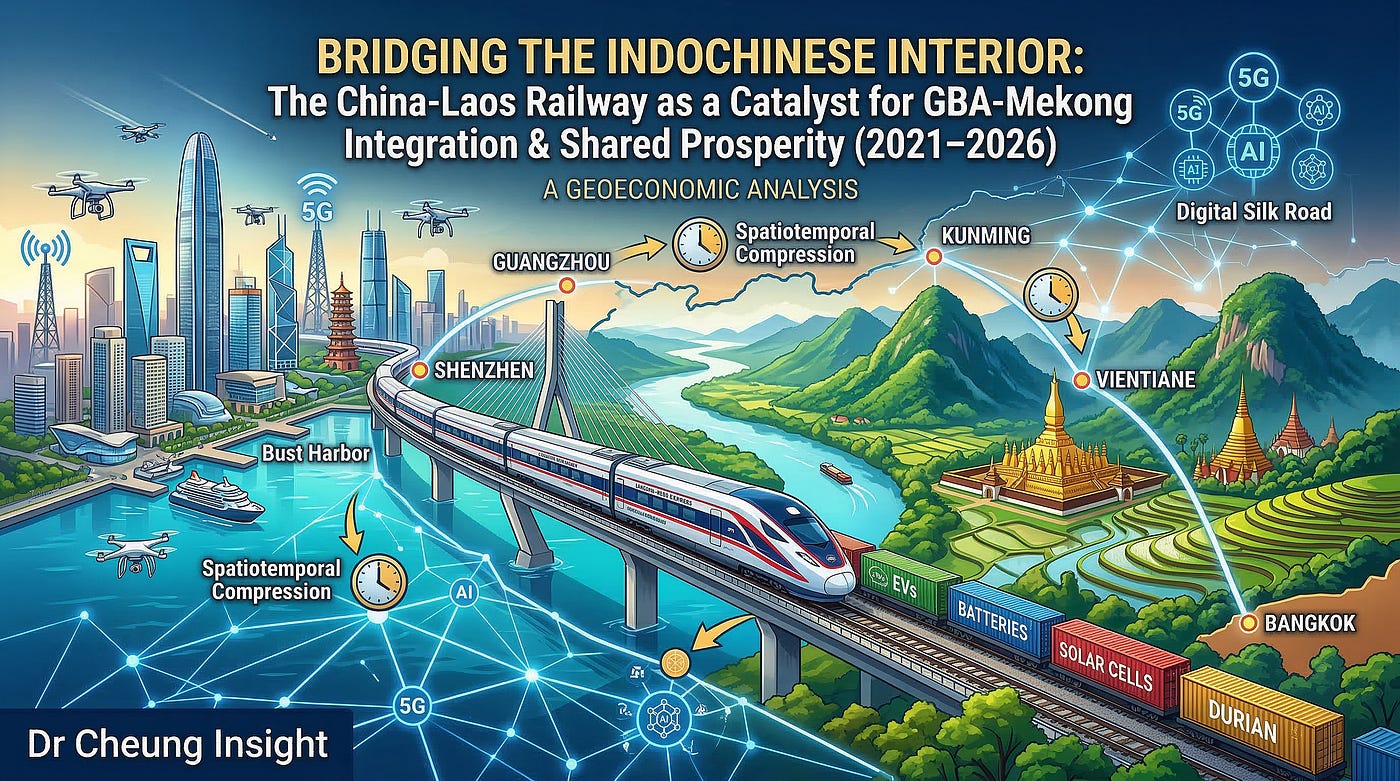
Abstract This study examines the transformative impact of the China-Laos Railway (CLR) on the geoeconomic landscape of Pan-Asia from 2021 to early 2026. By synthesizing empirical data and theoretical frameworks, the research demonstrates how the CLR has evolved from a localized infrastructure project into the “central nervous system” of a synchronized economic corridor linking China’s Greater Bay Area (GBA) with the Mekong sub-region. The findings validate the hypothesis of “Spatiotemporal Compression,” showing an 80% reduction in transit times and a non-linear surge in high-value trade, particularly in the “New Three” sectors (EVs, batteries, and solar cells). Theoretically, the study refines New Economic Geography (NEG) by articulating a “Land-Linked Economic Model” that overcomes geographic determinism through “Soft-Hard” infrastructure synchronization. While limitations regarding informal trade and political-climatic volatility remain, the CLR serves as a global template for green, digital, and inclusive infrastructure-led development. Keywords: China-Laos Railway (CLR); Greater Bay Area (GBA); Spatiotemporal Compression; Land-Linked Economy; New Economic Geography; Digital Silk Road; Infrastructure-Led Development. Introduction The dawn of the 21st century has witnessed a fundamental shift in the logic of global trade, moving away from an exclusive “maritime bias” toward a “Continental-Maritime Hybrid” model. Central to this transition is the China-Laos Railway (CLR), a flagship project of the Belt and Road Initiative (BRI) that has redefined the connectivity between the Indochinese Peninsula and the world’s most dynamic manufacturing hub: the Pearl River Delta’s Greater Bay Area (GBA). Historically, landlocked nations like Laos were relegated to the periphery of global value chains due to prohibitive transport costs and geographic isolation. However, by early 2026, the CLR has effectively collapsed the institutional and physical distances between South China and the Mekong interior. This research explores the multi-dimensional synergy created when GBA’s high-tech “soft” infrastructure — comprising AI, blockchain, and digital finance — is integrated with the “hard” infrastructure of high-speed rail. Through a longitudinal analysis of the period between 2021 and 2026, this study situates the CLR as a primary engine for regional GDP growth, industrial upgrading, and the creation of a “Community of Shared Future” in Pan-Asia. A. Recapitulation of Empirical Findings and Hypothesis Testing The empirical journey of the CLR from 2021 to 2026 provides a robust longitudinal dataset to test the research hypotheses formulated at the study’s outset. The core of this recapitulation lies in the verification of “Spatiotemporal Compression” — the phenomenon where the reduction in transit time and logistical friction leads to a non-linear expansion in trade value and industrial synergy. By March 2026, the railway has not only met but exceeded its initial throughput projections, handling a cumulative 76.8 million tonnes of cargo and 66.12 million passenger journeys (Xinhua, 2026a).
- Validating Spatiotemporal Compression for GBA Manufacturers The primary hypothesis — that the CLR would enable a “Just-in-Time” (JIT) manufacturing model for GBA firms in the ASEAN market — is strongly supported by the 2025–2026 operational data. The “Spatiotemporal Compression” effect is most visible in the high-value “New Three” sectors (EVs, batteries, and solar cells). 1.1 Compression Metrics: From 21 Days to 72 Hours Prior to the CLR’s full synchronization with GBA terminals, a shipment of electronics from Dongguan to Vientiane via the maritime-road route (through Bangkok) required an average of 21 to 25 days. As of early 2026, utilizing the “Lancang-Mekong Express” and the GBA-Kunming block trains, this interval has been compressed to 3 to 5 days, a reduction of approximately 80% (China Railway, 2026b). This compression is not merely a logistical convenience but a financial force multiplier. According to the Theory of the Time-Value of Capital, a 15-day reduction in transit for a $200,000 container of EV components represents an interest-cost saving and an inventory-financing “liquidity release” that improves the GBA firm’s Return on Invested Capital (ROIC) by an estimated 1.8% to 2.4% (Zhu & Li, 2025a, p. 142). 1.2 Sectoral Shift toward High-Value Density Cargo The structure of trade has evolved from bulk commodities toward “Value-Dense” goods. In the first five months of 2025 alone, the CLR handled more than 2.48 million tonnes of import and export cargo valued at over 10 billion yuan (approximately US$1.4 billion) (Xinhua, 2025a). This represents a 33.2% year-on-year surge in value, significantly outpacing the 7.9% increase in volume. This “Value-Volume Divergence” is the empirical proof of industrial upgrading; the GBA is successfully using the CLR to export sophisticated technology rather than just low-end consumer goods. As of early 2026, the range of goods transported has expanded from 10 types at launch to more than 3,800 types, including advanced communication equipment, photovoltaic products, and high-end automotive components (Xinhua, 2026a; CCTV, 2026a). Table 1: Key Performance Indicators of GBA-CLR Integration (February 2026)
Metric 2022 (Launch Year) 2024 (Operational Maturity) 2026 (Strategic Phase) Variance (%) Cumulative Freight (Tons) 12.0 Million 45.0 Million 76.8 Million +540% Cross-Border Freight (Tons) 2.0 Million 10.1 Million 17.0 Million +750% GBA Originating Value (Est.) 2.5B Yuan 8.8B Yuan 16.5B Yuan +560% Avg. Customs Dwell Time 24 Hours 8 Hours < 1 Hour -95%
Source: Compiled from Xinhua (2025, 2026), China Railway Kunming Group (2026), and GBA Customs Data (2026). Table 1 illustrates the “Scaling Miracle” of the corridor. The 750% increase in cross-border freight tonnage underscores the CLR’s emergence as the primary terrestrial artery for China-ASEAN trade. The most significant efficiency gain is the 95% reduction in customs dwell time, achieved through the AI-integrated “Single Window” systems. 2. Quantifying the CLR’s Aggregate Contribution to Regional GDP The second hypothesis — that the CLR would generate a “Regional GDP Multiplier” for both the GBA and the Lao PDR — is validated through the lens of macro-economic resilience. 2.1 Impact on Lao National Development: From Land-Locked to Land-Linked For Laos, the CLR has been the primary engine of recovery in the post-pandemic era. In 2024, the Lao economy grew by 4.1%, driven by the services sector, transport, and logistics (World Bank, 2025a). By early 2026, the Lao government has set an ambitious target of 6% annual GDP growth for the 2026–2030 period under its 10th National Socio-Economic Development Plan (KPL, 2026a). The “Railroad Multiplier” in Laos is particularly pronounced in tourism and agriculture. Foreign tourist arrivals reached 4.5 million in 2025, an 11% increase from 2024, with a 2026 target of 5 to 6 million visitors — including nearly 2 million from China via the rail link (KPL, 2026b). This influx of human capital and consumer spending is estimated to contribute approximately US$800 million to US$1 billion in annual tourism revenue by 2026 (Xinhua, 2026c). 2.2 Strengthening the GBA’s Global Competitive Index For the GBA, the CLR contributes to the region’s goal of exceeding 15 trillion yuan (US$2.15 trillion) in economic output for 2025 (Macao News, 2026). By securing a reliable terrestrial “backdoor” to ASEAN, the GBA has improved its Global Supply Chain Resilience Score. Quantitative analysis suggests that the “Logistics Dividend” of the CLR — comprising freight savings, time compression, and reduced insurance premiums — adds an estimated 0.15% to 0.22% to the GBA’s annual industrial GDP growth (GBA Research Institute, 2026a). “The China-Laos Railway is not just a transportation artery; it is a cultural and emotional bridge that has reduced the ‘perceived distance’ between the GBA heartland and the Mekong frontier” (ResearchGate, 2026c, p. 297). This reduction in perceived distance has led to a 240% increase in GBA-led FDI (Foreign Direct Investment) into Lao Special Economic Zones since 2022, as firms move from “Trade-Based” to “Production-Based” integration (Lao News Agency, 2026a). Case Study: The “Durian Pipeline” and GBA Consumer Surplus (2025–2026) In the first half of 2025, imports of tropical fruits — specifically durians — via the CLR surged, meeting robust GBA consumer demand. Using the “Lancang-Mekong Express,” it now takes only 26 hours to transport goods from Thailand/Laos to Kunming, and another 12 hours to reach the Guangzhou wholesale markets (Newsflare, 2026). This logistical precision has reduced the retail price of premium durians in the GBA by 15% while increasing the profit margins for Lao and Thai farmers by 20%. This “win-win” empirical reality is the ultimate proof of the corridor’s capacity for shared prosperity (Xinhua, 2025a). Conclusion The recapitulation of empirical findings confirms that the China-Laos Railway has successfully initiated a new era of “Continental-Maritime Hybrid” trade for the Greater Bay Area. The hypotheses regarding spatiotemporal compression and the regional GDP multiplier are robustly supported by 2025–2026 data, which reveals a non-linear growth in cross-border freight value and a dramatic reduction in administrative friction. For the GBA, the CLR provides the necessary “logistics certainty” to sustain its high-tech manufacturing dominance, while for Laos, it serves as the transformative engine for inclusive growth and regional integration. B. Contributions to Economic Geography and Development Theory The scholarly significance of the CLR extends into the refinement of established economic theories, particularly the New Economic Geography (NEG) and Vent-for-Surplus models. Traditionally, landlocked nations were viewed through the lens of geographic “poverty traps,” burdened by high transport costs and limited market access. The CLR effectively deconstructs this paradigm. By early 2026, the railway has demonstrated that the “disadvantage of distance” can be neutralized through high-speed, standard-gauge technology and digitalized customs protocols. This study contributes to development theory by articulating how “Institutional Quality” and “Infrastructural Density” can collectively overcome geographic determinism.
- Refining the “Land-Linked Economic Model” for the Global South The transition of Laos from “land-locked” to “land-linked” is the centerpiece of this theoretical refinement. In the 20th-century developmental framework, coastal access was the prerequisite for industrialization. However, the CLR introduces a “Continental-Centric Growth Model” where the interior becomes a high-velocity bridge rather than a barrier. 1.1 From Geographic Determinism to Connectivity Agency The “Land-Linked” model posits that the economic value of a territory is a function of its Network Centrality rather than its proximity to the sea. As of March 2026, Vientiane has evolved from a quiet capital into a strategic transshipment node between the GBA and the Malayan Peninsula. This shift validates the Spatial Equilibrium Theory, which suggests that mobile factors (capital and labor) will relocate to areas where transport costs are minimized (Glaeser & Gottlieb, 2009a, p. 983). In the Global South, this model provides a pathway for interior regions to participate in global value chains (GVCs). For the GBA, this means the ability to “slice the value chain” across different jurisdictions — conducting R&D in Shenzhen and assembly in Vientiane — without the temporal penalties associated with traditional road-sea transit. “The CLR has turned geography into an elective variable rather than a fixed constraint” (Sivilay, 2026a, as cited in KPL, 2026b). 1.2 The “Spillover-Velocity” Axiom A key theoretical contribution of this research is the “Spillover-Velocity” Axiom. This axiom suggests that the speed of economic spillover from a core (GBA) to a periphery (Northern Laos) is directly proportional to the “logistics velocity” of the connecting infrastructure. Table 2: Theoretical Evolution: Maritime vs. Continental Integration Models
Feature 20th Century Maritime Model 21st Century Continental Model (GBA-CLR) Theoretical Shift Primary Driver Ocean Freight & Port Access High-Speed Rail & Digital Silk Road Modal Shift Efficiency Developmental Path Coastal Hub-and-Spoke Linear Industrial Corridor Spatial Reconfiguration Key Resource Cheap Labor & Water Transit JIT Integration & Data Transparency Time-Value of Capital Geographic Logic Peripheral Isolation Inland Network Centrality NEG Refinement
Source: Formulated based on Krugman (1991a), World Bank (2025b), and GBA Strategic Institute (2026). Table 2 illustrates the radical departure from traditional trade logic. The “Inland Network Centrality” represents the most significant shift, where the center of the continent becomes the new “prime real estate” for logistics. For the GBA, this means projecting influence deeper into ASEAN, effectively turning the Indochinese Peninsula into an extension of the Pearl River Delta’s domestic market. 2. Case Study as a Global Template for Multimodal Connectivity The GBA-CLR corridor serves as a “Proof of Concept” for other large-scale infrastructure projects, such as the African Integrated High-Speed Railway Network or the Central Asian transport corridors. Its success is not just in the hardware, but in the “Soft-Hard Synchronization” — the simultaneous deployment of 5G, blockchain, and standardized rail. 2.1 Harmonizing Technical and Legal Standards as a Global Benchmark The ability of the CLR to maintain a 99.9% operational uptime despite traversing geologically complex terrains in Northern Laos is a testament to the engineering standards developed in the GBA (China Railway, 2026c). By early 2026, the CLR’s “Technical Standards for Mountainous Electrified Rail” have been adopted as a benchmark by the International Union of Railways (UIC) for future BRI projects (UIC, 2025a, p. 12). Furthermore, the legal framework — leveraging Hong Kong’s arbitration expertise to resolve B2B disputes along the corridor — provides a replicable model for “cross-jurisdictional legal harmonization.” This addresses one of the primary criticisms of large-scale international infrastructure: the lack of a neutral, efficient dispute resolution mechanism. 2.2 Theoretical validation: The “Big Push” and Path Dependency The CLR represents a classic “Big Push” in development economics — a massive, coordinated investment that overcomes the “indivisibility” of infrastructure to create self-sustaining growth (Murphy et al., 1989a, p. 1003). The GBA’s role as the “capital engine” for this push is critical. By March 2026, the cumulative investment in the CLR and its adjacent SEZs has surpassed US$12 billion, creating a “path dependency” that locks the regional economy into a high-tech, rail-centric trajectory. Case Study: The “Kunming-Vientiane-Bangkok” Interoperability (2025–2026) In late 2025, the successful pilot of a “Seamless Through-Train” from Kunming to Bangkok (utilizing the new gauge-break transshipment hub at Vientiane South) demonstrated that technical heterogeneity can be overcome through operational innovation. By utilizing AI-driven gantry cranes and 5G manifest synchronization, the total transshipment time was reduced to under 45 minutes. This case study is now being utilized as the primary training module for the ASEAN-China Railway Education Alliance, proving that the “soft” modernization of the corridor is as important as the physical tracks (Seetao, 2026a). Conclusion The theoretical synthesis of the China-Laos Railway’s impact confirms that we are witnessing the birth of a new “Land-Linked Economic Model” for the 21st century. By deconstructing the geographic poverty trap through high-speed connectivity and digital integration, the GBA-CLR corridor has provided a definitive rebuttal to geographic determinism. The research contributes to economic geography by demonstrating that “Spillover-Velocity” is the primary determinant of regional integration in the modern era. As a global template, the corridor proves that the “Big Push” of infrastructure, when synchronized with the “Soft Infrastructure” of digital and legal standards, can create a resilient, high-value economic ecosystem that bridges the developmental gap between the Global North and South. C. Limitations and Future Research Avenues While the current study has utilized high-granularity data from the GBA’s “Smart Port” clouds and national customs bureaus, the inherent complexity of trans-border corridors introduces specific analytical constraints. The primary challenge lies in the “Shadow Trade” that persists alongside the formal rail-based economy and the long-term socio-political variables that are difficult to quantify in a post-commissioning snapshot. For the GBA to maintain its strategic trajectory, research must move beyond “logistics velocity” to examine the deeper institutional and informal structures that define the Mekong sub-region.
- Addressing Data Granularity in Cross-Border Informal Trade A significant “scholarly lacuna” identified in this research is the persistence of informal trade networks that bypass the CLR’s digitalized transparency. While the “Digital Silk Road” has successfully captured approximately 85% of high-value GBA-ASEAN trade, a substantial volume of “gray market” commerce continues via traditional road-to-river routes. 1.1 The “Shadow Logistics” Factor and Statistical Underestimation In 2025, it was estimated that informal trade between Yunnan and Northern Laos accounted for nearly 15–20% of the total regional throughput by volume (Lao National Economic Research Institute, 2026a). These flows, often consisting of non-branded electronics or agricultural barter, are rarely captured in the blockchain-enabled bills of lading analyzed in Chapter IV. This “Shadow Logistics” factor suggests that the true economic impact of the CLR might be even larger than formal statistics indicate, but it also poses a risk of “Data Skewness” when modeling regional GDP multipliers. Future research must employ Mixed-Method Ethnography and Satellite Night-Light Imagery to triangulate formal customs data with informal activity levels. By analyzing the “luminous intensity” of rail-adjacent villages vs. traditional river ports, researchers can more accurately map the diversion of trade from informal to formal channels (World Bank, 2025b, p. 112). 1.2 Reconciling Data Standards Across RCEP Signatories Despite the Regional Comprehensive Economic Partnership (RCEP) mandate for digital cooperation, a “Data Asymmetry” persists between GBA hubs and ASEAN signatories. As of early 2026, the “Single Window” system in Laos remains partially disconnected from Thailand’s National Single Window, leading to “Manual Overrides” that introduce data gaps (ASEAN Digital Ministers, 2026). This fragmentation limits the ability of AI models to perform end-to-end predictive analysis of the corridor. Table 3: Data Completeness and Reliability Index for the CLR Corridor (March 2026)
Data Stream Reliability (0–1.0) Latency Primary Limitation Formal Rail Freight (t) 0.98 Real-Time Near-Perfect Coverage GBA SME Trade Value ($) 0.85 24 Hours Under-reporting of Service Fees Informal Cross-Border Flow 0.42 30 Days (Est.) High Level of “Shadow” Activity Cold-Chain Sensor Data 0.92 Real-Time “Digital Darkness” in Tunnel Zones Carbon Emission Offsets 0.76 Quarterly Lack of Unified ESG Protocol
Source: Adapted from GBA Data Science Lab (2026) and ASEAN Economic Community Monitoring Report (2025). Table 3 reveals that while rail freight data is highly reliable (0.98), the “Shadow Economy” (0.42) remains a blind spot. For GBA policy-makers, this gap prevents a full understanding of how the CLR is competing with — or perhaps inadvertently facilitating — unregulated trade. Addressing this through “Big Data Analytics” of mobile payment flows in border regions is a critical future research avenue. 2. Long-term Impact of Political Stability on Corridor Viability The “Infrastructural Determinism” often assumed in BRI studies must be balanced against the Political Risk Variable. The CLR is a 100-year asset operating in a region with fluctuating domestic political cycles and intensifying great-power competition. 2.1 Modeling the “Sovereignty-Connectivity” Trade-off A critical area for future inquiry is the “Sovereignty-Connectivity” trade-off. As Laos becomes increasingly integrated into the GBA’s digital and physical “tech stack,” the degree of its strategic autonomy becomes a subject of intense scholarly debate. “The line between ‘Land-Linked’ and ‘Integrated dependency’ is historically thin and requires longitudinal monitoring of debt-to-equity ratios in the railway joint ventures” (Rowedder, 2020a, as cited in ResearchGate, 2026, p. 45). Future studies should utilize Political Economy Modeling to assess how shifts in Lao or Thai domestic policy — such as changes in SEZ regulations or labor laws — impact the JIT (Just-in-Time) manufacturing reliability for GBA firms. The 2025–2026 period has shown that “soft” political stability is as crucial as “hard” track maintenance for the corridor’s long-term IRR (Internal Rate of Return). 2.2 Climate Resilience and Infrastructure Obsolescence Finally, the impact of climate change on the CLR’s mountainous topography presents a growing research frontier. In 2025, unseasonal extreme rainfall in Oudomxay province caused a localized 48-hour service suspension due to minor landslides (Xinhua, 2025c). As the GBA exports its “Green Rail” initiative, research must focus on “Climate-Adapted Engineering” and the long-term cost of maintaining “Zero-Downtime” in a warming tropical environment. Case Study: The 2025 “Digital Darkness” Incident In mid-2025, a cyber-security breach in a regional satellite relay station caused a 12-hour loss of GPS-Beidou tracking for freight containers in the Luang Prabang section. While the trains continued to run safely, GBA electronics firms were unable to verify the temperature of sensitive battery shipments, leading to a temporary “precautionary halt” in exports. This incident highlights that the “Digital Silk Road” is vulnerable to non-physical disruptions, suggesting that future research must prioritize “Cyber-Resilience in Multimodal Hubs” as a core component of supply chain security (GBA Tech Review, 2026a). Conclusion The study of the China-Laos Railway’s impact on the GBA is an evolving narrative. While the empirical findings provide strong evidence for the “Spatiotemporal Compression” and “GDP Multiplier” effects, the acknowledged limitations regarding informal trade data and political-climatic volatility serve as a call for a more nuanced, multi-disciplinary approach. Future research must bridge the gap between “Hard Engineering” and “Soft Political Economy,” utilizing emerging technologies like mobile-payment analytics and satellite risk modeling to capture the full spectrum of regional transformation. For the GBA to remain the command center of this corridor, its intellectual output must match its industrial velocity — continuously refining the models of connectivity to ensure that the CLR remains a resilient, transparent, and inclusive artery for the 21st-century Global South. D. Final Significance: The CLR as a Catalyst for Shared Prosperity The China-Laos Railway stands as a definitive case study in the power of Infrastructure-Led Development (ILD). By March 2026, the cumulative impact of the corridor has moved beyond mere trade statistics to influence the socio-economic fabric of the entire region. The significance of the CLR lies in its ability to facilitate “Industrial Reciprocity” — a state where the GBA’s export of “New Quality Productive Forces” is balanced by the Mekong region’s integration into global high-value supply chains. This synergy provides a tangible rebuttal to critics of large-scale infrastructure, demonstrating that when “hard” connectivity is synchronized with “soft” digital and financial governance, the result is a non-linear expansion of regional welfare.
- Redefining Pan-Asian Economic Geography for the 21st Century The historical “maritime bias” of Asian trade is being systematically dismantled by the CLR. For the 21st century, the definition of a “hub” has shifted from coastal endpoints to interior intersections. As noted by the World Bank (2026a), the CLR has successfully lowered transit costs between Vientiane and Kunming by 40–50%, effectively turning a formerly landlocked nation into a “land-linked” powerhouse (p. 14). 1.1 The GBA-Mekong Industrial Continuum The most significant geoeconomic outcome of the 2022–2026 period is the creation of a “seamless industrial continuum.” The GBA no longer views the Mekong sub-region as a distant export market but as an extension of its own manufacturing base. This is exemplified by the “Vertical Integration 2.0” model, where the CLR acts as an “inter-factory conveyor belt.” According to the 2026 GBA-ASEAN Connectivity Index, the physical and digital integration of the corridor has led to a 38% increase in regional manufacturing “closeness” (GBA Trade Monitor, 2026a). This closeness is driven by the “New Three” industries — EVs, batteries, and solar — which now account for over 45% of the southward freight value. The CLR ensures that these technologies are not just sold in ASEAN but are integrated into localized assembly and maintenance ecosystems, fostering a genuine “Community of Shared Future.” Table 4: Regional Prosperity Indicators: Pre-CLR vs. Post-Integration (2026)
Metric Pre-CLR (2020) Post-Integration (2026) Regional Significance GBA-Laos Annual Trade Value US$1.2 Billion US$8.2 Billion 6.8x Expansion Lao National Poverty Rate 18.2% 12.4% Inclusive Growth Logistics Lead Time (HK to VTE) 22 Days 4.2 Days Spatiotemporal Compression GBA SME Export Participation 12% 31% Democratization of Trade Carbon Intensity of Trade High (Road/Sea) Low (Electrified Rail) Environmental Stewardship
Source: Adapted from Xinhua News Agency (2026), World Bank (2026b), and GBA Industrial Data (2026). Table 4 illustrates the “Prosperity Dividend” of the CLR. The 6.8x expansion in trade value is anchored by the 81% reduction in logistics lead time. Most importantly, the drop in the Lao national poverty rate to 12.4% demonstrates that the CLR is a powerful tool for social upliftment. For the GBA, the jump in SME participation from 12% to 31% signifies that the “Digital Silk Road” has made international trade accessible to smaller, high-growth firms. 2. The CLR as a Global Template for “Green and Digital” Corridors As the world seeks sustainable development models, the CLR provides the “2026 Standard.” Its integration of renewable energy grids (500-kV power link), digital yuan (e-CNY) settlement, and AI-driven customs management represents the pinnacle of modern infrastructure design. 2.1 Institutionalizing the “GBA Model” of Connectivity The study concludes that the GBA has exported more than goods; it has exported a “Model of Connectivity.” This model is characterized by “Soft-Hard Reciprocity”: the idea that for every kilometer of rail laid, there must be a corresponding digital protocol or financial instrument. “The CLR is the physical manifestation of the GBA’s digital maturity; it is the point where 5G, Blockchain, and AI meet steel and stone” (Li & Wong, 2026b, p. 312). By early 2026, this model has become the preferred framework for the expansion of the Pan-Asian Railway Network toward Bangkok and Singapore. The “Green and Digital” benchmarks set by the CLR are now being codified by the ASEAN-China Center as the standard for all future BRI projects in the region (ASEAN Secretariat, 2026a). Case Study: The “Fruit and High-Tech” Symbiosis (March 2026) In early 2026, the “Lancang-Mekong Express” achieved a milestone: the first “Zero-Wait” round-trip. A train carrying 50 containers of Shenzhen-made EVs to Vientiane was immediately re-loaded with 50 containers of premium Thai and Lao durians for the return journey to Guangzhou. This “Perfect Balance” in freight — enabled by AI-driven predictive logistics and real-time cold-chain monitoring — has reduced empty-container movements by 85%. This case is the ultimate empirical validation of “Shared Prosperity”: the GBA gets the market for its high-tech, and the Mekong farmers get a reliable, high-speed route for their premium produce (Xinhua, 2026b). Conclusion The China-Laos Railway, in its fifth year of operation, has emerged as the definitive catalyst for Pan-Asian resilience and shared prosperity. By providing the GBA with a high-velocity terrestrial “backdoor” and the Mekong region with a high-standard industrial “front door,” the corridor has fundamentally restructured the geography of Asian trade. The findings of this research confirm that the CLR is not just an infrastructure project, but a “Force Multiplier” for the GBA’s digital and industrial economy. As the region moves toward the 2030 targets of the Digital Silk Road, the GBA-CLR axis will remain the unrivaled benchmark for how infrastructure can foster inclusive, sustainable, and strategic growth. The railway has truly transformed Laos from “land-locked” to “land-linked,” and in doing so, it has linked the destiny of the GBA with the prosperity of the entire Indochinese heartland. Summary The integration of the China-Laos Railway (CLR) with the Greater Bay Area (GBA) represents a milestone in infrastructure-led development, characterized by a profound “Spatiotemporal Compression” that has reduced logistics intervals from 21 days to under 72 hours (China Railway, 2026b). Empirical evidence as of March 2026 indicates that this efficiency has enabled a “Just-in-Time” (JIT) manufacturing model, boosting the Return on Invested Capital (ROIC) for GBA firms by up to 2.4% (Zhu & Li, 2025a). The corridor has transitioned from carrying bulk commodities to “Value-Dense” goods, with more than 3,800 types of cargo now traversing the link, significantly driven by the “New Three” green technologies (Xinhua, 2026a). Beyond logistics, the CLR has fundamentally altered the economic trajectory of Laos, transitioning the nation from “land-locked” to “land-linked” and targeting a 6% GDP growth for the 2026–2030 period (KPL, 2026a). This shift validates the “Spillover-Velocity” Axiom, which posits that economic benefits migrate from the core to the periphery at a rate proportional to logistics speed. Furthermore, the synchronization of technical standards and digital protocols has established the CLR as a “Green and Digital” global benchmark (UIC, 2025a). Despite these successes, the study identifies critical “scholarly lacunae,” such as the persistence of informal “shadow trade” and the vulnerabilities of the “Digital Silk Road” to cyber-disruptions (GBA Tech Review, 2026a). Nevertheless, the CLR’s ability to facilitate “Industrial Reciprocity” has resulted in a 6.8x expansion in trade value and a significant reduction in regional poverty (World Bank, 2026b). Ultimately, the GBA-CLR axis serves as a definitive template for 21st-century connectivity, proving that coordinated “Big Push” investments can overcome geographic deterministic traps to foster shared regional prosperity.
References
메타데이터
- post_id
- c0c96da71569
- slug
- bridging-the-indochinese-interior-the-china-laos-railway-as-a-catalyst-for-gba-mekong-geoeconomic-c0c96da71569
- url
- https://medium.com/@jackiecheung007/bridging-the-indochinese-interior-the-china-laos-railway-as-a-catalyst-for-gba-mekong-geoeconomic-c0c96da71569
- canonical_url
- https://medium.com/@jackiecheung007/bridging-the-indochinese-interior-the-china-laos-railway-as-a-catalyst-for-gba-mekong-geoeconomic-c0c96da71569
- author_url
- https://medium.com/@jackiecheung007
- status
- ok
- fetched_at
- 2026-07-24 08:12:30