HUBA #6EN: Do We Have Both Balls? The Wrecking One and The Crystal One?
In other words, The Chainsaw Manifesto: What the Munich Security Report Really Tells Investors. HUBA — hunting unicorns, breeding angels —…
HUBA #6EN: Do We Have Both Balls? The Wrecking One and The Crystal One?
In other words, The Chainsaw Manifesto: What the Munich Security Report Really Tells Investors. HUBA — hunting unicorns, breeding angels — a personal blog on experiences and insights while making venture capital investments.
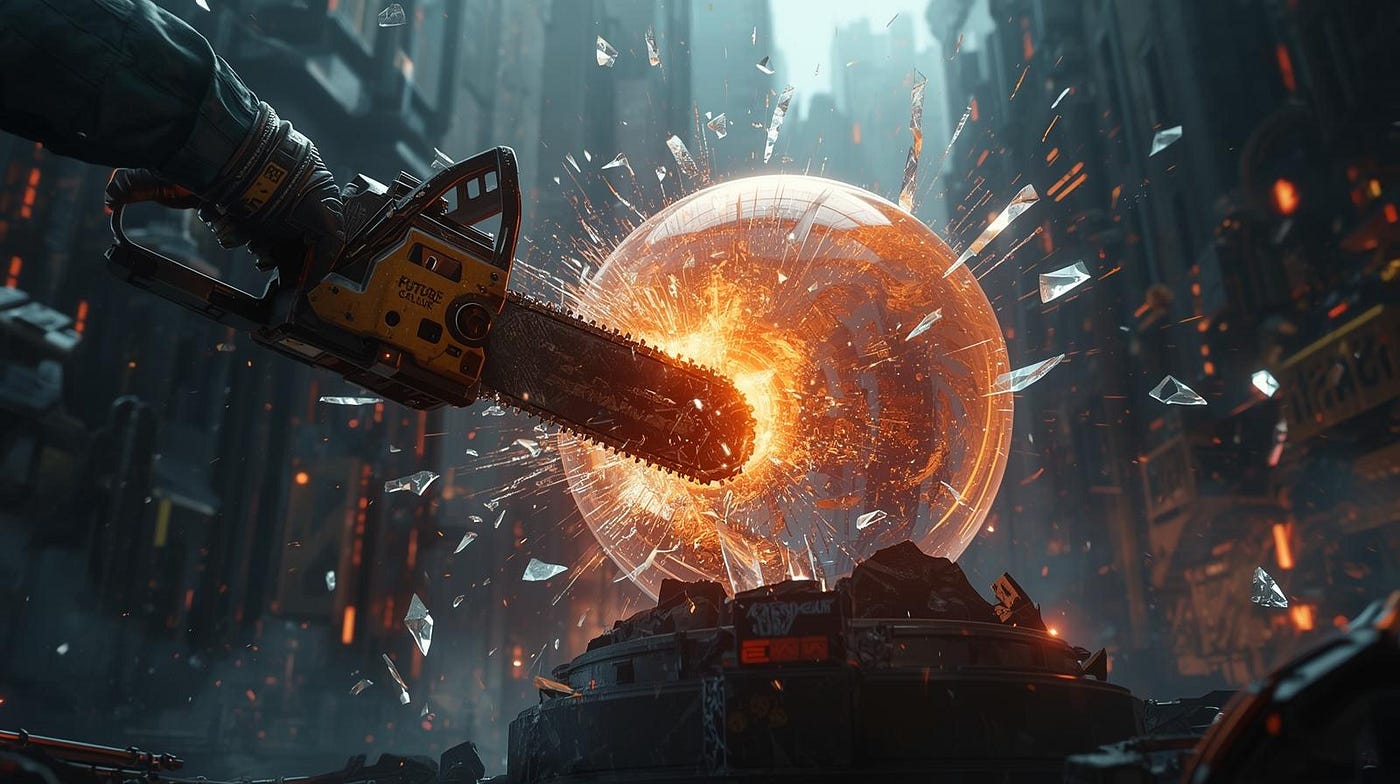
TL;DR: The world order is getting demolished with actual wrecking balls. But this time, Europe might actually see it coming. Here’s why that matters for your portfolio.
Part I: The MSC Report — Turns Out They’re Using Actual Chainsaws
Wait, They’re Literally Demolishing The White House?
Not as a metaphor. Actually demolishing it. That’s the intro to the Munich Security Report 2026, casually mentioning that in October 2025, construction crews started tearing down parts of the White House. With sledgehammers. And wrecking balls.
If that doesn’t tell you everything about where we are politically, I don’t know what does.
Welcome to “wrecking-ball politics” — where instead of carefully fixing things, everyone just grabs power tools and starts smashing stuff.
The Demolition Men Are Having Their Moment
The report calls them “demolition men” and honestly, it’s the perfect name:
Exhibit A: Javier Milei The Argentine president who literally campaigned with a chainsaw. Not a metaphor chainsaw. An actual chainsaw he waved around at rallies.
Exhibit B: Elon Musk Created something called the “Department of Governmental Efficiency” — DOGE, because he can’t help himself — specifically to blow up bureaucracy.
Exhibit C: Pretty Much Everyone Else Politicians everywhere openly calling for destroying courts, bureaucracies, and international agreements.
What they all have in common: They believe you can’t fix things, you can only demolish them and hope something better grows in the rubble.
For investors: When demolition becomes the mainstream political strategy, defense and reconstruction become trillion-dollar markets.
Why Everyone Wants To Burn It All Down
Here’s the uncomfortable truth the report lays out:
People’s lives stopped getting better.
Not “getting better more slowly.” Actually stopped. For most people in most developed countries:
- Can’t afford housing
- Can’t expect to do better than their parents
- Can’t see their kids doing better than them
- Can’t trust that the system will fix any of this
The report has a very German name for this: Zerstörungslust — literally “lust for destruction.”
When surveyed, only a tiny percentage of people in G7 countries think their government’s policies will improve their kids’ lives. When the social contract is that broken, people don’t want reform. They want a wrecking ball.
Translation for VCs: Angry populations create defense budgets. Defense budgets create opportunities. Pay attention to the angry populations.
The “Peaceful World Order” Triangle Just Got Demolished
Since 1945, US strategy was built on three big ideas (fancy people call it the “Kantian triangle” but let’s just call it the three things America believed):
#1: International organizations and rules make America stronger Status: Rejected. New policy: “America First, organizations are bad for sovereignty.”
#2: Open trade and economic integration make America richer Status: Abandoned. New policy: Tariffs on everyone, bilateral deals only
#3: Democracy and human rights are good for American interests Status: Replaced with something focusing more on culture and ethnicity instead of universal values
Marco Rubio, in his confirmation hearing, quoted a guy from the 1940s, Dean Acheson, who talked about “being present at the creation” of the postwar order. Rubio said America needs to “create a free world out of chaos again.”
The problem: The 1940s guy was building new things. Rubio is demolishing existing things first and promising to maybe build something later. Possibly. TBD.
“Westlessness” — When The West Forgets What It Is
Here’s an uncomfortable bit: The “West” can’t agree on what the “West” means anymore.
Old definition: Universal values, human rights, democracies working together New competing definition: Cultural/ethnic/religious identity clubs
Why this matters for investors: When allies can’t agree on basic values, you get chaos. Chaos creates volatility. Volatility creates opportunity (and risk). Choose your bets accordingly.
The Global South Is Just Watching And Taking Notes
Here’s a perspective you don’t hear much in Munich: The rest of the world doesn’t see this as a tragedy.
India’s Foreign Minister Jaishankar keeps pointing out that what the West called a “rules-based order” always looked pretty anarchic and hypocritical from outside the club.
From their perspective, American wrecking-ball politics is:
- Opening up space for new power centers
- Exposing double standards that were always there
- Creating opportunities to build alternatives
Investment angle: “Multipolarity” isn’t just a buzzword. It means real money flowing into non-Western infrastructure, payment systems, and supply chains.
Who Wins In The Rubble, Who Gets Crushed
The report’s darkest bit: It’s not clear this destruction leads to anything better.
The brutal numbers:
- The richest 1% captured 41% of all new wealth from 2000–2024
- The bottom 50%? Got 1% of new wealth
- Child deaths are rising for the first time this century
- And wrecking-ball politics makes all of this worse
The math is simple: If you have capital and capabilities, you can make money in the ruins. If you don’t, you get crushed under the rubble.
The ethical question: There’s alpha in chaos. Whether you chase it is between you and your conscience.
But Wait — The Report Has A Plan
Here’s the part most people miss. Buried in the report is this:
“Fighting back against the demolition men needs guts and new ideas. The people defending rules and institutions need to be just as bold as the people trying to destroy them.”
Translation: Stop being polite. Start being aggressive about defending what matters.
Small groups of countries need to move fast:
- Weimar Plus (France, Germany, Poland, UK)
- Group of Five (add Italy to the above)
These mini-coalitions will drive defense production, figure out what to do about Ukraine, and prepare Europe for what’s next.
The warning: If Europe keeps hesitating, it’ll end up stuck between bigger powers with no control over its own destiny.
What this means:
- Defense spending is actually happening (not just talk)
- Industrial base expansion is real
- Strategic autonomy is policy, not PowerPoint
- Alternative partnerships are forming
Part II: Show Me The Money — Three Charts That Explain Everything
Let me show you three charts from the report. Each one is basically a treasure map for where capital is flowing.
Chart 1: Who’s Actually Spending Money On Defense

What you’re looking at:
Countries colored by whether they’re:
- Dark blue (solid): Spending on defense AND have money to spare
- Dark blue (striped): Spending on defense but barely affording it
- Light blue: Not spending enough, regardless of whether they can afford it
The pattern that should jump out:
See all that dark blue in Eastern Europe? Poland, Estonia, Latvia, Lithuania, Finland, Norway, Sweden — they’re all spending heavily on defense. Proud Lithuanian I am.
Now look at Western Europe. Lots of light blue. Germany? Light blue. France? Light blue with stripes. Italy? Light blue. Cote’ d Azur? **Il dolce far niente? **The sweetness of doing nothing.
Eastern Europe isn’t waiting for permission. They’re spending because they remember what Russian occupation feels like. Meanwhile Western Europe is still having committee meetings about whether maybe they should consider possibly thinking about spending more.
The opportunity:
Western Europe will eventually spend €500 billion+ over the next 5 years. When they do, who will they buy from?
Companies that are already battle-tested in Poland/Baltics/Nordics — where procurement happens at startup speed, not bureaucracy speed.
Investment Thesis #1: European strategic autonomy is actually happening.
Not “someday.” Now.
Chart 2: The Ukraine Aid Gap That Creates Market Opportunity

What you’re looking at:
- Light blue bars: US aid
- Dark blue bars: European aid
- Purple bars: NATO’s emergency fund (PURL)
- That giant spike in early 2025? Biden’s team racing to ship everything before Trump could stop them
What happened after January 2025:
US aid dropped off a cliff. Europe increased aid, but couldn’t fill the gap. NATO’s emergency fund helps, but it isn’t enough.
The gap is real. And that gap is a market signal.
What this means:
Every euro the US isn’t sending creates demand for:
- European ammunition production
- Drone systems (this is why our portfolio companies are crushing it)
- Cyber defense capabilities
- Anything that doesn’t need American supply chains
Ukraine is proving every single day that:
- Drones work
- Cyber matters
- Ammunition matters more than fancy platforms
- Fast procurement beats perfect procurement
Investment Thesis #2: When you can’t rely on one power, you need multiple everything.
- Alternative payment systems
- Diversified supply chains
- Regional defense partnerships
- Multiple sources for critical materials
This is why friend-shoring isn’t dead — it’s just getting creative about who counts as a friend.
Chart 3: Russian Hybrid Warfare Is Going Crazy

What you’re looking at:
Different types of Russian attacks stacked up:
- Drone overflights (dark blue) — constant
- Sabotage (medium blue) — increasing
- Spying (light blue) — everywhere
- Arson (purple) — spiking
- Flammable parcels (yes, really) — new and terrifying
- Other creative chaos (gray)
Look at late 2025. That massive spike? That’s Russia testing what they can get away with now that Trump is back.
What this creates demand for:
Every single attack type needs a defense solution:
- Counter-drone systems
- Cyber defense (catching propaganda on TikTok, for instance)
- Infrastructure protection
- Supply chain security
- Border surveillance
- Satellite monitoring
The uncomfortable truth: Russian hybrid warfare is terrible for humanity but great for European defense tech startups.
Not because anyone wants it. But because Western Europe finally gets it.
Investment Thesis #3: The rubble needs rebuilding. Someone’s getting paid to do it.
Eventually, you have to rebuild. Questions are: What gets rebuilt? On whose terms? With whose technology?
Investment Thesis #4: Not Everyone Wins
Here’s who actually makes money in demolition:
- People with capital to buy distressed assets
- People with tech to build new infrastructure
- People positioned at chokepoints in new systems
- People who can operate across multiple power centers
What to avoid:
- Anything depending on American reliability
- Old globalization plays by assuming stable rules
- Investments depending on traditional aid flows
- Companies that can only manufacture in one place
The Contrarian Take: Maybe The Wrecking Ball Is Right?
Let me defend the demolition politics for a second.
What if the old order really was broken beyond repair? What if gentle reform was impossible because too many interests were entrenched? What if the only way to get Europe to actually spend on defense was to make US commitments unreliable?
Trump’s chaos has achieved:
- NATO countries are hitting spending targets
- Temporary Israel-Hamas ceasefire
- Europeans are realizing they need strategic autonomy
- Honest conversations about who pays for what
But: The rubble is real. Child mortality rising is real. Wealth inequality accelerating is real.
Creative destruction works in markets with safety nets and functioning institutions. Applied to world order without those? That’s just regular destruction.
Part III: Wake Up Call — You Should Have Seen This Coming
I’ve been joking for quite a while that Europe has one eye open but is still in bed. Maybe that’s finally changing.
Putin Literally Told You This Would Happen In 2007
Here’s the painful irony. In 2007, at the same Hotel Bayerischer Hof in Munich, Putin gave a speech. He said:
“This conference format lets me skip the polite diplomatic bullshit and say what I actually think.”
Everyone dismissed his words as sour grapes from a declining power.
With 19 years of hindsight: It was a roadmap disguised as complaining.
The Timeline Of Not Seeing It Coming
2007: Putin’s speech dismissed as bitter talk from a weak country 2008: Russia invades Georgia — “that’s a one-off” 2014: Russia takes Crimea — “unique situation” 2022: Russia invades all of Ukraine — “okay maybe this is a pattern” 2025: Vance comes to Munich, says harsh things about Europe — “surely just rhetoric” 2026: We’re here now, finally asking “wait, should we have been paying attention?”
Back in 2007 everyone thought: “Russia is weak and broke. This is just talk.”
What they missed: Russia’s economy was recovering. Oil prices were up. They had money to rebuild their military.
Putin’s speech was the warning. Georgia was the demonstration. Crimea was the escalation. 2022 was the execution.
Time from warning to everyone figuring it out: 19 years.
Are We Watching This Movie Again?
When a leader tells you their plan at a major conference and everyone ignores them — that’s usually an opportunity for someone paying attention.
Question: Is America telegraphing withdrawal from European security the same way Putin telegraphed his plans in 2007?
Follow-up question: Will it take 19 years to price in again? Or will Europe move faster this time?
Compare the patterns:
The 2007 playbook:
- Putin speaks → everyone ignores
- Russia rebuilds economically and militarily
- Red lines get crossed, no consequences
- Invasions follow
The 2026 situation:
- Europe speaks (Merz: “the old order doesn’t exist anymore”)
- Rubio brings flowers but policy hasn’t changed
- European defense budgets actually increasing
- Strategic autonomy actually happening
- Markets pricing in defense spending (stocks are up)
The big difference: Europe seems to be moving faster this time. The lesson from 2007 got learned.
So… Do We Have Both Balls?
The wrecking ball? Yeah, that one’s real. Demolition politics, international order in rubble, constraints gone, chaos everywhere.
But do we have the crystal ball? Can we actually see what’s coming?
The evidence says: Yes, finally.
Unlike 2007:
- Chart 1 shows Europeans are actually spending (not just talking)
- Chart 2 shows they’re filling gaps the US left
- Chart 3 shows the threat is undeniable
- Leadership coalitions are forming (Weimar Plus, Group of Five)
- Defense procurement is happening at scale
- Markets are pricing in the new reality
The lesson learned: When leaders telegraph their plans at conferences, believe them.
Don’t wait 19 years to figure it out.
Bottom Line: Where The Money Goes
The Munich Security Report isn’t just policy analysis. It’s a roadmap for where trillions will flow over the next decade.
Safe bets:
- European defense tech
- Infrastructure protection
- Supply chain backup systems
- Regional security that doesn’t depend on America
Riskier bets with bigger upside:
- Rebuilding infrastructure for whatever comes next
- Tech that enables a multipolar world
- Security for places where traditional aid is abandoning
- Betting on alternative power centers in the Global South
The ethical question you have to answer:
There’s money in chaos. There’s opportunity in rubble. What are you building, and for whom?
Because here’s what wrecking-ball politics teaches us: Hope isn’t a strategy. But neither is destruction without a plan for what comes next.
The demolition men are swinging chainsaws. The question is whether anyone’s drawing blueprints for what comes after.
And this time — unlike 2007 — it looks like people actually are.
Finally.
Go read the full thing: Munich Security Report 2026
Bonus tip: Page 99 has a further reading list if you want to sound smart at your next LP meeting.
Legal stuff: This is analysis, not investment advice. Do your own homework. The wrecking ball doesn’t care about your thesis.
This is huba — hunting unicorns breeding angels, my newsletter about VC investments in defense and beyond.
Find me on Medium and Substack.
If you actually read this far, you should probably subscribe. More takes on where smart money goes when the world order is getting demolished.
P.S. — If you’re building defense tech and think I should know about it, send your deck here: https://www.coinvest.lt/get-funded. Just make sure your startup is based in Europe and creates value for Lithuania — we are a sovereign VC.
메타데이터
- post_id
- c0d6b5fae338
- slug
- huba-6en-do-we-have-both-balls-the-wrecking-one-and-the-crystal-one-c0d6b5fae338
- url
- https://medium.com/@viktorija.trimbel/huba-6en-do-we-have-both-balls-the-wrecking-one-and-the-crystal-one-c0d6b5fae338
- canonical_url
- https://medium.com/@viktorija.trimbel/huba-6en-do-we-have-both-balls-the-wrecking-one-and-the-crystal-one-c0d6b5fae338
- author_url
- https://medium.com/@viktorija.trimbel
- status
- ok
- fetched_at
- 2026-06-15 20:49:13