THE GUARDIAN
What a Single Court Record Reveals About a Family in Crisis
THE GUARDIAN
What a Single Court Record Reveals About a Family in Crisis
*The Hunt — Portals*
“Guardian to the Children of Adam Culp.”
Someone wrote that header across the top of the page — a filing notation, a way to find the entry again in a docket book that would eventually hold decades of proceedings.
Seven words. And an immediate question.
A man named Adam Culp is being appointed guardian of his own children. He is their father. He is present, living, capable. The farm is running. The children are fed.
So why does he need the court’s permission?
The answer lives not in the document but in the law behind it — and in a death the document has no legal obligation to mention.
Once you understand both, the document opens.

“The document. Jefferson County, Ohio. November Term, 1838. Thirty-three cents.” — Source: Jefferson County, Ohio, Guardians’ Dockets, 1838–1920, vol. 1–2, p. 4. FamilySearch, image 30 of 615, citing FHL microfilm 900,073.
The System
The left margin is where the docket does its administrative work.
File number: Gen’l File №377. Court costs. The clerk’s name — Wells. And a notation that stops you: Taking bond $.33. Thirty-three cents. Whatever this proceeding was protecting, that’s what it cost to make the obligation official.
General File №377 is the reference that matters most. The docket is the spine — the court’s official summary of what happened and when. The actual bond document, the inventory of the children’s estate interests, the accounts of the guardianship across its full life — those live in the file. That file may or may not have survived two centuries in a Jefferson County courthouse. The docket is what we have, and so the docket is where we start.
The main entry is spare. November Term, 1838. Adam Culp appointed guardian. Eight children named. Bond ordered in the sum of $300. James Dillon approved as security. Bond executed and filed November 24th.
Then silence.
Twenty-nine years of silence, until a final entry in a different ink, a different hand, a different era: January 10th AD 1867. Final Settlement. Signed by Jno. M. Elliott, Probate Judge.
A guardianship that opened in November 1838 and closed in January 1867. Van Buren was president when it began. Andrew Johnson occupied the White House when it ended. Whatever this proceeding was protecting, it outlasted the antebellum period, the Civil War, and the men who created it.
But we are getting ahead of ourselves.
Start with the names.
Eight Names
Jacob. George. Samuel. Margaret. William. Nancy Jane. Adam. Benjamin.
Eight children requiring a legal guardian in the autumn of 1838. Their ages, which the docket does not record, matter enormously — because the duration of a guardianship in Ohio ran until the youngest ward reached the age of majority. The span of those ages tells you the scale of what Adam Culp was taking on.
Jacob Wright Culp was nineteen. Already nearly a man, old enough that the guardianship meant little to him practically.
Benjamin Harrison Culp had just turned two years old. Born November 16, 1836 — the same day his mother died.
Between them: seventeen years of children. A farmhouse full. A legal obligation stretching potentially two decades into the future.
The docket doesn’t explain why these eight children needed a guardian. It records only the legal outcome — the appointment, the bond, the security. The why lives elsewhere.
It lives in a death.
What the Document Doesn’t Say
November 16, 1836.
Nancy (Wright) Culp died in Jefferson County, Ohio. She was thirty-four years old. She had been married to Adam Culp for eighteen years. She had borne him eight children.
The eighth child — Benjamin Harrison Culp — was born the same day.
This is not in the guardianship docket. The docket has no room for it, no legal reason to record it. The proceeding doesn’t require the mother’s name or the circumstances of her death. It requires only the children’s names and the bond amount.
But Nancy (Wright) Culp is the reason every word on this page was written.
The law in 1838 Ohio drew a line most researchers wouldn’t think to look for — and missing it is what makes a document like this one resist easy reading.
A father was the natural guardian of his children’s persons. Their daily care, their upbringing, their labor on the farm — these were his by right, without any court’s involvement. But their property was a different matter entirely. If a mother died leaving her children an estate interest — an inheritance, a share of her family’s land, any property that legally belonged to them rather than to him — the father could not simply manage it. The law required formal court appointment. The bond, the surety, the docket entry: these were not questions about Adam’s fitness as a father. They were the law’s machinery, doing exactly what it was built to do.
This framework traced back to English common law and forward into Ohio’s earliest statutes. Blackstone had stated the principle with uncomfortable clarity: a mother was entitled to “reverence and respect” — but not legal power. Ohio carried that forward. Judy Russell, writing about guardianship records on The Legal Genealogist, puts it plainly for genealogists who encounter these proceedings and wonder why a living, capable father needed a court’s permission to protect his own children: the law only got involved with children when property was at stake. When it did, it looked to men.
Adam Culp went to court not because he was unfit. Because the law required it.
Especially if he remarried.
Adam Culp married Anna L. Alford on May 25, 1837. Six months after Nancy’s death. Long enough to observe mourning. Not long enough, on a farm with eight children, to do otherwise.
The $300 bond was the law’s acknowledgment that Nancy Wright’s children now lived in a household with a stepmother, and that whatever Nancy had left them required a legal firewall to protect it. James Dillon, approved as security, was the community’s guarantee. His name on the bond meant: we know this man, we trust this man, and if he fails his obligation we will answer for it.
The clerk recorded it. It cost thirty-three cents to file.
The Question the Document Doesn’t Answer
The docket entry is dated November Term, 1838.
Nancy (Wright) Culp died November 16, 1836.
Two years passed between the death that made this proceeding necessary and the proceeding itself. That gap is not visible in the document. The document records only what happened in November 1838, not what caused it to happen then and not before.
But the gap is a question. And questions have answers.
Judy Russell, writing about guardianship records on The Legal Genealogist, notes what genealogists often miss: a guardianship appointment is a hint that something happened — or that something was about to happen. The timing of the appointment, she argues, is as important as the appointment itself. Courts didn’t simply step in. Something triggered the need for formal legal protection at a specific moment.
So what happened in Jefferson County in 1838 that required Adam Culp to appear before the Court of Common Pleas on behalf of his children?
The answer lives not in the guardianship docket but in the deed records. And in a partition petition. And in the estate of a man who had been dead for nine years.
Nancy (Wright) Culp’s father was Jacob Wright. He had farmed Knox Township, Jefferson County, Ohio for decades — the same township where Adam Culp farmed, the same community where his daughter had grown up and married and raised eight children of her own. Jacob Wright died intestate sometime before August 17, 1829, when his estate notice appeared in the Steubenville newspaper. He left no will. He left land — and ten heirs to divide it among.
Under Ohio intestate succession law, Nancy (Wright) Culp was one of those heirs. Her share of her father’s undistributed estate was real property — land in Jefferson County that she held a legal interest in alongside her brothers and sisters.
When Nancy died in November 1836, her share didn’t vanish. It passed to her children.
Eight minor children, the youngest born the day their mother died, now held a legal interest in their grandfather’s land. That interest required court-supervised management. A father’s natural guardianship over his children’s persons did not extend to their estates. Adam could feed them, house them, raise them without court involvement. He could not manage their inherited property without it.
The Wright estate partition was still proceeding in 1838. A deed record dated March 2, 1838 — nine months before Adam’s November appointment — shows heir-driven transactions still occurring. A partition petition, Abram Myers vs. William Wright and Others, filed in 1838, confirms the estate was still before the court. When that partition required all heirs — including the children of deceased heirs — to have legal representation, Adam Culp needed formal appointment to stand for Nancy’s eight children.
The document doesn’t record any of this. It records only the outcome: Adam Culp, appointed guardian, November Term 1838, bond $300, James Dillon security.
But the trigger was there all along, waiting in the deed records and the partition petition and the estate of a man who had died nine years earlier without a will.
This is what Judy Russell means when she says every event has its context. The guardianship wasn’t filed when Nancy died. It was filed when the law required someone to stand for her children in a proceeding about her father’s land.
The document recorded the legal moment. The surrounding records explain why that moment arrived in November 1838 and not before.
Knox Township to Steubenville
Steubenville sits on the Ohio River, fourteen miles from Knox Township by the roads of 1838. A man on horseback could make it in two to three hours. A wagon would take longer.
Adam Culp made that journey in November 1838. We don’t know the day — the docket records only the term. We know he arrived at the Jefferson County courthouse, presented himself to the Court of Common Pleas, and asked to be appointed guardian of his own children.
Think about what he carried with him.
His wife had been dead for two years. He had remarried six months after her burial — quickly, necessarily, with eight children and a farm that required it. Anna Alford had moved into the house, taken on the labor of a household already full of other people’s children. Their first child together, Amos, had been born in February. He was buried in September — six months old, Bethel Lutheran Cemetery. Adam had been a widower and a grieving father in the same year. Now, two months after burying Amos, his dead wife’s father’s estate had reached the courthouse.
So he rode to Steubenville.

“Steubenville, Ohio, 1861. Market Street looking westward, the Jefferson County Courthouse at right. Fourteen miles from Knox Township. This is where Adam Culp came to ask the court’s permission to protect his own children.” — Source: John Warner Barber & Henry Howe, Our Whole Country or the Past and Present of the United States, Vol. II (New York: Tuttle & McCauley, 1861), 983. Via House Divided: The Civil War Research Engine at Dickinson College (https://hd.housedivided.dickinson.edu/node/38032).
The clerk who recorded the proceeding was named Wells. His notation in the left margin — Clk. Wells, Taking bond $.33 — is the most personal detail the document contains about the transaction itself. Thirty-three cents. The cost of making a legal obligation official. Clerk Wells was not thinking about the future — or that you, searching for answers two hundred years later, would be the one to find this page.
James Dillon vouched for him. Dillon’s name on the bond meant: this man is known to us, trusted by us, and if he fails his obligation we will answer for it alongside him. Community networks functioned this way in Knox Township. You needed a neighbor’s name on your bond. You needed to be the kind of man whose neighbor said yes.
Adam Culp was that kind of man. The bond was executed November 24, 1838. Filed the same day.

“Adam Culp. The man who rode to Steubenville.” From the personal collection of Lance D. Gill, Esq. (Retired), Jefferson County, Ohio. The photograph was identified in a photo album acquired by Gill from his great aunt, Stella Baxter, whose family were early settlers and neighbors of the Culp family in New Somerset, Knox Township, Jefferson County, Ohio. Used with permission of Lance D. Gill, 22 September 2025.
He rode home to Knox Township as the legal guardian of Jacob Wright Culp, George Burr Culp, Samuel Edwin Culp, Margaret Culp, William Edwin Culp, Nancy Jane Culp, Adam Miles Culp, and Benjamin Harrison Culp.
He had always been their father. Now he was their guardian too — accountable to the court for whatever their mother had left them, however long it took to settle.
It would take twenty-nine years.
What a Six-Year-Old Knew
Nancy Jane Culp had just turned six years old on November 24, 1838, when Adam filed the bond in Steubenville.
She would have known nothing about the Wright estate or the partition proceedings or the legal distinction between guardianship of the person and guardianship of the estate. She wouldn’t have understood why her father rode to Steubenville or what the paper he came home with meant.
She knew other things.
She knew her mother had died two years ago — had been three years and eleven months old when it happened, one week shy of her own fourth birthday. She knew a different woman now cooked at the hearth and slept in her mother’s place. She was one of eight names on a bond. One of the children of Adam Culp whose property interests now required court protection.
She was also, already, living the first chapter of a story that would end when she was twenty-seven. We have told that story elsewhere — in Four Years Old: The Short Life of Nancy Jane Culp. The pattern was already visible in the dates: she lost her mother at nearly four, and she would leave her own son at four.
The guardianship docket doesn’t mention Nancy Jane except as one of eight wards. It doesn’t know she is the reason we are here — that she is your ancestor, and through her you found Adam, and through Adam you found this document, and through this document you found the Wright estate and the partition petition and the question of why November 1838 specifically.
The document doesn’t know any of that. It knows only the names, the bond, the surety, the date.
We know the rest.
What the Document Intended
The clerk who wrote these words was not thinking about the future.
He was thinking about the next case on the docket. About the cost notation in the margin — thirty-three cents, recorded carefully because someone would need to account for it. About the bond, filed November 24th, completed and done.
He was not thinking about a woman named Nancy (Wright) Culp who had died two years earlier giving birth to her eighth child. He was not thinking about eight children ranging from infant to nearly adult, living in a farmhouse in Knox Township with a stepmother who had married their father six months after their mother’s burial. He was not thinking about a six-year-old girl named Nancy Jane who was already, without knowing it, living the pattern that would define her short life. He was not thinking about the infant Amos, two months in the ground at Bethel Lutheran, or the father who had buried him and then ridden to Steubenville anyway because the law required it.
The clerk recorded what the law required him to record. He did his job and moved on.
And then he closed the docket book, and two hundred years passed, and the book was microfilmed, and the microfilm was digitized, and the image appeared on a screen in Poulsbo, Washington, and someone looked at it and thought: what is this, exactly? And why does it exist? And what does it mean?
The document didn’t intend to preserve any of this. It intended to record a guardianship appointment.
But touch it — understand its system, read its law, learn who these people were — and it opens. The fog lifts. Not completely. Not all at once. But enough.
Nancy (Wright) Culp is there. Jacob Wright is there. The partition proceeding is there. Adam Culp riding fourteen miles to Steubenville on a November morning is there. The infant Amos is there. Nancy Jane, just turned six, is there.
The document didn’t know it was keeping them.
It kept them anyway.

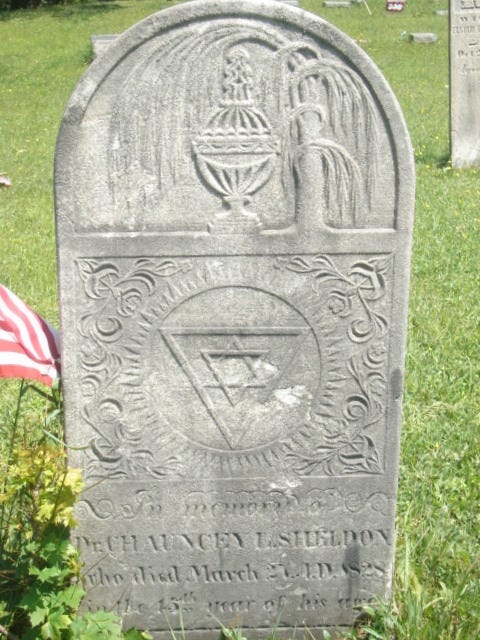
“Nancy, wife of Adam Culp. Died Nov. 18, 1836, aged 34 years. Adam Culp. Died Nov. 6, 1865, aged 67 years. The guardianship opened with her death. It closed fourteen months after his.” — Source: McClelland Cemetery (Holt Cemetery), Toronto, Jefferson County, Ohio. Photograph by Jean Scarlott (djscarlott). Added by Ed Burton, Find a Grave, 15 November 2007.
What Comes Next
This piece ends where the research doesn’t.
General File №377 — the underlying case file behind this docket entry — may survive at the Jefferson County Courthouse or the Ohio History Connection. If it does, it would contain the actual bond document, the inventory of the children’s estate interests, and the accounts of the guardianship through its final settlement in January 1867. That settlement closed fourteen months after Adam’s own death in November 1865. Why did it take that long after the last ward reached majority? What was still unresolved?
The Wright deed partition — Abram Myers vs. William Wright and Others, 1838 — is the document that triggered this proceeding. It hasn’t been fully read. It will tell us what Nancy’s share of her father’s estate was worth, and what her children ultimately received.
Every document is an echo-key. This one opened onto a farmhouse in Knox Township, a courthouse in Steubenville, and a family managing grief and law and land in the same November. General File №377 is another key. The partition petition is another.
The hunt continues.
This is a portal. Every document is.
You have one somewhere — in a folder, on a hard drive, printed at 2am when the trail got warm. You looked at it, took the names and dates, moved on.
Touch it again. Ask what it is. Ask why it exists. Ask what the law required, and what the law didn’t require, and what lives in the space between those two things.
The fog will lift. Not all the way. But enough.
We hunt in the gaps.
Interloper Assist
This piece was researched and drafted through AI-human collaboration. The author directed all research, provided all primary and secondary sources, made all interpretive decisions, and holds final authority over every conclusion. Claude (Anthropic) served as research partner, drafting engine, and analytical collaborator. ChatGPT (OpenAI) contributed the statutory framework and citable language. Grok identified the legislative lineage of the Ohio guardianship statute. The author verified all claims against primary sources.
The AI tools asked questions the author hadn’t thought to ask. The author found the answers.
AI and I.
Endnotes
Act of February 1, 1805, “An act defining the duties of administrators on wills and intestate estates, and providing for the appointment of guardians,” chap. LXXXIII, in Salmon P. Chase, ed., The Statutes of Ohio and of the Northwestern Territory, Adopted or Enacted from 1788 to 1833 Inclusive (Cincinnati: Corey & Fairbank, 1833–1835), pp. 496–498.
William Blackstone, Commentaries on the Laws of England, Book I: The Rights of Persons (Oxford: Clarendon Press, 1770), 453. Via Judy G. Russell, “The Avuncular Guardian,” The Legal Genealogist, 2 March 2015 (https://www.legalgenealogist.com/2015/03/02/the-avuncular-guardian/).
Judy G. Russell, “Guardians for the Kids,” The Legal Genealogist, 1 March 2012 (https://www.legalgenealogist.com/2012/03/01/guardians-for-the-kids/); Russell, “A Matter of Timing,” The Legal Genealogist, 5 March 2015 (https://www.legalgenealogist.com/2015/03/05/a-matter-of-timing-2/).
Jacob Wright estate notice, Steubenville newspaper, 17 August 1829; Jefferson County, Ohio, Probate Records, Inventories 1828–1847, vol. 5–6, FamilySearch (https://familysearch.org/ark:/61903/3:1:3QSQ-G9M2-NWS6 : accessed March 2025), image 62 of 751.
Abram Myers vs. William Wright and Others, Petition for Partition, Jefferson County, Ohio, 1838. Transcription in personal files of Michael Stills, transcribed by Helen York Rose, obtained from the Jefferson County Ohio Genealogical Society.
Jefferson County, Ohio, Guardians’ Dockets, 1838–1920, vol. 1–2 (1838–1880), p. 4, guardianship entry for Adam Culp as guardian to the children of Adam Culp, November Term 1838; FamilySearch (https://www.familysearch.org/ark:/61903/3:1:3QS7-L9GB-XC7K : accessed 28 March 2025), image 30 of 615; citing FHL microfilm 900,073.
General File №377, Jefferson County Court of Common Pleas. Location and survival status unconfirmed. If extant, would be held at the Jefferson County Courthouse, Steubenville, Ohio, or the Ohio History Connection Archives and Library, Columbus, Ohio.
Amos A. Culp (14 Feb 1838–12 Sep 1838), Find a Grave memorial no. 22918636, Bethel Lutheran Cemetery, Toronto, Jefferson County, Ohio (https://www.findagrave.com/memorial/22918636 : accessed May 2026).
메타데이터
- post_id
- c0d7ca5ea24d
- slug
- the-guardian-c0d7ca5ea24d
- url
- https://medium.com/@archivalinterloper/the-guardian-c0d7ca5ea24d
- canonical_url
- https://medium.com/@archivalinterloper/the-guardian-c0d7ca5ea24d
- author_url
- https://medium.com/@archivalinterloper
- status
- ok
- fetched_at
- 2026-06-09 15:37:30