I Automated 80% of My Work With AI. The Most Valuable Lesson Had Nothing to Do With Technology.
Why AI Automation Is Quietly Creating a New Class of High-Leverage Professionals
I Automated 80% of My Work With AI. The Most Valuable Lesson Had Nothing to Do With Technology.
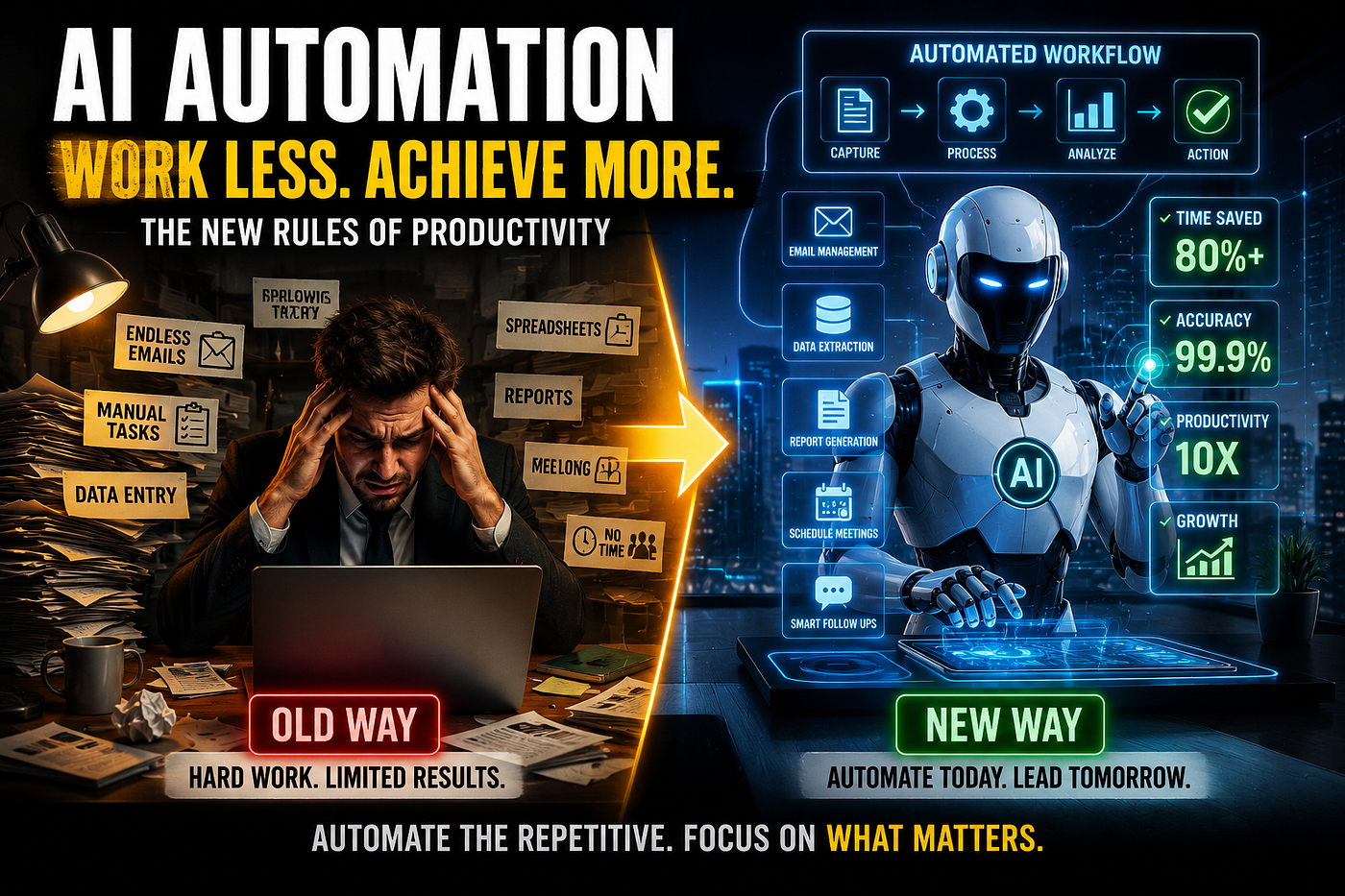
Why AI Automation Is Quietly Creating a New Class of High-Leverage Professionals
A few years ago, productivity meant working harder.
Then it meant working smarter.
Today, something far more interesting is happening.
A growing number of professionals are discovering that the biggest advantage isn’t working harder or smarter.
It’s building systems that work without you.
That sounds obvious until you realize how few people actually do it.
Most people use AI to save a few minutes.
A small group is using AI automation to reclaim entire days.
And the gap between those two groups is becoming impossible to ignore.
Here’s the surprising part:
The biggest winners in the AI era may not be the best programmers, the smartest analysts, or even the most experienced professionals.
They may simply be the people who learn how to automate workflows before everyone else.
After spending months studying AI automation systems, observing how companies deploy them, and analyzing why some implementations succeed while others fail, I came to a conclusion that changed how I think about work entirely:
AI automation isn’t primarily a technology revolution.
It’s an operating system revolution.
And most people haven’t realized it yet.
The Productivity Trap Almost Everyone Falls Into
Let’s start with a common misconception.
When people hear “AI automation,” they imagine software doing tasks faster.
That’s true.
But it’s also incomplete.
The real value isn’t speed.
It’s removing human dependency from repeatable processes.
Think about your typical workday.
How much time is spent on activities that follow predictable patterns?
- Reading emails
- Updating spreadsheets
- Creating reports
- Scheduling meetings
- Researching information
- Writing first drafts
- Responding to common questions
- Managing workflows
Now imagine if those activities happened automatically.
Not faster.
Automatically.
That’s a completely different conversation.
The difference between doing something quickly and not needing to do it at all is enormous.
Most discussions about AI miss this distinction.
And that’s where the biggest opportunities are hiding.
The Experiment That Changed My Perspective
I once spoke with a founder who believed his company needed more employees.
Revenue was increasing.
Customer requests were growing.
Operations were becoming more complex.
His assumption seemed logical:
More work requires more people.
Then he conducted a simple experiment.
Instead of hiring immediately, he mapped every recurring workflow inside the business.
The results were shocking.
Nearly 70% of operational activities followed predictable patterns.
Customer inquiries.
Lead qualification.
Data collection.
Reporting.
Internal notifications.
Documentation.
Most of these processes required human attention only because they had always required human attention.
Not because humans were actually necessary.
Within months, automation systems were handling significant portions of the workload.
The company continued growing.
Headcount barely changed.
The lesson was profound.
Many businesses don’t have labor problems.
They have workflow design problems.
Why AI Automation Is Different From Traditional Automation
Traditional automation has existed for decades.
Factories use it.
Software companies use it.
Large enterprises use it.
So what’s different now?
Flexibility.
Traditional automation works well when rules are fixed.
AI automation works when situations vary.
For example:
Traditional automation:
“If customer selects Option A, send Email A.”
AI automation:
“Understand the customer’s request, determine intent, generate a personalized response, decide urgency, and take the next appropriate action.”
That’s a huge leap.
For the first time, automation can handle ambiguity.
And ambiguity is where most knowledge work lives.
This is why AI automation is expanding into industries that were previously difficult to automate.
The Hidden Cost Nobody Calculates
When businesses evaluate automation, they usually focus on labor savings.
That’s a mistake.
The biggest benefit is often speed.
Consider two companies.
Company A completes a process in five days.
Company B automates the process and completes it in five minutes.
The advantage isn’t merely cost reduction.
It’s responsiveness.
Customers receive answers faster.
Opportunities are captured sooner.
Decisions happen earlier.
Momentum increases.
Speed compounds.
And in competitive markets, compounding speed can become a massive strategic advantage.
The companies winning with AI automation understand this.
They aren’t chasing efficiency.
They’re chasing acceleration.
The Four Stages of Automation Maturity
Most organizations unknowingly operate at different levels of automation maturity.
Understanding these levels reveals where the biggest opportunities exist.
Level 1: Manual Operations
Humans perform everything.
Processes depend entirely on individual effort.
Growth requires additional labor.
Most small businesses operate here.
Level 2: Assisted Work
AI helps people perform tasks.
Productivity improves.
Humans remain responsible for execution.
Many organizations currently operate at this stage.
Level 3: Automated Workflows
Entire processes execute automatically.
Human involvement becomes exception-based.
Instead of doing work, people supervise systems.
This is where major productivity gains emerge.
Level 4: Autonomous Operations
Systems monitor, decide, optimize, and execute continuously.
Humans focus on strategy rather than execution.
Few organizations have reached this stage.
Those that do often gain disproportionate advantages.
The Most Overlooked Opportunity in AI Automation
Everyone talks about content creation.
Few discuss decision automation.
This may be the biggest opportunity of all.
Most organizations generate enormous amounts of information.
Yet decision-making remains painfully slow.
Reports wait for review.
Insights wait for meetings.
Recommendations wait for approval.
Opportunities wait for action.
AI automation changes this dynamic.
Imagine systems that:
- Detect anomalies instantly
- Surface insights automatically
- Prioritize opportunities
- Trigger actions immediately
The value isn’t automation itself.
The value is eliminating decision latency.
And decision latency quietly destroys more value than most businesses realize.
The Rise of the High-Leverage Professional
One of the most fascinating outcomes of AI automation is the emergence of a new type of worker.
Not necessarily the most skilled.
Not necessarily the most experienced.
The most leveraged.
These individuals understand something important:
Every repetitive task is a candidate for automation.
Every workflow is a system waiting to be redesigned.
Every process contains hidden inefficiencies.
Instead of asking:
“How can I work faster?”
They ask:
“Why am I doing this manually at all?”
That question changes everything.
Because leverage isn’t about effort.
It’s about architecture.
A Contrarian Prediction About Jobs
Most conversations about AI focus on replacement.
I believe that’s the wrong framework.
The larger shift may involve amplification.
The highest performers will become dramatically more productive.
The gap between average and exceptional performers could widen significantly.
Why?
Because automation scales capability.
Imagine two marketers.
One manages campaigns manually.
The other manages automated systems.
Both work the same number of hours.
Yet one can influence ten times more outcomes.
The future may belong less to workers and more to orchestrators.
People who know how to coordinate systems.
Not just perform tasks.
The Automation Flywheel
The most successful automation strategies create a flywheel effect.
Here’s how it works.
Step 1
Automate repetitive tasks.
Step 2
Save time.
Step 3
Use saved time to improve systems.
Step 4
Create additional automation.
Step 5
Save even more time.
Over months and years, this compounds.
Small automation gains become massive operational advantages.
This is why early adopters often appear to accelerate faster than competitors.
The advantage isn’t one automation.
It’s the accumulation of hundreds of small improvements.
The Mistake That Causes Most Automation Projects to Fail
Many organizations automate tasks.
Few automate outcomes.
That’s a critical difference.
Task automation:
“Generate reports automatically.”
Outcome automation:
“Identify opportunities and recommend actions automatically.”
One saves effort.
The other creates value.
Organizations that focus exclusively on task automation often achieve modest results.
Organizations that automate outcomes transform operations.
The distinction seems subtle.
In practice, it’s enormous.
What Smart Professionals Should Automate First
If you’re wondering where to begin, start with these categories:
Information Collection
Research.
Data gathering.
Monitoring.
Reporting.
Communication
Follow-ups.
Notifications.
Routine responses.
Status updates.
Organization
Scheduling.
Documentation.
Task management.
Workflow coordination.
Analysis
Trend detection.
Performance tracking.
Pattern recognition.
Insight generation.
These areas often produce the fastest returns because they contain significant repetition.
The Future Nobody Is Talking About
The most interesting future isn’t AI replacing people.
It’s AI making individuals dramatically more powerful.
Imagine:
- A consultant serving ten times more clients.
- A developer managing multiple products simultaneously.
- A marketer operating campaigns at unprecedented scale.
- A founder running a global company with a tiny team.
These scenarios are becoming increasingly realistic.
Not because humans are improving.
Because systems are.
And when systems improve, human leverage expands.
The New Competitive Advantage
For decades, competitive advantages came from:
- Capital
- Talent
- Distribution
- Intellectual property
Those still matter.
But a new advantage is emerging.
Operational intelligence.
The ability to design workflows that continuously improve through automation.
Companies that master this will move faster, adapt quicker, and scale more efficiently.
Others may struggle to keep up.
Not because they lack talent.
Because they lack leverage.
Three Questions That Could Change Your Career
Before you close this article, ask yourself:
What tasks do I repeat every week?
Which decisions follow predictable patterns?
What would my work look like if I designed it from scratch today?
Most people never ask these questions.
The ones who do often discover opportunities hiding in plain sight.
And those opportunities are becoming more valuable every year.
Final Thought: AI Automation Is Not About Doing More Work
This is the insight I wish more people understood.
The ultimate purpose of AI automation isn’t productivity.
It’s freedom.
Freedom from repetitive work.
Freedom from operational bottlenecks.
Freedom to focus on creativity, strategy, relationships, and innovation.
The professionals who thrive in the coming decade won’t necessarily be the busiest.
They’ll be the ones who build systems that allow them to focus on what humans do best.
Everything else will increasingly be handled by automation.
And that raises a fascinating question:
When anyone can automate tasks, automate workflows, and automate decisions, what will become the true source of human value?
The answer to that question may define the next era of work.
메타데이터
- post_id
- c0dbf2b381ca
- slug
- i-automated-80-of-my-work-with-ai-the-most-valuable-lesson-had-nothing-to-do-with-technology-c0dbf2b381ca
- url
- https://medium.com/@shubham_kumar_78767/i-automated-80-of-my-work-with-ai-the-most-valuable-lesson-had-nothing-to-do-with-technology-c0dbf2b381ca
- canonical_url
- https://medium.com/@shubham_kumar_78767/i-automated-80-of-my-work-with-ai-the-most-valuable-lesson-had-nothing-to-do-with-technology-c0dbf2b381ca
- author_url
- https://medium.com/@shubham_kumar_78767
- status
- ok
- fetched_at
- 2026-06-09 15:37:30