Will You Vow to Atone My Sins Forever?
TW — Major spoilers, Rants about marriage, love, commitment, gun violences; abuse, bully, neglect, unsupervised internet for young people…
Will You Vow to Atone My Sins Forever?
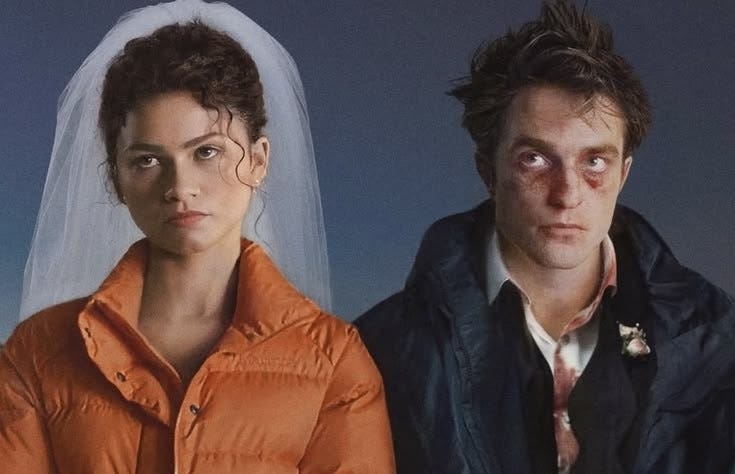
“The Drama” (2026)
TW — Major spoilers, Rants about marriage, love, commitment, gun violences; abuse, bully, neglect, unsupervised internet for young people; and my bad personal takes that might not resonates with everyone for the movie plot.
I sat there in the dark, watching A24’s The Drama, feeling an agonizingly familiar mirror being held up to my face. It is a terrifying thing to witness your own psychological architecture dismantled by a piece of fiction, to see the fragile scaffolding of your secrets shaken until the cracks finally shatter open.
The movie doesn’t really ask me whether love is enough. It asks a much crueler question: Would I still choose someone after knowing everything?
I have always been a person who overshares. When I feel vulnerable, I offer up pieces of myself like currency to friends and lovers alike, a desperate bid to be truly known. But there is a rot underneath that transparency; Because the uncomfortable truth is that I also lie a lot. Maybe not always directly, but I lie through omission. I bury parts of myself that I know people would judge. Things that clash a bad habit, the things I know fail the test of social norms, religion, or personal morality.
I hid my own sins alive, packing the earth down tight, foolishly hoping that if I don’t look at the dirt, the potential fractures in my life will never surface. Even now, with past lovers and friends who have faded out for worse, and also with the ones that are still beside me…I withhold my confessions. I am paralyzed by the fear that the truth will permanently warp their view of me. Admitting fault is a jagged pill to swallow, even when you know that their accidental discovery of your darkness would ruin you far worse.
Sometimes I become painfully aware that I’ve done something wrong, yet instead of confronting it, I quietly punish myself not being vulnerable to people and hope nobody digs deep enough to find it.
I kind of appreciate this film educates me as an outsider/foreigner about the harm of this mass shooting have impacted towards USA young lives since obviously in my country it’s quite different enough due to us not legalizing any gun controls unlike in USA; it gave me a new perspective that school shootings and gun violence shouldn’t stop at condemning the act itself. That’s necessary, but it’s not sufficient. Society also has a responsibility to educate young people about why these acts happen, how they affect victims and communities, and why they should never be romanticized.
In recent years, by how the movie try to portray it also; some corners of the internet have turned tragedy into an aesthetic. Lonely, angry, or socially isolated teenagers can stumble into online spaces that package violence with a sense of identity, rebellion, or notoriety. That framing can be dangerously misleading. In reality, these events leave families devastated, survivors traumatized, and entire communities carrying grief for years. There’s nothing glamorous about that.
That’s why media literacy and critical thinking matter just as much as telling people, “Don’t do this.” Young people benefit from learning to ask questions like:
Why am I drawn to this kind of content?
Is this community helping me cope, or encouraging me to sink deeper into anger?
Am I confusing attention with acceptance?
Is loneliness making me vulnerable to harmful ideas?
Teaching those habits early can help people recognize manipulation and resist narratives that glorify violence.
I also think it’s important not to reduce every potential perpetrator to “just a monster.” That doesn’t excuse horrific actions, but understanding the pathways that can lead someone toward violent fantasies — such as isolation, untreated mental health struggles, a desire for notoriety, or exposure to extremist online communities — is part of prevention. If we only react after violence happens, we’ve already failed.
What I appreciated about The Drama is that Emma’s past isn’t treated as something “cool” or “edgy.” The film frames it as a lifelong burden that continues to affect her relationships and sense of self. Rather than glamorizing her actions, it shows how one catastrophic decision can echo through years of guilt, fear, distrust, and broken intimacy.
To me, that’s a more responsible way of telling stories about violence. It neither sensationalizes the act nor pretends it exists in a vacuum. Instead, it invites viewers to think about accountability, remorse, and the difficult question of whether people can change — while never losing sight of the harm such violence threatens to inflict.
If there’s one social lesson I took from the film beyond its themes of love and confession, it’s that preventing violence starts long before a crisis. It starts with helping young people build empathy, emotional resilience, healthy ways to deal with loneliness, and the confidence to seek connection instead of validation through harmful identities. Those conversations may not be as dramatic as what happens on screen, but they’re far more important in the real world.
The Drama forced me to confront a devastating reality: people will punish you regardless of whether you speak the truth or let it rot in silence. Love does not automatically grant absolution.
I found the view of confession compelling. because it never suggests that telling the truth guarantees redemption. In fact, it almost argues the opposite: confession doesn’t control the outcome — it simply gives the other person the information they deserve to make their own choice. Whether they forgive you is no longer yours to decide.
Some people will hate you for telling the truth. Others will hate you even more for hiding it. The outcome isn’t something you can fully control because every person’s boundaries are different. Some people can live beside your flaws forever. Others will walk away after hearing a single sentence. or worse, they stay while they punish you forever…
“We weave a shroud of holy lies, To keep the monsters from their eyes, But in the dark, the fractures grow- How much of me can you endure to know?”
Watching the dissolution of Emma and Charlie’s pre-marital paradise made me re-evaluate the terrifying weight of commitment. Marriage is a monumental architecture; you must be rigid and selective before you lay down the foundation. If a partner’s past sins breed a poison of doubt before the vows are spoken, you still have a chance to run. Marriage feels terrifying because it’s a promise made after gathering as much information as you possibly can about another human being, while still knowing there will always be things you don’t know. That’s why I think dating is the stage where people should actually be stricter, not more forgiving. If your partner has done something that fundamentally changes how you see them, and you’re not married yet, I genuinely think it’s okay to leave.
It isn’t about seeking an impossible, flawless perfection — I know all too well that I am far from a good person myself; but about having the backbone to demand what you need before you tie the knot. We must minimize the structural damage early. If we are strict from the start, then whatever sins or ghosts crawl out after the wedding are things we have actively chosen to face, to accept, and to heal together. People often try to fix their volatile dating dynamics before a proper commitment, only to find that marriage magnifies the scale of the conflict until it crashes down upon them.
you should have enough backbone to admit them to yourself instead of constantly questioning whether you’re “allowed” to want them.
Once you’ve actually chosen marriage, though, I think the responsibility shifts. At that point, you’ve already made your decision with the information available to you. The inevitable flaws, mistakes, and future disappointments become something both people have to face together instead of constantly wondering if they should leave at the first sign of hardship. Ironically, I think many couples do the opposite.
The plot is less interesting as a mystery about Emma’s past than it is as an experiment about moral negotiation. The point drove itself is almost secondary; the real story is watching everyone reveal the limits of their compassion once that compassion becomes inconvenient.
If I were Charlie, tormented by the haunting echo of Emma’s past, I would have walked away. Not out of malice, but out of a desperate mercy to prevent myself from crashing out, ruining my own soul, and ultimately breaking Emma further with my brewing resentment. Because if her past haunted me enough to constantly question whether I could ever trust her again, staying would eventually destroy both of us. I’d rather walk away early than slowly become someone resentful who punishes her every day for something I claimed to forgive.
Love doesn’t magically erase doubt. Sometimes leaving is the kinder choice.
And if I were Emma, drowning in the suffocating guilt of withheld truth, I would have ended it too. I would have recognized that my reality was intolerable for my future husband, and that I needed to find a grace that could actually hold my history. Not out of self-pity, but because I’d know my silence created a foundation that wasn’t fair to the person standing beside me. I’d carry the guilt of not telling him sooner, and I’d accept that maybe what I need isn’t forgiveness from someone who can’t genuinely give it, but someone capable of accepting the person I already am.
The tragic, biting irony of the film lies in the hypocritical court that presides over Emma’s execution.
though. Some supporting characters — Rachel especially — can feel less like fully realized people and more like embodiments of different moral positions. Depending on how you read her, she either exposes hypocrisy or comes across as underdeveloped. I can understand why audiences are divided on her.
For me personally though; Rachel is a chilling, performative psychopath. She corners Emma with a righteous fury, yet she is the same person who locked a disabled child in an abandoned RV… She points at Emma from a position of moral superiority while seemingly forgetting that she is high key a passive aggressive bully towards everyone in her social circle. The only reason her story didn’t become a tragedy is because the child was (allegedly) found alive. Had things gone slightly differently, Rachel wouldn’t simply be remembered as a bully — she could’ve been responsible for someone’s death. A murderer…
That’s why her outrage toward Emma felt… performative.
Especially when she suddenly positions herself as this fierce protector of her cousin Sam after spending part of her own past treating another disabled child with shocking cruelty.
Throughout the movie, Rachel also quietly looks down on almost everyone around her. Emma. Charlie. Her husband Mike. Even strangers. There’s this white woman superiority that leaks into every interaction, as if she genuinely believes she’s entitled to judge everyone else’s moral failures while never truly confronting her own. she feels hollow, a theatrical display to mask her deep-seated elitism. She looks down on the world, passive-aggressively tossing tomatoes at Emma while her own hands are filthy.
Beside her stands Mike — not a bad man, perhaps, but a spineless observer. His cold-headed, submissive neutrality functions as a catalyst, quietly stirring the pot while he watches the world burn, a dynamic Rachel happily weaponizes to maintain her absolute control.
Mike isn’t exactly malicious. He’s almost the opposite. He’s so emotionally passive that he accidentally enables chaos. He constantly occupies the role of the “reasonable middleman,” but his refusal to meaningfully challenge Rachel ends up allowing her to dominate every room she’s in. Rachel benefits enormously from their marriage because Mike’s silence becomes permission.
Charlie’s arc was probably the most frustrating for me, but I think that’s intentional. He spends much of the film trying to figure out whether he can still marry Emma after learning who she was. His hesitation feels realistic. Loving someone doesn’t automatically erase fear, especially when violence is involved. At the same time, his moral certainty starts to crumble once he becomes the one asking for forgiveness. That irony is one of the film’s strongest ideas.
I sympathize with his terror — marrying someone with a capacity for violence is a horrifying prospect don’t you think? but his cowardice is maddening. He even casually judges the DJ earlier in the film with this almost sheltered, black-and-white worldview. It made me wonder if Charlie has simply lived a life where compromise never demanded much from him. He’s always been perceived as the awkward, good-hearted guy, so perhaps he’s never really had to imagine what it means to love someone morally complicated. incapable of understanding what it means to actually compromise or suffer in the gray areas of life. He spends the entire runtime withholding forgiveness from Emma, only to cheat on her and receive her immediate absolution within hours. He only agrees to a reset on the relationship when he himself falls into sin, utilizing the clean slate to restore his own fragile image of purity.
The biggest irony is how quickly his perspective changes after he commits a serious betrayal himself. out of a stupid impulse
It takes Charlie nearly the entire film to forgive Emma.
while it takes Emma only hours to forgive Charlie for cheating.
That imbalance says more than any of Charlie’s scrapped weeding speech could ever say about Emma and Charlie as growing developed individuals.
The movie begins with Charlie asking whether Emma deserves forgiveness.
It quietly ends by asking whether Charlie believes he deserves it.
And maybe that’s the cruelest part.
Everyone becomes more generous when they’re the one asking for grace.
What stayed with me most wasn’t Emma’s crime.
It was realizing that nearly everyone in this story carries blood on their hands in one way or another.
Emma committed the worst act — or almost did — but she also spent years drowning in remorse.
Meanwhile, people who never saw themselves as monsters continued hurting others in quieter, more socially acceptable ways while believing they occupied the moral high ground.
Maybe that’s what disturbed me most.
We’re often so eager to point at someone else’s sins that we forget our own hands aren’t exactly clean either.
“You hold the scale, you cast the stone, And build a fortress of your own, Yet sleep with blood upon your sleeve- Is it her crime, or your own, you grieve?”
What Emma did was horrific, and it cannot be defended. Yet, the film’s most piercing question is not about her capacity for violence, but about the profound blindness of those around her. They paralyze themselves with fear over her potential threat, totally oblivious to the active horrors they commit daily. Emma carries the crushing weight of genuine regret; her tormentors carry their sins with an arrogant, entitled peace.
One thing I appreciated is that the story refuses to divide people neatly into “good” and “evil.” Emma’s past is horrifying, but the movie doesn’t stop there. It keeps asking whether other characters are as morally consistent as they believe they are. That doesn’t make Emma’s actions equivalent to everyone else’s — it simply exposes how quickly people become comfortable judging others while overlooking their own failures.
I left the movie without a clean conclusion, my thoughts still tangled and processing in the dark. The Drama didn’t give me answers, but it cracked something open inside of me. It forced me to look at my own buried secrets, at the stones I am tempted to throw, and the terrible, beautiful, and costly price of truly wanting to be known by my loved ones…
Where I think the strongest of the story’s message is in asking uncomfortable questions without pretending there are universal answers. For example:
Is someone forever defined by the worst thing they’ve almost done?
Is hiding the truth a second betrayal?
Can forgiveness exist without trust?
Is love supposed to be unconditional, or are there moral boundaries where walking away is healthier?
I don’t think the movie answers any of those, and I think it’s better because of that. There are parts that I think are intentionally messy
What I took away most wasn’t a lesson about whether Charlie should have stayed or left. It was that love and forgiveness are separate choices. You can forgive someone and still decide not to marry them. You can understand why someone became who they are and still conclude that you’re not the right person to carry that history with them. Those aren’t necessarily acts of cruelty — they can be acts of honesty and mercy.
That’s what lingered with me after the credits. Not whether Emma deserved another chance, but whether any of us really know where our own line is until the person we love crosses it.
Would I confess everything if I knew it might destroy the relationship?
Would I rather be loved for the complete truth or accepted for an incomplete version of myself?
Can a marriage survive honesty?
Or is marriage simply an agreement to keep choosing each other despite the truths that inevitably surface?
I don’t know.
Maybe that’s why the film affected me as much as it did.
It didn’t convince me that love conquers everything.
It convinced me that love is less about finding someone without sin, and more about deciding which wounds you’re willing to live beside — and whether, after seeing every scar, every mistake, every version of each other, you can still say:
“I’ll stay.”
메타데이터
- post_id
- c0e0dbfa1603
- slug
- will-you-vow-to-atone-my-sins-forever-c0e0dbfa1603
- url
- https://medium.com/@4rchived/will-you-vow-to-atone-my-sins-forever-c0e0dbfa1603
- canonical_url
- https://medium.com/@4rchived/will-you-vow-to-atone-my-sins-forever-c0e0dbfa1603
- author_url
- https://medium.com/@4rchived
- status
- ok
- fetched_at
- 2026-07-10 15:36:45