Learning What Matters at MIT (Fall 2025)
This fall term at MIT was not about accumulating classes or credentials. It was about deliberately building judgment.
Learning What Matters at MIT (Fall 2025)
This fall term at MIT was not about accumulating classes or credentials. It was about deliberately building judgment.
I approached each course as a tool to sharpen my thinking, decision-making, and leadership skills in complex environments. Rather than optimizing for breadth or visibility, I optimized for depth: stress-testing assumptions, practicing leadership under pressure, and turning frameworks into repeatable capabilities.
What follows is not a list of courses, but rather the lenses that have most significantly reshaped how I approach building organizations, teams, and long-term value.
U.Lab
U.Lab was the anchor of the semester. Everything started from the individual.
The course challenged me to learn how to listen more deeply and at multiple levels, and it ignited a motivation to engage with policy design at the government and institutional levels, something I had never considered before.
This was the most complex, longitudinal, and systemic framework I encountered during the semester. It reframed leadership as a responsibility that extends beyond organizations into broader social ecosystems, and it left me better equipped to take ownership of the kind of systems we help create.
It also gave me real u.lab friendships that go beyond the classroom, grounded in shared reflection, trust, and purpose. That’s u.lab. You may love it or hate it, but it is undeniably mind-blowing.

Entrepreneurship 101
My main objective in Entrepreneurship 101 was to learn a systematic methodology for venture creation. Not to build a single startup, but to develop a long-term capability: a repeatable way of creating and scaling multiple business lines over time.
One of the most important lessons was around primary market research (PMR). PMR never ends, and it is a difficult process. Even when we say we are doing it, there is a strong tendency to avoid it. This course made that gap explicit and uncomfortable, forcing discipline over intuition.
Entrepreneurship 101 introduced new lenses through which I think about markets, velocity, and moats. Assumptions were constantly challenged through a rigorous, almost scientific approach to entrepreneurship.
Led by Bill Aulet, the course reinforced a simple but powerful truth: ideas and approaches will iterate and change, but a strong team is what ultimately sustains progress. Learning how to “fish” by building ventures systematically was the real takeaway. This venture (ANGY) will have its own post.

Global Markets
In Global Markets, learning from Simon Johnson and Luis Videgaray provided a clear snapshot of the current world order. The course helped frame how history, institutions, culture, and policy shape national power and long-term competitive advantage.
A key takeaway was the development of a broader understanding of how countries utilize policy and institutional design to shape their economies. Cases such as India and Singapore served as strong benchmarks of what deliberate, long-term choices can achieve, and as inspiration for what is possible in a country like Mexico.

Mobility Ventures
Mobility Ventures was a true playground for understanding and practicing different roles across complex environments.
Working with global teams, particularly those from Korea and Japan, revealed how perspectives, culture, and assumptions influence problem-solving and decision-making. It was a pleasure to be led by Jay, an outstanding consultant, and to reconnect with a consulting-style mindset focused on rigor and outcomes.
Taking on a secondary role, my focus was on maximizing outcomes rather than visibility. I leaned into the sales side of the venture and played devil’s advocate regarding the business model, helping to stress-test assumptions and sharpen the overall approach.
The class encouraged us to analyze markets we were not previously familiar with and to think deeply about scalability, regulation, and execution in the transportation and mobility sectors. Learning from professors and speakers at the forefront of the field made this one of the most demanding and enjoyable courses of the semester.

Marketing
In Marketing, my focus was on understanding the state of the art in applied AI from a decision-making perspective. Under the guidance of Juan Juan, the course outlined how AI models and tools can be leveraged across the extended marketing and funnel environment, accelerating content creation and iteration, enhancing experimentation, and maintaining a disciplined focus on value creation and ROI.
The key learning was not the tools themselves, but how to utilize AI as a lever to prioritize, learn more efficiently, and make better marketing decisions.

Financial Management
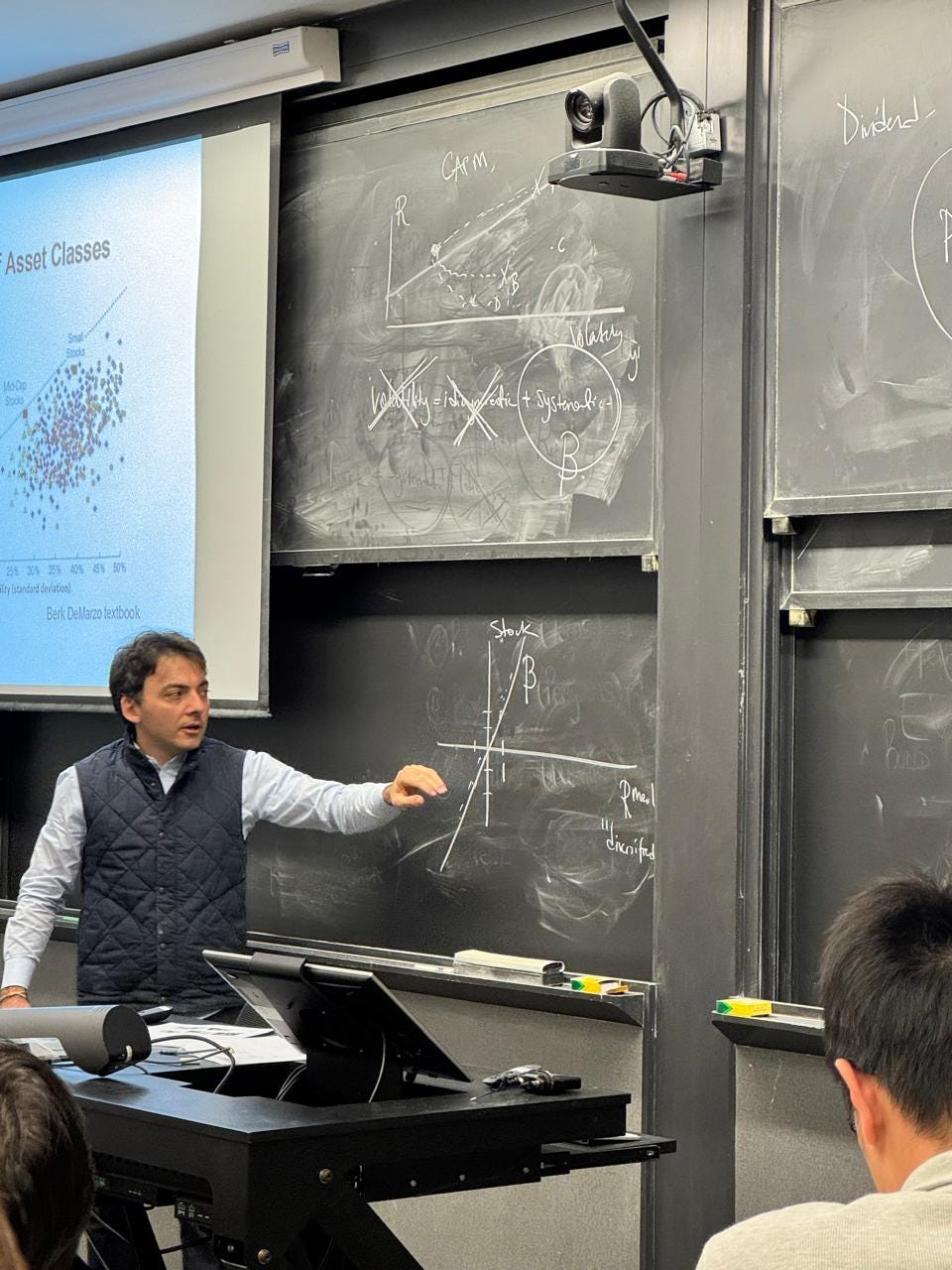
In Financial Management, the value was a clear refresh of how financial decisions are made at the executive level. With Denys Shapiro’s pragmatic and executive perspective, the course reinforced a true CFO mindset centered on capital allocation, risk, and long-term value creation.
Beyond formulas, the class helped frame finance as a strategic function, clarifying why decisions around investment, leverage, and financing are ultimately about judgment and responsibility, not just numbers.
Power & Negotiation
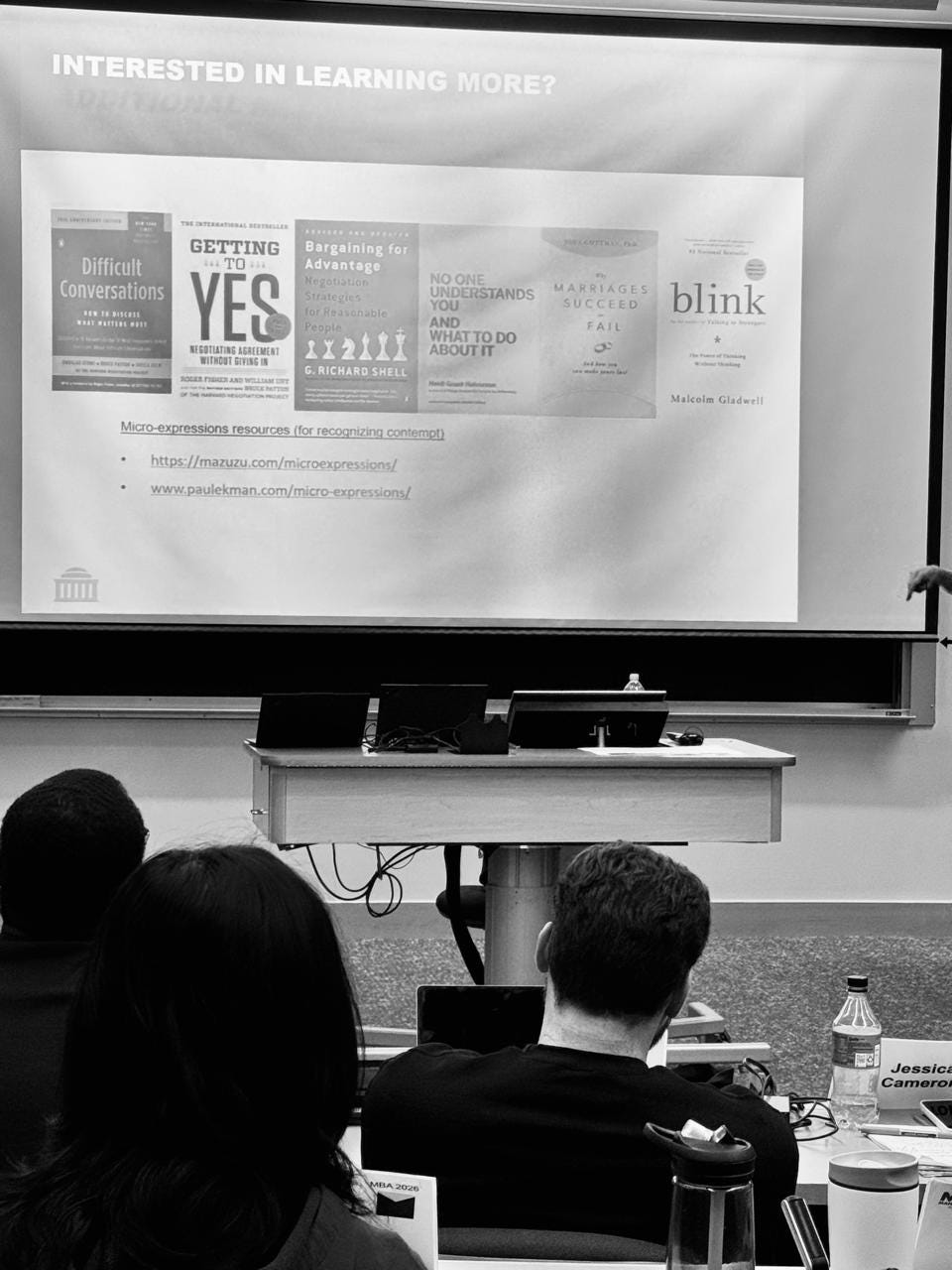
In Power & Negotiation, the core learning came from practice. Under the leadership of Basima Tewfik, whose research sits at the frontier of negotiation and power dynamics, the course made abstract concepts tangible through repeated real-world scenarios.
The key shift was reframing negotiation away from a focus on “winning.” The real value comes from creating better outcomes by understanding human motivations, interests, and power structures. Negotiation emerged as a fundamental leadership capability, deeply connected to trust, ethics, and long-term value creation.
Closing
Taken together, these experiences reshaped how I think about leadership, venture creation, and responsibility. Not as isolated skills, but as an integrated system that compounds over time.
I’m deeply grateful to the professors who prioritized rigor over comfort, engaged seriously with challenging questions, and consistently raised the bar for how to think and make decisions.
MIT is not a place to collect answers. It is a place that forces better questions.
This remains a work in progress. And that is exactly the point.
메타데이터
- post_id
- c10f665cc719
- slug
- learning-what-matters-at-mit-fall-2025-c10f665cc719
- url
- https://medium.com/@nestordesquivel/learning-what-matters-at-mit-fall-2025-c10f665cc719
- canonical_url
- https://medium.com/@nestordesquivel/learning-what-matters-at-mit-fall-2025-c10f665cc719
- author_url
- https://medium.com/@nestordesquivel
- status
- ok
- fetched_at
- 2026-06-21 20:33:08