Satya Nadella Just Named the AI Trap His Own Company Profits From
The Microsoft CEO just named the hidden tax every company pays to use AI. He also happens to sell the toll booth.
Satya Nadella Just Named the AI Trap His Own Company Profits From
The Microsoft CEO just named the hidden tax every company pays to use AI. He also happens to sell the toll booth.
Photo by Simon Ray on Unsplash
Here’s a sentence you don’t expect from a tech CEO: you are paying for AI twice, and the second payment is worse than the first. Satya Nadella wrote that, more or less, in an essay he posted on X called “The Reverse Information Paradox.” He runs Microsoft, one of the three companies with the most to gain from you never noticing this. He named the problem anyway, in plain language, and it’s worth your full attention for exactly that reason.
This isn’t a hit piece on Nadella. His argument is correct, sharply reasoned, and something almost nobody selling AI wants said out loud. But knowing who’s saying it, and what he sells, changes how you should read his advice. Here’s the whole thing broken down: what he actually claims, why it’s true, where his own interests bend the argument, and what you can concretely do about it before your next AI contract renewal.
The reverse information paradox
Nadella starts from real economics. Kenneth Arrow, the Nobel laureate, described a classic problem: a buyer can’t know what information is worth until they’ve seen it, and once they’ve seen it, they’ve effectively acquired it for free. Sellers of information are always at a disadvantage, because showing the goods gives them away.
Nadella flips it. With AI, he argues, the buyer is the one giving something away. In his words, “you essentially pay for intelligence twice, once with money, and again with something even more valuable: the proprietary knowledge you must reveal to make that intelligence useful.” Want the model actually to understand your business? You have to feed it your business. Your pricing logic, your edge cases, your customer complaints, your internal shorthand. As he puts it, “the buyer risks giving away knowledge, just to use what they bought.”
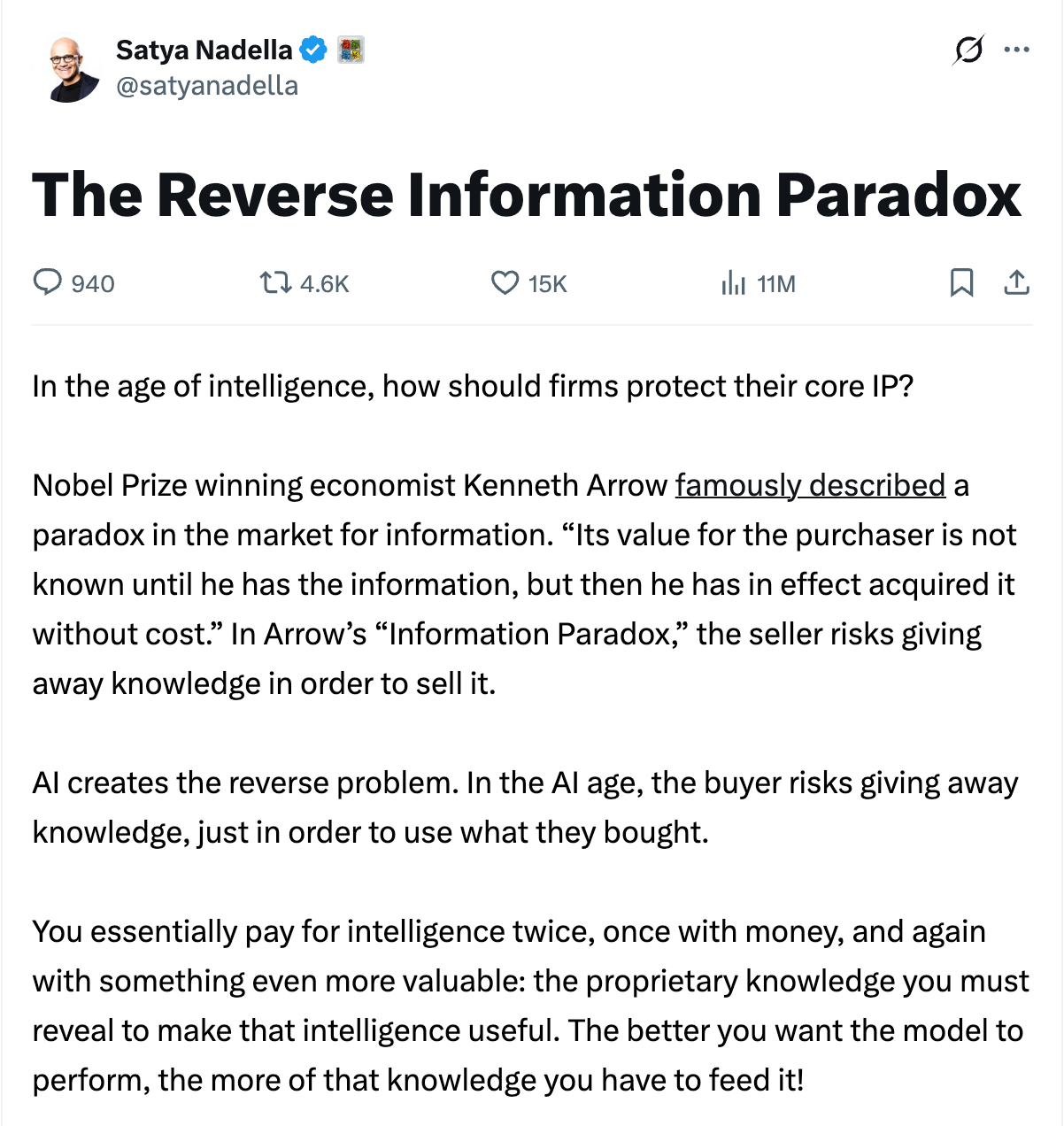
Satya Nadella on X.
Here’s the part that makes it dangerous rather than just clever: it doesn’t happen in one visible moment. Nadella calls it “exhaust,” the quiet residue of everyday use. Every prompt an employee writes. Every time someone corrects the model when it gets something wrong. He says those corrections get “distilled into institutional know-how, the kind of knowledge a competitor could never buy, and the kind that leaks almost imperceptibly, trace by trace, correction by correction.” No company would hand a rival its internal playbook on purpose. Piece by piece, without a contract that names it, that’s effectively what’s happening.
The double standard Microsoft won’t mention
Nadella pushes the argument one step further, and this is where it gets genuinely uncomfortable for the industry he’s part of. Frontier AI labs have spent years defending their right to train on the open internet under fair use. Scrape first, argue later. Those same labs, in their enterprise contracts, routinely restrict customers from doing the mirror version: taking a model’s output and using it to train a competing system. Information flows freely into the model. It flows back out only on the vendor’s terms. Nadella names that asymmetry directly, and he’s right to.
What he’s quieter about is his own position inside it. His fix for all of this is a five-part framework: control over your institutional memory, capability through private learning environments, choice so you’re not locked into one model, cost efficiency, and the ability to compound your own data’s value over time. Sounds right. It also happens to describe, almost line for line, the product lineup Microsoft has spent two years building: Azure AI Foundry for model portability, private fine-tuning tools, cost-management dashboards, data governance products sold under the banner of “control.” None of that makes the diagnosis wrong. It does mean the cure is for sale at the same counter where the disease was just described to you, and you should know that before you read this essay as a public service rather than a very well-written pitch.
What this actually costs you
Make it concrete. A mid-sized law firm rolls out an AI drafting assistant. Over eighteen months, its lawyers fix thousands of small errors: a misread clause, a missed jurisdictional quirk, a firm-specific precedent the model didn’t know. None of that feels like handing over secrets. It feels like using software. But those corrections, stacked across a firm’s best legal minds, teach the model something close to how that firm actually practices law, the kind of knowledge a competitor would otherwise only get by poaching a partner. Nobody signed anything that called this a transfer of expertise. It happened anyway, correction by correction, and there’s no way to pull it back out of the model once it’s absorbed.
That’s the real stake behind Nadella’s essay: not a single leak, but a thousand small, forgettable interactions that nobody would have approved all at once if you’d shown them the total. So don’t just read the warning. Act on it. Before your next AI vendor contract, push for answers on three things: whether your prompts, corrections, and usage data can be used to train the vendor’s models for other customers, whether you can export your fine-tuned model and switch providers without losing that accumulated value, and whether the contract gives you any rights over outputs your own team spent months correcting into shape. Almost no standard enterprise AI agreement addresses these questions today, which means the default answer, unless you negotiate otherwise, favors the vendor every time.
The bottom line
Nadella named a real problem, and named it more precisely than most people writing about AI and enterprise risk have managed. That deserves real attention. But a warning about a power imbalance is still shaped by whoever’s delivering it, and Microsoft profits either way, whether you fall into the trap or buy the tools to avoid it. That doesn’t make the diagnosis wrong. It means you should read this essay for exactly what it is: sharp economic reasoning from someone with a direct financial stake in how you respond to it, and a genuinely useful prompt to go read your own AI contracts before you sign the next one.
Thanks for reading. Clap if you really liked my story.
Support my work: Buy me a coffee
Follow me on X: @itsvksharma_
메타데이터
- post_id
- c121fed97715
- slug
- satya-nadella-just-named-the-ai-trap-his-own-company-profits-from-c121fed97715
- url
- https://medium.com/write-a-catalyst/satya-nadella-just-named-the-ai-trap-his-own-company-profits-from-c121fed97715
- canonical_url
- https://medium.com/write-a-catalyst/satya-nadella-just-named-the-ai-trap-his-own-company-profits-from-c121fed97715
- author_url
- https://medium.com/@itsvksharma_
- status
- ok
- fetched_at
- 2026-07-16 11:26:35







