How I Got Into University Through Taiwan’s Special Talent Admission
A cybersecurity-focused reflection on applications, portfolios, interviews, and turning CTF experience into a coherent story
How I Got Into University Through Taiwan’s Special Talent Admission
A cybersecurity-focused reflection on applications, portfolios, interviews, and turning CTF experience into a coherent story
Photo by Poh Soo Donald Soh on Unsplash
Taiwan’s special talent admission is an alternative university admission pathway for students with unusual achievements, skills, or experiences. It is not the mainstream route, and it does not remove academic requirements entirely. But it gives students a chance to be evaluated through a lens that fits their actual strengths better than standardized exams alone.
I applied to cybersecurity-related programs. These were my results:
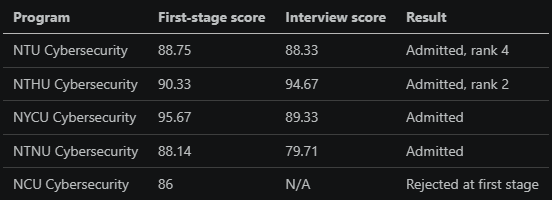
Special Talent Admission Results
This is not a universal guide to getting admitted. Every university, department, and committee may value different things. What I can share is how I prepared my materials, how I framed my cybersecurity experience, what the interviews felt like, and what I would tell younger students who want to follow a similar path.
How I started thinking about this route
I first heard about special talent admission in high school, but most teachers introduced it very briefly. For many students, it felt like a rare and distant option, not a realistic path.
The first time I saw it up close was during an ISIP cybersecurity course, when a senior student talked about getting into National Taiwan University through special talent admission. At that time, I simply admired him. I did not imagine I would later apply through the same system.
That changed near the end of 2024, after my teammates Jackoha, Hongyo, and I won second place in a national cybersecurity competition for high school students. For the first time, I started thinking that my CTF, community, competition, and teaching experiences might be more than hobbies. They could become a structured learning record.
Still, I did not build everything only for admission. Creating a cybersecurity study group at my high school, preparing for OSCP, and joining community events were things I genuinely wanted to do. That mattered later, because my application was not just a list of achievements. It had a motivation behind it.
Preparing the portfolio
I started writing my application materials around the second half of the summer in 2025. Instead of writing everything in one intense sprint, I worked on one or two pages a day and slowly turned my experiences into a readable story.
After school started, I asked my computer science teacher, Chinese teacher, and counseling teacher to review the drafts. Their feedback was useful, but it also revealed a real challenge: different teachers had very different ideas about what an application portfolio should be.
Some believed the portfolio should emphasize motivation, problem-solving, and personal growth. Others thought it should be a dense showcase of awards, certifications, and projects.
In the end, I combined both perspectives, but kept the main structure story-driven. My reasoning was simple: the committee can see my awards, but they also need to understand why I pursued cybersecurity, how I learned, how I handled problems, and where I want to go next.
For each university, I only made major changes to the application motivation and future plan sections unless the school had specific formatting or word-count requirements. The core experience remained the same, but the emphasis changed depending on the program.
The first rejection
The first result I received was from National Central University. I did not pass the first stage.
That hit harder than I expected. Because it was the first result, it was easy to start questioning the entire application direction.
Fortunately, other schools later invited me to interviews. That helped me reset emotionally. It also taught me something important: the same profile can be interpreted very differently by different committees.
A rejection from one program does not necessarily mean your work has no value. It may simply mean that your materials did not match that program’s expectations.
Interview experiences
Based on my experience, the interview difficulty felt roughly like this: NTU, NYCU, NTNU, then NTHU.
NTU and NYCU asked more technical questions. The self-introduction time was short, and the professors seemed more interested in quickly verifying my ability and reasoning process than hearing a long personal story. For these interviews, technical depth and clarity mattered a lot.
NTNU’s cybersecurity group also had an additional written test. I did not find it too difficult, especially for someone with CTF and basic cybersecurity experience. The interview itself felt more like a confirmation of my background and current learning state.
NTHU’s interview was more conversational. The professors asked about my role in competitions, how I worked with teammates, and what I actually contributed. The atmosphere was friendly, and the discussion felt more like a structured conversation than a pressure test.
I honestly did not expect to be admitted to NTU. The screenshot below is from a Discord conversation before the results came out. Someone tagged me and asked, “Are you nervous about today’s results?” I replied, “Not really. I’m not getting in anyway.”
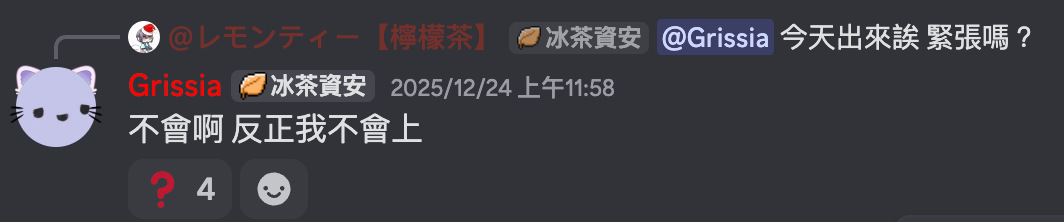
Admission result screenshot
That message aged very poorly, in the best possible way. When I saw that I was admitted, it felt unreal. Throughout the process, I had never fully believed this path would actually work.
Advice for cybersecurity students
If you are a student interested in cybersecurity and special talent admission, my first advice is: do not start by trying to write a perfect application. Start by building real experience.
Choose a direction first. Do you want to focus on CTFs, penetration testing, binary exploitation, web security, reverse engineering, or maybe Web3 security? Different directions require different skills and different kinds of evidence.
If you are still new, start with beginner-friendly resources such as picoCTF, AIS3 Junior, school computer clubs, or regional student communities. The value of these activities is not only certificates or awards. They help you discover what you enjoy, what you are good at, and who you can learn from.
When it is time to prepare the portfolio, do not simply fill it with everything you have done. Awards and certifications are evidence, but reflection is what connects the evidence. The reader should be able to understand your growth, not just count your achievements.
Practical notes
The general process is: universities publish admission guidelines, applicants submit materials, first-stage results are released, interviews or second-stage evaluations happen, final results are announced, admitted students confirm enrollment intention, waitlists may move, and students eventually register.
One important detail is that the enrollment intention deadline and the final withdrawal deadline may not be the same. Always read each university’s official guideline carefully.
There is no single correct portfolio style. I personally prefer a story-driven structure that highlights motivation and process, but some programs may prefer dense achievement lists. The safest approach is to keep a clear narrative while making sure important results are visible.
For interviews, practice with counseling teachers, subject teachers, or seniors who have gone through similar processes. You need to explain who you are, what you have done, why you are applying, and how you think through technical problems in a very short amount of time.
Final thoughts
Special talent admission is not a shortcut. It is a way for different kinds of effort to be seen.
For me, the most valuable part of the process was not only the admission result. It was the first time I organized several years of cybersecurity learning into one coherent story: CTFs, community work, competitions, OSCP, teaching, and running a study group.
If you want to take this route, focus first on doing meaningful work. When application season arrives, your task should not be to invent a persona. It should be to explain the work you have already done in a way that others can understand.
메타데이터
- post_id
- c1299c735d12
- slug
- how-i-got-into-university-through-taiwans-special-talent-admission-c1299c735d12
- url
- https://medium.com/@grissia/how-i-got-into-university-through-taiwans-special-talent-admission-c1299c735d12
- canonical_url
- https://medium.com/@grissia/how-i-got-into-university-through-taiwans-special-talent-admission-c1299c735d12
- author_url
- https://medium.com/@grissia
- status
- ok
- fetched_at
- 2026-07-13 07:32:09