Why Model Context Protocol (MCP) Will Change AI Engineering More Than Prompt Engineering
From better prompts to smarter systems.
Why Model Context Protocol (MCP) Will Change AI Engineering More Than Prompt Engineering
From better prompts to smarter systems.
For the last couple of years, prompt engineering has been one of the biggest topics in AI. Everywhere you looked, people were sharing prompt templates, prompt frameworks, prompt tricks, and examples of how changing a few words could improve model outputs. At that stage, it made complete sense because most AI applications were essentially a user talking directly to a model.
The idea was simple. If you wrote a better prompt, you got a better answer. But as AI systems started moving from demos into real production environments, something became increasingly obvious. Prompt quality alone was no longer the biggest bottleneck.
The bigger challenge became, how does the model access information, interact with systems, make decisions, and operate inside real business environments?
This is where the conversation started shifting from improving prompts to designing systems around models. Model Context Protocol(MCP) emerged as one attempt to make that transition more structured.
I think MCP may end up changing AI engineering more than prompt engineering because it accelerates a shift that had already started. AI systems are gradually moving from isolated prompting toward architectures built around context, tools, and system interaction. MCP makes that transition more structured by shifting the conversation from “how do we ask the model?” to “how do we build systems around the model?”
That is a much bigger architectural change.
Prompt Engineering Solved an Important Problem, But It Was Never the Final Layer
Prompt engineering became important because early language models had a very simple operating model. You gave instructions, added examples, described constraints, and the model generated an answer.
For writing tasks, summarization, classification, brainstorming, and simple workflows, this approach worked extremely well. But once teams started deploying AI into actual business environments, limitations started appearing.
Real production systems are not isolated chat windows where everything the model needs is provided inside a single prompt. Customer information is usually stored across databases, documents live inside storage systems, business rules are implemented through internal services, and actions are executed through APIs. On top of that, systems must operate within access permissions and security boundaries while handling data that changes continuously. This means the challenge is no longer just generating good responses but enabling models to work reliably within constantly evolving business environments.
Eventually teams realized that improving prompts was giving diminishing returns because the model itself was not the complete application.
The model became one component inside a larger system, that is the environment MCP is designed for.
What MCP Actually Changes
At a high level, MCP provides a structured way for AI models to communicate with external systems.
Instead of building custom integrations every time a model needs access to tools, databases, APIs, internal applications, search systems, or files, MCP introduces a common interface for interaction.
This may sound like a small implementation detail, but it changes how AI systems are designed.
If APIs standardized communication between software systems, MCP attempts to standardize communication between models and the environments they operate in. One thing worth clarifying here is that MCP does not replace APIs or existing business systems. Those systems still continue to exist underneath. MCP acts more like a communication layer that helps models discover, access, and interact with those capabilities in a more structured and consistent way. In many ways, MCP introduces for AI interactions what APIs introduced for service-oriented architectures.
The important idea here is not the model itself but the protocol that enables communication. Prompt engineering helps improve how users interact with models and can lead to better outputs for individual tasks. Protocols, however, improve the overall architecture by creating structured and reliable communication between systems. In production environments, architecture is often what determines whether a system remains scalable, maintainable, and reliable over time.
Tool Calling Was the First Sign of This Shift
Before MCP became popular, we already started seeing this transition through tool calling.
Instead of expecting a model to answer everything from memory, models started using external capabilities.
For example, when a user asks for the weather, the model does not generate an answer purely from what it already knows. Instead, it calls an external weather service, receives the latest information, and then generates a response based on that data. Similarly, if a user requests a business report, the model may query a database, process the returned results, build an explanation, and finally present insights to the user.
This represented an important shift in how we think about intelligence in AI systems. Intelligence was no longer defined by whether the model already knew everything. Instead, intelligence became the ability of the model to identify, access, and use the right tools at the right time.
However, early implementations introduced a different challenge. Since there was no common approach, every team started building their own integration patterns with different schemas, wrappers, orchestration layers, and interfaces. While this worked initially, over time these custom implementations became increasingly difficult to scale, maintain, and extend across production systems.
MCP tries to solve that by creating a predictable communication layer between models and tools.
Instead of custom integration logic everywhere, tools expose capabilities in a way that models can understand consistently.
Context Is Becoming More Valuable Than Prompting
One thing that becomes very clear when building production AI systems is that better outputs often come from better context rather than better prompts. People sometimes assume that model quality is the main factor behind good performance, but in practice, the quality and availability of context often have a bigger impact.
Imagine giving the same task to two identical models and asking both to summarize customer sentiment. The first model only receives the request itself. The second model receives access to CRM records, purchase history, support tickets, previous customer interactions, internal documentation, and business policies. Even though both systems use the exact same model, the second one will usually generate a much stronger and more reliable result. The difference is not that the prompt became better. The difference is that the model had access to richer and more relevant context.
At the same time, more context does not automatically mean better outcomes. Production systems also need to retrieve the right context at the right time because excessive or irrelevant information can increase latency, cost, and reduce answer quality.
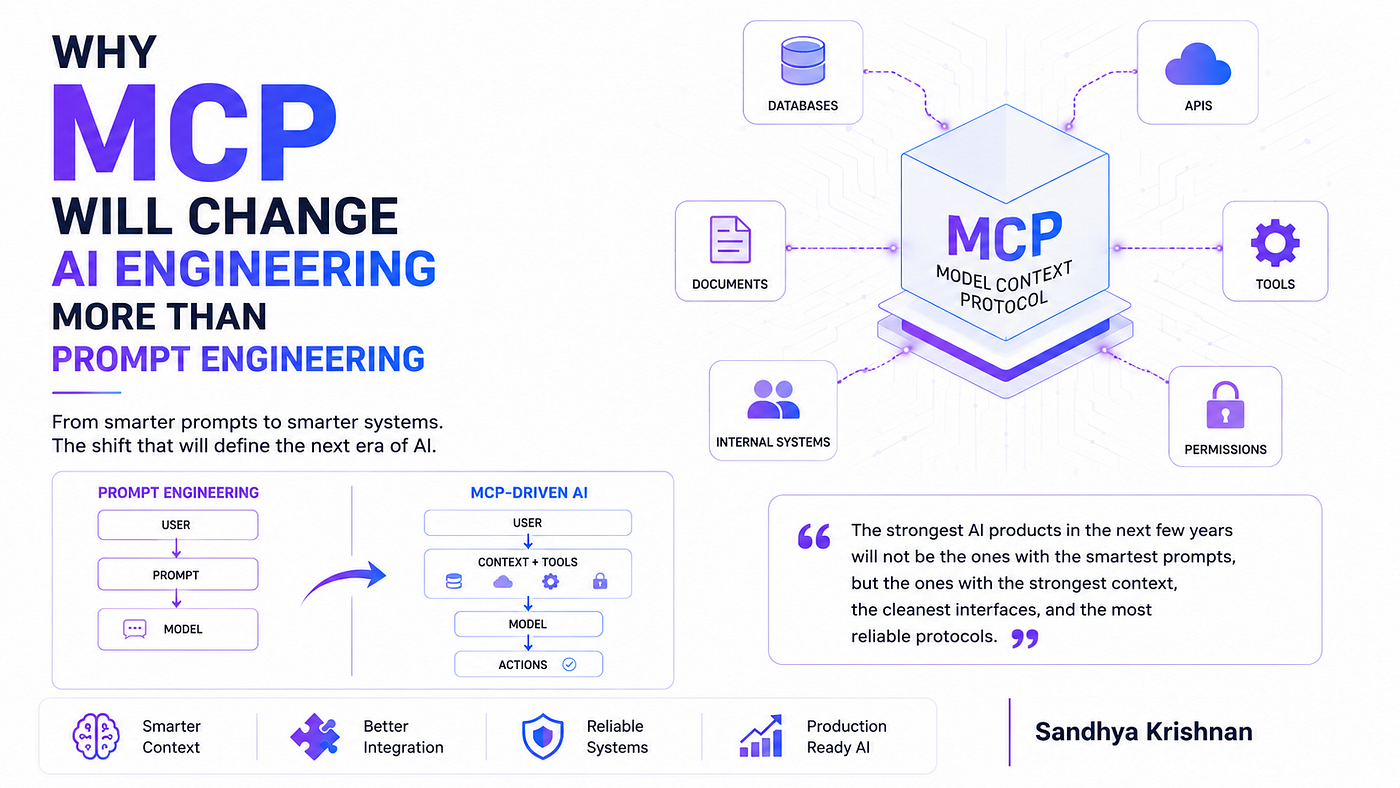
This shift is changing how modern AI systems are designed. Instead of following a simple flow where a user provides a prompt and the model generates an answer, architectures are increasingly built around providing context, accessing tools, and then allowing the model to perform actions based on that information. Although this change may look small at first glance, it changes almost everything in production environments.

Traditional AI focused mainly on prompting the model, while modern AI systems increasingly combine context retrieval, tool access, and execution layers around the model.
This is also where MCP becomes important because context no longer needs to be manually packed into prompts every time. Instead, models can retrieve relevant information when needed, work with external systems, and operate with a much more structured understanding of the environment.
Why Protocols Usually Become More Important Over Time
If we look at the history of software systems, protocols often end up having a much bigger long-term impact than individual optimizations. Technologies like TCP/IP transformed how networks communicate, HTTP became the foundation of the modern internet, REST standardized how applications exchange information, and GraphQL changed how systems retrieve and expose data. These technologies became influential not because they optimized one specific workflow but because they created common ways for entire ecosystems to operate.
That is why protocols tend to matter more over time. They create structure, reduce friction between systems, and make large-scale adoption possible.
When I think about prompt engineering and protocols in AI, they feel like two different layers of the stack. Prompt engineering helps improve interaction and can make outputs better for individual tasks, which makes it feel closer to optimization. Protocols, on the other hand, feel more like infrastructure because they define how models, tools, and systems work together.
Infrastructure is often what shapes how systems evolve in production.
That does not mean prompts become irrelevant. Prompts will continue to matter and remain an important part of building AI applications. But instead of being the central engineering problem, they become one layer among many.
Because of this, I would not be surprised if future AI engineers spend less time thinking about how to phrase prompts and spend more time designing context flow, orchestrating tools, defining system boundaries, and building architectures that allow models to operate reliably at scale.
A Production Example
Let’s take a simple example and imagine building an AI receptionist for a beauty salon.
In the first version, prompt engineering alone might be enough. The system receives instructions like, “You are a helpful assistant, and answer the customer questions politely.” For basic interactions, this works quite well. Customers ask about opening hours, service pricing, available treatments, or general information, and the model can generate useful responses.
But production systems rarely stay that simple.
As soon as users start asking operational questions such as “When is my next appointment?”, “Can I move my booking?”, or “Can you apply my membership discount?”, the problem changes completely.
At this point, the model can no longer rely only on instructions inside a prompt. In production, this also introduces additional requirements such as identifying the customer correctly, checking permissions before executing actions, maintaining audit history, and ensuring updates happen safely across connected systems.
This is usually the moment where teams realize that improving prompts is no longer solving the actual problem, but the solution becomes architecture.
Instead of only generating responses, the assistant now needs to identify the customer, retrieve the relevant context, understand which actions are available, apply business rules, execute updates across connected systems, and then return a response based on the latest information.
That transition is important because the intelligence is no longer coming primarily from how well the prompt was written. It comes from how effectively the system can access context, use tools, and operate within the surrounding environment.
As models start interacting with tools and external systems, understanding outputs alone is no longer enough. Teams also need visibility into which context was retrieved, which tools were called, what decisions were made, and where failures occurred. Building production AI increasingly means designing systems that are observable, measurable, and maintainable over time.
That is where AI starts becoming less about prompt engineering and more about protocol-driven architecture.
Conclusion
Prompt engineering played an important role in making AI accessible and lowering the barrier to experimentation. It allowed people to interact with models more effectively and helped accelerate the adoption of AI across different use cases.
But I think MCP represents a deeper shift.
Instead of focusing only on generating better answers, MCP helps move AI toward operating inside real systems where models can access context, interact with tools, and perform meaningful actions.
Because of that, I do not think the strongest AI products in the next few years will necessarily be the ones with the smartest prompts. More likely, they will be the systems that combine strong models, thoughtful prompting, high-quality context, clean interfaces, and reliable protocols between models and the environments around them.
That is why I do not see MCP as just another AI trend or another layer added on top of existing models. I think it represents one of the architectural shifts that could redefine what AI engineering actually means and where the next generation of AI systems will create value.
Thanks for reading! If you found this useful, follow me here on Medium. I regularly write about Python, data engineering, AI tools, and developer productivity.
🔗 X (Twitter): @GersentAI 🎥 YouTube: @GresentAI
I share practical tools, guides, and code for Python, ML, and AI. Friend links to my other Medium articles are available in my Highlights on X. 📘 You can also read my book “Python Coding for Kids (Age 08–10)” for free on Kindle
메타데이터
- post_id
- c14e6d6ef2c0
- slug
- why-model-context-protocol-mcp-will-change-ai-engineering-more-than-prompt-engineering-c14e6d6ef2c0
- url
- https://medium.com/@sandhyakrishnan02/why-model-context-protocol-mcp-will-change-ai-engineering-more-than-prompt-engineering-c14e6d6ef2c0
- canonical_url
- https://medium.com/@sandhyakrishnan02/why-model-context-protocol-mcp-will-change-ai-engineering-more-than-prompt-engineering-c14e6d6ef2c0
- author_url
- https://medium.com/@sandhyakrishnan02
- status
- ok
- fetched_at
- 2026-07-23 21:04:19




