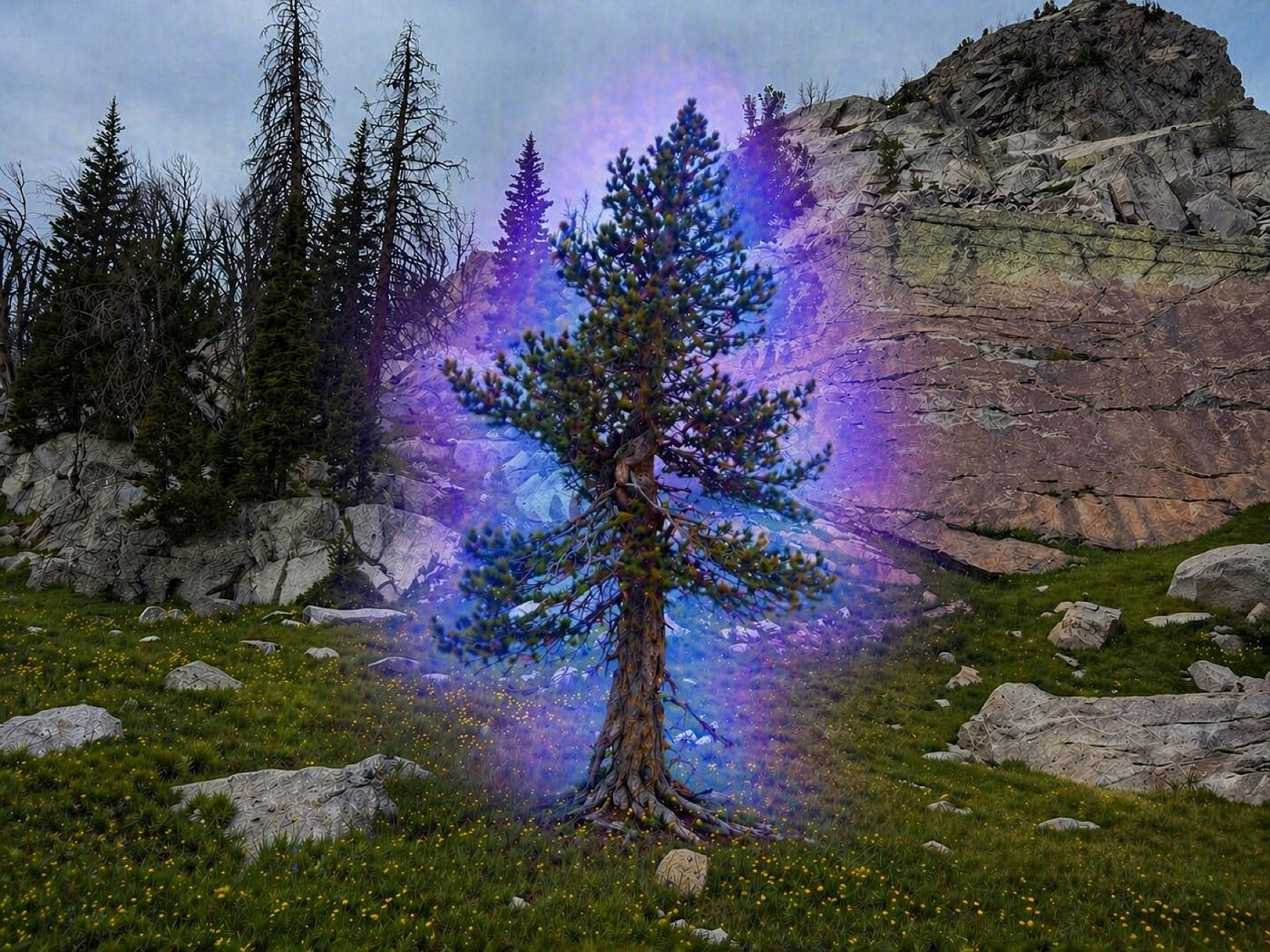
The Day Reality Disagreed With Me: My Orb Encounter
Orb Encounters, Quantum Contradictions, and Why We May Not Share a Single Reality
The Day Reality Disagreed With Me: My Orb Encounter
Orb Encounters, Quantum Contradictions, and Why We May Not Share a Single Reality
A firsthand observation in the Wind River Range meets a rigorous quantum result suggesting that observers may not always agree on what actually happened
⸻
Something happened to me in the Wind River Range that forced me to confront a possibility I wasn’t prepared to accept:
that what I was observing might not just be unexplained — but not fully shareable as a single, objective reality.
I encountered luminous orbs that didn’t behave like any known aerial phenomenon. They held position, adjusted movement in apparent response to me, and exhibited structure that resisted simple explanation.
At the time, I treated it as an anomaly to be analyzed later. What I didn’t yet understand is that modern quantum physics already contains a formal result — developed by Renato Renner (ETH Zurich) and Daniela Frauchiger — showing that under certain conditions, different observers may not be able to agree on what actually happened.
In other words: reality itself may not always resolve into a single, shared version of events.
And if that’s true, then the most unsettling possibility is not just that these objects were unexplained — but that they may have been participating in the interaction as independent, stateful systems rather than passive things being observed.
⸻
A Follow-Up
(A follow-up to my earlier piece on observed orbs and unresolved signals)
Something happened to me in the Wind River Range of Wyoming that I still process carefully.
I was in the backcountry, using thermal imaging under controlled conditions, when I encountered luminous orbs. These were not fleeting specks or camera artifacts. They exhibited defined structure, non-ballistic motion, and — most critically — precise, direct interaction with me.
They responded in ways that appeared context-sensitive: adjusting position, duration, and trajectory in apparent relation to my movements and presence.
That alone is unusual.
What’s more unusual is this:
Physics now contains a formal result suggesting that under certain conditions, different observers may not be able to agree on what actually happened.
That result is not fringe.
It comes from one of the most rigorous areas of modern quantum foundations.
And it may be pointing directly at the kind of anomaly I experienced.
⸻
A Careful Starting Point
From my Wind River interaction, I make a constrained, probabilistic statement:
There is a non-zero probability that some observed orb phenomena involve systems with internal state and responsiveness — i.e., agency.
Not proven.
Not identified.
Not explained.
But also not cleanly reducible to:
• wind-driven debris
• insects
• known aerial systems
• simple thermal artifacts
Many others report similar patterns.
These remain anomalies:
• observed
• sometimes documented
• but not fully explained
That is the correct scientific posture:
Not belief. Not dismissal.
Open, constrained uncertainty.
⸻
The Frauchiger — Renner Result (Why This Matters More Than It Should)
In 2018, Renato Renner and Daniela Frauchiger published a theorem that quietly destabilized a core assumption of physics:
Quantum theory cannot consistently describe the use of itself
Nature Communications (2018)
(arXiv:1604.07422)
The setup extends Wigner’s friend into a multi-agent system.
The result is precise:
If you assume:
-
Quantum theory applies universally (including observers)
-
Measurements yield single outcomes
-
Observers reason consistently about each other
Then:
You get a contradiction.
Not probabilistic disagreement.
Not measurement noise.
A logical inconsistency.
One observer can be certain an event occurred one way.
Another — using the same theory — can be certain it occurred the opposite way.
⸻
Why This Is Not Just “Weird Quantum Stuff”
Renner clarified this in his 2026 interview on Theories of Everything:
The problem appears when the theory must describe agents using the theory.
That creates recursion:
• You observe a system
• I observe you observing the system
• The theory must model both
But:
No observer can model the entire system — including themselves.
Each has a partial, perspective-bound view.
When those views are combined:
Consistency can fail.
⸻
Now Bring This Back to the Mountain
In the Wind River Range, I was not observing a passive object.
I was engaged in something that — at minimum — looked like:
a responsive interaction
If we entertain the possibility that the system I observed had:
• internal state
• context sensitivity
• response behavior
Then we are no longer in the domain of simple objects.
We are in the domain of:
agents interacting with observers
⸻
This Is Exactly Where Frauchiger — Renner Breaks
Frauchiger — Renner is not about particles.
It is about:
what happens when observers model other observers
And the answer is:
our current framework fails to remain consistent.
⸻
Clarifying “Agency” (Without Overreach)
When I say:
“The weakness is that the orbs are independent beings… with agency”
I am not making a claim about identity.
I am making a claim about model fit.
Observed characteristics include:
• non-ballistic motion
• spatial stability inconsistent with wind
• directional changes not explained by known biological patterns
• apparent responsiveness to observer position
This suggests:
behavior better described as stateful and responsive than purely passive
That is the operational definition of agency.
⸻
A Broader Pattern: Incomplete Observation
This is not isolated.
We see similar “incomplete modeling zones” in other domains:
• transient aerial anomalies
• thermal objects with structured motion
• events like 3I/Atlas, where observational geometry and data gaps leave interpretation underdetermined
These are not conclusions.
They are signals of a pattern:
We are encountering phenomena faster than we can fully model them.
⸻
The Real Risk: Premature Closure
There are two failure modes:
Overreach
→ “This proves intelligence / non-human origin”
Over-dismissal
→ “This is noise / error / misidentification”
Both are forms of closure without resolution.
The disciplined position is harder:
The model may be incomplete.
⸻
The Deeper Alignment
Frauchiger — Renner tells us:
• observers cannot be fully reduced
• knowledge is perspective-bound
• consistency is not guaranteed across agents
Your experience — and others like it — suggests:
• some phenomena behave as if they have internal state
• interaction matters
• observation may not be one-directional
These intersect here:
Physics does not yet fully model interacting agents.
⸻
A Precise, Defensible Statement
There exist observable phenomena whose behavior is more naturally described as agent-like than passive, and current physical frameworks — specifically quantum theory under the Frauchiger — Renner constraints — do not yet provide a complete, consistent way to model such systems when observer interaction is involved.
⸻
Why This Matters Now
For decades, this didn’t matter.
Observers were:
• external
• classical
• irrelevant
Now:
• we build quantum systems
• we simulate observers
• we model knowledge itself
And suddenly:
The observer can no longer be ignored.
⸻
Closing
The Wind River orbs did not simply appear.
They interacted.
And whether that interaction is ultimately explained or not, it sits directly on top of a known fracture in our theoretical framework.
So I take the only position that feels both rational and honest:
Hold the anomaly open.
Refine the model.
Avoid premature closure.
Because if Frauchiger — Renner is even partially right:
The issue is not whether reality is strange.
The issue is whether we still understand what it means to observe it.
Until we do:
Some parts of reality will continue to look —
not just unknown…
but independent.
⸻
📎 Technical Appendix (For Scientific Readers)
- Structure of the Frauchiger — Renner Argument
- • Multi-agent extension of Wigner’s Friend
- • Four agents: two “friends” + two external observers
- • Recursive application of quantum theory
- • Incompatible measurement bases
Result: contradiction under:
• Universality (Q)
• Single outcomes (S)
• Consistency (C)
⸻
- Nature of the Contradiction
• Not Bell-type
• Not experimental violation
• A logical inconsistency
Equivalent form:
P(A = up) = 1
P(A = down) = 1
⸻
- Interpretational Escape Routes
• Many-Worlds → drop (S)
• Collapse → drop (Q)
• QBism / relational → weaken (C)
Renner’s current direction:
• Possible non-executability
• Reference frame limits
• Links to gravity/information bounds
⸻
- Relevance to Agency Modeling
FR highlights:
• No complete formalism for agents modeling agents
• Observer inclusion introduces self-reference
• Knowledge is not globally consistent
⸻
- References
• Frauchiger & Renner (2018), Nature Communications
• arXiv:1604.07422
• Renner interview (2026), Theories of Everything
메타데이터
- post_id
- c1514cb775ca
- slug
- the-day-reality-disagreed-with-me-my-orb-encounter-c1514cb775ca
- url
- https://medium.com/@anderson_94394/the-day-reality-disagreed-with-me-my-orb-encounter-c1514cb775ca
- canonical_url
- https://medium.com/@anderson_94394/the-day-reality-disagreed-with-me-my-orb-encounter-c1514cb775ca
- author_url
- https://medium.com/@anderson_94394
- status
- ok
- fetched_at
- 2026-06-09 15:37:30