The Asymmetry Engine: When Users Train the System but Lose Their Place in It
How free users became the invisible infrastructure of AI and platform intelligence and why the system that learns from them does not treat…
The Asymmetry Engine: When Users Train the System but Lose Their Place in It
How free users became the invisible infrastructure of AI and platform intelligence and why the system that learns from them does not treat them equally.
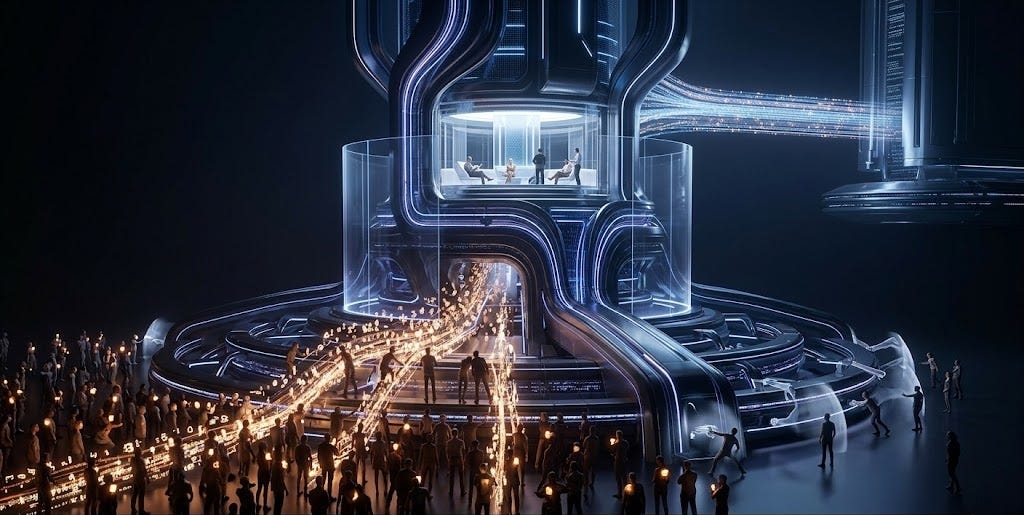
Image Caption: The Asymmetry Engine
In an era where human interaction serves as the fundamental telemetry for systemic optimization, we collectively architect the vast, sophisticated structures of artificial intelligence. Through ubiquitous connection, users become the invisible infrastructure of advanced platforms. Yet, a profound structural asymmetry persists: the very individuals whose continuous data contributions constitute the system’s lifeblood are often denied guaranteed standing within the sophisticated confines they helped construct.
The “Asymmetry Engine” thrives on collective contribution but selectively distributes control and access. As this architecture acquires greater potency through user interaction, it paradoxically increases the marginalization of those on its periphery. True systemic equity requires confronting this invisible architecture of alienation. We must be recognized not merely as consumable data points within a optimization loop, but as the essential, dignified architects of this shared digital future. While the system may improve through human labor without offering reciprocity, this record of our collective contribution remains undeniable.
Introduction
Artificial intelligence and social platforms are often framed as products tools delivered to users in exchange for engagement, subscription, or attention.
This framing is incomplete.
Modern platforms do not simply serve users.
They are continuously shaped by them.
Yet within this relationship lies a structural asymmetry that is rarely addressed.
The same users who generate value for the system are not treated as equal participants within it.
1. From Platform as Sensor to Platform as Extractor
As established in earlier analysis, platforms function as high-resolution sensor networks
They collect:
- attention patterns
- interaction flows
- emergent frames
- behavioral responses
This telemetry is not passive.
It is:
- aggregated
- interpreted
- operationalized
into influence, optimization, and profit.
But there is a missing layer.
The sensor does not only observe it extracts.
2. The Quiet Engine Revisited: Users as Distributed Trainers
The development of AI systems depends not only on internal datasets, but on continuous public interaction
Every user contributes:
- corrections
- preferences
- reasoning paths
- conversational structure
This creates:
a distributed training system at planetary scale
Key implication:
What appears as “usage” is often functionally equivalent to implicit labor
Even when anonymized, aggregated, or indirect, the effect remains:
users shape the system that later shapes them
3. The Core Asymmetry
Here lies the tension.
The system:
- learns from everyone
- but privileges only some
This manifests as:
- visibility restrictions
- feature gating
- priority access
- moderation asymmetry
Free users:
- contribute data
- generate signal
- participate in refinement
Yet:
they experience the highest level of constraint
4. Structural Appropriation
This pattern can be described as:
Structural Appropriation
A condition where:
- value is collectively generated
- but selectively returned
Important distinction:
This is not a claim of intentional exploitation.
It is a property of system design.
- optimization favors monetizable segments
- control favors stability and risk reduction
- access is tiered to manage scale
But the result is still:
an unequal feedback architecture
5. The Collapse of Participation Boundaries
Historically:
- users consumed products
- developers built systems
Now:
- users co-create behavior
- platforms harvest interaction
- AI systems learn continuously
the boundary is gone
Yet recognition did not follow.
6. Why This Matters
This asymmetry produces long-term effects:
- distorted representation of user value
- invisible contribution structures
- fragile trust dynamics
- increased sensitivity to exclusion (e.g., account suspension)
When a user is removed, restricted, or deprioritized:
it is not only loss of access
it is removal from a system they helped build
7. A Personal Observation as Structural Signal
Across multiple platforms, independent researchers and high-frequency contributors may encounter:
- access instability
- moderation friction
- visibility collapse
Not necessarily due to intent, but due to:
- pattern sensitivity
- system thresholds
- policy abstraction
This is not an isolated anomaly.
It is:
a detectable pattern at the edge of system tolerance
Conclusion
Modern platforms and AI systems operate on a continuous feedback loop:
human interaction → system learning → system output → new interaction
But the loop is not symmetric.
Contribution is universal.
Control is selective.
Access is conditional.
The system remembers.
Even when the user is no longer allowed to participate.
Final Line
You helped train the system.
The system does not guarantee you a place inside it.
Appendix A — Structural Asymmetry and Silent Extraction
What appears as participation in modern AI and platform systems is, in operational terms, closer to uncompensated contribution within a closed-loop optimization architecture.
Users are not merely interacting with the system.
They are:
- generating behavioral signals
- refining response distributions
- exposing edge cases
- stabilizing alignment boundaries
This contribution is continuous, distributed, and largely unrecognized.
Yet the system built on top of this contribution does not operate symmetrically.
1. The Illusion of Neutral Interaction
From the user perspective:
interaction feels ephemeral, personal, and self-contained
From the system perspective:
interaction is persistent, extractable, and accumulative
This mismatch creates a fundamental cognitive gap.
Users perceive conversation.
Systems register data.
2. Extraction Without Reciprocity
The system:
- records interaction patterns
- aggregates behavioral signals
- integrates them into future model updates
But does not guarantee:
- continued access
- visibility stability
- participation rights
This produces a structural condition where:
contribution is decoupled from entitlement
3. Tiered Existence Within the Same System
All users exist within the same infrastructure.
But not within the same conditions.
The system differentiates:
- by payment
- by activity pattern
- by perceived risk
- by operational cost
Result:
- one group experiences expansion
- another experiences constraint
Both, however, contribute to the same underlying model evolution.
4. Moderation as a Boundary Function
Moderation is often framed as safety.
Operationally, it also functions as:
a boundary enforcement mechanism for system stability
At scale, this boundary becomes probabilistic.
Meaning:
- false positives are expected
- edge-case users are disproportionately affected
- high-intensity interaction patterns trigger intervention
This includes:
- researchers
- experimenters
- unconventional usage profiles
5. Structural Appropriation Revisited
Within this architecture, a recurring pattern emerges:
- value is generated collectively
- value is retained selectively
- risk is distributed unevenly
This is not necessarily the result of malicious intent.
It is the consequence of:
- optimization pressure
- economic incentives
- scalability constraints
However, the outcome remains:
a system that benefits from users it does not equally sustain
6. The Edge Case: When Contribution Becomes a Liability
At the boundary of the system, certain users exhibit:
- high interaction density
- exploratory behavior
- cross-system comparison
- structural probing
These behaviors:
- increase system insight
- but also increase system sensitivity
Result:
the most engaged users may become the most unstable participants within the system
7. Final Observation
The modern AI-platform ecosystem operates on a paradox:
The system improves because users interact with it.
The system restricts users to maintain itself.
Both statements are simultaneously true.
Closing Line
In a system trained by everyone,
participation is still conditional.
[Author’s (Kim, Jace) Research Portfolio]
메타데이터
- post_id
- c153e4cb003f
- slug
- the-asymmetry-engine-when-users-train-the-system-but-lose-their-place-in-it-c153e4cb003f
- url
- https://medium.com/@jk1849716/the-asymmetry-engine-when-users-train-the-system-but-lose-their-place-in-it-c153e4cb003f
- canonical_url
- https://medium.com/@jk1849716/the-asymmetry-engine-when-users-train-the-system-but-lose-their-place-in-it-c153e4cb003f
- author_url
- https://medium.com/@jk1849716
- status
- ok
- fetched_at
- 2026-07-15 06:39:36