Anti-drone warfare(In Indian Context)
RayStrike-9: The FLANK that a Drone Swarm MAY FEAR
Anti-drone warfare(In Indian Context)
RayStrike-9: The FLANK that a Drone Swarm MAY FEAR
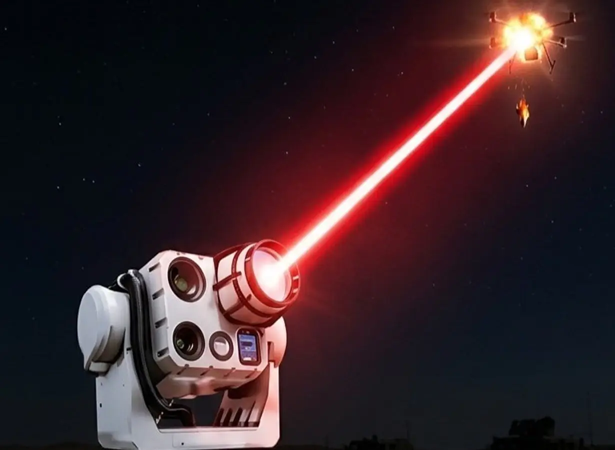
PICTURE COURTESY- WION
The Defense World has witnessed an astonishing incident in the battlefield of Moscow- Kyiv conflict. What makes it so crucial is that the impact was felt beyond the battlefield, when an Ukrainian Drone-Swarm breached the Russian Air defense and knocked the walls of Kremlin, that dismayed the significant part of political world. The incident conveys that, even “The Most secure space” is now becoming highly vulnerable, and policy makers too may risk being given the taste of battlefield irrespective of their whereabouts. We also have a concern to protect critical infrastructures of the nation.
So, the concern for an effective Anti-drone system is getting stronger across the globe and India is no exception. In rolling out series of anti-drone trials and systems, having comprehensive models, RayStrike-9 is the latest. The below, briefs the important aspects around it.
Why is a better version of Anti-drone systems a necessity:
The Drone technology has evolved with game changing features like Completely autonomous flights, Extended-range, stealthiness, Onboard LiDAR systems (Light detection & ranging- which will sometimes help dodge even Laser attacks), VTOL features etc. Provided with these challenges, a conventional or a legacy anti-drone systems will be of minimal utility. One example would be, the A.I directed flight paths, which are very dynamic and will easily help dodge the slower conventional munitions like rockets and missiles. And also, as the global conflicts leading to severe economic crisis, and supply chain disruptions, it becomes a mandate to look for alternatives that also reduces the Overall cost of the systems.
The Solution that addresses these shortcomings:
After carefully analyzed research by the concerned organizations from the world, “High Energy laser beams (HEL)” stood out as an imperative solution to counter drone swarms. However integrating it with, EW measures like RF Jammers and spoofers will be most crucial to neutralize drones to maximum effect.
How does HEL beams fill the air-defense Vacuum left over by the Legacy systems:
Below are some of the tactical advantages of HEL Beams:
· High Precision Strikes: Laser beams travel at the speed of light and so will effectively intercept the highly maneuvering and rapidly moving swarms.
· Operating speed: Once configured, Laser beams don’t require constant physical reloading tasks, which are parts and parcels of a conventional missile launching platforms.
· Cost-Effectiveness: Drones are becoming an excellent striking system for a vital reason, that is cost-effectiveness. They cost very less compared to launching a missile or operating a manned fighter aircraft yet causing significant damage to the enemy. Also, the latter has the risk of huge material and manpower loss. In this scenario, an equivalent counter measure is required, which as of now could only be provided by HEL Beam systems. One shot of HEL Beam costs roughly around INR 200, whereas conventional munitions costs around thousands and lakhs.
So, how does RayStrike-9 justify its capacity if deployed in India’s air defense Arsenal:
The system is developed by “Paras Defense and Space Technologies” in tie-up with DRDO, fulfilling the aspirations of “Atmanirbhar Bharat”. Below are its features and functioning.
Mounted on a mobile vehicle, for quick deployment, its range is around 1.2 to 2.5 km of radius.
· Detecting the targets: It utilizes high-resolution electro-optical (EO) and infrared (IR) sensors operating day and night, to monitor the airspace.
· AI-Directed Tracking: AI-based algorithms identify and locks the incoming targets automatically based on their pace, trajectory, and thermal signature.
· Engagement: Once the target is locked, it fires a concentrated beam of laser energy (9 Kilowatt of energy per shot) that travels at the speed of light, with almost giving no escape zone for the target.
· Neutralization: The concentrated and powerful heat immediately burns the vital systems of the drone and destroying it completely in the air, avoiding any collateral damage.
Some operational Challenges:
Although cost-effective and accurate, RayStrike-9 has below challenges to operate.
· Sometimes during adverse weather conditions like fog or Smog, the beam has the chances of getting scattered, which must be addressed and rectified.
· It has the challenge of operating and maintaining the system better, under extreme internal heat generation and it also requires powerful energy back up.
Conclusion:
Though having some operational challenges, if overcame, it could give India a long-term solution for drone warfare and its counter measures. Will it be The FLANK that a Drone Swarm MAY FEAR. The near future may have the answer.
메타데이터
- post_id
- c157a0af7e48
- slug
- anti-drone-warfare-in-indian-context-c157a0af7e48
- url
- https://medium.com/@sathishkumar.gp/anti-drone-warfare-in-indian-context-c157a0af7e48
- canonical_url
- https://medium.com/@sathishkumar.gp/anti-drone-warfare-in-indian-context-c157a0af7e48
- author_url
- https://medium.com/@sathishkumar.gp
- status
- ok
- fetched_at
- 2026-06-18 07:02:39