AI Agents for HR: Driving Productivity, Agility and Better Employee Experiences
Human resources leaders are under increasing pressure to improve workforce experiences, accelerate decision-making, reduce administrative…
AI Agents for HR: Driving Productivity, Agility and Better Employee Experiences
AI Agents for HR
Human resources leaders are under increasing pressure to improve workforce experiences, accelerate decision-making, reduce administrative effort and support business growth with limited resources. Traditional automation has helped streamline repetitive activities, but many HR processes still depend heavily on manual coordination, fragmented systems and human intervention. This is where agentic AI is beginning to reshape HR operations.
Unlike conventional automation, intelligent agents can understand context, make decisions within defined parameters, execute tasks across systems and continuously improve based on outcomes. As organizations look for new ways to increase productivity and enhance workforce support, AI agents are emerging as a practical solution for transforming HR service delivery.
For executives evaluating the future of HR, understanding how AI-powered agents work, where they create value and how to deploy them effectively is becoming increasingly important.
What are AI agents for HR?
AI agents for HR are intelligent software entities that can perform HR-related tasks autonomously or semi-autonomously. They combine artificial intelligence, workflow automation, enterprise data and business rules to execute activities that traditionally required significant human involvement.
Unlike traditional HR automation tools that follow predefined workflows, these agents can interpret requests, evaluate context, determine appropriate actions and interact with multiple systems.
An AI agent for HR may handle employee inquiries, support recruiting processes, coordinate onboarding activities, assist managers with workforce planning or automate HR service delivery tasks. As organizations mature their AI capabilities, these agents increasingly operate as connected digital workers rather than isolated automation tools.
Why are AI agents for HR important?
The role of HR continues to evolve from administrative support to strategic business partnership. This shift requires HR leaders to improve service quality, accelerate decision-making and provide more personalized employee experiences.
This is where agentic AI in HR creates significant value. Intelligent agents help organizations manage growing workforce complexity while reducing the manual effort associated with routine HR activities.
The importance of AI agents for human resources stems from several factors:
- Increasing employee expectations for fast and personalized support.
- Growing pressure to improve productivity across HR operations.
- Expanding workforce data that requires analysis and action.
- The need for consistent policy execution and compliance.
- Greater demand for workforce insights that support business decisions.
As organizations continue their digital transformation efforts, agentic AI for HR is becoming an important enabler of scalable and intelligent HR service delivery.
How HR AI agents work
Modern HR agents combine artificial intelligence, workflow automation, enterprise data and business rules to execute work across HR processes.
Most AI agents in human resources follow a structured operating model:
- Receive a request or trigger from an employee, manager or system.
- Analyze the request and identify the required action.
- Access relevant workforce data, policies and business rules.
- Execute tasks across HR platforms and enterprise applications.
- Escalate exceptions or sensitive decisions to human stakeholders when necessary.
- Learn from outcomes to improve future performance.
Many organizations are implementing connected agentic systems that allow multiple agents to collaborate across end-to-end HR processes. These agents may work alongside agentic chatbots, HR platforms and workflow technologies to deliver seamless employee experiences.
The growing maturity of agentic AI tools is making it easier for organizations to design, manage and scale these intelligent HR capabilities.
Types of AI agents used in HR
Organizations can deploy different types of AI agents depending on business requirements.
- Simple reflex agents execute predefined actions based on specific triggers.
- Model-based agents use historical context to improve decision-making.
- Goal-based agents evaluate multiple actions to achieve a defined outcome.
- Utility-based agents optimize decisions based on competing priorities and constraints.
- Learning agents continuously improve performance through feedback and experience.
As HR organizations mature their AI capabilities, multiple agent types often work together across complex workforce processes.
Benefits of using AI agents for HR
Organizations adopting intelligent HR agents are realizing benefits across operational, workforce and business dimensions.
Improved productivity
Agents automate repetitive and administrative tasks, allowing HR teams to focus on workforce strategy, talent development and employee engagement.
Faster service delivery
Employees receive quicker responses to inquiries and requests, improving overall workforce satisfaction.
Better decision-making
Agents analyze large volumes of workforce data and provide recommendations that support more informed HR decisions.
Enhanced employee experiences
Personalized interactions and proactive support help improve employee engagement throughout the workforce lifecycle.
Greater scalability
Organizations can support workforce growth without proportionally increasing HR administrative workloads.
Increased agility
Intelligent agents help HR organizations respond more effectively to changing business and workforce needs.
These outcomes are accelerating agent adoption among organizations seeking to modernize HR operations and improve workforce support.
Key use cases for AI agents in HR
Organizations are finding value across multiple HR functions through AI agents.
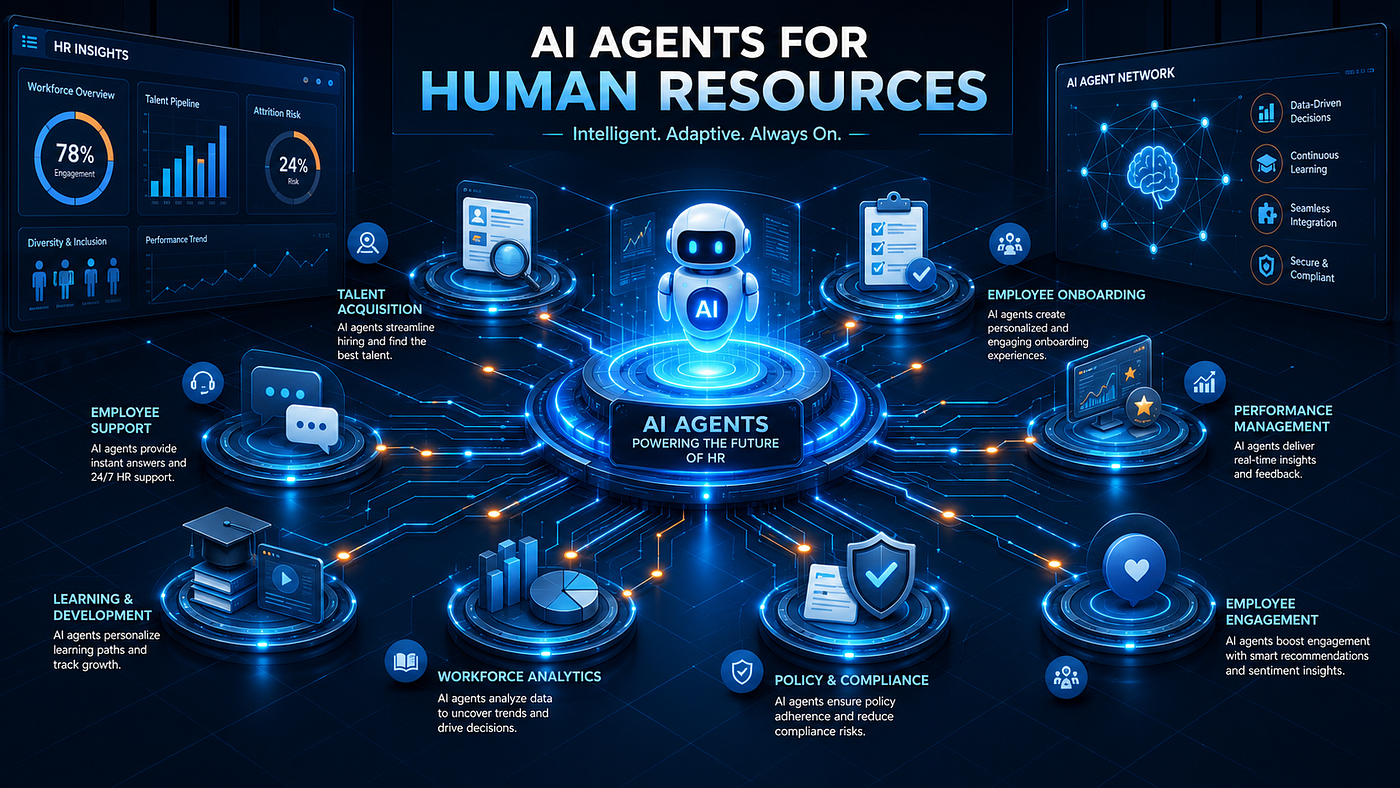
Talent acquisition
Agents can screen candidates, schedule interviews, coordinate communications and provide hiring managers with recommendations based on defined criteria.
Employee onboarding
New hire processes often involve multiple departments and systems. Intelligent agents can coordinate tasks, monitor completion status and proactively resolve delays.
Employee support
Many organizations deploy agentic chatbots to answer common employee questions regarding benefits, policies, payroll and HR procedures. More advanced solutions can complete transactions rather than simply provide information.
Learning and development
Agents can recommend personalized training programs, identify skill gaps and support workforce development initiatives.
Workforce planning
AI-powered agents can analyze workforce data, identify trends and support scenario planning activities.
Performance management
Agents can gather feedback, monitor milestones and help managers prepare for performance discussions.
These examples represent some of the most common agentic AI use cases in HR currently being explored by leading organizations.
Best practices for using AI agents in HR
Successfully implementing intelligent HR agents requires more than technology. Organizations should adopt a structured approach that aligns AI initiatives with business goals.
Start with high-value use cases
Focus on processes that are repetitive, data-intensive and capable of delivering measurable business value.
Establish strong governance
Define oversight mechanisms, approval requirements and accountability structures to ensure responsible use of AI.
Ensure data readiness
High-quality workforce data is essential for effective agent performance and reliable outcomes.
Maintain human oversight
Not every HR decision should be automated. Human review remains important for sensitive workforce matters.
Prioritize change management
Successful deployment of AI agent initiatives requires employee education, leadership support and clear communication.
Design integrated workflows
Organizations should focus on creating connected agentic HR workflows rather than automating isolated tasks.
Build for scale
As organizations expand AI adoption, they should establish a roadmap for HR AI agent development that supports long-term growth and business objectives.
Why choose The Hackett Group® for HR AI agent development?
Successfully implementing AI agents in HR requires more than technology. Organizations need a clear understanding of where intelligent agents can create value, how they should be deployed and what governance structures are needed to support long-term success.
The Hackett Group® helps organizations identify, prioritize and implement AI-driven HR transformation initiatives. Using Hackett AI XPLR™, organizations can evaluate HR use cases, assess feasibility, estimate business impact and prioritize opportunities for intelligent automation and AI agent adoption.
Through The Hackett Group®’s AI agent development services, organizations can:
- Identify high-value opportunities for AI agents across recruiting, onboarding, workforce planning and HR service delivery.
- Assess readiness across data, processes, governance and technology.
- Design scalable HR AI agent strategies aligned with business objectives.
- Establish governance, risk management and human oversight frameworks.
- Implement enterprise-ready AI solutions that deliver measurable business value.
This combination of HR expertise, proven methodologies and AI capabilities helps organizations accelerate the adoption of AI agents while maintaining control, compliance and workforce trust.
Endnote
AI-powered agents are changing how HR organizations operate. From recruiting and onboarding to employee support, workforce planning and performance management, intelligent agents are helping HR teams improve productivity, increase agility and deliver better employee experiences.
As organizations continue investing in AI, the role of intelligent agents will expand beyond task automation to support more autonomous, connected and data-driven HR operations. Leaders who establish the right strategy, governance and implementation approach today will be better positioned to capture long-term value from AI-enabled workforce transformation.
메타데이터
- post_id
- c17618d76849
- slug
- ai-agents-for-hr-driving-productivity-agility-and-better-employee-experiences-c17618d76849
- url
- https://medium.com/@thehackettgroup/ai-agents-for-hr-driving-productivity-agility-and-better-employee-experiences-c17618d76849
- canonical_url
- https://medium.com/@thehackettgroup/ai-agents-for-hr-driving-productivity-agility-and-better-employee-experiences-c17618d76849
- author_url
- https://medium.com/@thehackettgroup
- status
- ok
- fetched_at
- 2026-06-12 18:14:10