J.S. Bach’s 20 Children
The Women Who Shaped Bach’s Family and Legacy
J.S. Bach’s 20 Children
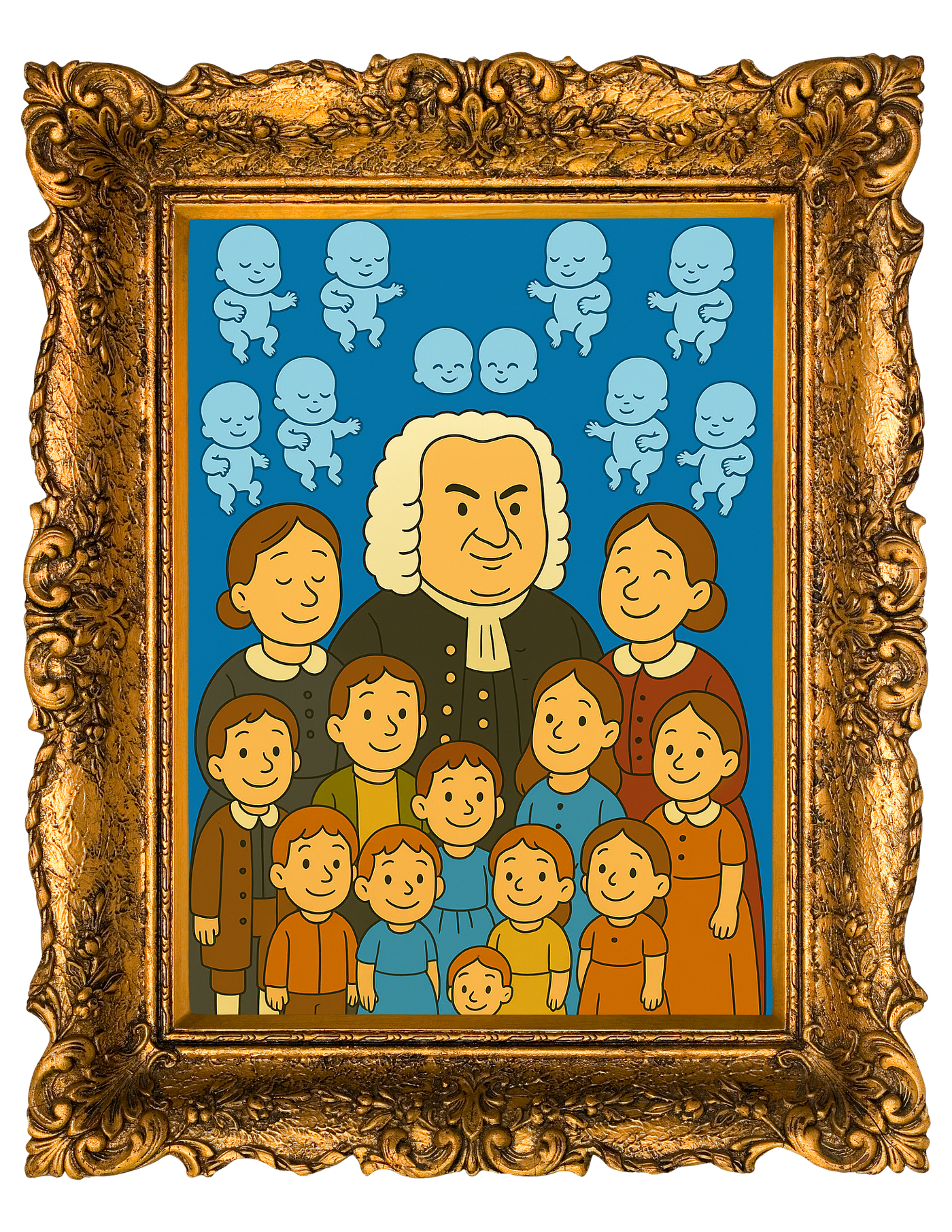
The Women Who Shaped Bach’s Family and Legacy
Johann Sebastian Bach (1685–1750), often regarded as the pinnacle of Baroque artistry, was not only a prolific composer but also the father of a remarkably large family. Across two marriages, he fathered 20 children, of whom 10 survived to adulthood. The two women he married were central to his domestic and creative life.
In 1707, Bach married Maria Barbara Bach, his second cousin. The Thuringian Bach family was vast and deeply musical, and Maria Barbara’s lineage made her both a familiar and a culturally fitting partner. Their marriage produced seven children, four of whom lived beyond childhood. Maria Barbara’s sudden death in 1720, while Bach was away in Carlsbad, was a life-altering shock. Accounts suggest Bach returned to find her already buried, an event that may have influenced the intensity and grief-laden quality of some of his works written shortly afterward, such as the Chaconne from the Partita in D minor for solo violin.
In 1721, Bach entered a second marriage with Anna Magdalena Wilcke, a soprano and daughter of a court trumpeter. At the time, she was already employed in Köthen, where Bach served as Kapellmeister. Their union produced thirteen children, of whom six survived into adulthood. Anna Magdalena was far more than a spouse: she was a professional musician in her own right, and an indispensable collaborator in Bach’s household. She copied scores, maintained order in a musically bustling home, and cultivated her children’s education. The Notebooks for Anna Magdalena Bach — compilations that included works by Bach, his contemporaries, and pedagogical pieces — demonstrate how central she was to the fusion of family life and music.
Together, Maria Barbara and Anna Magdalena embodied two distinct eras of Bach’s life, each contributing to the continuity of his musical dynasty and the rhythms of his daily existence.
Lives Shaped by Music: From Cradle to Career
Bach’s children were born across nearly four decades, spanning an era of rapid musical and cultural change. Growing up in a household saturated with performance and composition, their destinies varied — some became professional musicians of international reputation, while others lived quieter domestic lives.
The Children of Maria Barbara Bach
- Catharina Dorothea Bach (1708–1774) — Bach’s eldest daughter, who never married and lived a relatively private life, contributing to the household’s devotional and musical fabric.
- Wilhelm Friedemann Bach (1710–1784) — Perhaps the most technically gifted of Bach’s children. Known for his brilliance as an improviser, he secured posts in Dresden and Halle but struggled with personal finances and stability (Williams, 2007).
- Carl Philipp Emanuel Bach (1714–1788) — The most famous of Bach’s sons, a central figure in the empfindsamer Stil (“sensitive style”). He served Frederick the Great in Berlin and later directed music in Hamburg. His keyboard treatise was studied by Haydn, Mozart, and Beethoven (Schulenberg, 2014).
- Johann Gottfried Bernhard Bach (1715–1739) — Trained as a musician but died young, never establishing a lasting career.
- Maria Sophia (1713) — Died in infancy.
- Leopold Augustus (1718–1719) — Died in infancy.
- Twins (1713) — Both perished in infancy.
The Children of Anna Magdalena Bach
- Gottfried Heinrich Bach (1724–1763) — Described as mentally impaired yet musically talented. His brother C.P.E. Bach remarked on his gifts, though he was never able to live independently.
- Elisabeth Juliana Friederica Bach (1726–1781) — Married Johann Christoph Altnickol, one of her father’s pupils.
- Johann Christoph Friedrich Bach (1732–1795) — Known as the “Bückeburg Bach,” he composed symphonies and chamber works that bridged Baroque and Classical idioms.
- Johann Christian Bach (1735–1782) — The “London Bach,” celebrated for his operas and symphonies. His galant style influenced Mozart directly (Jones, 2006).
- Johanna Carolina Bach (1737–1781) — Lived quietly in Leipzig, contributing to family life but leaving little public record.
- Regina Susanna Bach (1742–1809) — The last surviving child, she lived into the 19th century in poverty, supported by admirers of her father’s music.
- Christiane Sophia Henrietta (1723–1726) — Died in early childhood.
- Ernst Andreas (1727) — Died shortly after birth.
- Christiana Benedicta (1728–1729) — Died as an infant.
- Christiana Dorothea (1731–1732) — Died as an infant.
- Johann August Abraham (1733) — Died in infancy.
Inside the Bach Household: A Workshop of Music and Faith
Bach’s home was not an ordinary household; it was an active workshop where domestic life, rigorous pedagogy, and deeply held faith converged. As Kantor of St. Thomas Church in Leipzig, Bach lived in the Thomasschule, where his responsibilities extended far beyond composing. He trained boys for the choir, provided instruction in Latin, and oversaw music for four major Leipzig churches. His children were immersed in this atmosphere where piety and polyphony were inseparable.
The foundation of the Bach household was Lutheran hymnody, which saturated both the domestic and ecclesiastical environment. Chorales — simple, four-part hymns central to Lutheran worship — were sung daily in school, at church, and in the home. For Bach’s children, learning to sing chorales was as natural as learning to speak. The chorale provided their first experience of collective music-making, instilling both spiritual discipline and musical literacy. Bach’s own output of more than 350 chorale harmonizations, as well as his cantatas based on familiar hymn texts, ensured that his children were raised within a sonic world that married theology and artistry.
Pedagogical materials such as the Clavier-Büchlein für Wilhelm Friedemann Bach and the Notebooks for Anna Magdalena Bach not only contained keyboard exercises and fashionable dances but also chorales and sacred songs. These volumes reinforced the Lutheran conviction that music was a form of devotion — musica sacra — capable of deepening faith. Bach’s choice to include hymn settings in these family collections demonstrates his commitment to training his children not only as musicians but also as faithful participants in the spiritual life of their community.
Manuscript evidence shows that copying was a family enterprise. Children assisted in preparing parts for Sunday cantatas, thereby absorbing the compositional style of their father while contributing tangibly to the weekly liturgical cycle. Even daughters, who had limited opportunities for public careers, sang and played in domestic devotions, where chorales and sacred arias formed the backbone of their musical participation.
Daily life in the Bach household likely followed the rhythm of church seasons: Advent, Lent, Easter, and Pentecost were not abstract cycles but structuring forces in the family’s year. Music rehearsed in the home prepared them for worship, and worship reinforced their training. This constant interplay of sacred time and domestic life gave the children a deep-rooted sense of identity as both Lutherans and musicians.
Thus, the Bach household was more than a family home — it was a liturgical workshop, where the sacred and the scholarly intertwined. Faith shaped artistry, and artistry expressed faith. In this environment, Bach’s children inherited not just musical technique but a worldview in which music was a divine calling, an echo of eternity within the rhythms of everyday life.
A Dynasty of Continuity and Change: The Human Legacy of Bach’s Household
The Bach family illustrates how a dynasty can sustain itself through both inheritance and reinvention. While Johann Sebastian Bach’s own reputation waned for several decades after his death, the prominence of his sons — particularly Carl Philipp Emanuel and Johann Christian — kept the family name alive in European musical culture. In the long arc of history, the intertwining of rigorous counterpoint, Lutheran devotion, and the stylistic experimentation of his descendants demonstrates how the Bach household became a crucible for musical change.
Bach’s impact, however, extended far beyond his children. His role as Kantor of St. Thomas Church placed him at the heart of Leipzig’s intellectual and spiritual life. His cantatas, passions, and chorale harmonizations shaped the soundscape of Lutheran worship for generations, embedding theological meaning in music that was both accessible and profound. Through his teaching, Bach trained not only his sons but also countless students who disseminated his style across Germany. His mastery of counterpoint became a benchmark for later theorists, while his blending of Italian expressivity, French elegance, and German depth created a cosmopolitan language that endured long after his death.
The lineage of influence stretches both backward and forward. From his father, Johann Ambrosius Bach, and his elder brother, Johann Christoph Bach, Johann Sebastian absorbed the principles of disciplined musicianship and the study of masterworks. To his sons, he passed on that rigor, adapted to new stylistic horizons. And to the broader world, he bequeathed a body of music that became foundational for Mozart, Beethoven, Mendelssohn, and Brahms, who all looked to him as a guiding model.
In the end, Bach’s children were not merely heirs of his bloodline; they were living extensions of a tradition shaped by earlier generations and responsive to the demands of a new age. His daughters, though less publicly visible, contributed to the family’s devotional life and helped preserve manuscripts. His sons carried his legacy into courts and cities across Europe, shaping the stylistic transition from Baroque density to Classical clarity.
To examine Johann Sebastian Bach as a composer alone is to miss half of his story. His life unfolded in the midst of bustling family rooms filled with chorales, copying tables, children’s laughter, and the sorrows of loss. His two wives, Maria Barbara and Anna Magdalena, embodied resilience and artistry, guiding the household through both tragedy and joy. His twenty children, ten of whom survived into adulthood, were raised in an atmosphere where music was not simply a career but a sacred vocation intertwined with the rhythms of Lutheran faith.
Thus, the Bach household was not only a family but a dynasty of continuity and change: grounded in faith, shaped by pedagogy, sustained by resilience, and propelled by creativity. Its story encompasses the fragility of life in the 18th century, the strength of devotional culture, and the enduring power of music to bridge generations. In telling the story of Bach’s children, we glimpse the fuller truth of Bach’s genius: it was not born in solitude, but in a family whose very existence was music itself.
Further Reading
- Christoph Wolff, Bach: The Learned Musician (New York: W.W. Norton, 2000).
- John Butt, Bach: Musician and Pastor (Cambridge: Cambridge University Press, 1997).
- Peter Williams, J.S. Bach: A Life in Music (Cambridge: Cambridge University Press, 2007).
- David Schulenberg, The Music of Carl Philipp Emanuel Bach (University of Rochester Press, 2014).
- Richard D.P. Jones, The Creative Development of Johann Sebastian Bach, 2 vols. (Oxford University Press, 2006–2013).
메타데이터
- post_id
- c180ec10babd
- slug
- bachs-20-children-music-marriage-and-family-life-c180ec10babd
- url
- https://medium.com/@jamez_dudley/bachs-20-children-music-marriage-and-family-life-c180ec10babd
- canonical_url
- https://medium.com/@jamez_dudley/bachs-20-children-music-marriage-and-family-life-c180ec10babd
- author_url
- https://medium.com/@jamez_dudley
- status
- ok
- fetched_at
- 2026-07-28 15:34:20






