Business interview for 0642.ua
In this interview, I share how I rebuilt my business after relocating and what decisions helped me maintain stability and find growth…
Business interview for 0642.ua
In this interview, I share how I rebuilt my business after relocating and what decisions helped me maintain stability and find growth opportunities in the new environment.
The original interview in Ukrainian is available at: https://www.0642.ua/news/4071967/terpiti-i-pracuvati-ak-buduvati-biznes-v-ukraini-v-novih-umovah-dosvid-pidpriemca-z-luganska
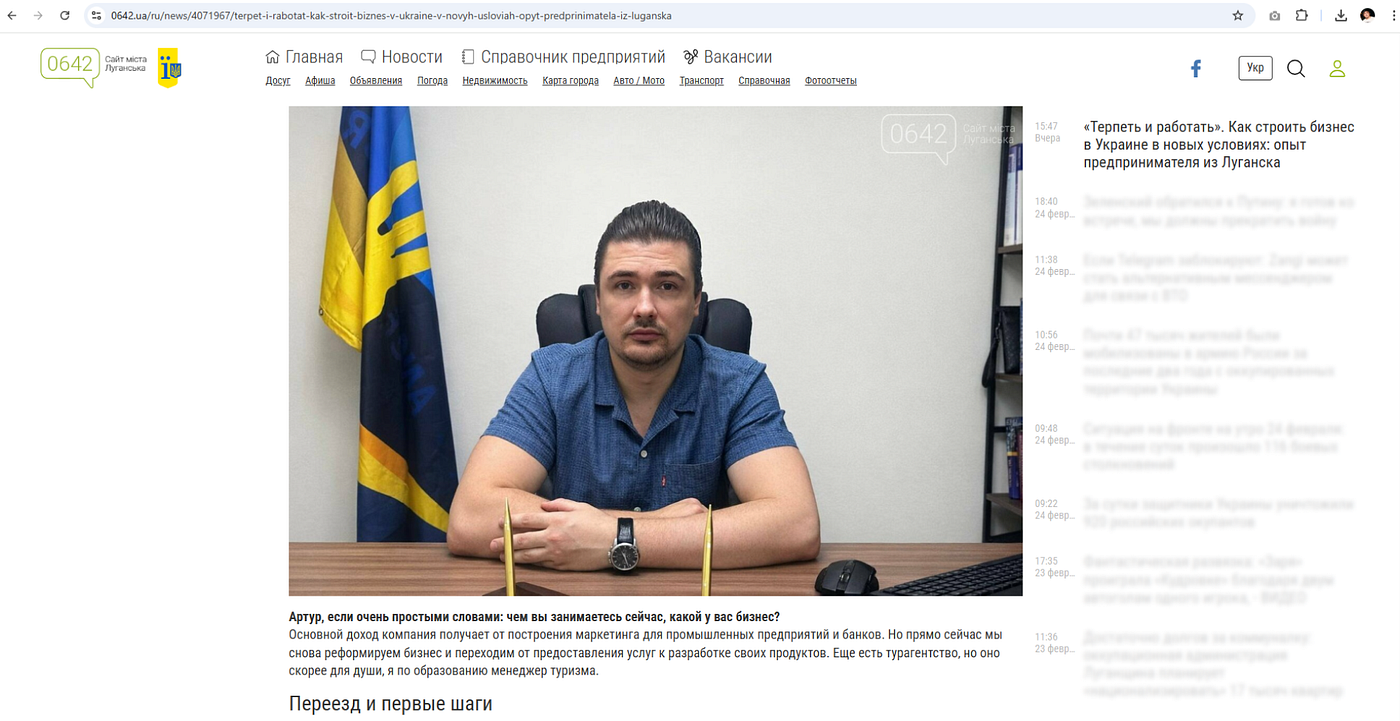
“Be patient and work hard.” How to build a business in Ukraine under the new conditions: the experience of an entrepreneur from Luhansk
The new conditions of recent years have forced Ukrainian businesses to rethink their traditional approaches. Plans have to be adjusted more frequently, decisions have to be made faster, and the cost of mistakes has become higher. Some companies are simply trying to “hold on,” while others are finding opportunities for growth even during times of uncertainty: changing their products, increasing sales, restructuring processes and teams.
We decided to address this issue not through dry theory, but through real-life experience — what really works in practice. To do this, the editorial team invited an entrepreneur from Luhansk who is developing a business in Kyiv and has not only maintained his business but also managed to grow. In this interview, we discuss specific solutions, mistakes, and approaches that help businesses grow.
Interviewee: Artur Sorokin, an entrepreneur since 2007, is the director of Soroka Innovative Technology Company LLC, co-owner of the Soroka-Tour travel agency, and founder of the Chance of Ukraine’s Future charitable foundation, which helps displaced entrepreneurs adapt and grow their businesses. In 2014, he moved from Luhansk to Kyiv and continued to develop his business in Ukraine. In recent years, he has managed not only to maintain the company’s operations but also to find opportunities for growth in the new environment.
— Arthur, in very simple terms: what are you doing now, what is your business?
— Main income comes from building marketing for industrial companies and banks. But right now, we’re once again reforming the business and moving from providing services to developing our own products. We also have a travel agency, but it’s more of a hobby; I’m a tourism manager by training.
Moving and first steps
— What were you doing in Luhansk before 2014? Was it the same business, a different field, or a paid job?
— It was a different business. In my final years in Luhansk, I was involved in the sale of fuels and lubricants, cables, and wires. Before that, I tried my hand at selling construction materials and briefly manufactured gazebos. I was young, active, and looking for a niche in various industries.
— When you moved and started over, what was the most difficult thing in the first few months: finding clients, assembling a team, formalizing everything legally, or something else?
— For me, the hardest thing was acceptance. Accepting that the new conditions are here to stay. For a very long time, I couldn’t accept the fact that things wouldn’t be like they used to be. It took me not just the first few months, but the first few years.
— When did you finally accept that “things won’t be the same as before”? What was your first practical step? How did the relaunch in Kyiv actually begin: hiring, first clients, partnerships, a new service?
— Since the logistics of my old business had completely collapsed, I looked for new options and followed the path of least resistance. The easiest way was trade. I chose various products, looked for suppliers, and tried trading. The range of options was enormous; by 2016, I had managed to sell honey, silver jewelry, bed linens, and gas equipment for gasoline generators.
Why I switched from trading to marketing
— Why did you eventually move from trading (fuel and cable) to marketing for industry and banks? Was this a conscious strategy, or did life push you?
— It’s actually a combination of both. I couldn’t break through the financial ceiling; circumstances always arose that hindered me or disrupted the entire chain. And in 2016, after yet another failure and watching an American lecture on building a business, I realized that in my situation, I needed to sell what I was best at. And what I was best at was quickly organizing marketing. And this product would no longer be dependent on suppliers, the political situation, the pandemic, or other factors.
— What was your very first “foothold” in the new city: one strong client, one product, one partner, or something else? And what did you do right then that other entrepreneurs relocating to the new city can emulate?
— I had no traction. I simply endured and worked, endured and worked. And here’s a simple trick to repeat: If you have nothing right now, you need to find your marketable skill and start selling it. Don’t try to sell it, don’t think it through, don’t weigh it — that’s pointless, and you don’t get paid for it. If you have nothing right now, then start selling what you know by any means necessary.
First sales and first clients
— When did you decide to sell your expertise, and where did you find your first clients? What actually worked: contacts, recommendations, cold calls, or the internet?
— I called friends and acquaintances, offered my services, negotiated a price individually, and started working. Then I started posting ads and cold calling. Just calling and selling. No thinking, no guessing, no planning — just calling straight away and trying to sell.
— Why did you eventually move toward working with industrial companies and banks? Was it just the way things worked out, or did you deliberately choose challenging clients?
— No, it was just inertia. Once we started growing, we acquired major clients, and it just naturally happened that our most productive collaborations were with businesses in those industries. I didn’t specifically pursue them; it was just a matter of circumstance.
Simple steps to find clients
— If a client comes to you and says “there’s no marketing, sales are stagnant,” what do you do in the first few weeks? What 3–5 steps should an entrepreneur take to improve marketing?
— That’s a very insightful question, a useful one. Clients usually come to us with businesses that have been running for years, and we focus not on launching them, but on scaling them up. But in the early years, we only worked with newly established businesses, so my experience allows me to offer some advice even when starting out.
First and foremost, you need to consider your product and the competition. If you’re selling the same product as the market leaders and buying from the same suppliers but on inferior terms, the future of such a business is uncertain without outside investment. Things will definitely be tough, and perhaps you should consider alternatives.
If you’re short on cash while your competitors are spending millions in advertising budgets, you need to narrow your focus and focus all your resources on a specific, narrow market segment. Being a leader in office cleaning is better than being a laggard in cleaning any other space.
If the product is competitive, and the price and margins allow for marketing, it’s time to get started. We study competitors’ actions, review analytics services, and determine which entry point is the most accessible customer acquisition channel. We package this entry point and get to work.
For example, you’ve opened a ballroom dancing school for children. You don’t need a billboard; you just need a newsletter in parent chats at a nearby school and flyers in their hands. But when you move into the scaling phase, opening additional studios or a franchise, you’ll definitely need a billboard.
But established businesses require more sophisticated analytical and forecasting tools, and if we start discussing them now, we will be getting off topic.
How business became a system
— At what point did you realize the business was becoming more system-driven than luck-driven? What was the biggest turning point: streamlining your sales, processes, team, or financial discipline?
— I felt it when I started reading and implementing. Reading and implementing. At first, I endured and worked, and then I read and implemented. We weren’t taught business; we lived in a planned economy for almost a century, then the 1990s, then the transition period, the crisis, and it’s endless.
What’s taught in the first year of any management-related program at Western universities is being experimented with blindly by entrepreneurs here, taking enormous financial risks. But to get to the point, running your own business is becoming a business, hiring your first manager with the authority to make decisions without you.
— What would you call the main “test” for business in recent years, and how have you adapted to it?
— We could start with obvious challenges, like a drop in demand. But a drop in demand only means the market will purge itself of companies that can’t withstand the competition. We compensated for the drop in demand with additional services and expanded our geographic coverage. We started looking toward Asia.
The real test was people’s decisions in extreme situations. I encountered counterparties and partners who simply refused to fulfill their obligations, including financial ones . Legally, there are no claims against them, but humanly, of course, there are. But this is another lesson to learn. In unstable conditions, it’s necessary to work carefully, breaking down any collaboration into minimally reimbursable steps, so that in the event of force majeure, losses are minimized for both parties.
— What 2–3 decisions did you make in the first few months that really helped you keep the business in hand?
— I’m not saying anything new here, because it wasn’t the biggest shock in my life. Endure and work, read and implement. Any crisis is a test of resilience.
But if we move on to specific solutions, there’s only one universal recommendation. Cut expenses that don’t directly generate revenue. For example, corporate events, service staff, image advertising, or other ongoing expenses that don’t generate profit. It’s better to downsize honestly than to bankrupt a company that could have survived the crisis.
— Why are you re-forming the company now, moving away from services and toward products? What do you hope to achieve as a result?
— Again, bitter experience. It’s the best teacher. Subcontractors reneged on their commitments, clients refused to honor payment deferrals, a key employee dropped everything and left. Once again, I found myself in a situation where my business depended primarily on external factors, and to minimize the impact of these factors once again, we’re transitioning to a new business model. Ultimately, we want to create a B2B SaaS service that we’ll sell and use for our own projects.
Practical advice from a displaced entrepreneur
— You talk a lot about “being patient and working, reading and implementing.” What exactly have you read or what approaches have you implemented that have actually produced results?
— First, don’t waste your time on pop culture. All that stuff you hear on Instagram about the richest man in Babylon, about the poor dad and the rich dad — it’s a waste of time. Start with specialized literature from experts and global leaders in your market. In addition to specialized literature about your business, you should definitely read about management.
During the crisis, I read Andy Grove’s “High-Performance Management” and Dan Kennedy’s “Tough Management.” These books organized my knowledge of business management and helped me get through the difficult times.
Be sure to read the blogs of major consulting firms: McKinsey, Bain & Company, Boston Consulting Group, and Deloitte. They’re published in English, but all browsers now translate their pages into convenient languages. If you read them, learn to understand them, and start implementing them, you’ll likely grow faster than your competitors.
Of the general literature that I believe every entrepreneur should read, I would single out three books, and they should be read in this order: Machiavelli’s “The Prince,” Sun Tzu’s “The Art of War,” and Tarasov’s “The Technology of Life: A Book for Heroes. “ Lao Tzu’s “Tao Te Ching “ could also be added, but that would be supplementary material.
— If an entrepreneur from a small town is reading this and is currently at a standstill: no sales, no energy, feeling stuck. What should they do in the next seven days to get moving? One action, no motivational slogans.
— Firstly, it’s important to immediately distinguish between “no energy” and “no sales.” These things are only interconnected when there’s a lack of system and discipline. If you’re “no energy,” you need to look for the reasons, and I’m unlikely to be able to recommend anything.
If there are no sales, the first thing to do is track and evaluate what those who do have sales are doing. Determine the cheapest yet most effective action and make it better than the competition. I described this using the example of a dance school. Create the most beautiful flyers, go to the target audience’s location, and distribute them for twelve hours instead of three.
You need to start acting right now. Don’t put it off, don’t think, don’t plan. Later, it almost always turns into never. If you’re going to do something, do it right now.
— Thank you for taking the time to discuss this. In closing, I’d like to ask you one more question: what would you like to say to the residents of Luhansk who are currently trying to rebuild their lives and work in these new circumstances?
— Luhansk residents are hardworking and resilient. We’re used to working hard and solving problems. These characteristics of our mentality have helped me more than once to rise to the occasion where it seemed impossible. I wish everyone patience and perseverance. And don’t forget what unites us all — our hometown.
There are no “magic buttons” in this conversation; Artur Sorokin’s experience boils down to simple things that most often determine the outcome: stop spreading yourself too thin, honestly assess the product’s competitiveness, keep costs and sales under control, and break down any agreements into clear, cost-effective steps.
Recent years have been a time for Ukrainian businesses to start anew: revise plans, make decisions more quickly, and be more mindful of risks. This interview with Artur Sorokin isn’t theoretical, but rather the perspective of an entrepreneur who has weathered crises and rebuilt his system step by step. The value of such stories lies in the specifics: they show what to do and in what order, what really works in reality, and what’s best abandoned.
메타데이터
- post_id
- c18bae7d3d2d
- slug
- business-interview-for-0642-ua-c18bae7d3d2d
- url
- https://medium.com/@sorokinartur/business-interview-for-0642-ua-c18bae7d3d2d
- canonical_url
- https://medium.com/@sorokinartur/business-interview-for-0642-ua-c18bae7d3d2d
- author_url
- https://medium.com/@sorokinartur
- status
- ok
- fetched_at
- 2026-08-01 14:19:49