Pair-Bondings and Gendered Capital in Early Medieval Ireland
In a recent seminar, I had the pleasure of examining how early Irish jurists conceptualised pair-bondings (to borrow Ruth Karras’s term)…
Pair-Bondings and Gendered Capital in Early Medieval Ireland
In a recent seminar, I had the pleasure of examining how early Irish jurists conceptualised pair-bondings (to borrow Ruth Karras’s term), gendered capital, and the position of women within one of the most sophisticated non-Roman legal traditions of early medieval Europe. Drawing on the remarkable corpus of Old Irish law texts, the presentation highlighted both the constraints and the notable agency afforded to women in this status-based society.
The Vernacular Legal Landscape
Among the most significant tracts from medieval Ireland concerning women and marriage are Cáin Lánamna (The Regulation of Couples), Bandíre (Compensation for Offences against Women), Bretha Crólige (Sick-Maintenance), and Cáin Adomnáin (the Law of the Innocents, 697), alongside the influential Irish canon law collection, the Collectio Canonum Hibernensis.
Honour-Price, Guardianship, and Compensation
Irish society operated on a finely calibrated system of honour-price (lóg n-enech), which determined legal capacity, compensation, and social standing. A woman’s honour-price was typically half that of her guardian, whether father, husband, sons, kin, or the Church. However, offences usually carried both a share of this honour-price and a specific fine for the wrong committed. Cáin Adomnáin, promulgated at the Synod of Birr in 697, stands out as a deliberate legal intervention with robust protections for non-combatants, particularly women. It imposed severe penalties, including mutilation followed by execution (or heavy compensation in lieu), for the killing of a woman, reflecting a deliberate effort by ecclesiastical authorities to elevate the status and safety of women in times of war and beyond.
The Taxonomy of Unions
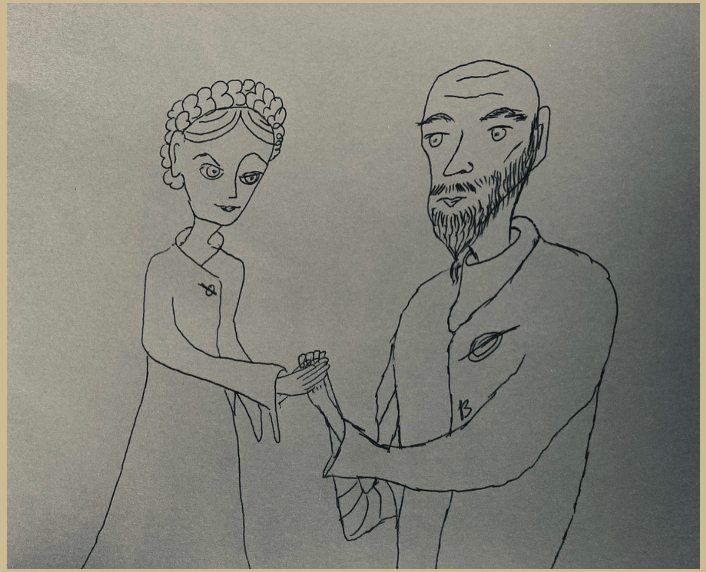
One of the most striking features of Irish law is its detailed classification of pair-bondings. Cáin Lánamna enumerates up to ten types of sexual unions, ranging from the formal and economically balanced to those involving abduction, seduction, or even mockery. At the apex stands lánamnas comthinchuir — the union of joint contribution — where husband and wife are of equal socio-legal standing and bring comparable wealth to the marriage. This form, favoured by the Church, granted the wife significant agency: she could impugn her husband’s contracts and enjoyed considerable autonomy in household matters. Divorce was recognised on various grounds, including a husband’s impotence, obesity impeding marital relations, or the betrayal of intimate confidences. Such provisions underscore a pragmatic approach to marital breakdown, unusual for the period. The way in which marriage and sexual unions are discussed in the Irish texts forms a stark contrast to the continent, though we find parallels in Anglo-Saxon laws, where a one-fits-all definition of matrimony appears to have been equally unstable.
Female Heiresses and Legal Agency
Where no male heir existed, a woman could become a banchomarbae (female heir), enjoying life-long usufruct of kin-land, though she could not transmit it to her sons. The land ultimately reverted to her paternal kin. Irish jurists even contemplated strategic marriages to paternal cousins to keep property within the lineage, arrangements that tested canonical prohibitions on consanguinity but found justification in biblical precedents. The tract Dín Techtugud (On Legal Entry) provides a fascinating ritualised procedure (bantellach) for women claiming hereditary land, structured in deliberate parallel to the male equivalent. This involved staged entries onto the land with symbolically gendered animals and witnesses, culminating in the claimant kindling a fire and spending the night to establish title.
Broader Reflections
The Irish legal sources reveal a dynamic interplay between customary law and the normative impulses of the Church. While ecclesiastical texts sought to improve women’s position and relationships between men as central components of social cohesion — particularly concerning marriage and inheritance rights — the extent to which these ideals translated into social reality remains a matter of scholarly debate. In a similar vein, women of a higher legal status and social standing who had access to the most elevated union likely benefitted the most from such changes. Nevertheless, the creation of analogous legal procedures for women and the sophisticated taxonomy of unions demonstrate a pragmatic legal culture attuned to the complexities of trans-generational capital preservation, and the ‘danger’ of disruption posed for and by unrecognised offspring. These developments find intriguing parallels in the leges barbarorum of the post-Roman Continent, where legitimate daughters also gained enhanced inheritance rights over time. Together, they illustrate how early medieval societies, both insular and continental, negotiated the transformation of late antique legal and social norms.
I am grateful to the organisers and audience for the rich discussion. For those wishing to delve deeper, the editions and translations of these fascinating texts — many still awaiting full critical treatment — offer a rewarding, if linguistically demanding, journey into early Ireland’s legal mind.
메타데이터
- post_id
- c19bfc8c7ff4
- slug
- pair-bondings-and-gendered-capital-in-early-medieval-ireland-c19bfc8c7ff4
- url
- https://medium.com/@jaqueline.bemmer/pair-bondings-and-gendered-capital-in-early-medieval-ireland-c19bfc8c7ff4
- canonical_url
- https://medium.com/@jaqueline.bemmer/pair-bondings-and-gendered-capital-in-early-medieval-ireland-c19bfc8c7ff4
- author_url
- https://medium.com/@jaqueline.bemmer
- status
- ok
- fetched_at
- 2026-06-28 10:39:35