Gravity and the Equivalence Principle
From Newton to Einstein and….back again?
Gravity and the Equivalence Principle
From Newton to Einstein and….back again?
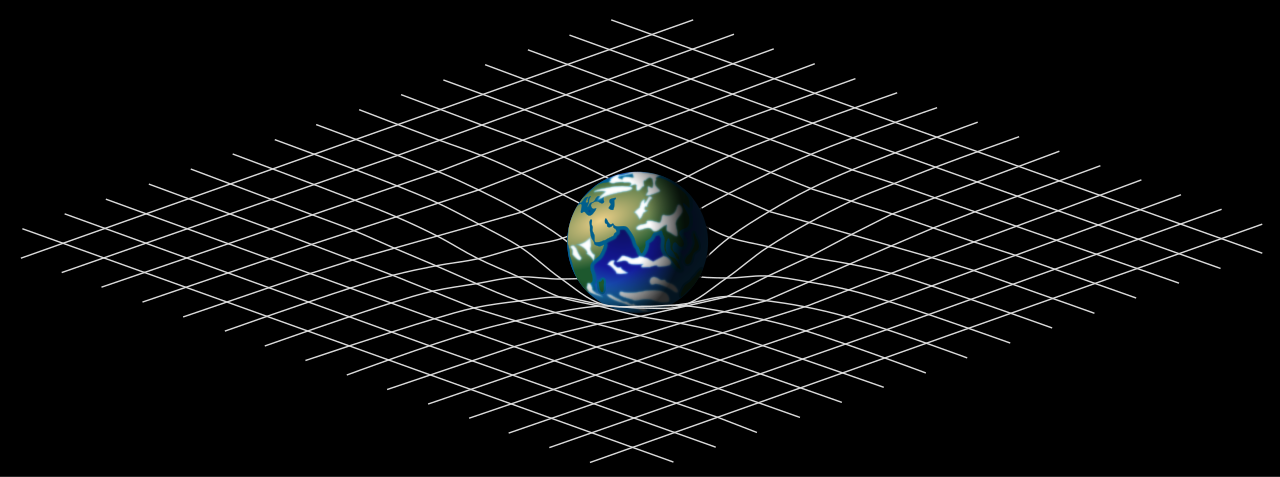
Image via Wikimedia Commons (CC BY‑SA 4.0).
Gravity feels familiar until we try to say exactly what it is. Newton gives us equations that predict how masses attract; Einstein gives us geometry that represents how spacetime bends. Both accounts succeed brilliantly at describing what gravity does. Neither claims to reveal what gravity is.
One of the most intriguing clues in the history of gravitational theory is the equivalence principle — the fact that inertial mass and gravitational mass, defined in completely different ways, act as if they are the same thing. This simple observation played a central role for both Newton and Einstein, shaping their thinking and guiding the development of gravitational theory.
In this article, we take the equivalence principle as a point of departure for examining Newton’s and Einstein’s ideas about gravity and for developing a fresh perspective of our own. We begin with Isaac Newton.
Newton and Gravity
Newton’s concept of gravitation is usually introduced with the image of an apple falling from a tree. The story is simple and familiar — it appeals even to children, and anything that brings physics into the realm of childhood is grand physics indeed. But the real breakthrough was far deeper. Newton unified two enormous realms of inquiry — the motions of the planets and the fall of earthly objects — and discovered that both obey the same mathematical rule. His universal law of gravitation, expressed in a single compact equation, captured the behavior of worlds and apples alike with astonishing accuracy.
What Newton did not do was explain how gravity operates. “Hypotheses non fingo” — I frame no hypotheses — was his mantra. (1) He refused to speculate about the mechanism by which one body could influence another across empty space. Something must convey the interaction, he insisted. The idea of one body reaching across a void to tug on another was, he wrote, “so great an absurdity” that no thinking person should accept it. (2) His mathematics described the behavior, but it left untouched the ontological question of what gravity must be, if it can act across a void.
Although Newton declined to give gravity an ontology, he certainly gave one to the medium through which gravity acted: space. For him, space was not relational or perspectival; it was a real, self‑subsisting entity. In the Principia he wrote, “Absolute space, in its own nature, without relation to anything external, remains always similar and immovable.” (3) Space was the fixed, infinite, motionless framework within which all bodies moved and through which gravitational influence was transmitted. It existed whether anything occupied it or not — the vessel of reality itself. And this absolute space was Euclidean in structure, or more precisely: the bodies within it behaved in accordance with Euclidean geometry.
But neither the law that described gravitational behavior nor the absolute Euclidean space that framed it offered any account of the mechanism by which gravity acts. And although he refused to advance hypotheses about that mechanism, he did not abandon the search for clues about what gravity might be.
The equivalence principle
One of the most striking clues for him came from a simple test. Newton wanted to know whether different materials respond to gravity and to applied forces in the same way. So he built pendulums with bobs made of different substances — wood, stone, metal — each with the same gravitational weight. He then set them swinging under identical conditions to see how each mass responded to the same force. If different materials had different inertial behavior, their motions would slowly drift apart. They did not. To the limits of his instruments, the gravitational pull on each pendulum was always matched by its resistance to acceleration. That one‑to‑one matching — the equality of gravitational and inertial mass — is the equivalence principle.
Newton took this as a foundational clue. Whatever gravity is, it couples to matter in a way that is indifferent to its substance: the gravitational pull on an object and its resistance to acceleration always appear in the same proportion. He offered no further insight into this equivalence. But another scientist would.
And so we turn to Einstein.
Einstein and Gravity
Einstein’s perspective on space underwent a striking evolution. In his 1905 paper on special relativity, he offered no geometric structure at all — no spacetime diagrams, no metrics, no curvature. His arguments were operational and algebraic, built from clocks, rods, and thought experiments. It was Hermann Minkowski who supplied the missing geometry, showing that Einstein’s algebraic relations could be reinterpreted as statements about a four‑dimensional spacetime endowed with its own intrinsic geometric structure.
“Henceforth,” Minkowski declared, “space by itself, and time by itself, fade away into mere shadows.” (4) Einstein eventually embraced this geometric formulation and extended it, using the curvature of spacetime to describe gravitational phenomena.
Einstein and the equivalence principle
Like Newton, Einstein sought a deeper principle that could reveal the structure underlying gravitational behavior. He suspected that the key lay in the same equivalence principle that had guided Newton. Einstein often illustrated this principle with a simple thought experiment: a man in a box. Place the box on Earth, and the man feels the familiar pressure of gravity on his feet. Place the box in deep space and accelerate it upward, and he feels the same pressure. In a small enough region, the two situations are indistinguishable.
This indistinguishability has a simple requirement: all masses must move the same way in a gravitational field. If different masses fell differently, the man-in-the-box could tell at once whether he was in gravity or in an accelerating box. That sameness of motion — the fact that all objects accelerate identically in a gravitational field regardless of their mass — is the heart of the equivalence principle.
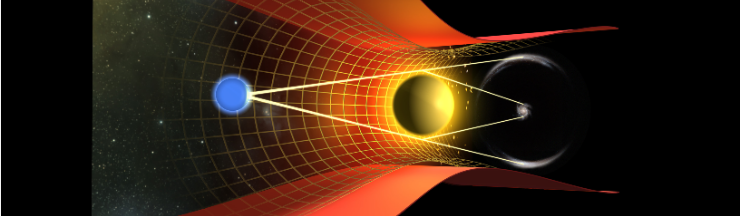
Einstein did not claim the two situations were identical in every respect; he knew that gravity induces tidal forces that inertial acceleration does not. Rather, he used the comparison as a heuristic — a way to unify inertial and gravitational effects within a single mathematical framework. His remarkable intuition that light should bend in a gravitational field emerged directly from this insight.
Einstein’s self-described “happiest thought” pushed the idea further: a freely falling body experiences no force locally at all. (5) Attach an accelerometer to a falling object and it reads zero. This was the conceptual breakthrough. If gravity can be transformed away locally by moving to a freely falling frame, then perhaps gravity is not a force in the Newtonian sense at all, but a feature of how motion is structured.
Einstein and spacetime geometry
This insight led Einstein to curved spacetime. In this geometry, freely falling objects follow geodesics — the straightest possible paths in a curved manifold. A geodesic is the path a body takes when no force acts on it, and moreover, the geodesic equation contains no mass term. All bodies, regardless of composition or mass, follow the same geodesics. In this sense, Einstein built the equivalence principle directly into the structure of motion. He did not explain why inertial and gravitational mass are equal; he made the distinction unnecessary.
Einstein’s geometry is elegant, powerful, and predictive. But does it tell us what gravity is?
Geometry and space
Not quite. Geometry is not necessarily a “thing,” out there, in the world. It is first and foremost a system of rules, definitions, and inferences that we use to organize and describe the behavior of things in the world. It is not, by itself, a substance or a mechanism.
Consider the case of Newton and Euclidean geometry. Their geometry is not a collection of physical lines and points inhabiting space. A Euclidean line is not a thread stretched across the universe; it is the set of all points satisfying certain axioms. And those axioms — the rules that define what a line is — do not exist in space at all. They exist only within a conceptual or formal system. That was a creative act of the mind, not a discovery of something already in space. Neither Euclid nor Newton discovered geometry in space in the same way you might find iron ore in the earth. They are part of our intellectual apparatus, not part of the furniture of the world.
So when we turn to modern gravitational theory and say that a falling object “follows a geodesic,” we must resist the temptation to imagine a geodesic as a physical track occupying space. A geodesic is no more a physical object than a Euclidean line is. It is a rule‑governed description of how matter moves under certain conditions, not an entity that reaches out and compels motion. The real world may exhibit patterns of motion that geometry captures perfectly — but that does not mean that geometry, as such, is what does the pushing and pulling.
We must take great care not to conflate mental things with physical things.
So Einstein gave us a brilliant structural solution to the equivalence principle. But the deeper question remains: what is it that behaves this way? Geometry describes the behavior, but what, exactly, is “behaving,” and why?
If we want to see further, we may need to look not beyond Einstein, but behind him — back to Newton. For Newton left us a clue, one that has been hiding in plain sight for centuries.
So, back to Newton we go.
Newton Again!
Hidden in Newton’s gravitational equation is a feature that neither Newton nor Einstein fully appreciated — a feature that dissolves the very puzzle that pushed Einstein toward geometry in the first place: the equivalence puzzle. Why should all masses fall with the same acceleration? To see the answer cleanly, let’s warm up with something familiar: Coulomb’s law for electrical force, and then run the same algebraic experiment in both theories. The comparison is surprisingly revealing.
Before we go any further, please be advised: I will present no new physics or unfamiliar mathematics. Every equation here is standard, first‑year material. What will be new is how we look at these expressions — the ontological commitments we attach to them, and the structural meaning we draw out of their algebra. The mathematics stays exactly the same; what changes is what we take the mathematics to be about.
Coulomb’s Law
Start with Coulomb’s law for the force between two charges q₁ and q₂:
F = k·(q₁ q₂)/r²
The force grows with both charges and falls with distance squared.
From this expression, we define the electric field created by q₁ as the force per unit test charge:
E = F/q₂ = k·q₁/r²
This field tells us how strongly q₁ would push or pull on a unit charge placed at distance r.
To find the acceleration of a test charged body with mass m₂, we still need to divide the force by that mass:
a = F/m₂ = (q₂/m₂)·E
Ok — that was simple enough, yes? Now perform a simple experiment: double the test charge.
q₂ → 2q₂
The force doubles:
F′ = 2F
And the acceleration doubles as well. Using the expression we just wrote down:
a′ = F′/m₂ = (2F)/m₂ = 2a
So in the electric case, the test charge q₂ genuinely matters. It directly controls how strongly the test body responds. Even though we defined a field E by dividing out q₂, the acceleration still depends on q₂ via the factor (q₂/m₂).
Newton’s Law of Gravity
Now turn to Newton’s gravitational law, written in the same form:
F = G·(m₁ m₂)/r²
Again, perfectly symmetric: the force grows with both masses and falls with distance squared.
By analogy with the electric case, we define the gravitational field created by m₁ as the force per unit test mass:
g = F/m₂ = G·m₁/r²
This field tells us how strongly m₁ would pull on a unit mass placed at distance r. It is the gravitational counterpart to the electric field — the same idea, just with mass in place of charge.
Now perform the same experiment as before for charge: double the test mass.
m₂ → 2m₂
The force doubles:
F′ = 2F
But the acceleration does not change:
a′ = F′/(2m₂) = a
The force doubled. The mass doubled. The acceleration stayed exactly the same.
Gravity simply refuses to care about the test mass the way that the electric field cares about the test charge.
What Just Happened?
Why does the acceleration double in the electric case and remain unchanged in the gravitational one?
Because in the electric case, the test charge q₂ is a genuine physical parameter. It survives the entire derivation. Double q₂ and the acceleration doubles. Nothing cancels; nothing disappears. The test charge really does shape the motion.
Gravity behaves differently. The test mass m₂ enters Newton’s two‑body force law, but the moment we divide by m₂ to compute the acceleration, it vanishes. The motion never depended on it. It did not persist. In fact, m₂ behaves like a dummy variable when we compute the acceleration. We put it into Newton’s equation at the beginning, and we divide it right back out again when we ask how the test body moves. The acceleration never depended on m₂ in the first place. And this cancellation occurs not only in the two‑body case but in the full many‑body Newtonian law; the test mass always divides out of the acceleration.
And that means something important. It means we can write the dynamical content of Newton’s law in a simpler form. We don’t need m₂ in it at all; we never did. Instead of F = G·(m₁ m₂)/r², we can write the motion‑governing equation as
a = G·m₁/r²,
with the acceleration itself serving as the field. The quantity we call the “gravitational field” is not something that later becomes an acceleration when divided by mass — it already is the acceleration. The algebra has been telling us this from the beginning.
Again, none of this rewrites physics. None of it alters Newton’s law. Multiply both sides by m₂ and you recover the familiar two‑body force law, F = m₂·a = G·(m₁ m₂)/r². Newton’s equation remains exactly what it always was: a brilliant and accurate description of the force between two masses. You absolutely need both m₁ and m₂ to compute that force.
But when the question is how the test body moves, the two‑body form collapses into a one‑body acceleration field, and the deeper structure of the law comes into view. Seen in this light, gravity is a one‑body acceleration field masquerading as a two‑body force law. The two‑body form is how we compute forces; the acceleration form is how nature actually moves things. Once you divide by m₂, the mask falls away, and the primary ontological entity — the acceleration field — stands alone.
Now why does this matter? Why did we go through all of this?
We are not just manipulating equations: we are beginning the work of building an ontology for gravity. We are trying to understand not just what gravity does, but what gravity is. The idea that gravity is fundamentally an acceleration field — not a force, not a two‑body interaction, not a field defined by dividing a force by a mass — is the first step in that reconstruction. It is only a beginning, but it is a beginning that points somewhere.
Or at least, that is the hope.
Where this all is going
We accomplished quite a bit, I should think. But this is only the beginning. We might pause here and see if we can take it a bit further — not by adding new mathematics, but by looking at the same mathematics from a slightly different angle.
An acceleration field can be expressed in a more revealing way: as a velocity field equipped with an update rule. We can think of this in terms of a computer model. Imagine that every object has a position and a velocity encoded in the system’s state. At each tick of the clock, the program applies a rule that updates every object’s velocity. If the rule says “add 9.8 m/s downward each second,” the simulation reproduces the familiar gravitational acceleration 9.8 m/s/s near Earth’s surface.
Why bother with this?
Because relativity enters at the very beginning.
We can treat the object’s velocity as a vector, and the field as being composed of velocity‑update vectors. When the object’s velocity is combined with the field’s update, they add according to Einstein’s velocity addition formula. In this way, the velocity‑field picture builds relativistic structure directly into the update rule itself.
And where do we go from here? Well, actually I don’t know, but the direction feels right. If Newtonian gravity is the low‑velocity, weak‑field limit of general relativity, then a formulation that builds relativistic velocity‑addition into its very structure ought to mesh with the deeper theory. We have not changed the mathematics; we have only changed the interpretation.
But this really has an end-goal in mind. My deeper project is to articulate a unified interpretive framework for physics that is more intuitive and more imaginatively picturable. Some of this work is already complete and published. If you are interested in the broader philosophical motivations behind this approach, I invite you to explore my earlier two articles on relativity and quantum mechanics. This current essay represents my first attempt at applying the framework to general relativity.
A third essay decidated to this theme is underway — although, to be honest, I am just now working my way through a formal course on general relativity (and it is tough going!)
So it will take some time. And whether I can extend this interpretive framework into general relativity remains an open question. But the effort to expand our intuitive grasp of physics is worth making, and if it appeals to you, then I hope this little essay has helped you along the way.
- “Hypotheses non fingo.” Wikipedia. https://en.wikipedia.org/wiki/Hypotheses_non_fingo
- Greenberg, Neil. “Newton on the Absurdity of Gravity.” NeilGreenberg.com. Accessed June 2026. https://neilgreenberg.com/quote-newton-on-the-absurdity-of-gravity/
-
- “Absolute space and time.” Wikipedia. https://en.wikipedia.org/wiki/Absolute_space_and_time
- 3) “Hermann Minkowski.” **Wikiquote. https://en.wikiquote.org/wiki/Hermann_Minkowski**
- 5) Giulini, Domenico. **“Einstein’s Happiest Thought.” arXiv:2209.13781 [physics.hist-ph]. Accessed June 2026. https://arxiv.org/abs/2209.13781**
메타데이터
- post_id
- c1b6ccf6e90d
- slug
- gravity-and-the-equivalence-principle-c1b6ccf6e90d
- url
- https://medium.com/@anon1836/gravity-and-the-equivalence-principle-c1b6ccf6e90d
- canonical_url
- https://medium.com/@anon1836/gravity-and-the-equivalence-principle-c1b6ccf6e90d
- author_url
- https://medium.com/@anon1836
- status
- ok
- fetched_at
- 2026-06-26 03:39:16