The Political Power of Black Cultural Gatherings
Documenting Joy in a Time of Democratic Anxiety
The Political Power of Black Cultural Gatherings
Documenting Joy in a Time of Democratic Anxiety
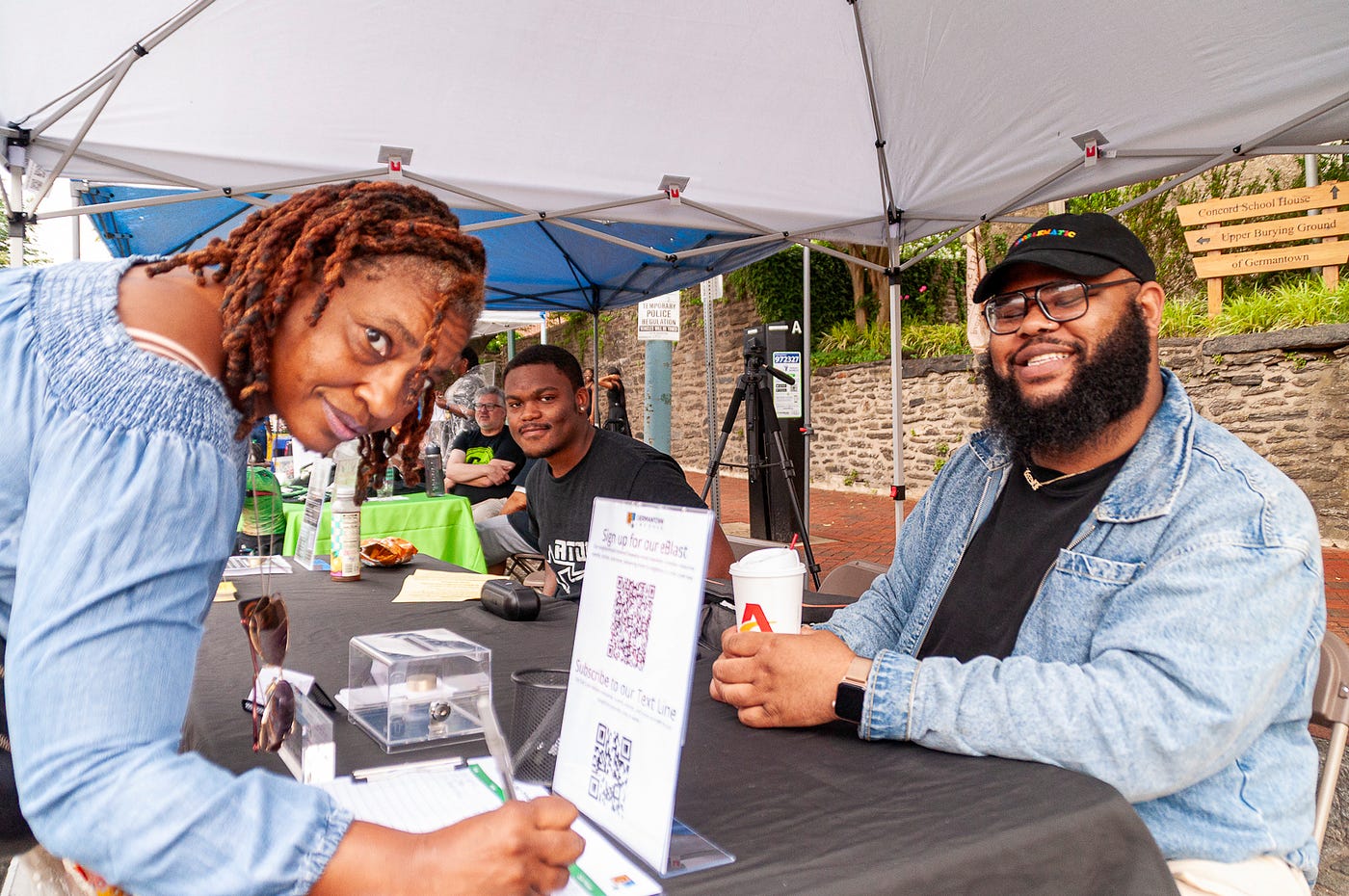
Photographed by Tieshka Smith at the 19th annual Philadelphia Juneteenth Festival in Germantown, June 14, 2025. This image is protected by copyright.
By midafternoon, the 6300 block of Germantown Avenue was already vibrating with competing sounds: basslines rolling from the main stage, children laughing through bursts of double dutch chants, vendors calling out to passing families, elders greeting one another with the familiarity of people who had survived both history and each other.
Down the way, a local organizer spoke quietly but urgently about voting access and neighborhood displacement while a line formed nearby for barbecue and water ice. A few feet away, teenagers posed for selfies in front of a Juneteenth banner before drifting toward a table stacked with community flyers and voter registration forms. Nobody seemed to find the juxtaposition unusual.
That is what many people misunderstand about Black community gatherings, particularly Juneteenth festivals rooted in neighborhood history. They are rarely just celebrations. They are meeting grounds. Information exchanges. Oral history projects unfolding in real time. Spaces where joy and vigilance occupy the same block at the same hour.
At the Philadelphia Juneteenth Festival in Germantown, those conversations move as steadily as the music.
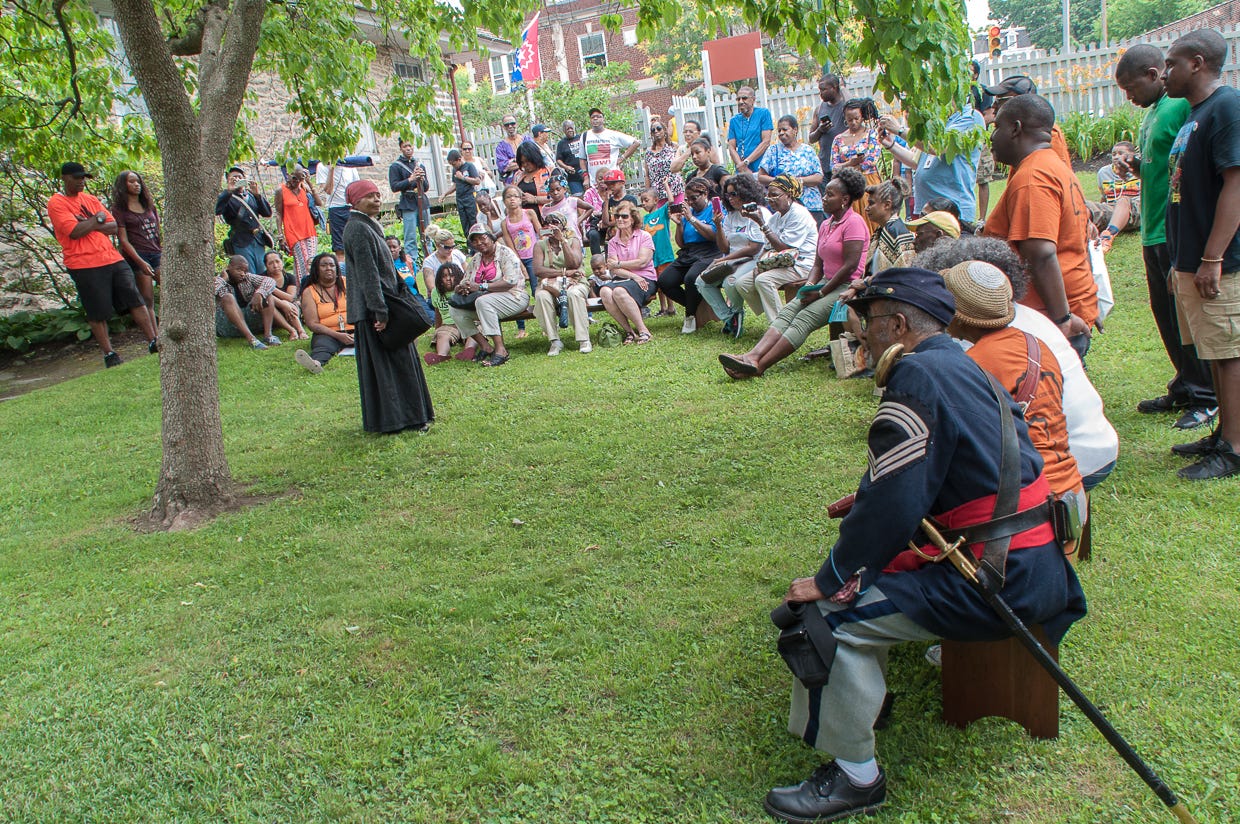
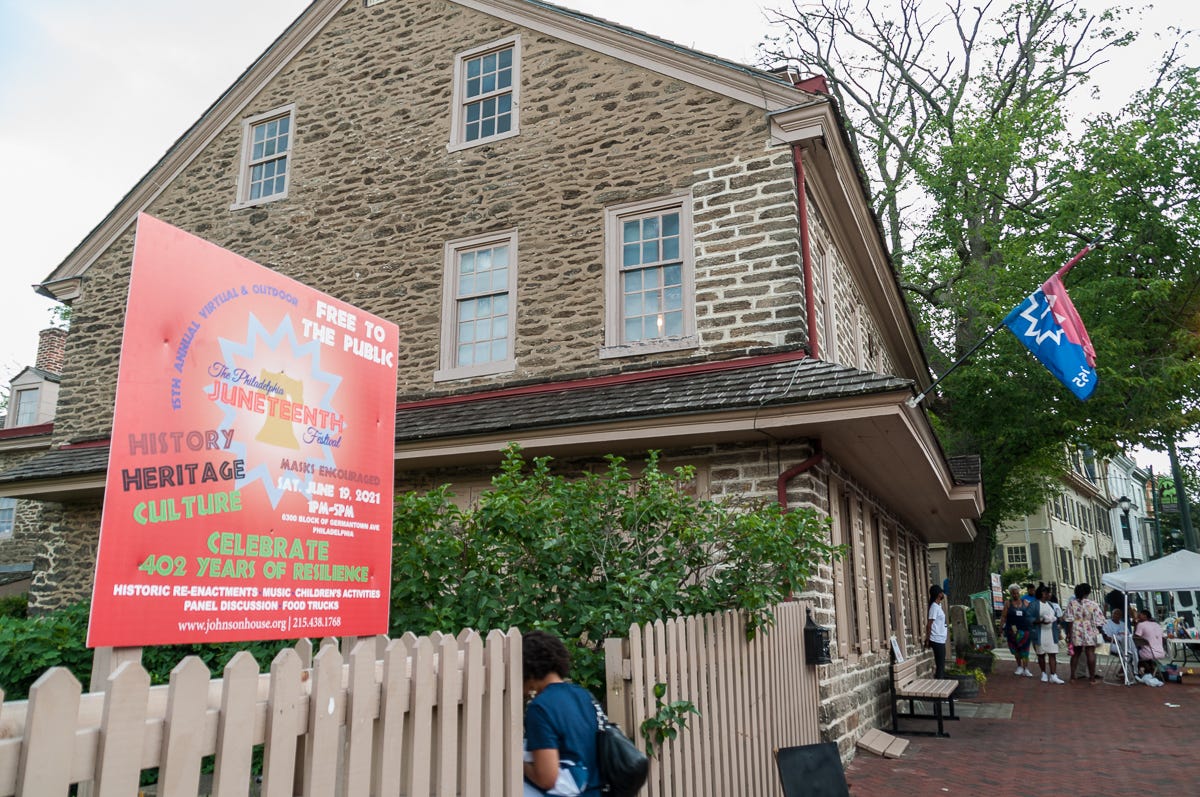
Millicent Sparks as Harriet Tubman, speaking to the audience gathered on the lawn of the Johnson House Historic Site. Photographed by Tieshka Smith at the 9th annual Philadelphia Juneteenth Festival in Germantown, June 20, 2015. This image is protected by copyright.
Too often, Black festivals are interpreted through an overly narrow lens. Outsiders see music, food, dancing, bright colors, and crowded streets and assume the gathering begins and ends with entertainment. Joy itself becomes flattened into spectacle — something pleasant to observe, consume, photograph, and move on from.
But historically, Black public gatherings have always carried multiple responsibilities at once. They have functioned as places to mourn, organize, educate, strategize, worship, fundraise, reconnect, and warn one another. Celebration has never existed separately from survival.
That duality feels especially visible now.
As debates around voting rights, historical memory, public education, censorship, and civic participation continue intensifying across the country, community-centered events like the Philadelphia Juneteenth Festival in Germantown take on an even deeper significance. The festival is not disconnected from those realities. It responds to them.
Between performances and family activities are conversations about neighborhood change, economic inequality, gun violence, public policy, mutual aid, education, and political accountability. Information moves through these spaces informally but powerfully — across folding chairs, vendor tables, sidewalk conversations, church groups, activist organizations, and intergenerational exchanges.
In many ways, the Festival operates as a living civic space disguised as a celebration.
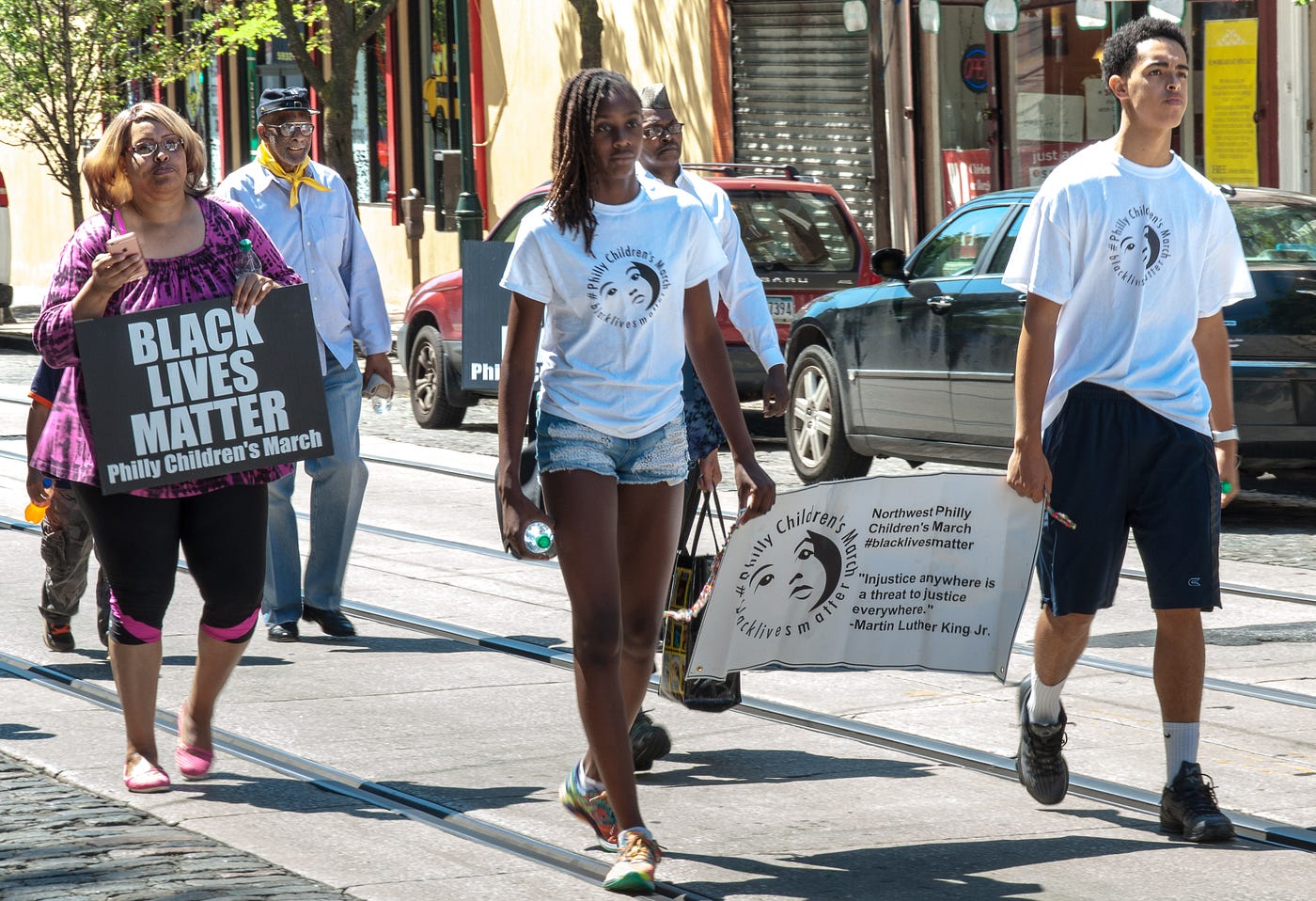
Community members march to the Festival with banners and signs. Photographed by Tieshka Smith at the 10th annual Philadelphia Juneteenth Festival in Germantown, June 18, 2016. This image is protected by copyright.
The current national conversation around voting often centers on laws, court rulings, election procedures, and political strategy. Those things matter. But underneath all of that is something less measurable and far more fragile: people’s belief that their participation still matters.
Across many communities, there is visible exhaustion. People are overwhelmed by disinformation, political hostility, economic instability, book bans, attacks on historical truth, and the growing sense that civic life has become more performative than responsive. For Black communities in particular, that fatigue exists alongside a long historical memory of exclusion from the democratic process altogether.
That is part of why spaces like the Philadelphia Juneteenth Festival in Germantown matter beyond their cultural significance.
They create opportunities for people to encounter one another outside the isolation and algorithmic manipulation of digital life. People exchange information face-to-face. Organizers share resources. Elders contextualize current events for younger generations. Local activists connect national issues to neighborhood realities people can actually see and feel.
In that environment, civic engagement becomes less abstract.
It becomes a conversation over music. A flyer handed across a folding table. A discussion between neighbors standing near a food truck. A teenager hearing, perhaps for the first time, why voting access and local elections directly shape the conditions of daily life.
None of this guarantees political transformation. But it reinforces something equally important: community visibility, civic presence, and the reminder that people are not navigating these anxieties alone.
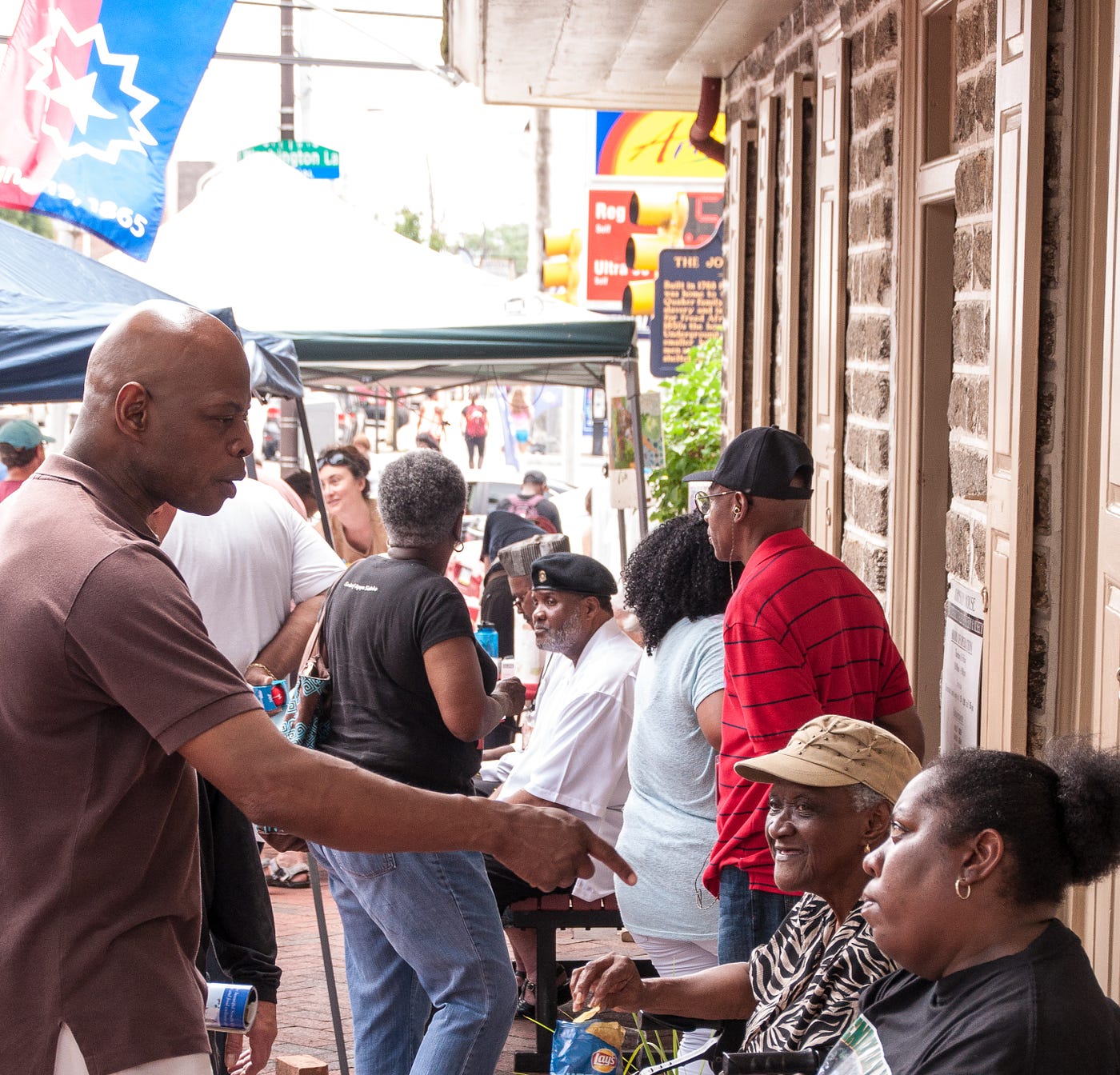
(Former) Pennsylvania state representative Stephen Kinsey chats with Festival goers gathered in front of the Johnson House Historic Site. Photographed by Tieshka Smith at the 11th annual Philadelphia Juneteenth Festival in Germantown, June 17, 2017. This image is protected by copyright.
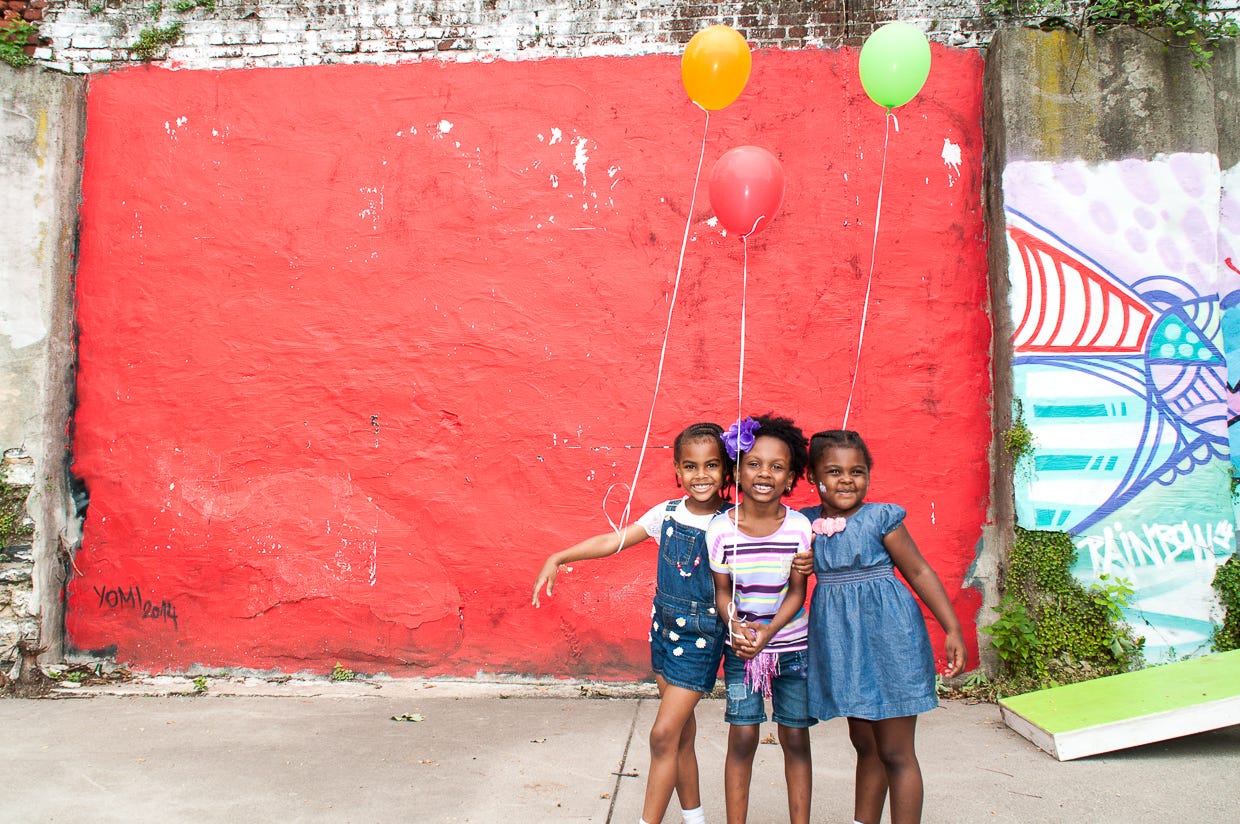
Working on Compositions of Black Joy pushed me to think more deeply about what I was actually documenting when I photograph community gatherings like the Philadelphia Juneteenth Festival in Germantown.
At first glance, many of the images appear to capture celebration: children playing, families embracing, neighbors laughing, performers entertaining crowds, couples dancing in the street beneath summer sunlight. Those moments matter. I want them preserved. Black life deserves to be documented outside the constant framing of trauma, violence, and loss.
But over time, I began to recognize that the photographs were also documenting something else: Participation, engagement and connection.
They were documenting what it looks like when people intentionally gather in public space to remain visible to one another. They were documenting the informal networks that help sustain neighborhoods long after festivals end — organizers, elders, artists, educators, activists, faith leaders, small business owners, volunteers, and residents all contributing to a shared civic ecosystem, whether they describe it that way or not.
The camera helped me see how closely joy and civic engagement actually sit beside one another in Black community life.
A photograph of children dancing near the stage may also contain a voter registration table in the background. An image of friends laughing together may exist only a few feet away from a conversation about housing insecurity, school funding, or gun violence prevention. The festival does not separate these realities. The community carries them simultaneously.
That complexity is part of what makes the work meaningful to me.
Compositions of Black Joy is more than a book project that documented happiness and joy; it documented presence, continuity, and the ongoing work of people choosing community even while navigating uncertainty, frustration, and political strain.
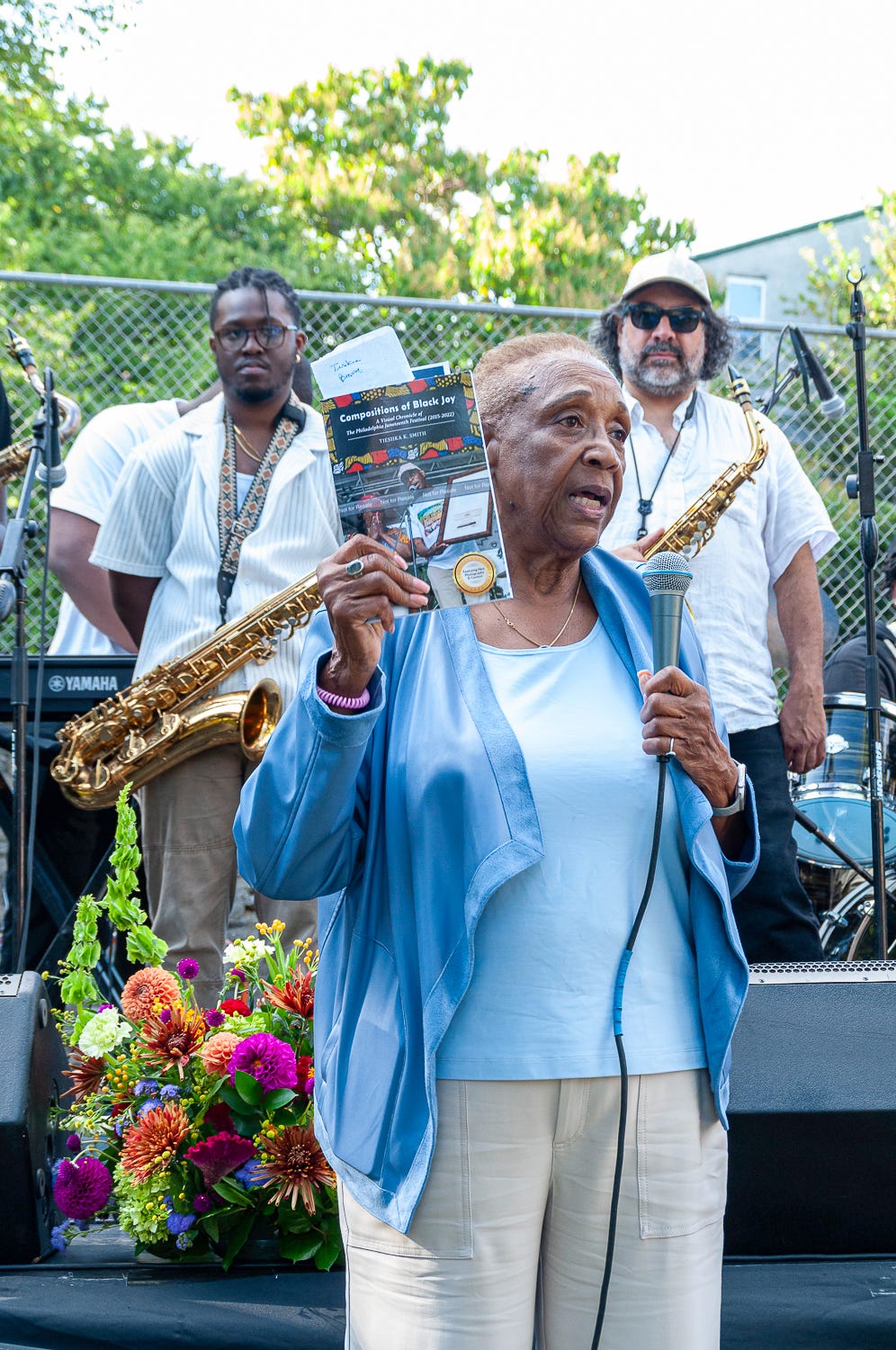
Johnson House Historic Site board president Pat Bass holds a copy of Compositions of Black Joy while addressing the audience gathered for the Jammin’ In The Garden fundraising event on September 20, 2025. Photographed by Tieshka Smith. This image is protected by copyright.
At a time when so much public discourse feels fractured, hostile, and performative, there is something deeply significant about people continuing to gather with intention.
That is part of what I see when I walk through the Philadelphia Juneteenth Festival in Germantown with my camera.
I see celebration, yes. But I also see people practicing visibility. I see neighbors reaffirming connection to one another. I see elders passing knowledge forward in real time. I see artists, organizers, and residents creating temporary spaces where community feels tangible rather than theoretical.
None of this erases the very real concerns surrounding voting rights, political division, economic inequality, or the broader anxieties shaping American life right now. If anything, those pressures make gatherings like these even more necessary.
Black joy has never been proof that struggle disappeared. More often, it has been evidence that people continued building, organizing, loving, creating, teaching, and showing up for one another despite the struggle remaining fully visible.
That may be one of the most important civic acts of all.
메타데이터
- post_id
- c1c2c6181bdd
- slug
- the-political-power-of-black-cultural-gatherings-c1c2c6181bdd
- url
- https://medium.com/@tieshka/the-political-power-of-black-cultural-gatherings-c1c2c6181bdd
- canonical_url
- https://medium.com/@tieshka/the-political-power-of-black-cultural-gatherings-c1c2c6181bdd
- author_url
- https://medium.com/@tieshka
- status
- ok
- fetched_at
- 2026-06-09 15:37:30